The best modern recliners are the ones that fit your body first and your room second. Look for a seat height that lets your feet rest flat on the floor, a seat depth that leaves 2 to 3 inches of space behind your knees, and a reclined length your room can actually hold. Check the exact model’s spec sheet before you order, because typical ranges in this guide are a starting point, not a promise for any single chair.
For years, the recliner sat in an awkward spot in home design. It was the most comfortable seat in the house and often the least attractive. People hid it in a corner, draped a throw over it, or simply accepted that comfort and good looks did not belong in the same chair. That trade off is gone now. Modern recliners come in slim profiles, honest materials and quiet mechanisms, and many of them look like ordinary lounge chairs until you lean back.
This guide flips the usual buying order. Instead of starting with a style you like in a photo, you start with measurements, then with how the chair moves, and only then with the look. A beautiful chair that pushes your knees up, leaves your feet dangling, or blocks a walkway will annoy you every single day. A well fitted chair in a simpler style will feel luxurious because it supports you properly. Fit is what makes a recliner feel expensive, long after the newness wears off.
Which Recliner Mechanism Fits Your Room?
The mechanism decides how a recliner moves, how much wall space it needs, and how easy it is to use. Two chairs can look identical from the front and behave completely differently when they recline. This is why the mechanism belongs at the top of your shortlist, right beside your measurements. Read the table below, then think about your room before you fall for a silhouette.
| Mechanism | How it moves | Typical wall clearance | Best for | Watch out for |
|---|---|---|---|---|
| Standard recliner | Back tilts and footrest lifts in one motion, manual or powered | Typically 12 to 18 inches | Open living rooms with space behind the chair | Needs real room behind it, so it suits a wall only if you can pull it forward |
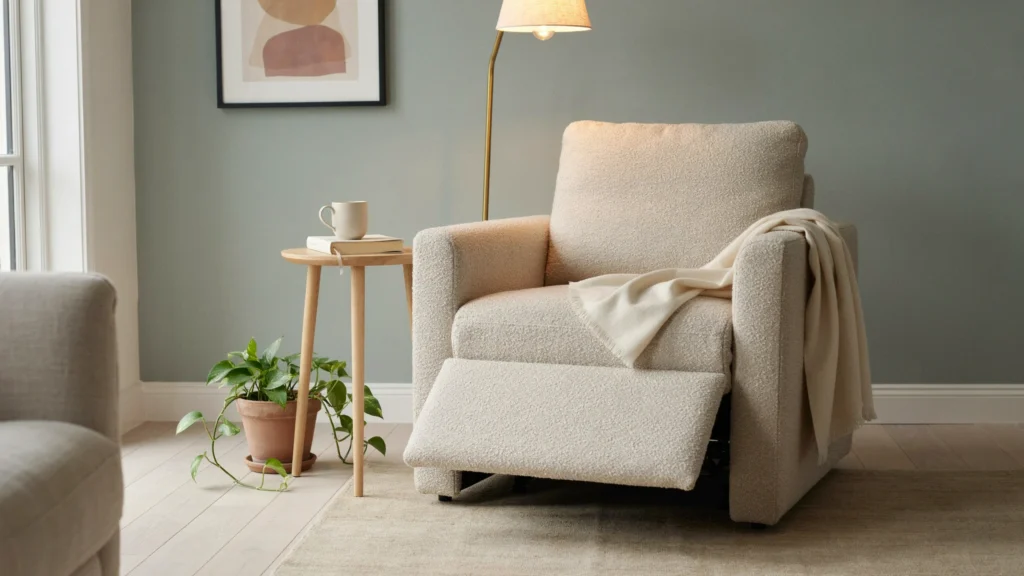
| Wall hugger | Seat slides forward as the back reclines, so the chair barely moves backward | Typically 4 to 6 inches | Small rooms, apartments, and chairs placed near a wall | Check the front clearance, because the seat travels forward into the room |
| Power recliner | Motor adjusts the back and footrest, often independently, at the touch of a button | Varies by model, often similar to a standard or wall hugger design | Precise positioning, easy use, and shared households where people want different angles | Needs a power outlet nearby and a cord route that will not get pinched |
| Lift recliner | Motor tilts the whole chair forward to help you stand up | Varies by model, check the spec sheet for the tilted footprint | Anyone who finds standing from a low seat difficult | Heavier and bulkier than a standard recliner, so measure doorways with extra care |
| Zero gravity recliner | Lifts the legs slightly above heart level while the back supports the spine in a neutral position | Varies by model, allow generous space for the full reclined length | Long reading or resting sessions, and people who want pressure taken off the lower back | The fully reclined position is long, so it needs more floor space than it first appears to |
Wall clearance figures in the table are typical ranges, not guarantees. A wall hugger from one maker might need 4 inches while another needs 6, and a standard recliner might need more than 18 inches once a thick back cushion is counted.
Always find the clearance figure on the exact model’s spec sheet, and measure it yourself in your room with painter’s tape on the floor. Tape the upright footprint, then tape the fully reclined footprint, and walk around both. That ten minute exercise prevents most recliner regrets.
Manual and power mechanisms each have honest strengths. A manual recliner has no cord, no motor to fail, and a fast, simple motion. You pull a handle or push back with your weight, and the chair responds at once. A power recliner moves slowly and precisely, which matters if you want the footrest halfway up while the back stays fairly upright, or if a handle is hard to reach.
Power also helps anyone with limited hand strength. The trade off is dependence on electricity and a motor that will one day need service, so check the warranty on the mechanism separately from the warranty on the frame and fabric.
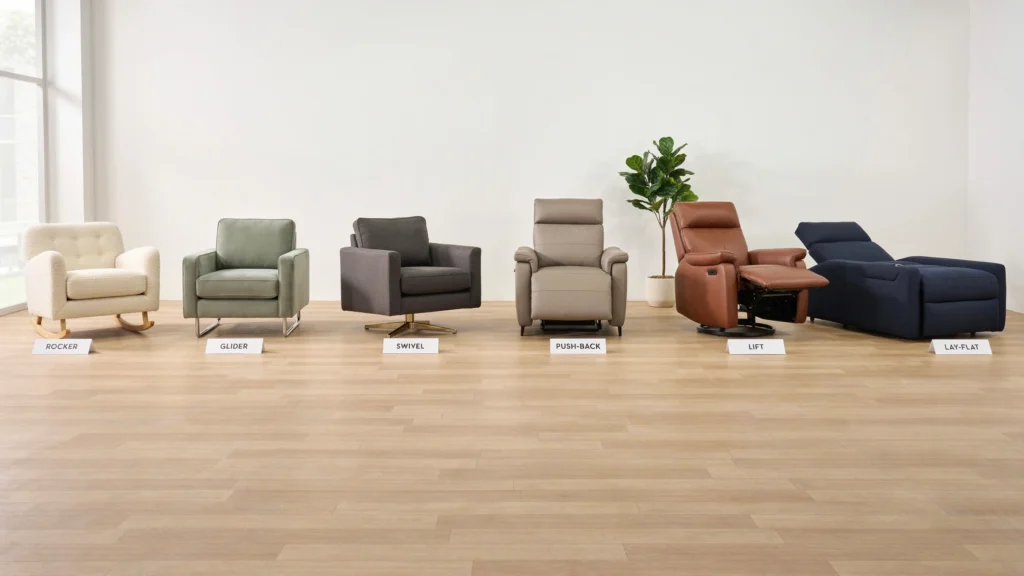
Other movements are worth knowing too. A rocker rocks gently upright, which suits a nursery or reading corner. A glider moves in a smooth straight line, a swivel turns a full circle for open plan rooms, and a push back has no visible handle but needs your body weight to recline, so lighter sitters should test it in person. A lay flat opens near flat for napping, but it needs the longest floor space of all.
How Do You Measure Your Body for the Right Fit?
Showroom lighting flatters every chair. Your body does not lie. A recliner that fits will let you sit down, lean back, and stand up without adjusting yourself, shuffling forward, or tucking a cushion behind your back. Work through the five measurements below with a tape measure and a willing helper, then compare your numbers with the spec sheet of any chair you consider. If a retailer does not publish seat height, seat depth, seat width, and reclined length, treat that silence as useful information and look elsewhere.
Seat height: can your feet rest flat?
Sit on a dining chair with your feet flat and your thighs roughly level. Measure from the floor to the crease behind your knee. That number is close to your ideal seat height. When a recliner seat is too high, your feet dangle, pressure builds behind your thighs, and your lower back compensates by arching.
When it is too low, standing up becomes a small workout, and your knees sit higher than your hips, which strains the lower back over a long evening. A difference of even one inch changes how a chair feels after an hour, so do not guess this number.
Seat depth: leave room behind your knees
Seat depth is measured from the front edge of the seat to the backrest. The research angle that matters most here is simple. You want roughly 2 to 3 inches of clear space between the front edge of the seat and the back of your knees when you sit fully back. That gap keeps the seat edge from pressing into the back of your legs and cutting off circulation during a long film or a long read.
To check your own depth, sit against a wall on a firm surface and measure from the wall to the back of your knee. Then subtract 2 to 3 inches. That is your target seat depth. A seat that is too deep forces you to slouch forward to reach the floor, which defeats the back support you paid for.
A seat that is too shallow leaves your thighs unsupported and makes the chair feel like a perch rather than a lounge seat. Taller people often need a deeper seat, and this is one reason a single chair rarely fits a whole household perfectly.
Seat width: hip width plus ease
Measure across your hips at their widest point while seated, then add a few inches of ease so you can shift position, tuck a leg up, or sit with a book on your lap. The arms count here too. Wide, padded arms eat into the sitting width, so a chair that measures 40 inches across the outside might offer only 22 inches of actual seat. Always compare inside seat width, measured between the arms, not the overall width.
Backrest height and arm height: support without shrugging
A backrest should support your head and neck when reclined, not just your lower back when upright. Sit back, let your head rest, and notice whether your neck falls into a gap or pushes forward. An adjustable headrest solves this for many people, because it moves independently of the back angle. If the chair has a fixed high back, check that the top of the backrest reaches at least the top of your ears when you sit fully back.
Armrests should let your forearms rest with your shoulders relaxed and down. If your shoulders rise toward your ears, the arms are too high. If your arms dangle and your shoulders roll forward, the arms are too low. This detail seems small in a shop, but over months it decides whether your neck and shoulders feel rested or tight after an evening in the chair. Test it with a book in your hands, because that is how you will really use the chair.

How Do You Measure Your Room and Delivery Path?
A recliner has three footprints, not one. There is the upright footprint, the fully reclined footprint, and the delivery footprint, which is the size of the box or the chair as it travels through your home. Measure all three, or the chair that fits your room perfectly might never reach it.
Start with the reclined length. Typical reclined lengths run roughly 60 to 74 inches from the back of the chair to the tip of the extended footrest, but again, the exact model’s spec sheet is the only number that counts for your purchase. Mark that length on your floor with tape, then add walking space.
You want at least 2 to 3 feet of clear walking space around the fully reclined chair, not just enough room for the chair itself. A recliner that blocks the path to a door or forces everyone to squeeze past the footrest will create daily friction, no matter how comfortable it is.
Next, check the side clearances. A swivel recliner needs room to turn without hitting a side table or a lamp. A wall hugger needs room in front for the seat to slide forward. A power recliner needs an outlet within cord reach, and the cord route should run where feet and vacuum cleaners will not catch it. Plan the cord route before delivery day, not after the chair is already in place and the nearest outlet is behind a bookcase.
Then measure the delivery path, and do it honestly. Measure every doorway, hallway turn, lift door, and stairwell bend between the street and the room, including the narrowest point, not the average.
Compare those numbers with the packaged dimensions, and ask whether the back comes off for delivery, whether the legs are removable, and whether the delivery team will carry the chair upstairs or only to the door. A chair that fits your living room but not your hallway is a return waiting to happen, so confirm this before you pay.
For small rooms, the honest question is not whether a recliner fits, but whether it fits without crowding everything else out. A wall hugger mechanism, a slimmer arm profile, and a lighter colour can all help a chair sit quietly in a compact room.
If you are furnishing a small flat, look at apartment design ideas for modern living before you commit, because the layout around the chair matters as much as the chair itself. A recliner beside a slim side table and a floor lamp reads as a reading corner. The same chair jammed against a sofa and a television stand reads as clutter.
Which Luxury Style Suits Your Home?
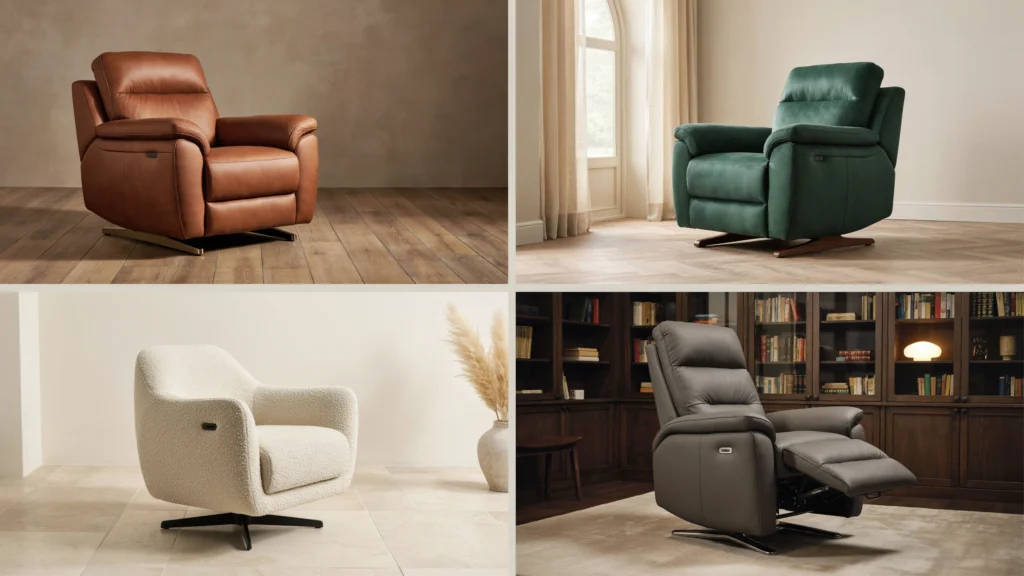
Once fit and mechanism are settled, style becomes enjoyable rather than stressful. The four directions below are not brands or models, they are design approaches. Use them to narrow your search, then judge individual chairs against your measurements and your room, not against a photograph.
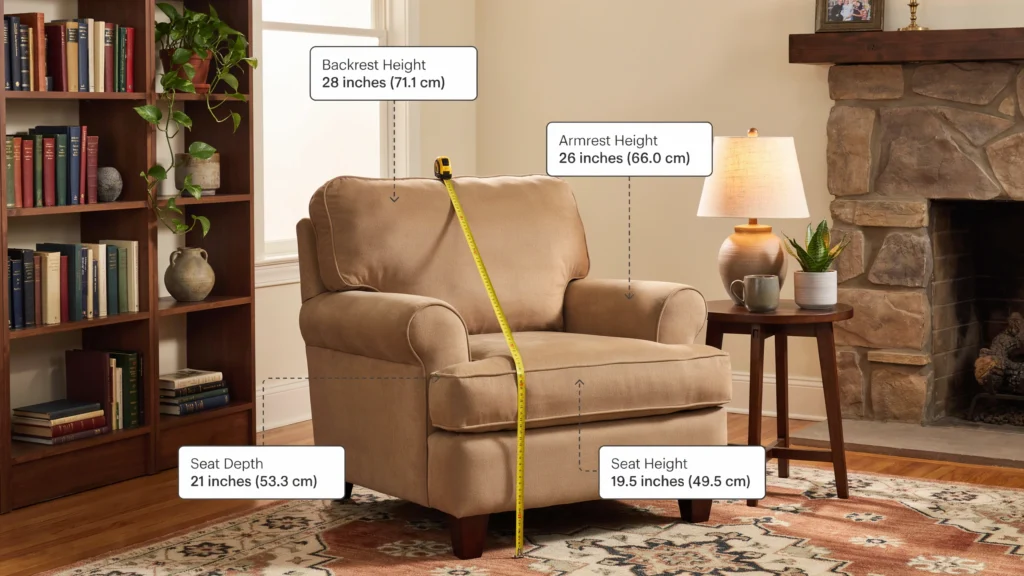
The architectural statement
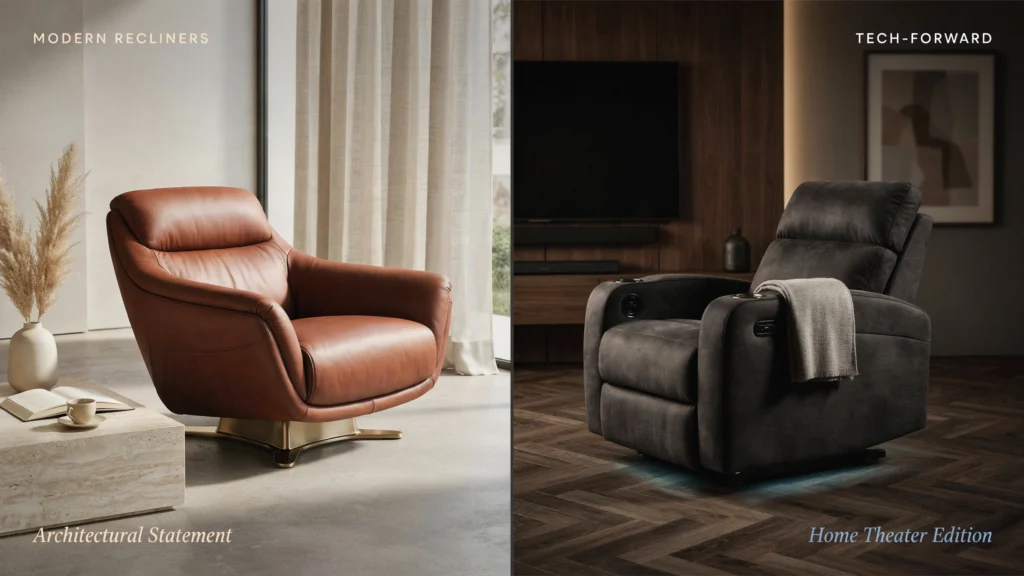
This is the recliner as sculpture. Think of a geometric base in matte black or polished metal, tailored leather, and a silhouette with crisp edges rather than soft curves. The controls hide discreetly, often in the seam between seat and arm, so nothing interrupts the shape. This style suits a contemporary living room where furniture is meant to be looked at as well as sat in.
Place an architectural recliner where it can be seen from more than one angle, because its back and base are part of the design. A plain wall behind it, or a black accent wall that gives it a dramatic backdrop, will make the shape stand out.
Keep the side table minimal, a slim metal or stone top rather than a chunky wooden piece, so the chair remains the clear focal point. If your room already has several strong shapes, this style can tip the space into busyness, so pair it with calm, quiet neighbours.
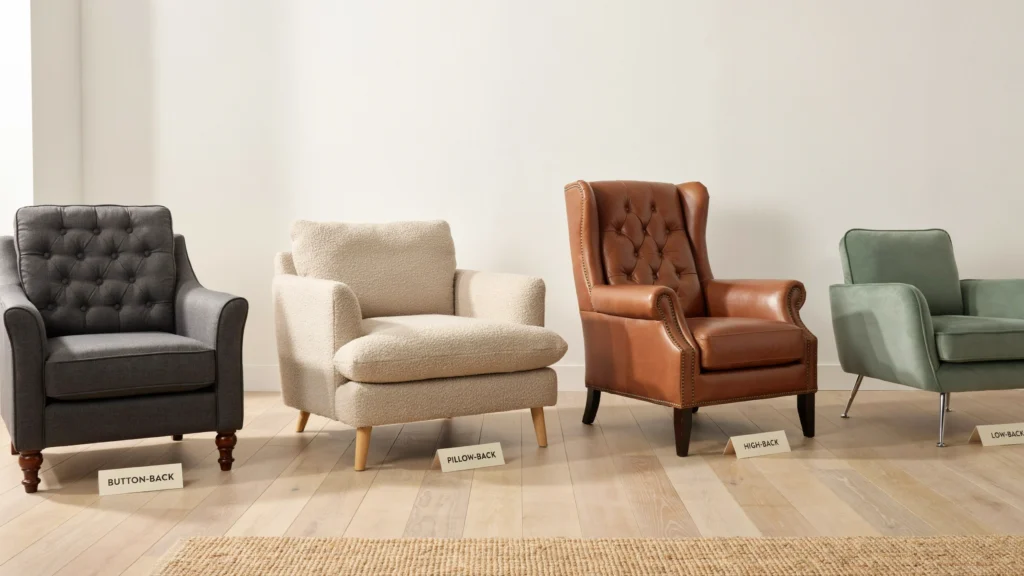
The tech-forward recliner
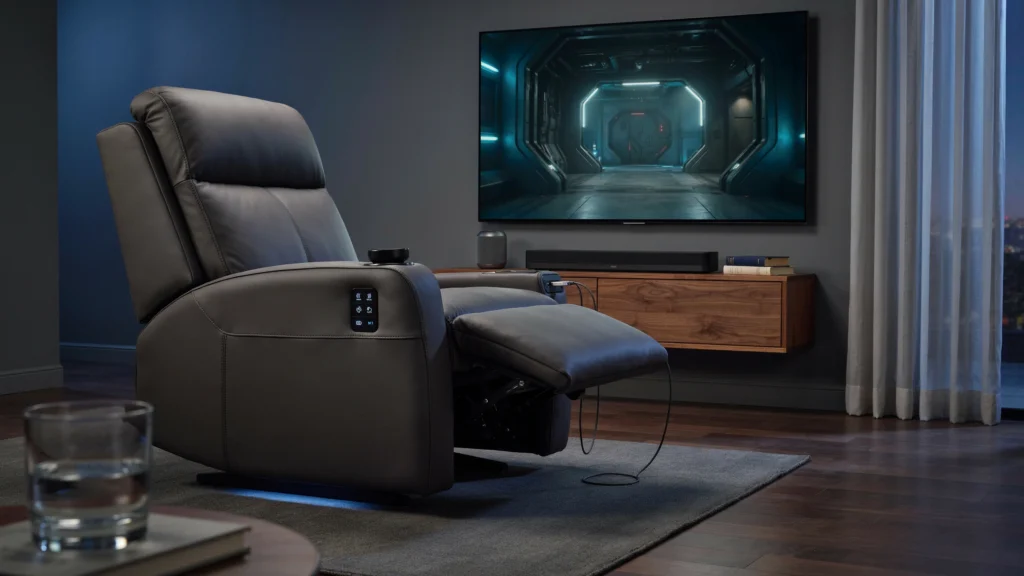
This style is built around how you spend an evening. Expect power reclining with independent back and footrest control, memory settings that return the chair to your favourite angle, built in USB charging, and sometimes heat or massage functions. It is the natural choice for a home theatre, a media room, or a dedicated relaxation corner where the chair is the command centre.
Tech features are only worth it if you will genuinely use them. A massage function you try twice and forget adds weight, cost, and something else that can fail. A memory setting you use every night, because two people share the chair at different angles, earns its place.
Check where the controls sit and whether you can reach them without twisting. Check the cord length and the outlet position. And ask what happens if the power goes out, because some power recliners stay in position until power returns, which matters if you rely on the chair to help you stand.
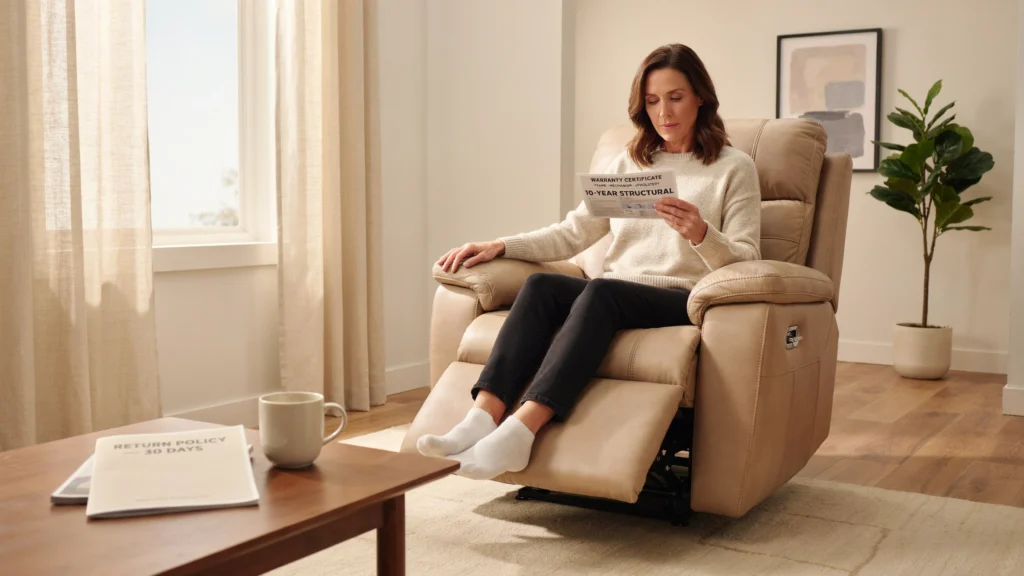
Scandinavian serenity
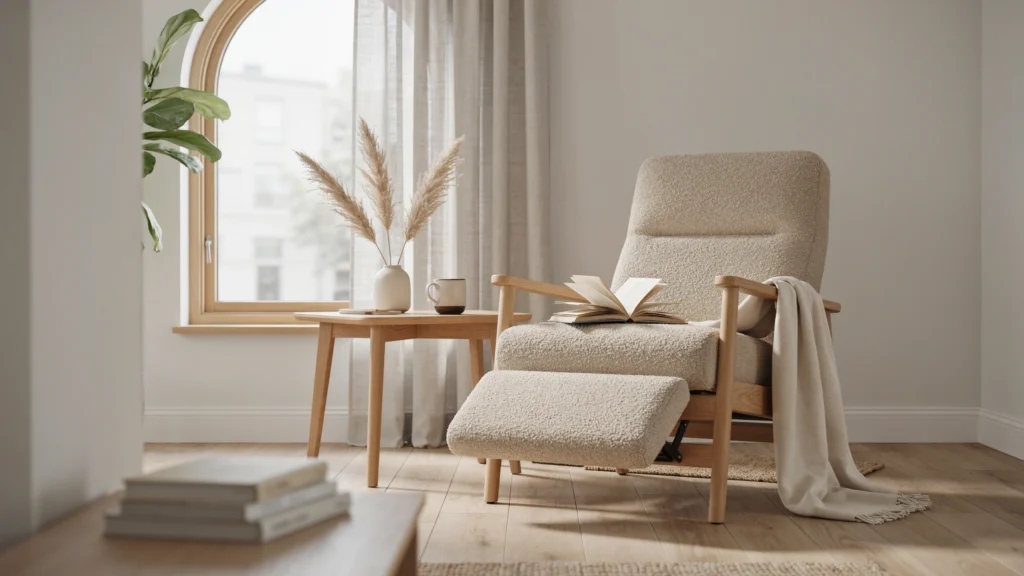
Scandinavian recliners are quiet, light, and warm. Pale oak or walnut accents, oatmeal or light grey fabrics, and an ergonomic shape that follows the natural curve of the spine. Nothing is oversized. The chair is designed to sit in a sunlit corner with a book and a cup of tea, and to disappear into the room when not in use.
This style works beautifully in a reading nook, a bedroom corner, or a calm living room. Layer it with a soft throw and a cushion, but keep the palette restrained, because the serenity comes from the lack of visual noise. If your home leans toward cozy grey boho living room ideas, a Scandinavian recliner in a warm neutral will slide in without a fight. Add a floor lamp with warm light behind the chair, and the corner becomes the spot everyone drifts toward in the evening.
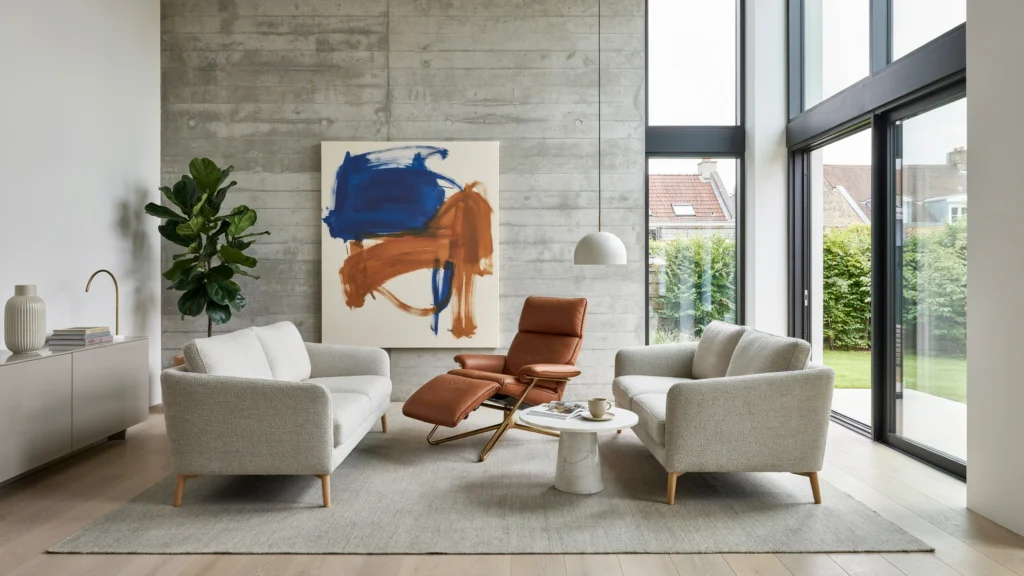
Mid-century modern revival
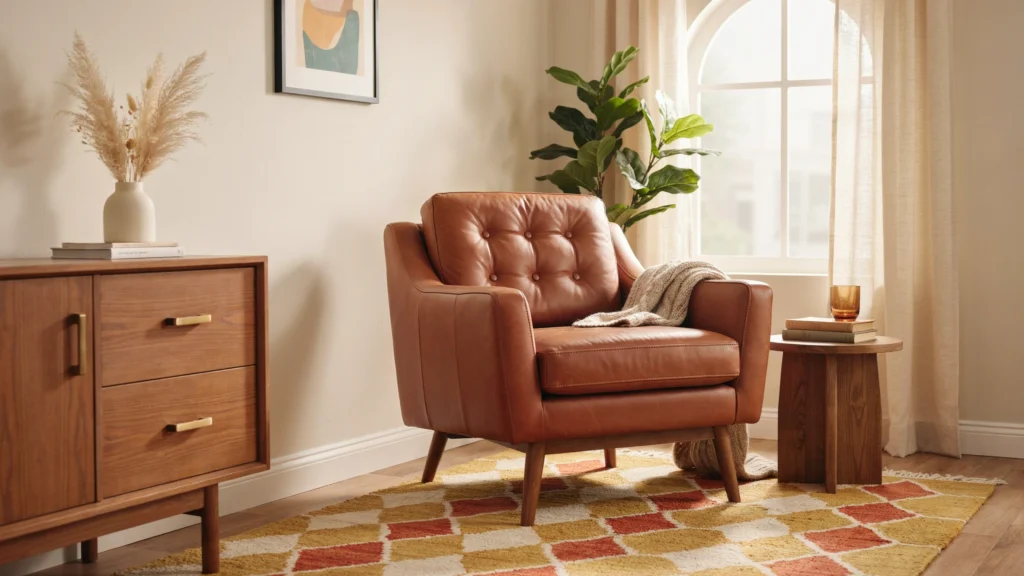
Mid-century recliners borrow from classic mid-century design: tapered wooden legs, gently sloped arms, tufted leather or tweed, and a silhouette that is compact rather than sprawling. They suit retro inspired rooms, stylish home offices, and anyone who wants character without bulk. Because the profile is slimmer, they often fit smaller rooms better than a deep, overstuffed recliner.
Pair a mid-century recliner with honest materials around it, such as a teak side table, a simple rug with a geometric pattern, or a wooden bookshelf, and avoid piling on competing retro details. One strong vintage shape is charming. Five of them in one corner start to look like a theme park. If your room is already full of mid-century pieces, a plainer recliner in a matching wood tone may serve the room better than another statement shape.
How Do You Place a Recliner So It Belongs?
Placement is where a recliner either joins the room or invades it. Start with the view. A recliner should face something worth looking at, whether that is a television, a fireplace, a window, or a conversation area. A chair facing a blank wall, simply because that is where the clearance worked, will sit empty. Turn the chair at a slight angle if a straight placement feels stiff. An angle often reads more inviting and can solve a clearance problem at the same time.
Next, build the corner around the chair rather than dropping the chair into an empty gap. A slim side table within arm’s reach holds a book, a drink, and reading glasses, which means you will actually use the chair for long stretches. A floor lamp behind or beside the chair gives task light for reading and shows off the texture of the upholstery in the evening.
If the chair sits near a sofa, check that the two pieces talk to each other in scale and colour. A recliner that dwarfs the sofa, or clashes with it completely, will always look like an afterthought. Ideas for comfortable sofas for relaxing living rooms can help you judge that balance before you buy.
Styling should stay light. A throw draped over one arm adds warmth and softens a leather chair, and a single cushion adds colour without hiding the shape. Resist the urge to pile on blankets, cushions, and covers, because they hide the chair you chose so carefully and they slide off every time the mechanism moves.
For layering ideas that stay tidy, modern throw blanket ideas for a cozy living room show how one well chosen throw does more than three competing ones. The same restraint applies to cushions, where mixing and matching throw pillows well means choosing one or two that echo the room, not a stack that fights the chair.
How Do You Look After a Luxury Recliner?
Good maintenance is unglamorous and it is what keeps a luxury chair looking luxury. The routine depends on the material, and the wrong cleaner does more damage than no cleaner at all, so always test any product on a hidden spot first and follow the maker’s care guidance for your exact upholstery.
For performance fabrics, vacuum regularly with an upholstery attachment and spot clean spills promptly, blotting from the outside inward. For velvet or boucle, brush gently in one direction after cleaning to restore the nap, and avoid heavy water use, which can mark the pile.
Mechanisms need attention too. Keep cords clear of moving parts, check that the power box connection stays firm, and listen for new noises. A squeak or grind that appears suddenly is worth investigating early, before a small wear issue becomes a mechanism failure.
Do not force a stuck recliner, and do not let children swing on the footrest, because that stresses the mechanism in ways it was not designed for. Once a year, a professional upholstery clean refreshes the fabric and lets a specialist spot wear you might miss, which is a sensible habit for a chair you plan to keep for many years.
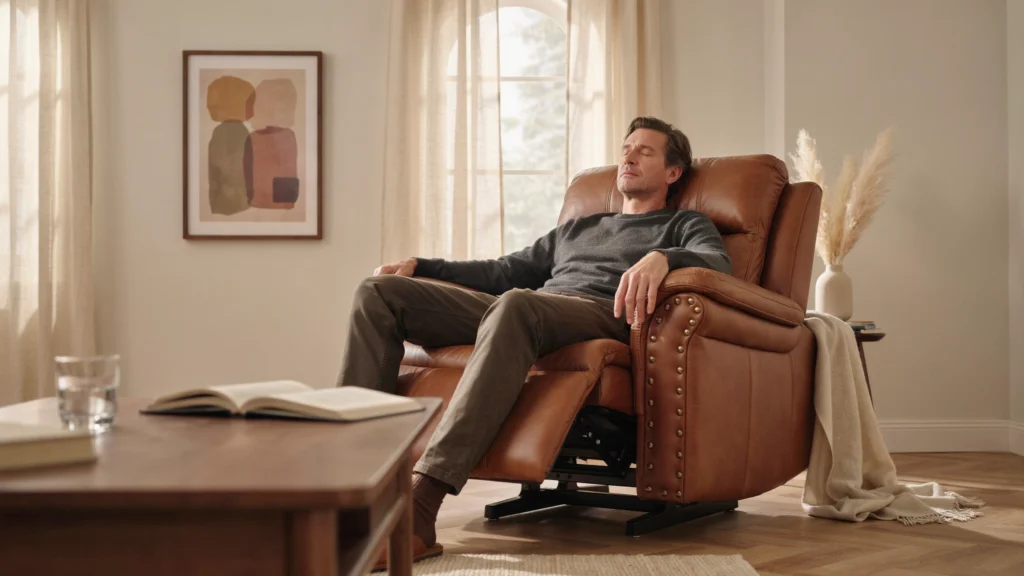
Frequently Asked Questions About Modern Recliners
How much wall clearance does a modern recliner need?
It depends on the mechanism. A standard recliner typically needs 12 to 18 inches of wall clearance, while a wall hugger typically needs only 4 to 6 inches, because the seat slides forward as it reclines. Power, lift, and zero gravity models vary, so always check the clearance figure on the exact model’s spec sheet and mark the reclined footprint on your floor before you order.
Are power recliners better than manual recliners?
Power recliners offer precise, independent control of the back and footrest, and they are much easier to operate for anyone with limited hand strength or mobility. Manual recliners have no cord, no motor to maintain, and a faster, simpler motion. Choose power if you want fine control or share the chair with someone who needs easy operation. Choose manual if you want simplicity, no outlet nearby, or a cleaner profile with no visible controls.
What seat depth should I look for?
Look for a seat depth that leaves roughly 2 to 3 inches of space behind your knees when you sit fully back. Measure from a wall to the back of your knee while seated, subtract 2 to 3 inches, and compare the result with the chair’s published seat depth. Too deep and you will slouch forward. Too shallow and your thighs will feel unsupported.
What is the most durable fabric for a recliner?
Top grain leather and tightly woven performance fabrics are among the most durable choices. Leather wipes clean and develops character over time, while performance fabric resists snagging and handles daily family use well. Velvet and boucle look beautiful but need more regular care. Ask for swatches, test them in your light, and choose based on your household, pets, and cleaning habits, not on appearance alone.
Can a recliner work in a small room?
Yes, if you choose the right mechanism and size. A wall hugger with a slim arm profile needs far less floor space than a standard recliner, and a lighter colour helps the chair sit quietly in a compact room. Measure the fully reclined footprint, allow walking space around it, and check the delivery path. If the chair fits only by blocking a walkway or a door, it is too large for that room, however good it looks.
Do I need to try a recliner before buying?
Trying in person is strongly recommended whenever possible, because specifications cannot tell you how a seat feels against your body. Sit fully back, recline completely, rest your head, and stand up from the chair. If you cannot try it in person, confirm the return or exchange policy before ordering, and measure everything twice. A generous return policy is part of the purchase, not an afterthought.

Try Before You Buy: Your First-Step Plan
You do not need to decide today. You need a short, practical plan that takes you from browsing to a confident purchase without regret. Work through these steps in order, and do not skip the measuring, because it is the step most people skip and most people regret skipping.
- Measure your body. Record your ideal seat height, your target seat depth with 2 to 3 inches behind your knees, and your inside seat width with room to shift. Write the numbers down and keep them on your phone for shop visits.
- Measure your room. Tape the upright and fully reclined footprints on the floor, allow 2 to 3 feet of walking space around the reclined chair, and note the nearest power outlet if you want a power model.
- Measure the delivery path. Check every doorway, hallway turn, and stairwell bend, and ask whether the back or legs come off for delivery.
- Choose your mechanism. Match the wall clearance and movement style to your room, using the table near the top of this guide, then confirm the exact figures on the spec sheet.
- Shortlist by style. Pick the design direction that suits your room, architectural, tech-forward, Scandinavian, or mid-century, and gather fabric or leather swatches to test in your own light.
- Sit in the chair. Recline fully, rest your head, place your feet flat, and stand up again. Repeat it several times. If anything pinches, dangles, or strains, that chair is not your chair, however good it looks.
- Check the warranty and returns. Confirm separate cover for the frame, the mechanism, and the upholstery, and confirm what happens if the fit feels wrong once the chair is home.
When you follow that order, the choice usually makes itself. One or two chairs will fit your numbers, suit your room, and feel right when you sit in them.
The rest will fall away, not because they are bad chairs, but because they were never your chair. That is exactly how a luxury recliner should feel, like it was made for your body, your room, and the way you actually spend your evenings. Take the measurements, trust what your body tells you in the shop, and choose the chair you will still love after the newness fades.
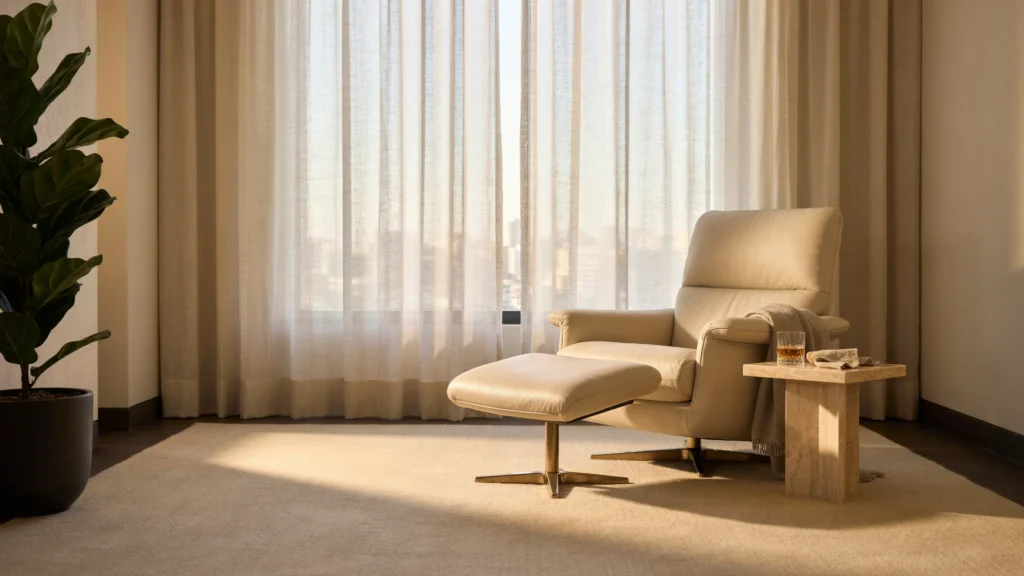
My own pick for a first luxury recliner would be a wall hugger in a performance fabric. It fits the most rooms, it is easy to live with, and the fabric forgives daily use.