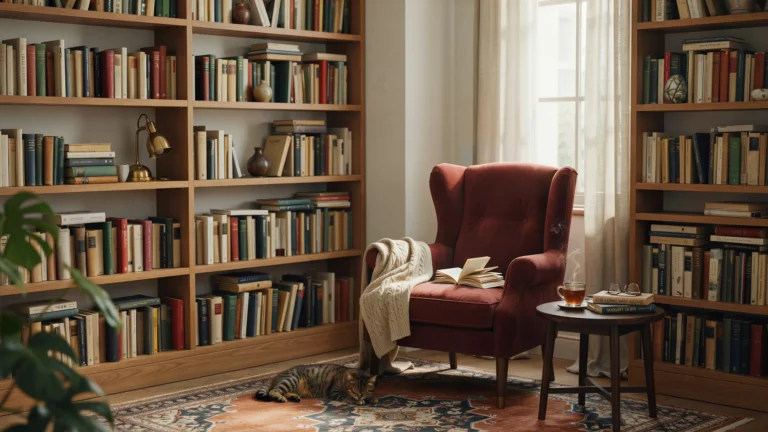
A black accent wall works best when you paint just one wall, choose a matte or eggshell finish, and add warm light that actually hits the wall. Pick the wall your eye lands on first when you walk in, usually behind the bed, sofa, fireplace or television. Keep the rest of the room light, bring in wood or brass for warmth, and test your black on the wall for a few days before you commit.
Black has a bad reputation in home decor, and most of it is unfair. People picture a dark cave, but a single black wall usually does the opposite. It pushes back visually, so the room feels deeper, and it frames whatever sits in front of it. A light sofa, a wooden dresser or a row of framed prints all look more deliberate against black than they do against plain white.
The trick is restraint. One wall, not four. A finish that suits the room. Light planned before the paint goes on, not after. Get those three things right and black stops feeling risky. This guide walks through 20 ideas room by room, with the practical detail that decides whether each one looks rich or falls flat.
Pick the Wall Before You Pick the Paint
Stand in the doorway and notice where your eyes go first. That is your accent wall. In a bedroom it is almost always the wall behind the headboard. In a living room it is the fireplace wall or the wall behind the sofa. In a home office it is the wall behind your desk, which also gives you a clean video call background. If no wall stands out, the longest uninterrupted wall is usually the safest choice.
Avoid walls broken up by lots of doors, or walls that face a window directly, because glare will wash the black out during the day. Small rooms can absolutely carry a black wall, but they need more light and lighter furniture to balance it. A powder room is the one place where you can break the rules, since a tiny room is meant to feel like a jewel box rather than an open space.
Finish matters more with black than with any other colour. Flat and matte finishes absorb light and hide bumps in the plaster, which is why they suit bedrooms and ceilings. Eggshell gives a soft glow and wipes clean more easily, so it works in living rooms. Satin and semi gloss reflect light and show every roller mark, so save them for trim, doors and small high traffic areas. Whatever finish you choose, use a grey tinted primer and plan on two coats at minimum. Black over white primer almost always needs a third.
| Finish | Look on a black wall | Best rooms | Watch out for |
|---|---|---|---|
| Flat or matte | Velvety, deep, no shine | Bedrooms, ceilings, low traffic walls | Scuffs easily, harder to wipe clean |
| Eggshell | Soft, low glow | Living rooms, bedrooms | Shows some roller marks if rushed |
| Satin | Smooth, subtle gleam | Dining rooms, hallways, trim | Highlights dents and patches |
| Semi gloss | Noticeable shine, almost lacquered | Powder rooms, doors, cabinets | Shows every flaw, needs a near perfect wall |
Lighting is the other half of the decision. A black wall in a room lit only by one ceiling fixture will look like a hole after dark. Aim for warm white bulbs around 2700K to 3000K, and layer at least three sources: something overhead on a dimmer, a lamp at seating height, and one accent light that washes the wall itself. Picture lights, wall sconces and LED strips behind shelves all do this job well. Put the accent light on a dimmer too, so you can turn the drama up or down.
20 Black Accent Wall Ideas
1. A Black Fireplace Wall
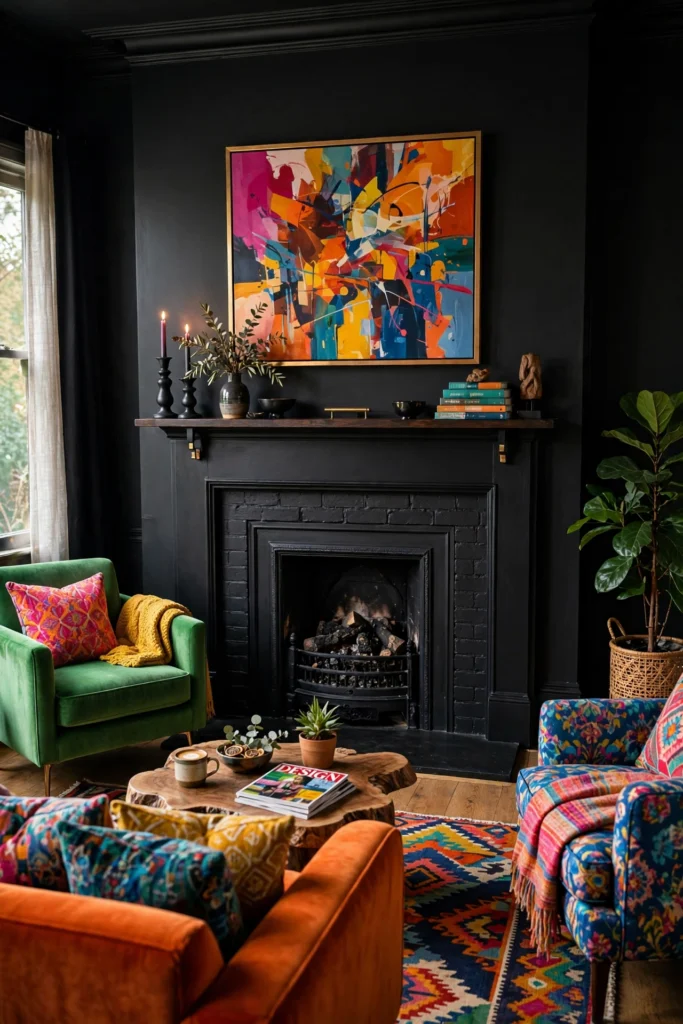
Painting the whole fireplace wall black, including the surround and the chimney breast, turns an ordinary fireplace into the clear centre of the room. It works best when the mantel stays simple, because a fussy mantel fights the clean block of colour. Keep the hearth in stone, concrete or wood rather than matching black tile, or the whole corner melts into one dark mass.
Hang the mirror or artwork above the mantel with a gap of around 15 to 20 cm so the pieces read separately from the mantel line. A pair of wall sconces on either side of the fireplace, fitted at about eye level, will wash warm light across the black and stop it looking flat at night. If your fireplace is not used, a cluster of pillar candles on the hearth gives the same glow without any wiring.
2. Molding Enhanced Black Wall
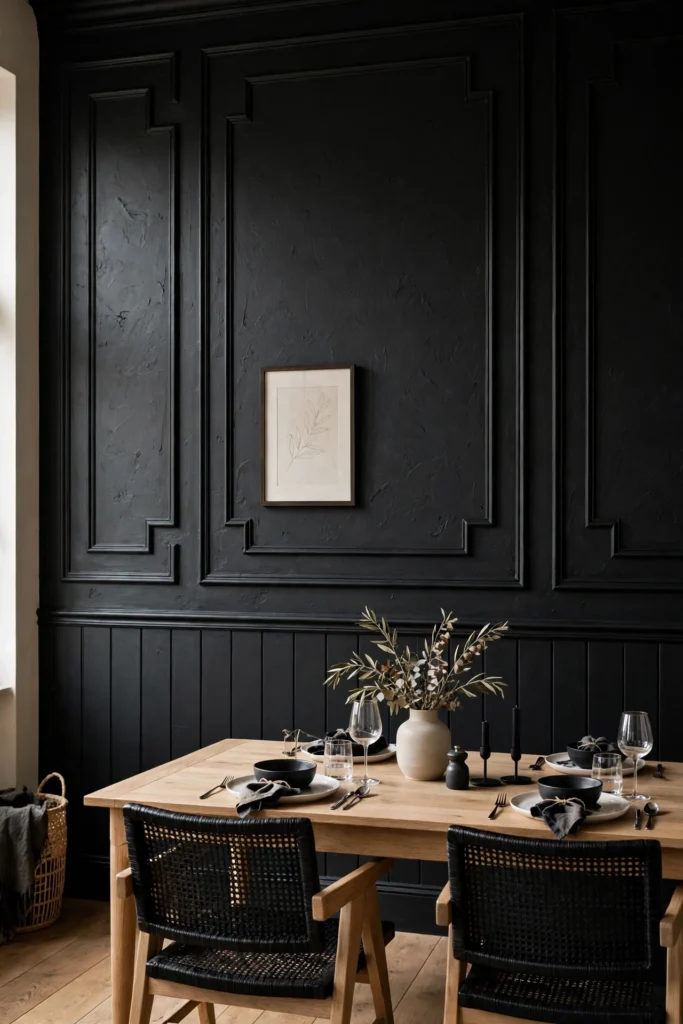
Applied molding is the cheapest way to make a black wall look expensive. Thin picture frame molding, painted the same black as the wall, adds shadow lines and structure without adding colour. Rectangles around 60 to 90 cm wide read best on a standard wall, and you should leave at least 10 cm between each frame and the edge of the wall so the pattern breathes.
Plan the layout on paper first and mark it on the wall with painter’s tape before you glue or nail anything. Uneven spacing is far more obvious on black than on a pale wall, because every shadow shows. Paint the molding after it is fixed, not before, so the joints disappear and the whole wall reads as one piece.
3. Black Wall Behind the Bed
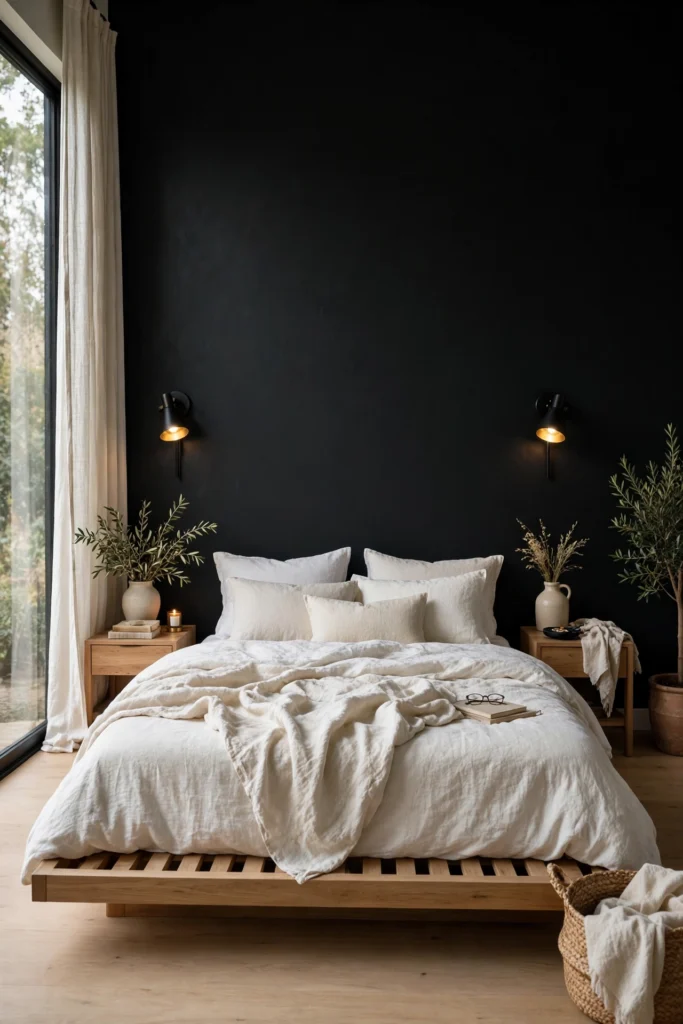
The wall behind the headboard is the classic black accent wall for a reason. You see it the moment you walk in, and it frames the bed like a backdrop. A tall upholstered headboard in cream, oatmeal or soft grey gives the strongest contrast, while a wooden headboard warms the whole scheme up. Keep bedding pale and add one darker throw so the bed does not float in a sea of white.
Bedside lighting matters here more than anywhere. Two wall sconces or pendant lights hung about 40 to 50 cm above the nightstands will pool light on the black and make the wall feel intentional rather than heavy. If you want more bedroom ideas in this palette, these black bedroom wall ideas show how the same colour works with different furniture and bedding styles. Avoid a black wall behind a low, dark headboard, because the bed will simply vanish into it.
4. Black Paired With Gold or Brass Accents
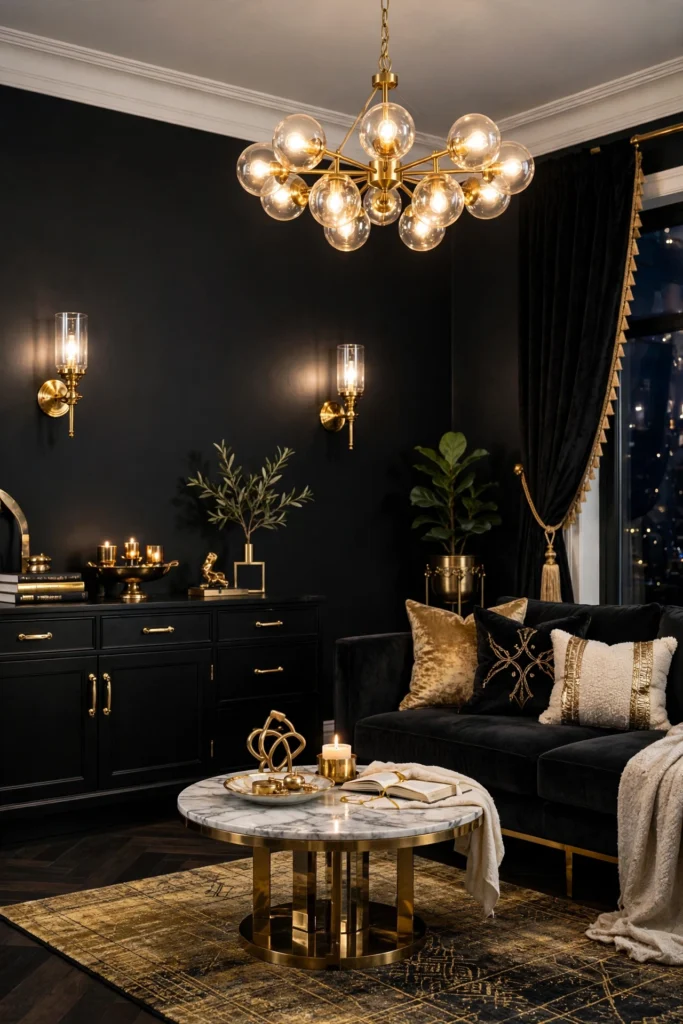
Black and brass is a pairing that rarely fails, but the proportion is what makes it work. One or two brass pieces, a large mirror, a floor lamp or a set of sconces, are enough. When every frame, handle and ornament is gold, the room starts to look like a hotel lobby. Let the brass be the jewellery, not the outfit.
Brushed or aged brass suits black better than shiny chrome gold, which can look harsh under warm light. Place brass where light will catch it, near a lamp or opposite a window, so it glows rather than sitting dull. Keep the rest of the metal in the room consistent, so avoid mixing brass with silver and blackened steel in the same sightline.
5. Ribbed or Textured Black Paneling
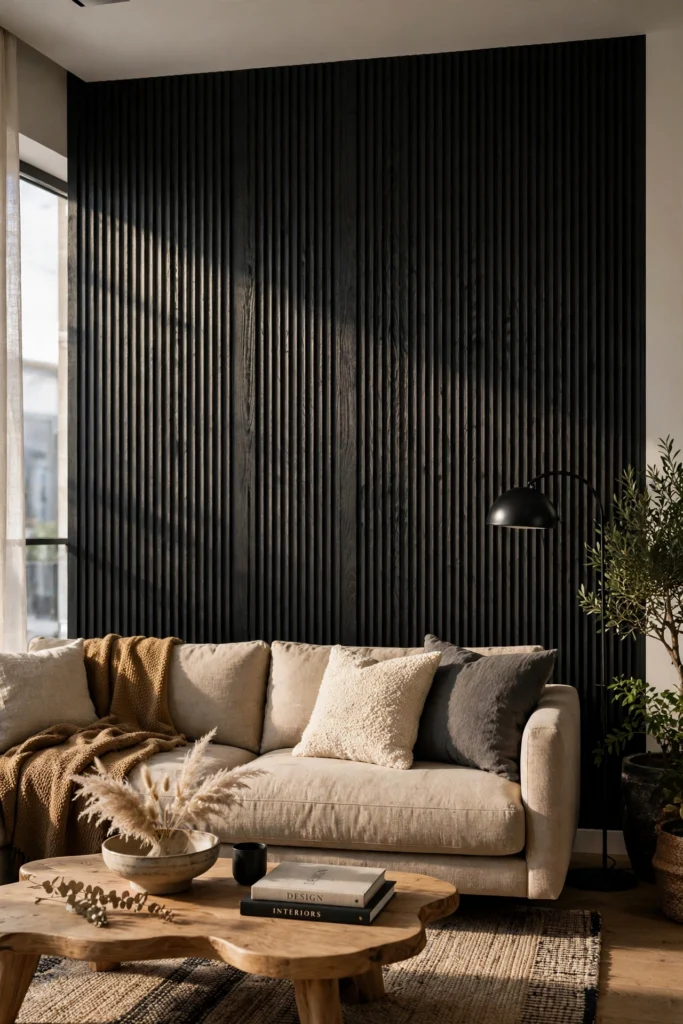
Flat black paint can look dull on a large wall, and that is where ribbed paneling earns its place. Vertical slats, fluted panels or reeded boards catch light along their edges, so the wall changes as you move around the room. Slats around 2 to 3 cm wide with a similar gap between them give a fine, furniture like texture. Wider boards, 8 to 10 cm, read bolder and suit larger rooms.
Run the panels floor to ceiling for the full effect, and finish the top edge with a simple trim piece so it does not look cut off. This treatment is heavier to dust than plain paint, so it suits a living room or bedroom better than a kitchen. Paint the panels after fitting, in a matte finish, so the texture comes from the shape rather than from shine.
6. A Black Ceiling
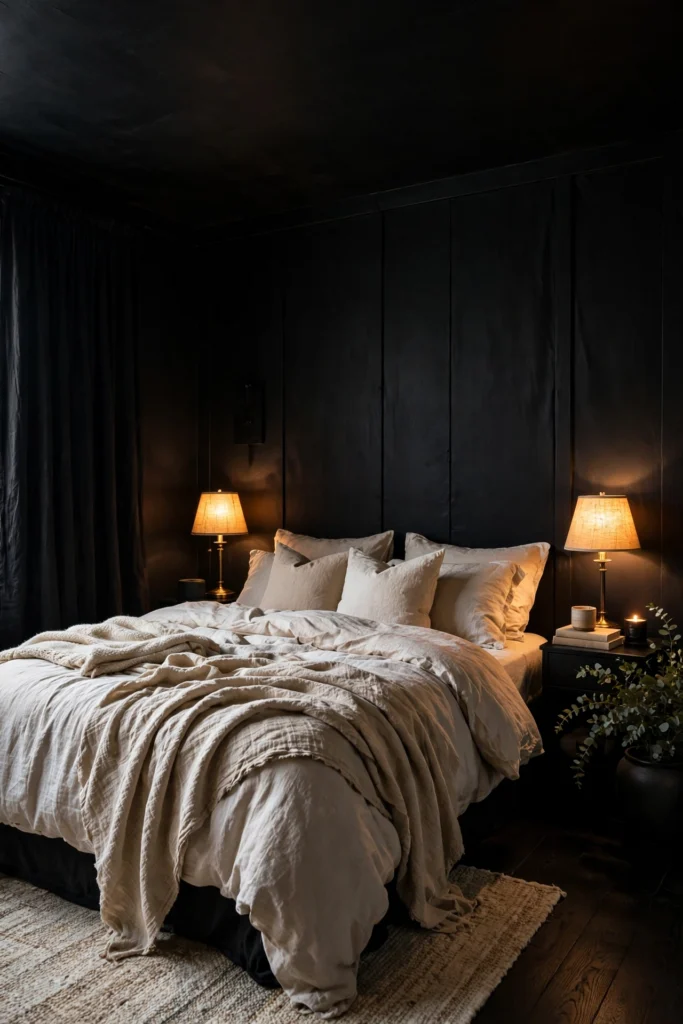
A black ceiling sounds dramatic, and it is, but it works only in the right room. Ceilings above about 2.7 metres can take it without feeling oppressive. Below that height, black overhead can make the room feel lower than it is, especially with a ceiling fan or a low hanging light pulling the eye down further.
The trick is to keep the walls pale and to use warm, upward facing light. Picture rail lighting, wall sconces that throw light up, or a pendant with an open shade will all stop the ceiling reading as a void. A flat finish is essential here, because any sheen on a ceiling shows every imperfection and catches glare from lamps. If you are unsure, paint a single ceiling panel or a coffered section first and live with it for a week.
7. Black Accent Wall in the Dining Room
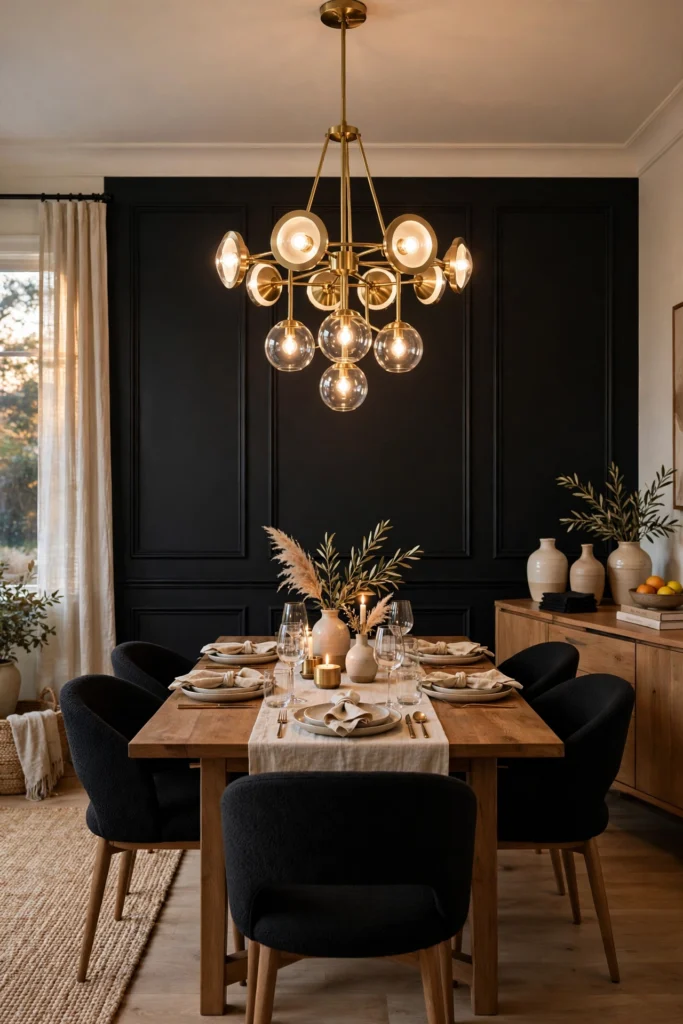
A dining room is one of the best places for a black wall, because the room is used mostly in the evening when warm light makes black look rich. Put the black on the wall behind the sideboard or the longest wall, and let the table sit against it. A wooden table, oak or walnut, stops the scheme feeling cold, and linen placemats in cream or sage soften the contrast.
Hang the pendant or chandelier so its lowest point sits about 75 to 80 cm above the tabletop. Too high and the light misses the table, too low and guests stare into bulbs. A dimmer is not optional here. At full brightness a black dining wall can feel stark, but dimmed to a warm glow it turns the room into the cosiest spot in the house.
8. Black Wall With a Neon Sign

Black is the ideal background for a neon sign, because the glow has nothing competing with it. A single short word or a simple shape works far better than a long quote, which is hard to read and dates quickly. Warm white or soft amber neon suits most rooms, while bright pink or blue is better saved for a teen room or a bar corner.
Mount the sign so its centre sits at eye level, roughly 150 to 160 cm from the floor, and hide the cable with a cord cover painted black to match the wall. Most LED neon signs run on a low voltage adapter, so you only need a nearby socket, not an electrician. Keep the rest of the wall bare. One sign plus one shelf or plant is plenty, and a crowded neon wall just looks noisy.
9. Black Wall Behind Bookshelves or Built Ins
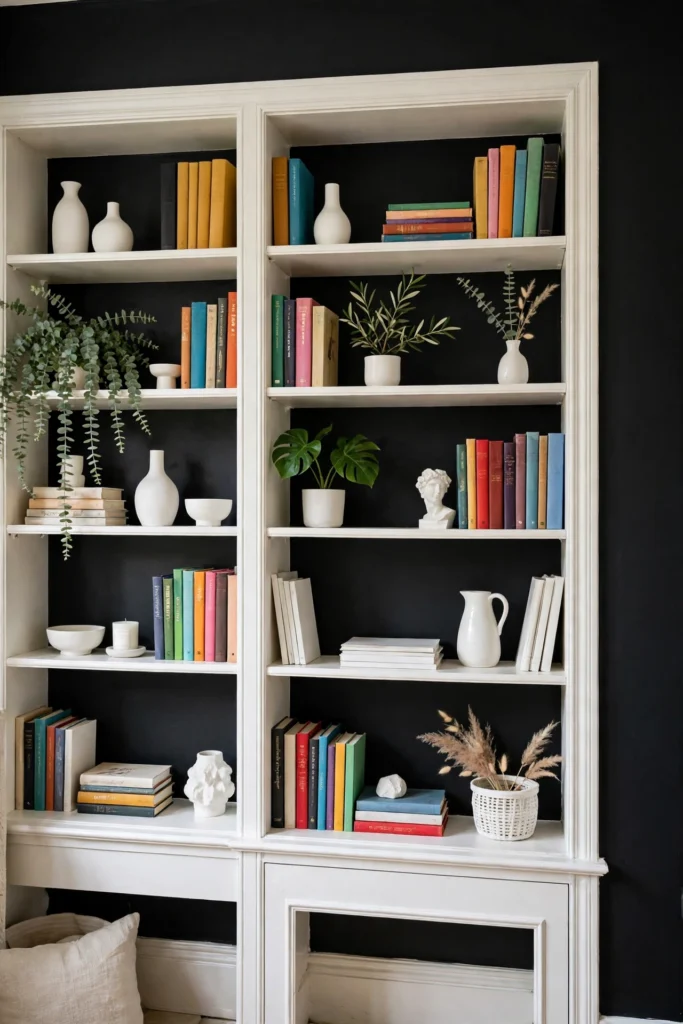
Painting the wall behind open shelving black makes books, ceramics and plants stand out like objects in a display case. Light coloured spines and pale pottery pop against it, which is useful if your shelves tend to look cluttered. The effect is strongest when the shelves themselves are wood or white, because dark shelves on a dark wall lose their edges.
Leave some breathing room on each shelf. A shelf packed edge to edge in front of black reads as a solid block, while a few gaps and one or two horizontal book stacks give the eye places to rest. Add a slim LED strip along the underside of one or two shelves, not every shelf, so the light feels like a highlight rather than a shop display.
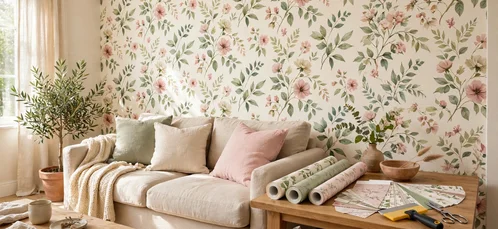
10. Renter Friendly Black Wallpaper
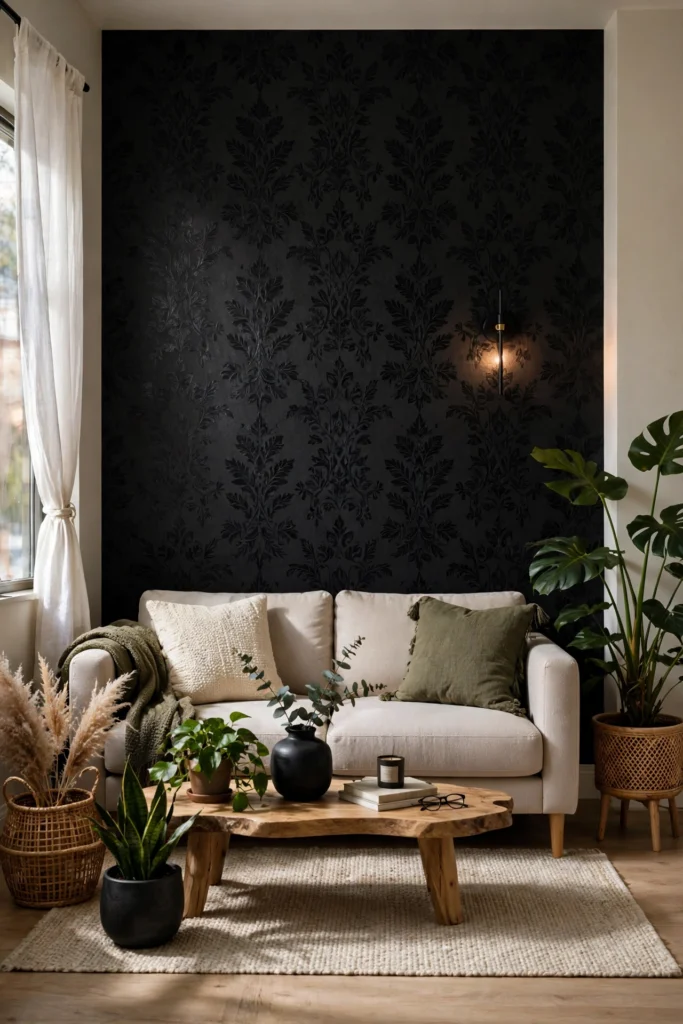
Peel and stick wallpaper is the renter’s answer to a black accent wall, and modern versions remove cleanly if the wall underneath is smooth and primed. A subtle pattern, a fine linen texture or a soft geometric print, looks far better than a flat black sheet, which can show every seam. Buy one extra roll beyond your measurement so pattern matching and mistakes do not leave you short.
Start in a top corner and work down in full drops, smoothing from the centre outwards with a plastic smoother to push air bubbles to the edges. Seams show most on dark paper, so butt the edges tightly rather than overlapping them. Avoid peel and stick paper on freshly painted walls, textured plaster or damp walls, because it will either peel off or pull paint with it when removed.
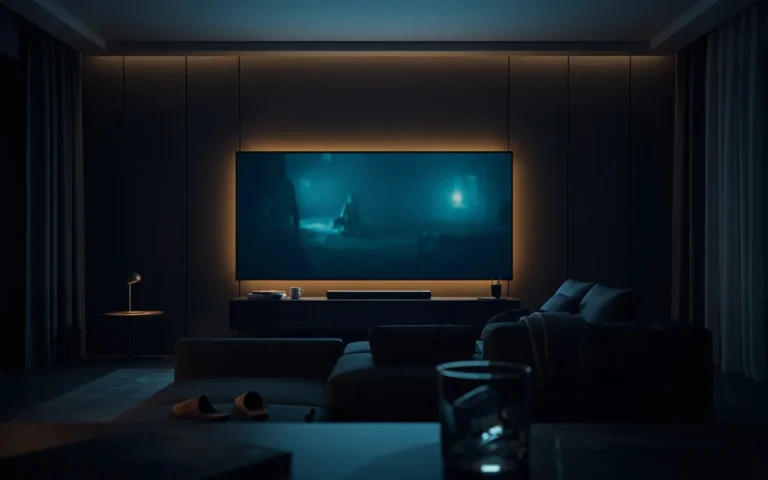
11. A Black Media or TV Wall
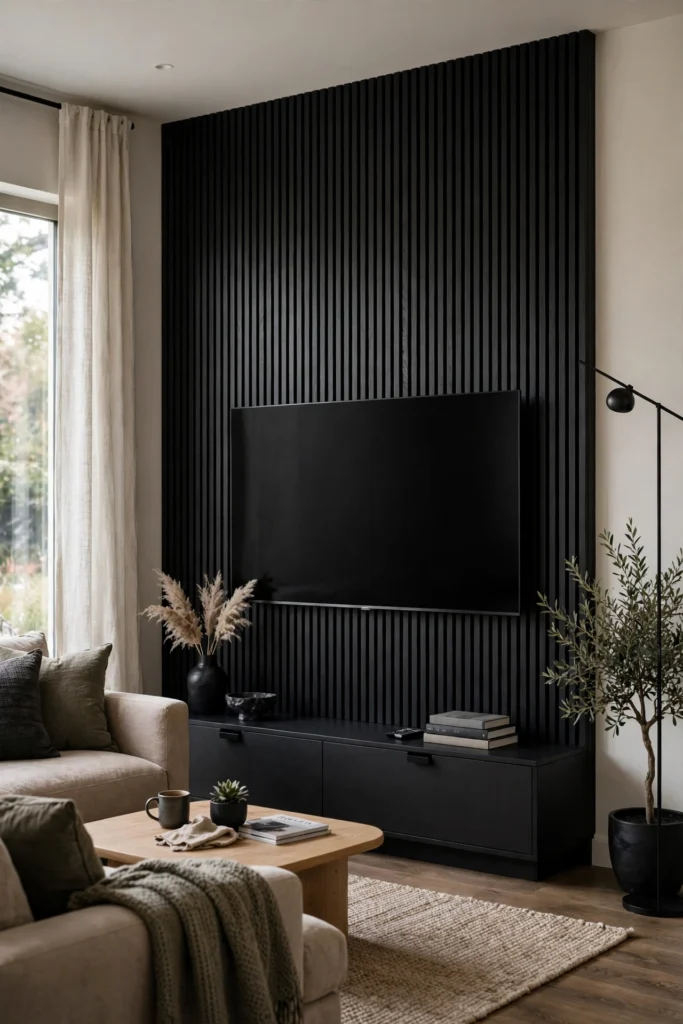
A television on a white wall is a black rectangle that dominates the room even when switched off. On a black wall it practically disappears. Mount the TV so its centre sits at eye level from your sofa, usually around 105 to 115 cm from the floor for a standard sofa, and keep cables hidden in a trunking channel painted the same black.
The mistake here is leaving the wall completely bare around the screen. Flank the TV with a low media console in wood, a pair of sconces, or one tall plant to give the wall scale. A soft light behind the television, a bias light strip, also reduces eye strain in a dark room. For more ways to style this wall, these black TV wall ideas cover lighting layouts and console pairings in detail.
12. Black Wall in a Home Office
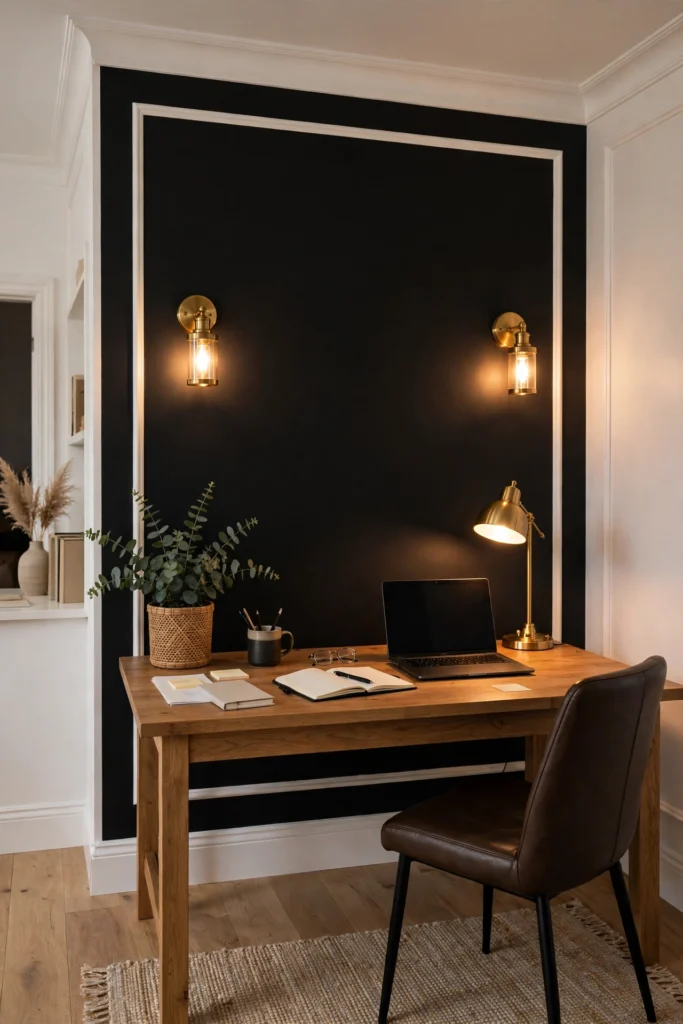
A black wall behind your desk is one of the smartest uses of the colour. On video calls you appear against a clean, dark background instead of a cluttered room, and the wall hides cables and shelving shadows. Keep the desk itself light, pale wood or white, so your workspace does not turn into a dark corner you avoid.
Task lighting is critical. A desk lamp with a warm bulb aimed at your work surface, plus one wall washer or sconce on the black wall, will keep the space usable after dark. Avoid placing your monitor facing a window, because the contrast between bright daylight and a black wall behind you causes eye fatigue. A matte finish is the right choice here, since any sheen will catch the monitor’s glow.
13. Black Wall With Stone or Brick Texture
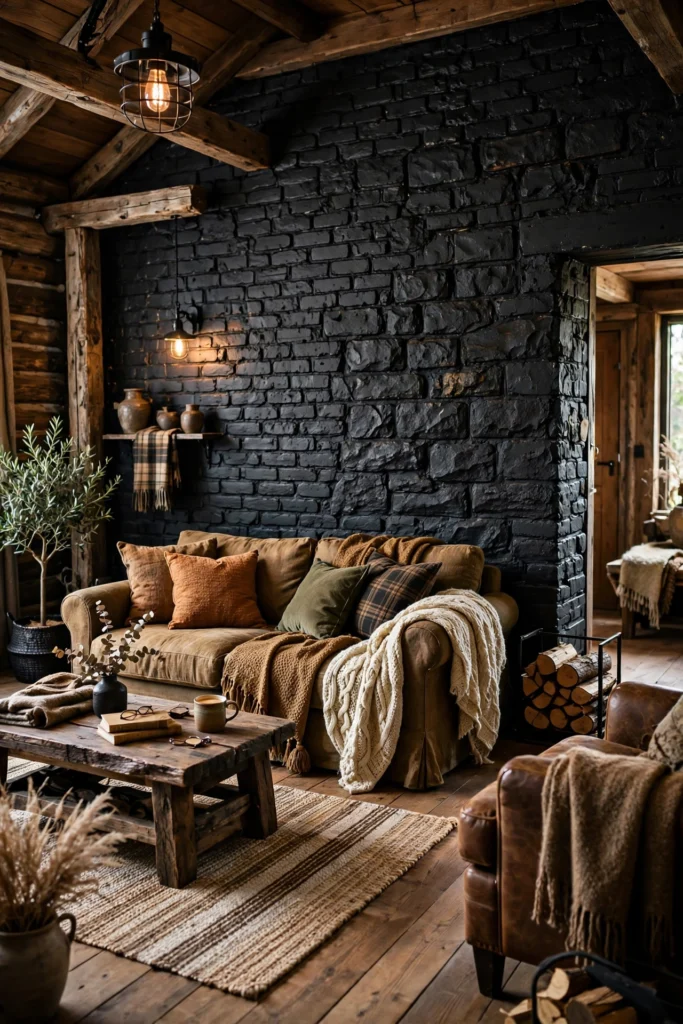
Black painted brick or a black stone clad wall adds the texture that flat paint cannot. The mortar lines or stone joints catch shadows, so the wall reads as a material rather than just a colour. Painted brick is the simpler route: clean the brick, use a masonry primer, and apply two coats with a thick roller worked into the mortar joints.
Do not paint brick that is damp, crumbling or in a fireplace that is still used for real fires, since heat and moisture will ruin the finish. For a cleaner look, thin stone veneer panels give the same depth without the weight of real stone, but they need a flat, solid wall to fix to. Leave the texture as the star and keep furniture and art in front of it minimal.
14. Black Paired With Natural Wood Tones
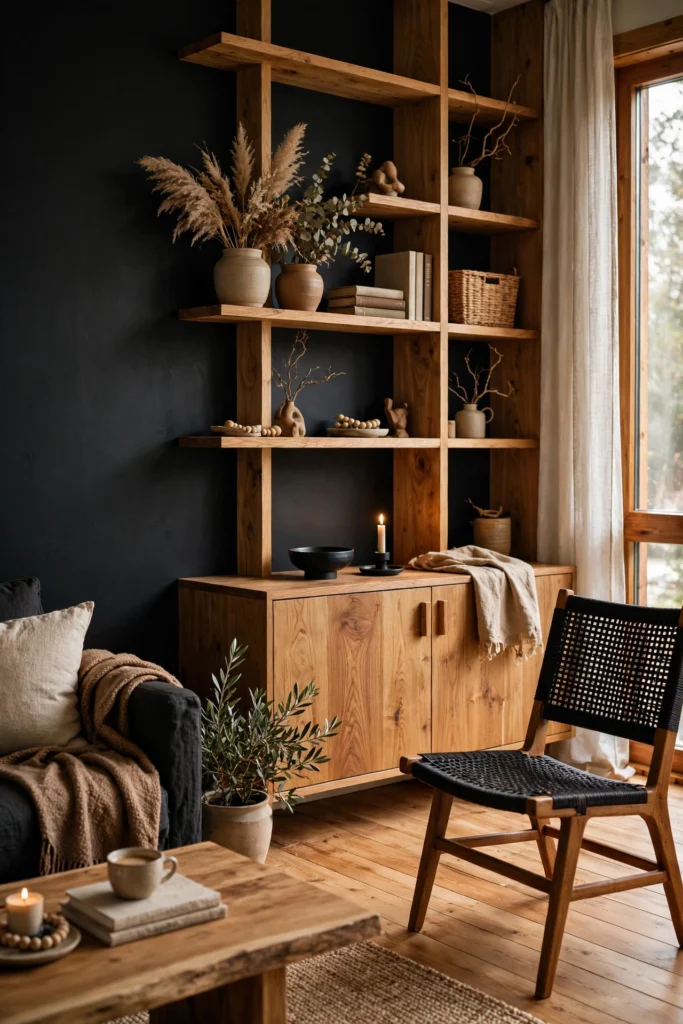
If black ever feels too cold in your home, wood is the fix. Oak, walnut and warm pine all soften black instantly, because their grain and warm tones break up the flat colour. A wooden bed frame, a live edge shelf or a rattan chair in front of a black wall gives the room a natural anchor that paint alone cannot provide.
Mixing wood tones is fine, but keep them in the same warm family. A cool grey washed wood next to a warm walnut can clash, while two warm woods sit together happily. If your room already leans soft and layered, this grey boho living room guide shows how natural textures and muted colour keep a dark backdrop feeling relaxed rather than severe. Add plants too, because green against black and wood is one of the easiest colour combinations to get right.
15. Black Accent Wall in a Small Powder Room
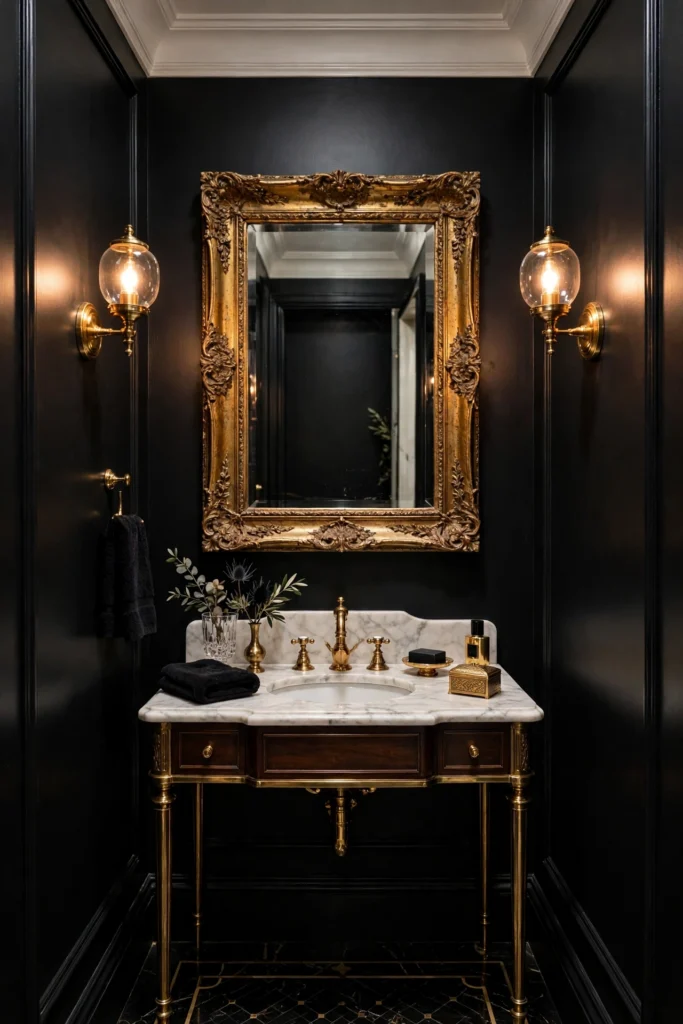
A powder room is the one small space where black works without apology. Guests spend minutes there, not hours, so the drama lands without the fatigue. Paint the wall behind the mirror black and keep the other walls pale, or go all in and paint the whole room if it has good lighting and a large mirror to bounce light around.
Fixtures matter more here than in any other room. A white basin, a brass tap and a mirror with a warm backlight will shine against black, while dark fixtures will disappear. Use a satin or semi gloss finish in a bathroom, because steam and splashes will mark a flat finish quickly. Ventilation matters as well, so make sure the extractor fan actually runs, or moisture will sit on the paint.
16. Black Wall as a Gallery Backdrop
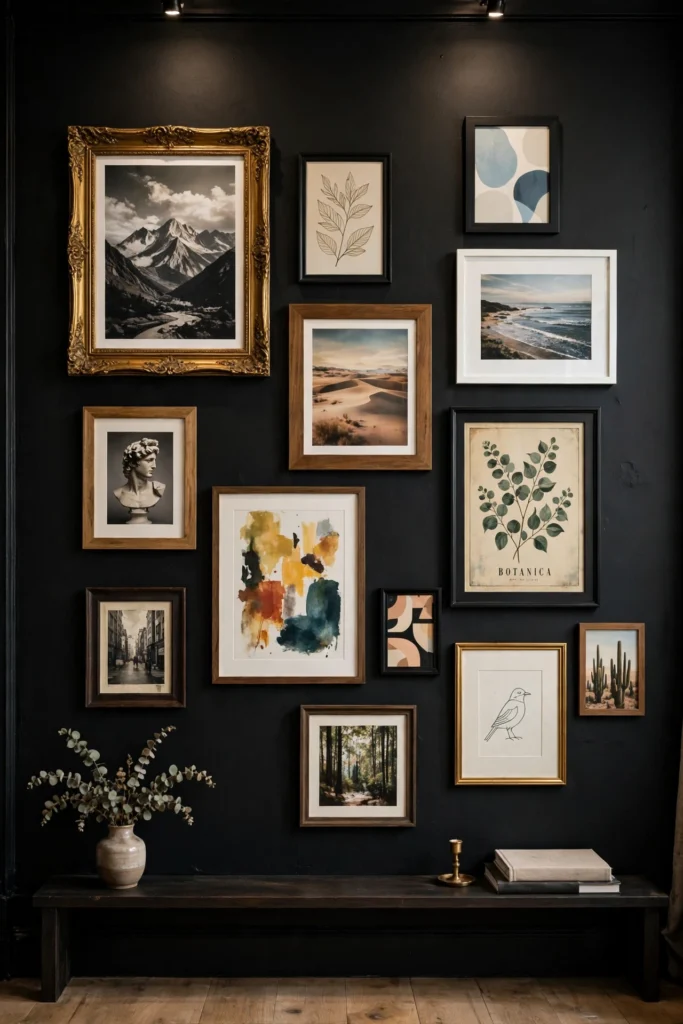
Art galleries paint their walls dark for a reason, and the same trick works at home. Black makes white mounts, light frames and colour photographs stand out, so even modest prints look considered. Use one frame style throughout, either all black, all white or all natural wood, because mixed frames on a black wall look scattered rather than collected.
Plan the arrangement on the floor first, then transfer it to the wall with paper templates taped in place. Hang the centre of the arrangement at eye level, around 145 to 150 cm from the floor, and keep a consistent gap of 5 to 8 cm between frames. Picture lights or a track light aimed at the wall will finish the gallery look. If you are styling the wall above a sofa, these above couch wall decor ideas help with sizing art to the sofa, since a gallery that is narrower than the sofa always looks lost.
17. Black Wall Layered With Metallic Textures
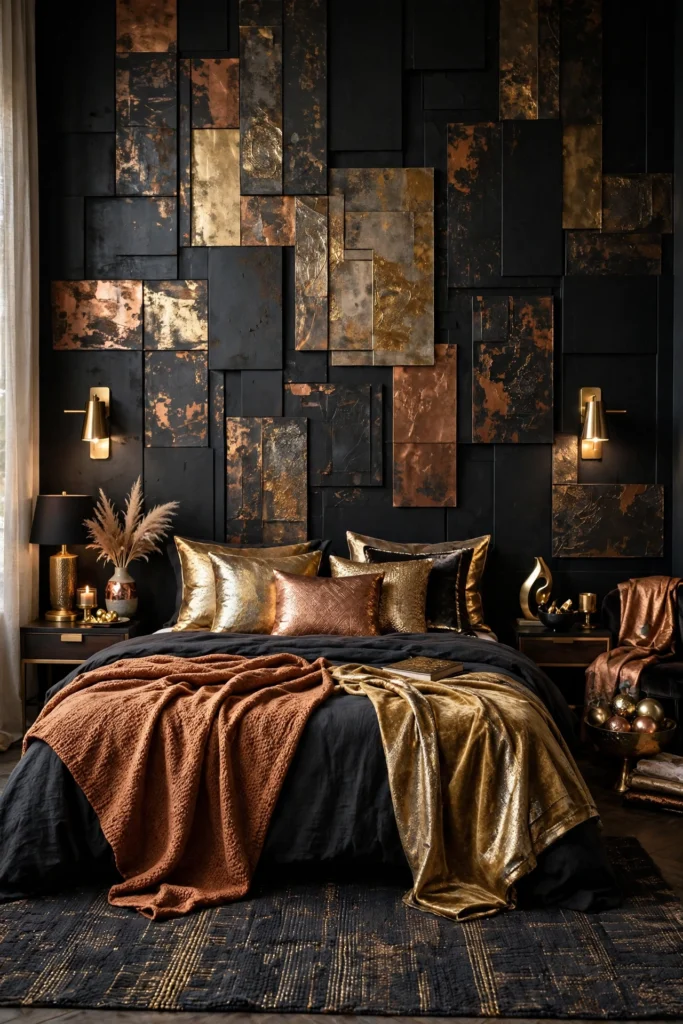
Metallic finishes on black behave like light itself, they catch the eye and move it around the room. A hammered metal panel, a brass grille or a set of copper planters will all glow against matte black. The rule is the same as with gold accents: choose one metallic family and repeat it, rather than mixing brass, copper and chrome in the same view.
Placement is what stops metallic texture looking like clutter. One large metallic piece, a mirror with a brass frame or a metal wall sculpture, reads as deliberate. Ten small metallic objects read as a collection that got out of hand. Keep metallic pieces where a lamp or window light will hit them, because metal in shadow against black simply disappears.
18. Two Tone Black Wainscoting
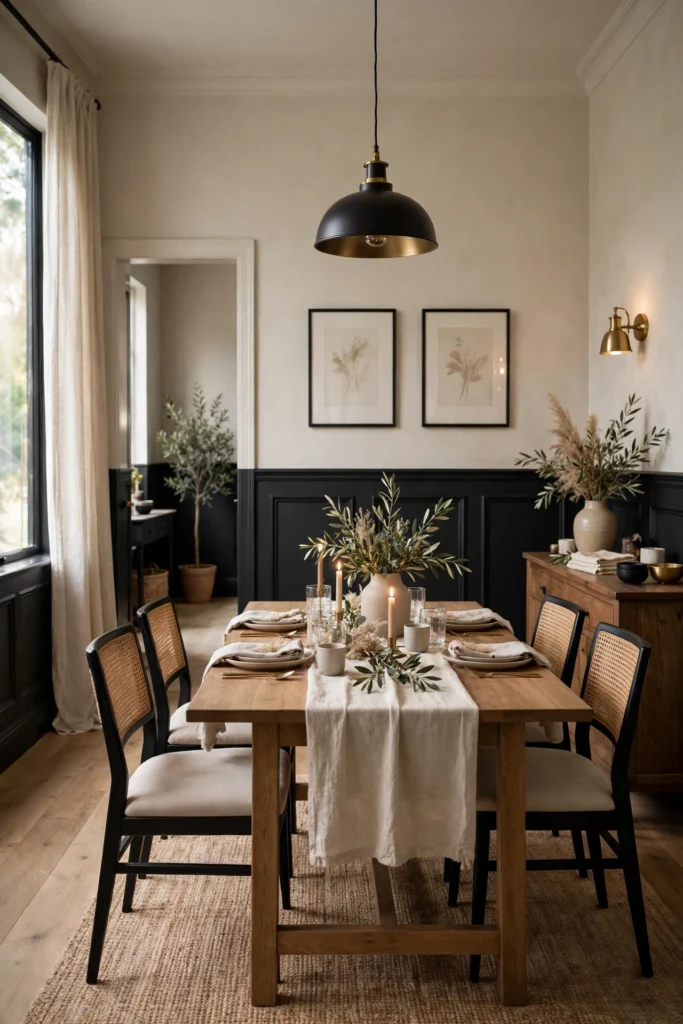
Two tone wainscoting gives you the drama of black without committing the whole wall. Paint the lower third, usually up to 85 to 95 cm, in black, and keep the upper wall pale. A chair rail or a simple trim strip hides the join and makes the split look built in rather than improvised. This treatment suits hallways, dining rooms and bedrooms with traditional or transitional furniture.
The split height matters. Too low and it looks like a skirting board that grew, too high and it chops the room in half. A good test is to tape the line at 90 cm and live with it for a day before you paint. Use a satin finish on the lower section, because it takes knocks from chairs, feet and vacuum cleaners far better than flat paint.
19. Black Accent Wall in a Teen or Kids Room
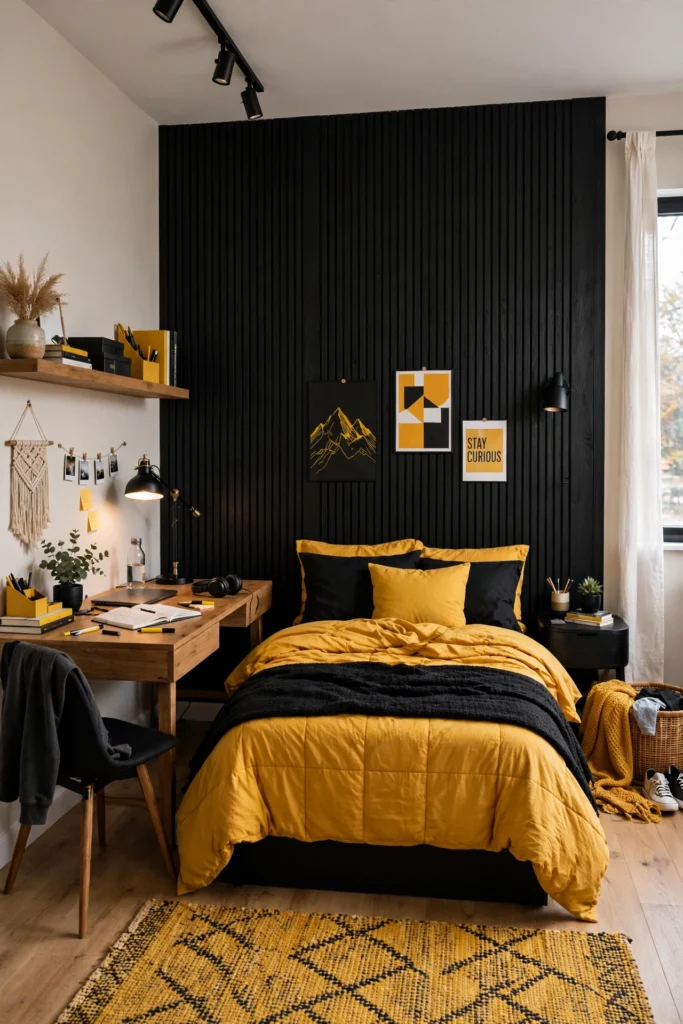
Teen rooms are a natural home for black, because teenagers tend to want a room that feels like their own rather than a guest room. A chalkboard black wall takes it further, giving a surface for notes, drawings and posters that can change weekly. Use proper chalkboard paint rather than ordinary matte black if you want to write on it, and season the surface by rubbing chalk over it once before first use.
Balance is still needed. Keep bedding, rugs and desk accessories in bright or pale colours so the room does not feel gloomy during homework hours. A washable matte or eggshell finish will survive far longer than flat paint in a room that gets daily use. Let the teenager choose the art and posters for the wall, since a black wall they helped style is one they will actually keep tidy.
20. Black Wall With Greenery Accents
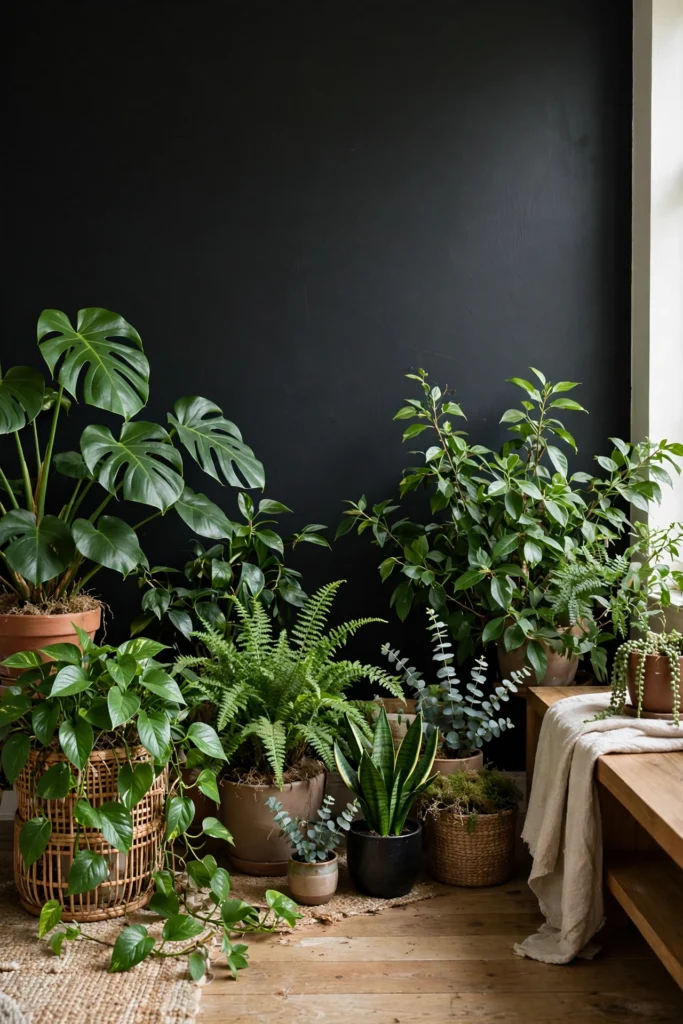
Green leaves against a black wall are one of the strongest colour pairings in interior design, because the contrast makes both colours look richer. A tall fiddle leaf, a trailing pothos on a shelf or a cluster of potted plants in front of the wall will do more for the room than any ornament. The key is scale: one large plant beats five tiny pots lined up on a windowsill.
Choose plants that suit your light honestly. A black wall in a north facing room will not keep a sun loving plant alive, so pick a pothos, a snake plant or a ZZ plant for low light instead. Group plants at different heights, one on the floor, one on a stool or stand, one trailing from a shelf, so the greenery forms a shape rather than a row. When the sofa sits against a black wall, a deep seat and soft cushions keep the corner inviting, and these comfortable sofa ideas show which shapes and fabrics hold up best in a dark living room.
Mistakes That Make a Black Wall Look Flat
The most common mistake is painting the wrong wall, usually the one with the most doors or the one you never look at. The second is skipping the primer, which leaves a patchy finish that shows through even after two coats. The third is lighting the room from above only, which turns the black wall into a dark hole once the sun goes down.
Other mistakes are easier to avoid once you know them. Do not pair a black wall with all black furniture, because the furniture loses its shape. Do not hang small art alone on a large black wall, because it looks lost; either go bigger or group pieces together. Do not choose a cool daylight bulb for a black room, since blue toned light makes black look grey and cold. And do not paint in a rush on an unprepared wall. Black shows roller marks, drips and missed patches more honestly than any pale colour, so the prep work is the project.
Questions About Black Accent Walls
Does a black accent wall make a room look smaller?
Not necessarily. A single black wall reads as further away than a white wall, so it can add depth rather than shrink a room. The room feels smaller only when several walls are black, the lighting is poor, or the furniture is dark as well. Keep the other walls light, add warm layered lighting and choose pale or wooden furniture, and a small room will usually feel deeper, not tighter.
What paint finish is best for a black accent wall?
Matte or flat is the safest choice for bedrooms and ceilings, because it hides wall flaws and gives a velvety look. Eggshell is a good middle ground for living rooms, since it wipes clean more easily while still looking soft. Satin and semi gloss suit trim, doors and bathrooms, but they show every dent and roller mark, so only use them on a wall that is in excellent condition.
Which wall should I paint black?
Paint the wall your eye lands on first when you enter the room. In a bedroom that is the wall behind the headboard, in a living room the fireplace wall or the wall behind the sofa, and in an office the wall behind your desk. Avoid walls crowded with doors, and avoid the wall directly opposite a large window if glare will wash the colour out in daylight.
How do I light a room with a black accent wall?
Layer at least three light sources at different heights, and use warm white bulbs around 2700K to 3000K. One ceiling light on a dimmer covers general light, a lamp at seating height adds warmth, and one accent light aimed at the wall itself, such as a sconce, picture light or LED strip, stops the black looking flat after dark. Dimmers make the biggest difference, because you can adjust the mood instead of living with one fixed brightness.
Can renters have a black accent wall?
Yes, with peel and stick wallpaper. Choose a subtle pattern or texture rather than a flat black sheet, and apply it to a smooth, primed wall for clean removal later. Test a small piece in a hidden corner first and leave it for a week, so you know it will come off without pulling paint. Avoid textured plaster and freshly painted walls, which are the two surfaces that cause problems.
What colours go with a black accent wall?
Warm neutrals are the easiest partners: cream, oatmeal, camel and natural wood all soften black without fighting it. Brass and gold add warmth and a touch of glamour, while sage green and dusty terracotta work well for a softer, earthier room. Green plants are almost always a good idea. Avoid pairing black with too many other dark colours, or the room loses contrast and starts to feel heavy.
Try the Tape and Light Test Before You Paint
Before you buy a full tin of paint, buy a sample pot and paint a square about 60 cm across on the wall you have chosen. Live with it for three or four days and look at it in morning light, evening light and lamplight. A black that looks soft and warm at noon can turn cold and blue under a daylight bulb at night, and the sample square is the cheapest way to find out.
While the sample is up, tape the outline of your planned art, mirror or shelving on the wall with painter’s tape. Step back and check the scale from the doorway. This ten minute test catches the two most common regrets, a black that is the wrong temperature and art that is too small for the wall, before either one costs you a weekend. Once the sample passes the test in all three lights, you can paint with confidence, knowing the wall will look rich in the morning and just as good after dark.