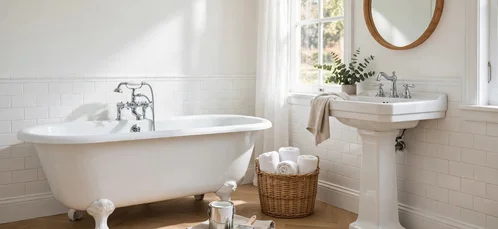
The mistake I see most often: too much black in a windowless room
I love a black bathroom. I also know how quickly one can go wrong. The version that goes wrong usually starts with good taste and a strong photo. Someone sees a large bathroom with tall windows, black walls, a black vanity, black floor tile, and a black framed shower screen, and they try to copy the whole look into a small room with no window at all. The photo had daylight doing half the work. The copy has a single ceiling light and four dark walls closing in.
Black does not make a room feel smaller all by itself. A small amount of black, placed where your eye expects a frame or an edge, can actually make a white room feel sharper and more finished. The problem starts when black covers the largest surfaces in a room that has little light to bounce back. White tile, white paint, and a white ceiling send light around. Black paint and matte black tile soak it up. In a windowless bathroom, that difference shows up fast. The room can feel dim even with the light on, and the mirror can feel like the only bright spot left.
There is a simple test I use before anyone buys paint or tile. Stand in the bathroom at night with the usual light on and look at the wall opposite the door. That is the wall you will see every time you walk in. If that wall goes black in a room with no window, you need a clear plan for the rest of the room: a lighter floor, a large mirror, brighter task lighting at the mirror, and white on at least two other surfaces. If you cannot add those things, keep the black off that wall. Put it lower down, or on a smaller surface, where it reads as an accent instead of a lid on the room.
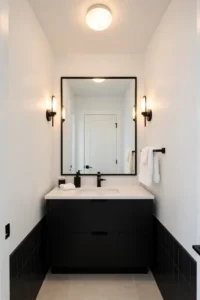
Short answer: in a windowless bathroom, keep white on most of the walls and ceiling and use black for the vanity, the mirror frame, the hardware, and one lower or smaller surface. Save large black walls for rooms with good daylight or strong layered lighting.
That one decision, how much black and where, matters more than the exact shade of white or the exact faucet you pick. Get the ratio right first. Then the floor, the walls, the fixtures, and the towels all fall into place, because each one is either carrying the white side of the room or the black side. The rest of this guide follows that order. We will set the ratio, then work surface by surface, then fix the lighting, because lighting is what lets black look rich instead of flat.
Pick your black to white ratio before you buy anything
Designers often talk about a room in parts, and black and white bathrooms are a good place to use that habit. Think of white as the room itself: the walls, the ceiling, the tub, the sink, and the large stretches of tile. Think of black as the outline: the vanity, the frame, the faucet, the grout lines, the towel rail, and one feature surface. When white carries the room and black draws the outline, the bathroom stays bright and still looks bold.
The table below is a starting point, not a rule written in stone. Use the row that matches your bathroom most closely, then adjust by one step if you love drama or if you prefer a quieter room. Light matters as much as size. A small bathroom with a large window can carry more black than a larger bathroom with a tiny frosted window high on one wall.
| Bathroom type | White share, as a starting point | Black share, as a starting point | Where the black works best |
|---|---|---|---|
| Small, no window | Most of the room | Accents only | Vanity, mirror frame, hardware, dark grout, one low wall band |
| Small, one good window | Most of the room | Accents plus one feature | Vanity and one feature wall, or a patterned floor, but not both at full strength |
| Medium, average daylight | About two thirds | About one third | Vanity, floor pattern or feature wall, fixtures and frames |
| Large, bright, with windows | About half to two thirds | About one third to half | Feature wall, black vanity, dark floor tile, framed shower screen |
| Powder room, guests use briefly | Can go darker | Can go darker | One bold wall works here because nobody spends long in the room |
Notice what the table leaves out. It does not put black on every surface at once. A black floor plus a black feature wall plus a black vanity plus black fixtures is a lot of black competing for attention. Pick one hero surface, the floor or the feature wall, and let the other black pieces be smaller and quieter. That is how the room keeps one clear focal point instead of four.
If you are still working out the layout, not just the colors, it helps to look at full rooms before you commit to a ratio. These dream bathroom designs for small and large spaces show how the same palette behaves very differently when the room size changes, and they are a useful check against copying a large room look into a small one.
Start at the floor, because it sets the mood
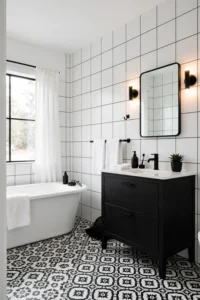
The floor is the first surface your eye lands on when you walk in, and in a black and white bathroom it does more work than people expect. A checkerboard floor is the classic choice, and it still works, but the size of the check changes the feel completely. Small checks feel busy and old fashioned in a good way, like a 1920s hotel bathroom. Large checks feel calmer and more modern, and they suit a bigger room. In a small bathroom, I lean toward a medium check or a simple pattern with plenty of white in it, so the floor reads as a pattern rather than a dark slab.
Large format tiles are the other strong option. A large white tile with dark grout, or a large black tile mixed with white in a simple layout, gives you fewer grout lines and a cleaner look. Fewer lines means less visual noise, which helps a small room feel less crowded. If you choose a dark floor, pick a tile with a little variation in it, a soft mottled finish or a matte stone look, rather than a flat solid black. Solid glossy black shows dust, hair, and water spots in a way that a slightly varied tile forgives. That one choice can decide whether you enjoy the floor or spend your weekends chasing marks on it.
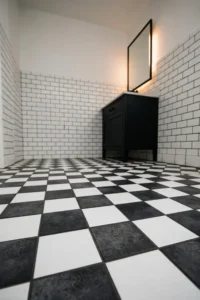
Grout deserves the same attention as tile. White grout with white tile looks soft and seamless, but in a wet room it can be hard to keep bright, especially on the floor. Dark grout with white tile draws a clear grid and hides dirt far better, and it is one of the cheapest ways to make plain white tile look intentional. The catch is the reverse: black grout next to white tile can stain the tile edges during fitting if the installer is not careful, so ask your tiler how they protect white tile when they grout dark. Sealed grout and a careful clean up make a real difference here, and it is worth asking about before the work starts, not after.
A patterned floor tile can also act as a rug. In a larger bathroom, a bold black and white pattern in the middle of the floor, with plainer tile around it, draws the eye to the tub or the vanity and gives the room a center. In a small bathroom, keep the pattern across the whole floor instead of cutting it into zones. A small room does not need zones. It needs one steady pattern that lets the eye travel without stopping at every edge.
Then the walls, where most black and white bathrooms are won or lost
Walls are where the ratio decision becomes visible, so take them one wall at a time. Start with the shower wall and the mirror wall, and keep those mostly white unless your room is large and bright. White subway tile with dark grout is popular for a reason: it is simple, it reflects light, and the dark lines give it shape so it does not look flat. Lay it in a straight stack for a modern feel, or in a brick pattern for a softer classic feel. Both work. The brick pattern hides small unevenness in older walls a little better, which matters in a house that is not perfectly square.
Half tiled walls are a practical middle ground. Tile the lower half, paint the upper half white or a soft warm white, and you get the waterproofing where you need it and an easy repaint later when you want a change. The line where tile meets paint becomes a design detail in itself, so finish it cleanly with a trim tile or a slim black metal strip. A messy tile edge at waist height draws the eye for all the wrong reasons.
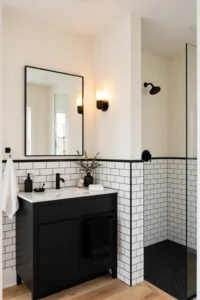
For the feature wall, pick one wall only, and pick it with the door in mind. The wall you see first when you walk in is the natural feature wall. The wall behind the door is not. A black feature wall behind a freestanding tub can look striking, because the white tub stands out against it like a shape cut from paper. A black feature wall inside the shower can work too, if the rest of the shower stays light and the glass screen stays clear rather than framed in heavy black on every side.
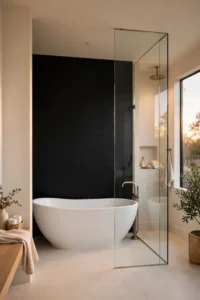
If a full black wall feels like too much, a black accent wall done well is still worth studying before you commit. These black accent wall ideas show how a single dark wall, a paneled wall, or a dark alcove can give a room a focal point without painting every wall dark, and several of the ideas translate directly to a bathroom feature wall.
Paint shade matters more than paint brand here. A pure bright white looks crisp and modern next to matte black, but it can feel cold under cool lighting. A warm white, with the faintest hint of cream in it, softens the room and makes white towels and white porcelain look less stark. Test both on the wall, not on a tiny card. Paint two large patches, live with them for a day, and look at them in morning light and in evening light. White paint changes more than any other color when the light changes, and a shade that looks perfect at noon can look grey or yellow at night.
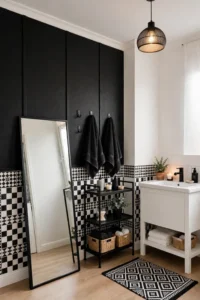
Renters, and anyone who does not want to repaint, have good options that do not touch the walls at all. Removable tile stickers, a large leaning mirror with a black frame, and dark accessories can suggest a black wall without creating one. If drilling is off limits, there are still plenty of ways to get the look. These apartment bathroom decorating ideas without drilling cover renter friendly fixes that work well in a black and white scheme, from adhesive hooks to freestanding storage that adds black without a single hole.
Fixtures are the jewelry, but they should also be easy to clean
Once the floor and walls are settled, fixtures are where the room gets its character. Matte black faucets are the most popular choice right now, and they look sharp against a white sink. They also show water spots up close, so if your water is hard, plan on a quick wipe after use or pick a finish that forgives spots a little better. Brushed black, or a black faucet paired with a chrome shower head, can be easier to live with than a full matte black set in a hard water home. There is no rule that every fitting must match. Matching looks tidy, but mixing two finishes on purpose, for example black faucets with chrome towel rails, often looks more like a real home and less like a showroom.
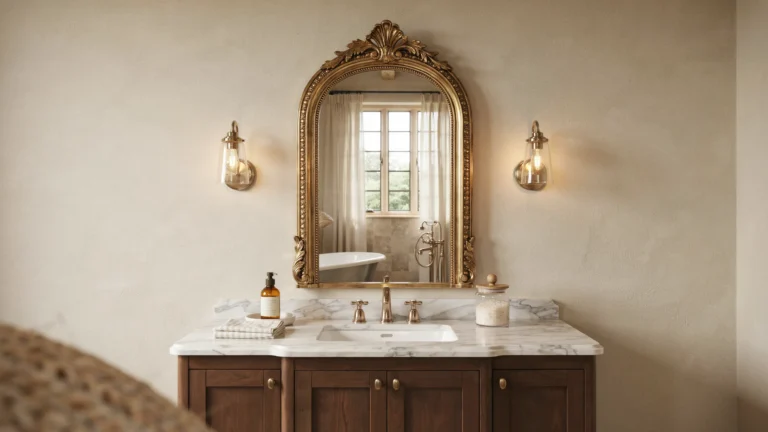
A warm metal is the simplest way to stop black and white from feeling cold. Brushed brass or gold hardware on a black vanity, a brass mirror frame, or brass sconces add warmth without adding a new color to manage. Keep the warm metal to two or three pieces. A whole room of brass starts to compete with the black and white story. Two or three warm pieces read as a deliberate accent. Ten read as a different palette altogether.
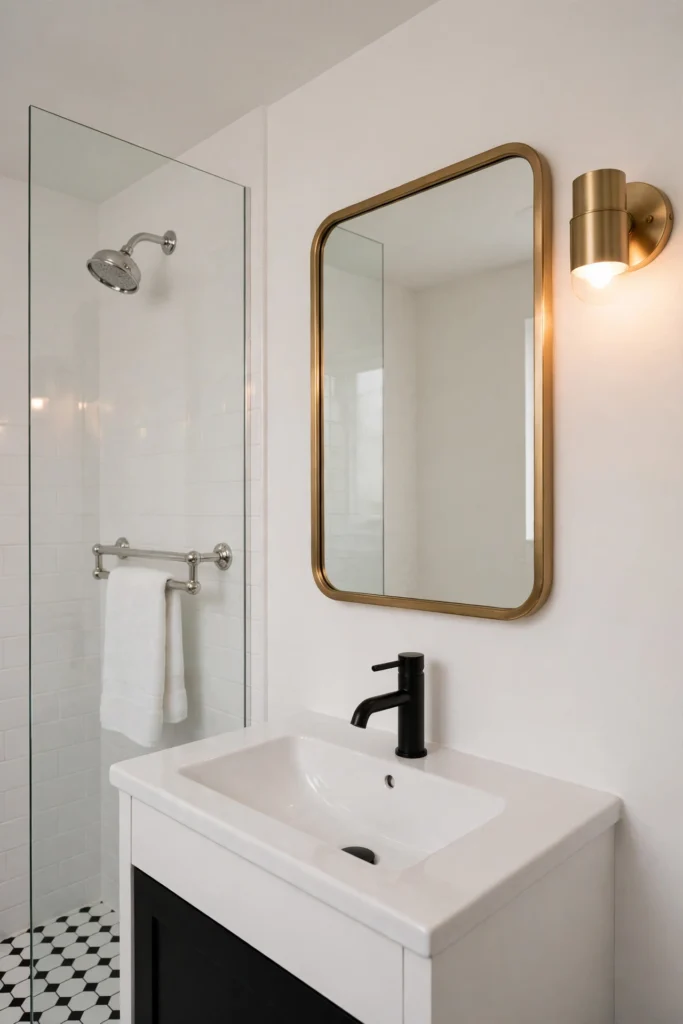
The vanity is the anchor. A black vanity with a white countertop is the classic pairing, and it works because it repeats the room ratio in miniature: dark base, light top. A floating vanity, fixed to the wall with the floor visible beneath it, makes a small bathroom feel larger because you can see more floor. It also makes cleaning easier, since a mop can pass underneath. The trade off is storage. A floating vanity usually holds less than a floor standing cabinet, so check what you actually store before you fall for the look. If you have a lot of bottles and cleaning supplies, a floor standing vanity with a black finish may serve you better, and it can still look modern with simple flat doors and slim black handles.
Sinks follow the same logic. A white porcelain basin on a black vanity is clean and easy to read. A black basin on a white countertop is bolder and shows toothpaste and soap marks more clearly, so it suits a guest bathroom or a household that wipes down often. An integrated sink, molded into the countertop with no rim to catch grime, is the lowest maintenance choice of all, and in a black and white room its smooth surface keeps the eye moving instead of stopping at every edge.
Toilets and tubs are mostly white in this palette, and that is a strength. A white freestanding tub against a dark wall, or a white tub with black feet, becomes a shape in the room rather than just a fixture. A wall hung toilet, with the tank hidden in the wall, leaves more floor visible and suits a modern black and white room well, but it needs proper wall support and access for repairs, so it is a job to plan with a plumber, not a weekend swap. A standard close coupled toilet in white, paired with a black seat or black flush plate, can give you most of the look with far less work.
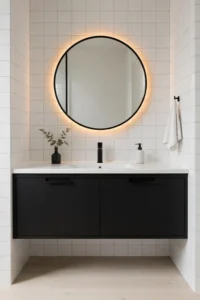
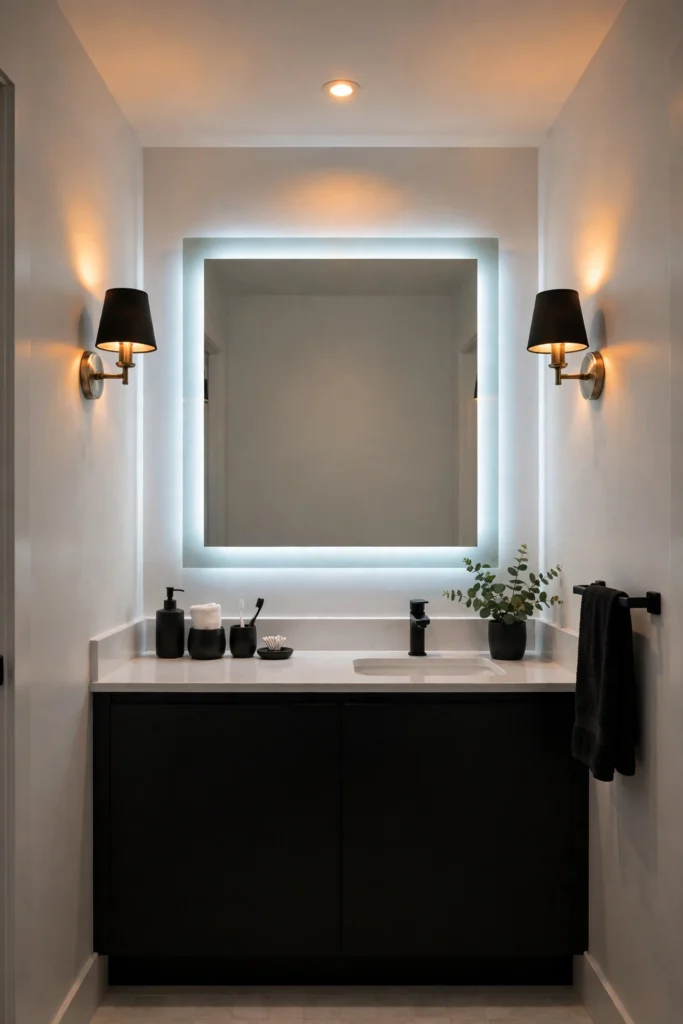
Mirrors deserve a paragraph of their own, because in a black and white bathroom the mirror is doing two jobs: it is a design piece and a light source. A round mirror with a thin black frame softens all the straight lines of tile and cabinetry. A rectangular mirror with a black frame repeats the vanity shape and feels more formal. Either way, size matters. A mirror that is a little narrower than the vanity looks balanced. A mirror much wider than the vanity can crowd the wall, and a tiny mirror over a wide vanity looks lost. Backlit mirrors add a soft glow that flatters faces and lifts a dark wall, and they are worth considering in a windowless room where the mirror light is doing extra work.
When the fixtures are settled, step back and check the warm side of the room. Black and white can feel crisp to the point of cold, and a little natural material fixes that fast: a wooden stool by the tub, a wooden tray on the vanity, or open wooden shelves for rolled towels. Wood is not a third color to manage. It is a texture that warms the contrast. For a broader sense of how warm and cool tones sit together in a home, these interior color trends for cozy homes are a useful reference, because they show how small warm touches keep a high contrast room feeling lived in rather than staged.
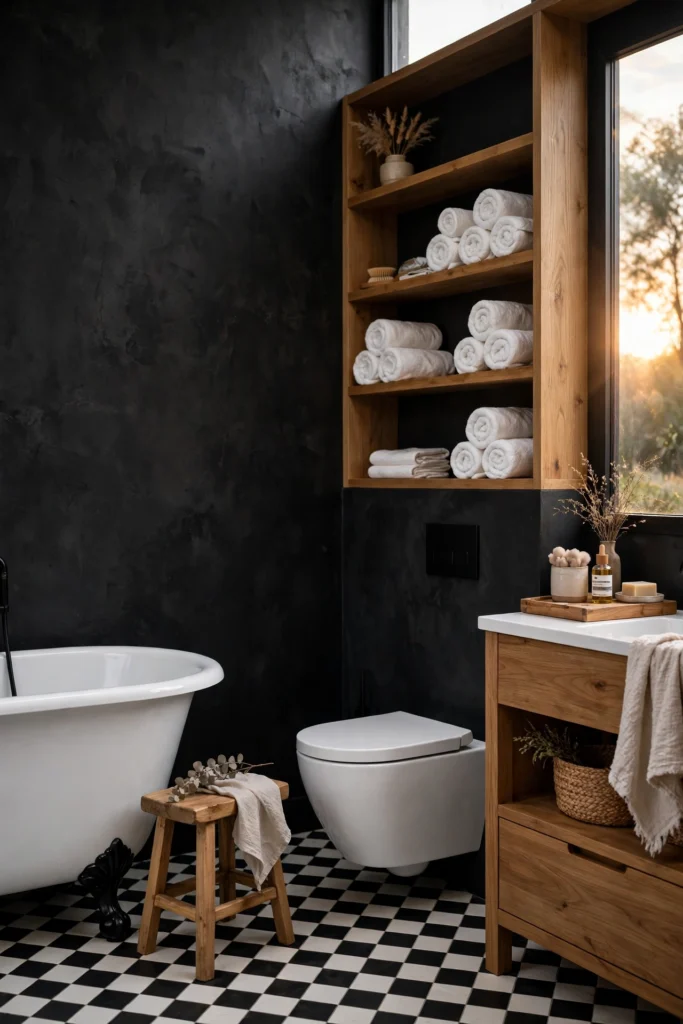
Textiles are where a hard room turns soft
A bathroom is mostly hard surfaces: tile, glass, porcelain, metal. Textiles are the only soft thing in the room, so they carry more weight than their size suggests. In a black and white bathroom, texture matters more than pattern. A thick white towel, a waffle weave hand towel, and a soft bath mat can make the same room feel like a hotel bathroom or a spare utility room, depending on how they are chosen.
Start with towels. White towels look fresh and make a black vanity or a black towel rail stand out. Charcoal towels anchor a mostly white room and hide marks better, but they need to be a true charcoal rather than a faded black, or they can look tired after a few washes. The practical answer for most households is both: white bath towels for the main use, and a darker hand towel or two for contrast. Keep the towel colors to those two, white and charcoal, and let texture do the talking. A mix of five towel colors in a black and white room is the fastest way to break the palette without meaning to.
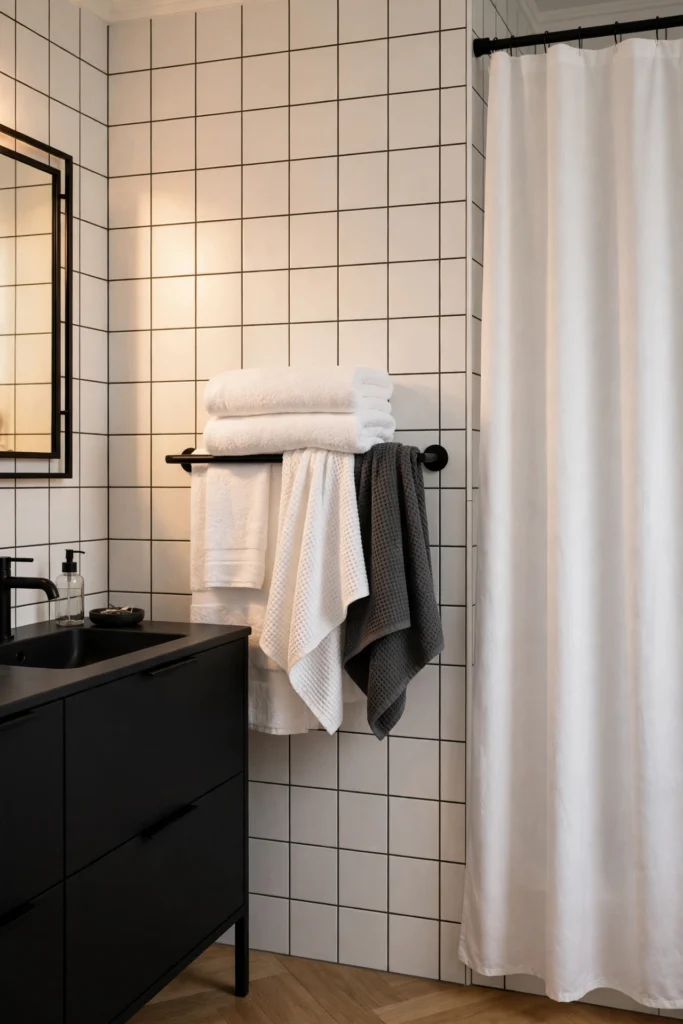
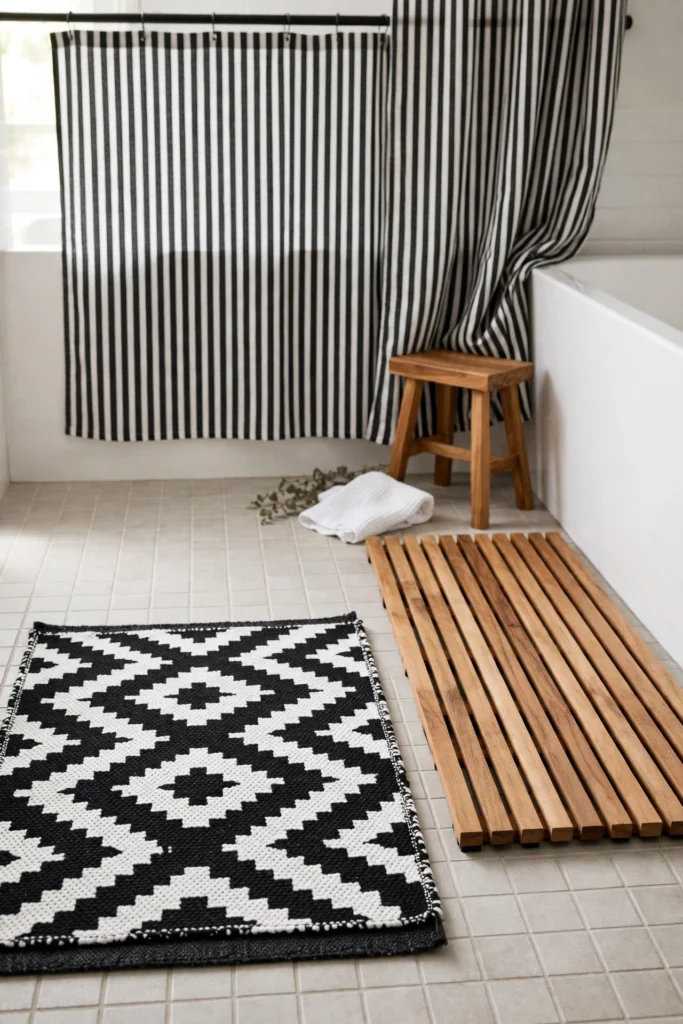
The bath mat is a small surface with a big job. A woven mat in a black and white geometric pattern adds personality without a new color. A plain white mat looks clean for about a week and then shows every mark, so in a busy family bathroom a patterned or charcoal mat is often the kinder choice. If you prefer a wooden bath mat, a slatted teak style mat adds warmth and dries fast, and it pairs well with the wooden stool or tray mentioned earlier. Whatever you pick, make sure it stays put. A mat that slides on a tiled floor is annoying every single day, and a non slip backing is worth more than a pretty pattern.
The shower curtain, if you have one, is the largest textile in the room. A plain white curtain keeps a small bathroom bright. A black and white striped or geometric curtain becomes a feature wall that you can change in minutes. That changeability is the point. A curtain is the cheapest way to test a bolder pattern before you commit to tile or wallpaper. If you love the bold curtain after a month, you may love a bold floor. If you tire of it, you have spent very little to learn that.
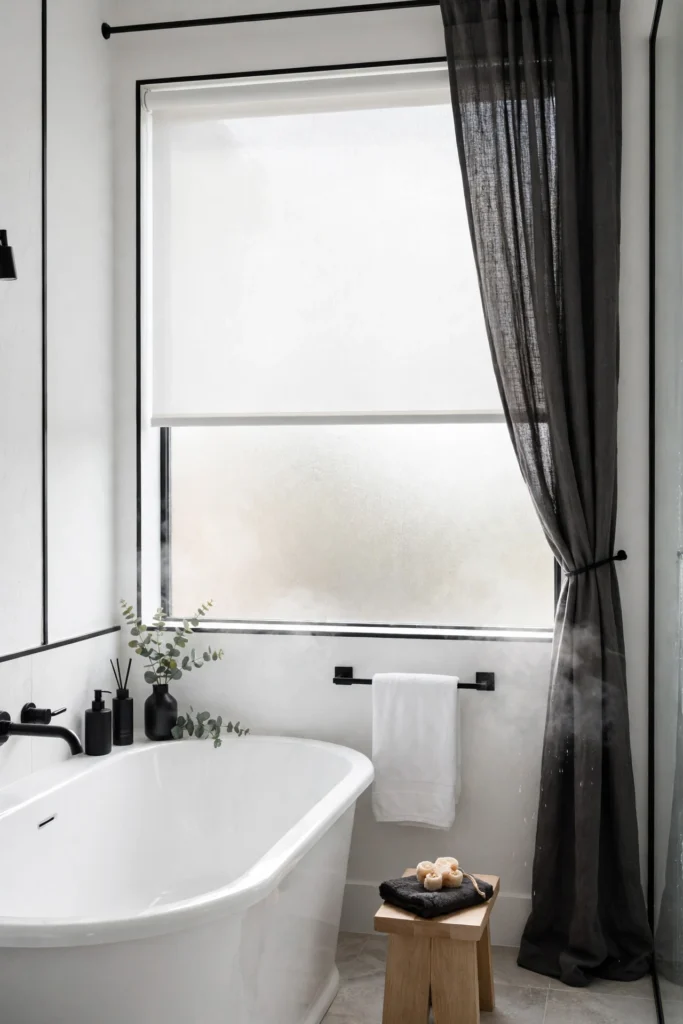
Window fabric in a bathroom has to handle steam and privacy at the same time. A sheer white roller blind lets daylight through while keeping the room private, and it suits a black and white room because it adds no new color. A heavier linen curtain in charcoal can frame a large window beautifully, but it needs room to hang without touching wet surfaces, so it suits a larger bathroom with a freestanding tub far from the shower. In a small bathroom, keep window fabric simple, light, and easy to clean. Frosted glass plus a simple blind is often the most practical pairing of all.
Light is what makes black look rich instead of flat
This is the section to read twice if your bathroom has no window. Black surfaces absorb light instead of bouncing it back, so a black and white bathroom needs more thought about lighting than an all white one. That does not mean brighter bulbs everywhere. It means light in the right places, at the right height, with a way to dim it when you want a calmer evening bath.
Start at the mirror, because that is where you actually use light. Sconces on either side of the mirror, at about eye level, give even light on your face without harsh shadows. A single light above the mirror casts shadows downward and makes grooming harder. If you only have one fixture, a wide bar light above the mirror is better than a single small spot, and a mirror with built in lighting is better still. Keep the mirror light close to natural daylight in tone, so makeup and shaving look right, while the rest of the room can be a little warmer and softer.
Next, add ambient light for the room itself. A ceiling light on a dimmer is the workhorse here. Bright for cleaning and morning routines, softer for an evening bath. If your ceiling is high enough, a black pendant or a simple glass pendant over a freestanding tub can act as a feature and a light source at once. Keep pendants out of the splash zone and away from where heads pass, and check the drop height before you buy. A pendant that hangs too low over a tub looks dramatic in a photo and gets in the way in real life.
Natural light still matters most, so do not block it with heavy window treatments. Keep window glass clear, keep blinds light in color, and keep the area around the window free of tall storage. If privacy is a worry, frosted film on the lower half of the glass keeps daylight while blocking the view, and it costs far less than a new window treatment. For ideas that balance privacy, light, and style in one window, these window treatment ideas for every room include options that work well in a bathroom, from simple roller blinds to layered treatments for larger windows.
Black and white bathroom questions, answered plainly
Can a small bathroom handle black walls?
Yes, but pick one wall, not four, and keep the other walls white. A small bathroom with one black wall, a large mirror, and a light floor can feel dramatic without feeling cramped. A small bathroom with four black walls and a single ceiling light usually feels smaller than it is. If you are unsure, start with black on the vanity and the accessories, live with that for a few weeks, and then decide if you still want a black wall.
What grout color should I use with white tile?
Dark grout with white tile is the practical choice for most bathrooms. It hides dirt, it draws a clear grid that makes plain tile look deliberate, and it ties the white tile to the black fixtures in the room. White grout looks softer and more seamless, but it needs more cleaning to stay bright, especially on floors and in showers. If you love white grout, use it on the upper walls where it stays cleaner, and use dark grout on the floor.
Do matte black faucets show water spots?
They can, especially in hard water areas. Matte black hides fingerprints better than chrome, which surprises people, but water spots show up close on a matte surface. A quick wipe with a soft cloth after use keeps them looking good. If that sounds like too much upkeep, a brushed black finish or a mix of black and chrome fittings will be more forgiving day to day.
How do I stop a black and white bathroom from feeling cold?
Add warmth through texture, not through a new paint color. A wooden stool, a wooden tray, a woven basket, and warm metal hardware in brass or brushed gold soften the contrast. Warm white paint instead of pure bright white also helps, as does warm lighting in the evening. Keep the warm pieces to a few, so the room still reads as black and white, just a warmer version of it.
Is a black floor a bad idea?
Not always, but it is the hardest black surface to live with. A solid glossy black floor shows dust, hair, and water marks more than any other choice. A patterned black and white floor, or a dark tile with variation in it, is far easier to keep looking clean. If you love a dark floor, choose a matte or slightly varied tile, keep the rest of the room light, and make sure the lighting reaches the floor rather than leaving it in shadow.
What is the cheapest way to refresh a black and white bathroom?
Start with the pieces you touch every day: new hardware on the vanity, a new mirror frame or a new mirror, fresh towels and a new bath mat, and a coat of paint on the vanity if the cabinet is sound. Those changes cost far less than retiling, and they change how the room feels every morning. Repainting a vanity black or white, swapping chrome handles for matte black ones, and adding a bold shower curtain can give you most of the refresh for a small part of a full renovation budget. Typical costs vary a lot by region and by the size of the room, so price the hardware and paint locally before you set a budget.
Start with one wall, not the whole room
If you take one plan from this guide, make it this: start with one wall, not the whole room. Pick the wall you see first when you walk in, or the wall behind the vanity, and make that your test. Paint it, tile it, or dress it with a bold curtain or a large black framed mirror, and live with it for a week. Notice it in the morning when you are half awake, and in the evening when the light is low. If it still makes you smile, you have found your feature wall. If it feels heavy, you have learned something cheap, and the rest of the room is still white and easy to adjust.
Then work outward in this order. First, fix the ratio, so white carries the room and black draws the outline. Second, settle the floor, because it grounds everything else. Third, choose the walls, one feature wall at most in a small room. Fourth, pick fixtures that are easy to clean and that repeat the ratio in miniature. Fifth, soften the room with towels, a mat, and a little wood. Last, check the lighting at night, because that is when a black and white bathroom either glows or goes flat.
Write the plan down before you shop. One line for the ratio, one line for the floor, one line for the feature wall, one line for the fixtures, and one line for the lighting. Take that list to the store and buy to the list, not to the prettiest single item on the shelf. A black and white bathroom works when every piece agrees on the same story: mostly white, black in the right places, warm touches where hands land, and light where faces and floors need it. Get that story right on one wall first, and the rest of the room will follow without a full renovation.