Where does everything actually go at 7am?
I asked myself that question on a school morning when the toothpaste was open on the counter, one towel was on the floor, another was missing completely, and my youngest was standing on tiptoes trying to reach a cup that lived on a shelf meant for adults. Nothing in that bathroom was broken. The room just had no clear answer for where things belonged when everyone was in a hurry. That is the real problem in most kids bathrooms. It is not a lack of storage baskets. It is a lack of decisions.
A kids bathroom works when a child can walk in half awake, find what they need without asking, use it, and put it back in the same spot without thinking hard. That sounds simple, and it is, but it only happens when every item has one home and that home makes sense to the child using it. If the toothbrush lives in a drawer one week, on a shelf the next week, and in a cup by the mirror the week after that, no routine can settle. Children do not fail at tidiness because they are careless. They fail because the system keeps changing or because the system was built for adult height, adult hands, and adult patience.
Give your kids bathroom four zones, sink, bath, toilet, and door, and give every item one home inside only one zone. Keep daily items where small hands can reach them, move spares and adult items out of reach, label each spot in words or pictures, and finish with a two minute reset at night. When each zone has a clear job, mornings get calmer because nobody has to search, argue, or improvise.
This guide uses zones instead of themes or shopping lists. You will not find a long list of products to buy first. You will find a way to sort what you already own, place it where it gets used, and keep it there. Work through the zones in order. Start with the sink because that is where the morning rush happens. Then sort the bath, then the toilet area, then the door and towels. The last part covers labels and routines, because a neat bathroom on Sunday means little if Monday morning pulls it apart again.
Before you move anything, take a quick look at the whole room with fresh eyes. Stand in the doorway at your child’s height if you can, or just crouch for a moment. Notice what is too high, what is hidden behind a door, and what is sitting out because it has nowhere else to go. Those three clues tell you most of what needs to change. A cup that is always left on the counter usually means the drawer is too full or too hard to open. Towels on the floor usually mean the hook is too high, too full, or too far from the shower. Bath toys all over the tub usually mean there is no drying spot that a child can reach. Fix the spot first, and the habit often follows.
The four zones at a glance
Think of the bathroom as four small workstations, not one big room. Each workstation holds only the things used there. That one rule stops the most common mess, which is items wandering from one corner to another until nobody knows where anything lives. The sink holds brushing and washing items. The bath holds washing, play, and drying items for bath time. The toilet area holds paper, cleaning basics, and anything needed close by. The door area holds towels, robes, and laundry on its way out. If an item does not clearly belong in the zone where you found it, move it to the zone where it is actually used.
| Zone | What lives there | What leaves this zone | One rule to keep |
|---|---|---|---|
| Sink | Toothbrush, toothpaste, hand soap, face cloth, hairbrush, cup | Spare bottles, medicines, adult grooming tools, bath toys | Only what is used every morning and night stays out |
| Bath | Shampoo, body wash, bath toys in one drying basket, bath mat | Towels, hair tools, toothbrushes, spare bottles | Everything in this zone must be able to dry |
| Toilet | Toilet paper, wipes if you use them, a small bin, a step stool if needed | Toys, towels, hair tools, reading material that piles up | Keep this zone clear so it is quick and easy to use |
| Door | One hook per child, one towel per child, robe if used, laundry hamper | Clean spare towels, cleaning products, spare toilet paper stock | One hook, one towel, no extras hanging around |
Zone 1: The sink, where mornings are won or lost
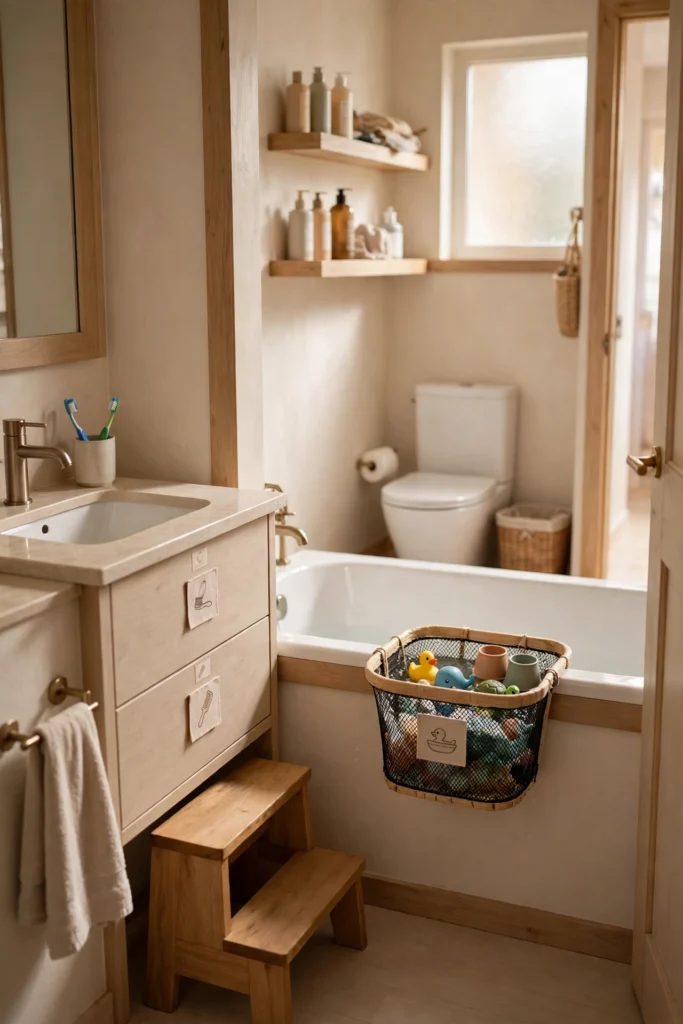
The sink is the busiest zone in a kids bathroom, and it is also the smallest. That combination is why counters end up crowded. Two children brushing teeth, washing faces, and combing hair in a few minutes will fill every flat surface unless each child has a defined spot. The goal here is not a clear counter for its own sake. The goal is a counter where a child can set down a toothbrush, use it, and put it back without knocking over three other things.
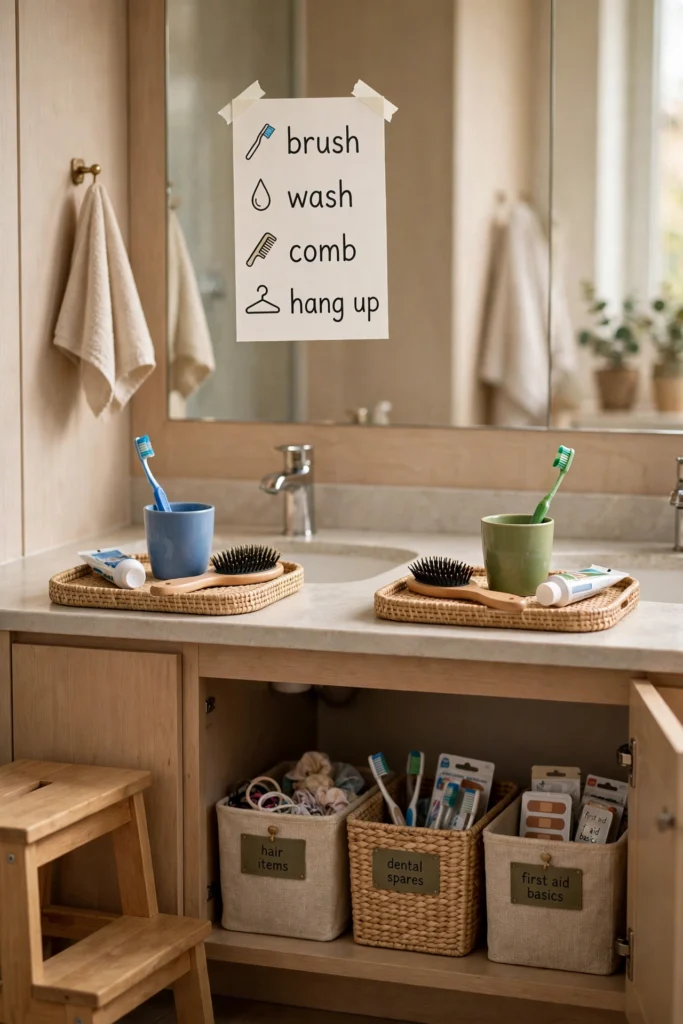
Start by choosing one home per child for brushing items. A cup, a small tray, or a divided section of a drawer all work, but the container matters less than the rule behind it. Each child keeps their toothbrush, toothpaste, and floss or other daily items together in that one spot. If siblings share a bathroom, colour helps more than any lecture about sharing. One child uses the blue cup, the other uses the green cup, and nobody has to guess which brush belongs to whom. The same idea works for face cloths and hairbrushes. When ownership is visible, arguments drop, because the boundary is clear before anyone is tired or rushed.
What should stay on the counter, and what should not
Keep only the items used at least once a day on the counter or in the top drawer. For most families that means a toothbrush, toothpaste, hand soap, and a face cloth. Everything else can live one step away. Spare toothpaste, extra soap, and new brushes belong in a higher cabinet or a linen cupboard, not beside the tap. When spares sit beside daily items, children reach for a new tube before the old one is finished, and parents lose track of what is actually running low. A simple test helps. If you have not used it in the past week, it probably does not need to live in the sink zone.
Height matters more than most parents expect. A child who cannot see into the mirror, reach the tap comfortably, or put a cup back on a shelf will leave things on the nearest flat surface, which is usually the counter edge or the floor. A sturdy step stool solves a surprising amount of sink mess, as long as it has a home of its own. Tuck it beside the vanity or under an open shelf where it can slide out and back without blocking the door. If the stool always ends up in the middle of the room, it is probably too large, too heavy for your child to move, or stored in a spot that is hard to reach. A smaller stool that a child can move alone beats a larger one that needs an adult every time.
Under the sink deserves the same zone thinking. It is tempting to treat that cabinet as one large dumping ground, but children rarely open a deep cabinet and find what they need. They open it, push things around, and close it again. Small bins inside the cabinet change that. One bin for hair items, one for dental spares, and one for first aid basics keeps categories separate. Label the bins, even if the labels are only for adults at first. When a parent can find the spare toothpaste without emptying the cabinet, restocking takes seconds instead of turning into a search.
What if two children share one sink?
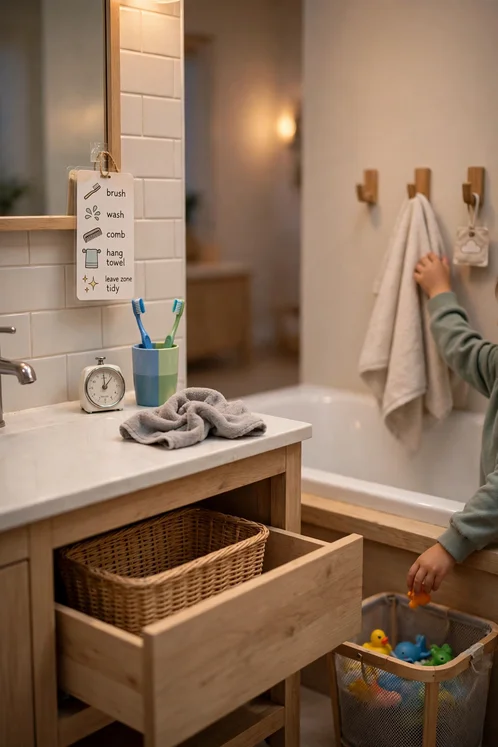
Shared sinks work when time and space are both divided. Give each child a side if the vanity allows it, even if the division is only a tray on the left and a tray on the right. If the sink is truly single, divide by time instead of space. One child brushes while the other washes hands or combs hair, then they swap. A small picture routine on the mirror can help younger children follow that order without a parent standing in the doorway. Keep the routine to three or four steps, in the order they happen. Brush, wash, comb, hang up. Long charts with ten steps look helpful but get ignored, because nobody wants to read a poster while half awake.
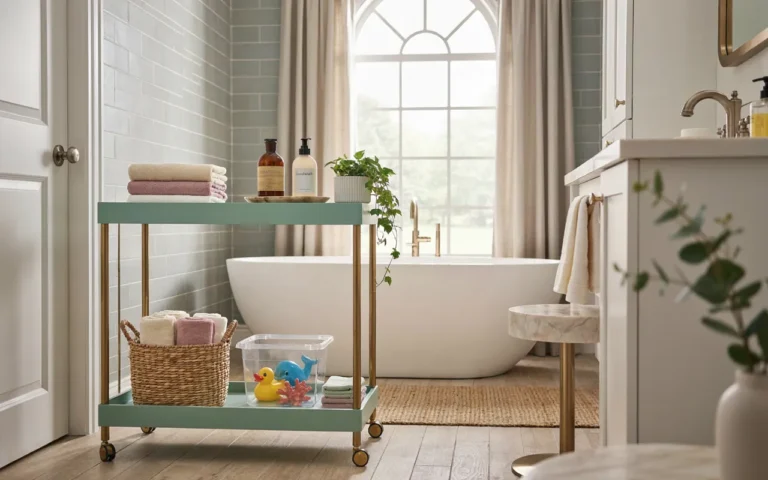
If you are still planning the look of the room, it helps to see how other families balance child friendly storage with a bathroom that still feels calm for adults. These kid bathroom ideas for a safe and stylish bathroom show storage placed at child height without turning the whole room into a toy shop. Borrow the placement ideas, not necessarily the colours or themes, and fit them to your four zones. A good idea in someone else’s bathroom only helps if it solves a real problem in yours, so test each idea against one question. Does this make the 7am routine easier for my child, or does it just add another thing to clean?
The small sink habits that keep the zone clear
Three small habits do most of the work in this zone. First, the toothpaste cap goes back on straight away, which sounds tiny but stops the sticky trail that spreads across counters and cups. Second, the face cloth gets hung up, not left in a ball by the tap, because a damp cloth left bunched up stays damp and starts to smell. Third, the cup gets rinsed and returned to its spot after brushing. None of these habits needs a reward chart to start. They need a spot that is easy to use and a parent who models the same steps for a week or two. Children copy what they see far more reliably than they follow what they are told once in a rush.
Zone 2: The bath, where water and toys need a drying plan
The bath zone has a different problem from the sink. It is not about small items on a counter. It is about water, and water makes everything heavier, messier, and harder to store. Shampoo bottles slide, bath toys hold water, washcloths stay wet, and a bath mat left bunched on the tub edge never dries properly. A bath zone works when everything in it can dry, drain, and be reached without climbing or stretching.
Start with the bath items your children actually use each bath. For most families that is shampoo, body wash or soap, a washcloth, and a small set of toys. Put those items together in one caddy, basket, or shelf close to the tub, at a height an adult can reach easily and an older child can reach safely. Spares stay elsewhere. If you keep six bottles beside the tub because they were on offer, children will knock them over, mix them up, and leave half of them open. Two bottles in use, plus spares stored away, is easier to manage and easier to replace when one runs out.
How many bath toys should stay in the tub?
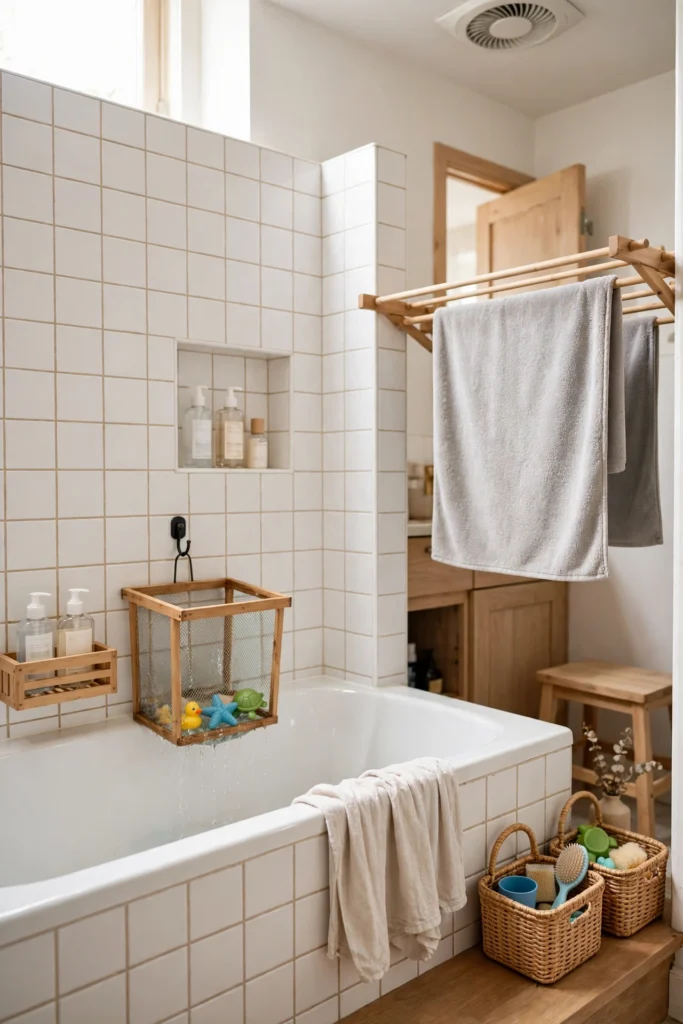
This is the question parents ask most about the bath zone, and the honest answer is fewer than you think. A small basket that drains is a better limit than a rule about numbers, because children understand a full basket in a way they do not understand a number on a list. Choose one basket or mesh bag that hangs or sits where water can drain away from the tub. When the basket is full, a toy has to leave before a new one stays. Let your child choose which toys earn a spot in the basket, and store the rest elsewhere for rotation. Rotating toys every few weeks keeps bath time fresh without letting the tub turn into a toy box that never drains.
Drying matters because toys and cloths that stay wet start to smell and need replacing sooner. After bath time, squeeze washcloths and hang them where air can reach them, not in a pile on the tub edge. Tip bath toys to drain if they hold water, and leave the basket where air circulates. If your bathroom stays damp for hours after a bath, leave the door open a little after bath time when it is safe to do so, and check that the extractor fan is actually running. A dry basket is not just tidier. It is the difference between toys that last and toys that have to be thrown away after a few weeks.
For larger bathrooms, or for families planning a change to the tub area, it is worth looking at how different layouts handle storage near the bath without crowding the room. These bathroom designs for small and large spaces include ideas for niches, shelves, and tub side storage that keep bottles and toys close but out of the splash path. Take the layout idea that fits your room size, then adapt it to your zone rule. A niche is only useful if it holds the two or three bottles you actually use. A large shelf that fills up with spares and decorations will recreate the same clutter, just higher up.
Bath zone checks that prevent the usual pile up
Keep the bath zones honest with a quick check after every bath. Towels go back on their hook and bath toys back in their own basket, and each child gets a small caddy for their own things so nothing drifts into a shared pile. Wipe the floor and the counter in one pass while the room is still warm, then give the zones a two minute reset once a week to catch whatever has crept out of place.
Zone 3: The toilet area, the zone that should stay boring
The toilet area works best when it is boring. It needs very little in it, and that is the point. Toilet paper, a small bin, and a step stool if your child still needs one are usually enough. When this zone collects toys, books, hair tools, and spare towels, it slows everyone down and makes cleaning harder. Keep it clear, keep it stocked, and let it do one job well.
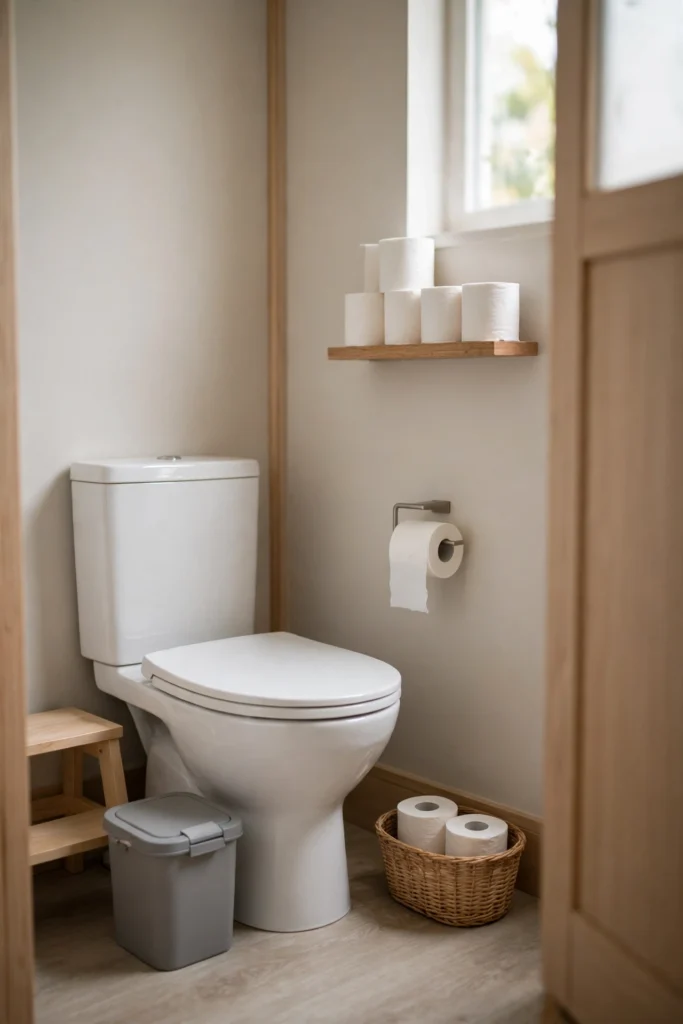
Toilet paper storage is a good test of zone thinking. A small holder or basket beside the toilet for the roll in use, plus a few spare rolls nearby, is enough for daily life. A large stockpile of rolls beside the toilet looks organised for a day, then turns into a tower that children knock over or use for building. Store the bulk supply in a linen cupboard or on a higher shelf, and keep only a few spares in the toilet zone. When the spare basket is empty, that is your signal to restock, not a reason to move the whole stockpile into the bathroom.
What if the toilet zone has no storage at all?
Many small bathrooms have no cabinet near the toilet, and that is fine as long as you do not try to force storage into a space that cannot hold it. A narrow basket beside the toilet, a small shelf above the paper holder if it is safely out of splash range, or a few rolls in a basket on top of a nearby cabinet can all work. What does not work is balancing rolls on the tank or on the floor where they get wet. If a spot gets splashed, it is not storage. Move the rolls to a dry spot, even if that spot is just outside the bathroom, and keep only the roll in use beside the toilet. Dry paper is more important than paper that is technically inside the room.
Zone 4: The door, towels, and laundry on its way out
The door zone is where towels live, and towels cause more bathroom arguments than almost anything else. A wet towel on the floor, a dry towel missing when it is needed, and two children claiming the same towel are all symptoms of the same problem. There is no clear towel home for each child, at a height each child can reach, with a rule about how many towels hang there.
Give each child one hook and one towel. That sentence is the whole system, and it works because it is easy to remember and easy to check. One hook per child means nobody has to search for a free hook. One towel per child means nobody hangs a second towel on top of a damp one and wonders why nothing dries. Choose hooks that are low enough for your youngest child to use alone, and strong enough to hold a wet towel without pulling out of the wall. If you rent, adhesive hooks rated for wet towels can work, but test one first and check it after a few days of use. A hook that falls down teaches children not to bother hanging anything up.
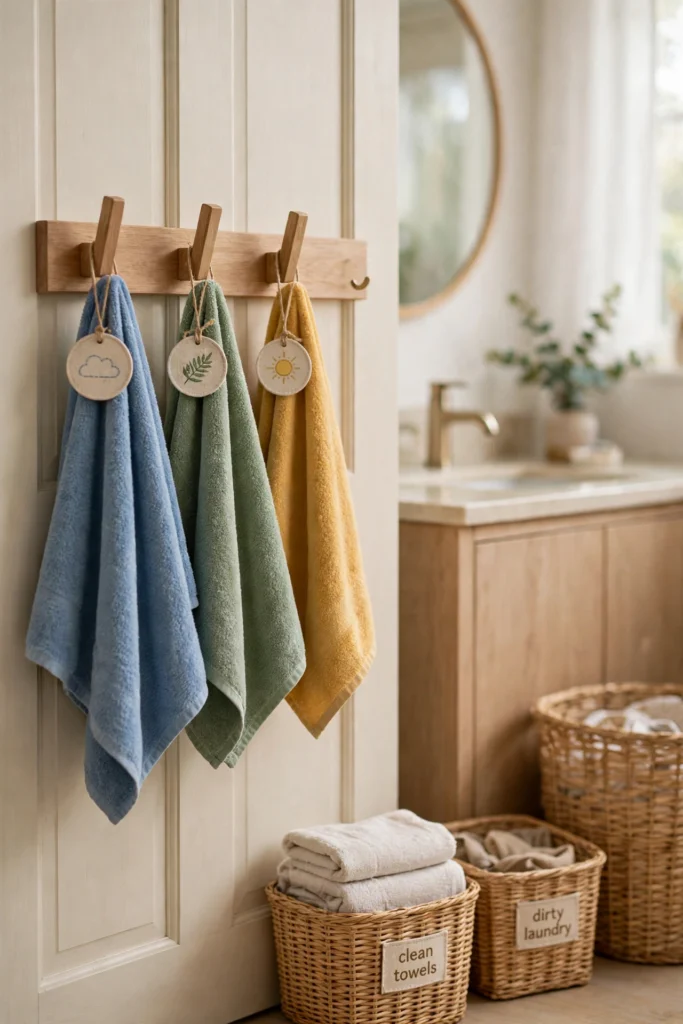
Colour or pattern helps here just as it does at the sink. Each child gets a towel colour or a hook with their name or picture on it. Younger children who cannot read yet do well with a picture, a coloured dot, or a small animal tag on their hook. Older children often prefer a plain hook and a towel in a colour they chose themselves. Either way, the point is the same. The towel home is personal, visible, and consistent. When a towel is on the floor, you can see at a glance whose hook is empty, and that makes the nightly reset quick and fair.
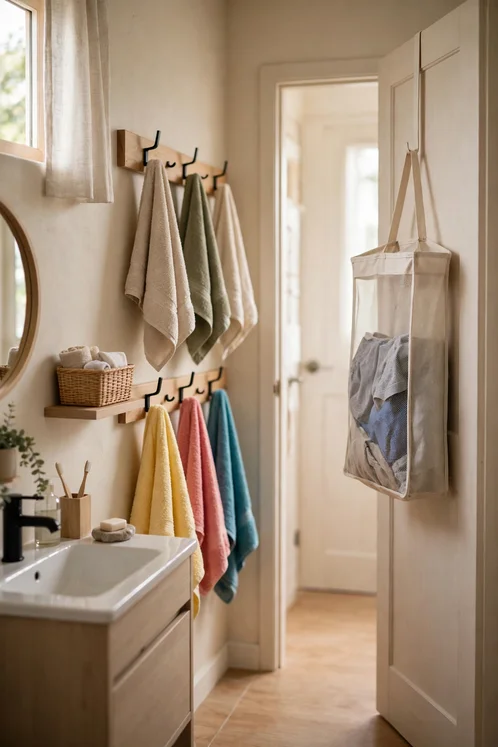
Laundry also passes through this zone, and it needs a home that is just as clear. A small hamper or a laundry bag on the door or beside the vanity gives wet towels and dirty clothes a place to go that is not the floor. If the hamper is too large, it fills slowly and starts to smell. If it is too small, it overflows and clothes end up beside it. A hamper that holds a few days of bathroom laundry for your family, emptied on laundry day, is the right size. Teach children to put their towel in the hamper only when it is truly dirty or after a set number of uses, not after every single wash, or you will be washing towels all week for no reason. A simple family rule, such as towels go in the hamper on laundry day unless they are muddy or smelly, keeps the system realistic.
If towel overflow keeps spilling into other rooms, the problem may be laundry storage rather than bathroom storage. These smart storage solutions for a small laundry room show how a small laundry space can hold towels, spares, and everyday supplies without taking over the house. Borrow the idea of one basket for clean towels and one for dirty laundry, and apply it at bathroom scale. Even a single labelled basket in the laundry area can stop the pile of clean towels that never quite makes it back to the bathroom shelf.
What if there is no room for a hamper?
Small bathrooms often have no floor space for a hamper, and a hamper that blocks the door is worse than no hamper at all. In that case, use the back of the door. A hanging laundry bag, a set of hooks with a small bag, or a slim basket on a shelf can hold a day or two of laundry without taking floor space. The key is that the bag is emptied often, because a hanging bag that fills up becomes heavy and hard to use. If the bag fills before laundry day, empty it into the main laundry basket in the evening. A small, often emptied bag beats a large hamper that nobody can reach or move.
Hooks deserve a second look, because they are often placed for adults and then expected to work for children. If you have ever watched a child try to hang a towel on a hook above their head, you know why towels end up on the floor. Lower the hooks, add a second row at child height, or use a hook rail with several hooks at different heights so the rail can grow with your children. For ideas on hook placement that still looks tidy in a hallway or entry, these mudroom wall decor ideas for a welcoming entryway show how hooks, rails, and small shelves can look intentional rather than improvised. The lesson transfers well. Hooks at the right height, spaced far enough apart for towels to dry, look better and work better than a crowded row of hooks at adult height.
Labelling and routines: how zones stay zones
Zones fail without labels and routines, because memory alone cannot hold four zones, two children, and a busy morning. Labels turn a system into something a child can follow without asking. Routines turn a tidy bathroom into a tidy bathroom that stays tidy. Neither needs to be fancy. Both need to be consistent.
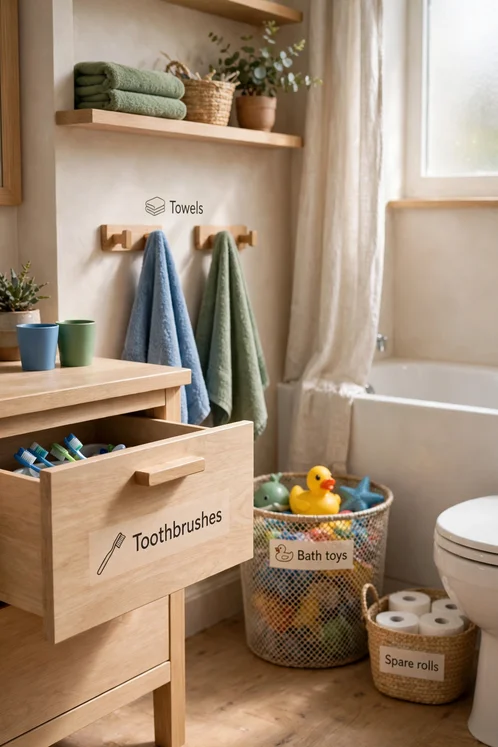
Start labels with pictures for younger children and words for older children, and use both together during the changeover years. A picture of a toothbrush on a drawer, a picture of a towel on a hook, and a picture of a toy basket on a shelf tell a pre reader exactly where things go. As children learn to read, add the word beside the picture, then keep the word when the picture is no longer needed. Labels should be placed where the item lives, not on a chart on the wall. A label on the bin itself helps far more than a label on a poster across the room, because the child sees it at the moment they need to decide.
Keep labels short and specific. Toothbrushes is better than bathroom stuff. Towels is better than things. Bath toys is better than toys, because toys could mean anything and bath toys means the basket by the tub. If a label is vague, children will guess, and guesses are how items end up in the wrong zone. Check labels every few months, because children grow and zones change. A label that still says step stool after the stool has left the bathroom is just clutter on a bin.
For containers and labels that actually get used, rather than admired for a week and ignored, it helps to choose simple products that fit your bins and your children. These home organization products that actually work focus on practical bins, dividers, and labels rather than pretty sets that do not fit real drawers. Use that practical test for every purchase. Does this bin fit the drawer I measured? Does this label stay readable when it gets wet? Does this divider stay in place when a child pulls it? If the answer to any of those is no, the product will not help, no matter how tidy it looks in a photo.
How do you keep labels useful as children grow?
Labels grow with children when you review them twice a year, at the start of a school term or after a growth spurt, whichever comes first. Ask your child what still makes sense and what feels babyish or confusing. A ten year old may want plain word labels instead of pictures. A teenager may want no labels at all in a shared bathroom, but a labelled bin inside a drawer where guests do not see it. Let older children take part in relabelling, because a system they helped update is a system they are more likely to follow. The goal is not labels forever. The goal is a habit that no longer needs labels, built by labels that were clear when they were needed.
Routines work the same way. A morning routine and a night routine, each with only a few steps, beat a long list of rules. Morning routine: brush, wash, comb, hang towel, leave zone tidy. Night routine: bath toys away, towel hung, counter wiped, toothbrush back in its cup. Keep the steps in the order they happen, and keep them visible for younger children. A small card inside a drawer or on the mirror, with pictures or short words, helps for the first few weeks. After that, most children follow the order from memory, especially if the zones themselves remind them. A cup by the sink reminds a child to put the brush back. A hook by the door reminds a child to hang the towel. The room does part of the reminding, so parents do not have to.
The nightly two minute reset is the routine that protects all the others. Set a timer for two minutes, not ten, and let each child reset their own zone. One child returns bath toys to the basket. Another hangs towels and wipes the counter. A parent checks the toilet zone and empties the bin if needed. Two minutes is short enough to do every night, even on tired evenings, and long enough to stop small messes from becoming weekend projects. If the reset regularly takes longer than a few minutes, a zone has probably collected items that do not belong there. Use that extra time as a clue, not as a reason to give up. Remove the extra items, and the reset gets short again.
One drawer at a time: your first step plan
You do not need a whole weekend to start. You need one drawer, one zone, and one evening when nobody is in a rush. Start with the sink drawer or cup that causes the most morning trouble. Empty it, keep only the daily items, give each child one spot, and label it. That single drawer will change tomorrow morning, and that small win makes the next zone easier to tackle.
| Step | Do this | Time to allow |
|---|---|---|
| Day one | Sort the sink zone and set one spot per child | One evening |
| Day two | Set the bath basket and towel hooks at child height | One evening |
| Day three | Clear the toilet zone and set the nightly two minute reset | A few minutes |
Work through the zones in that order, and stop when a zone is done. Do not buy new containers until you have sorted what you already own. Do not relabel everything in one night. Let each zone settle for a few days, watch where items still land on the floor or counter, and adjust that one spot. A system that is adjusted after real use lasts longer than a system that looks tidy for a photo and falls apart on Monday.
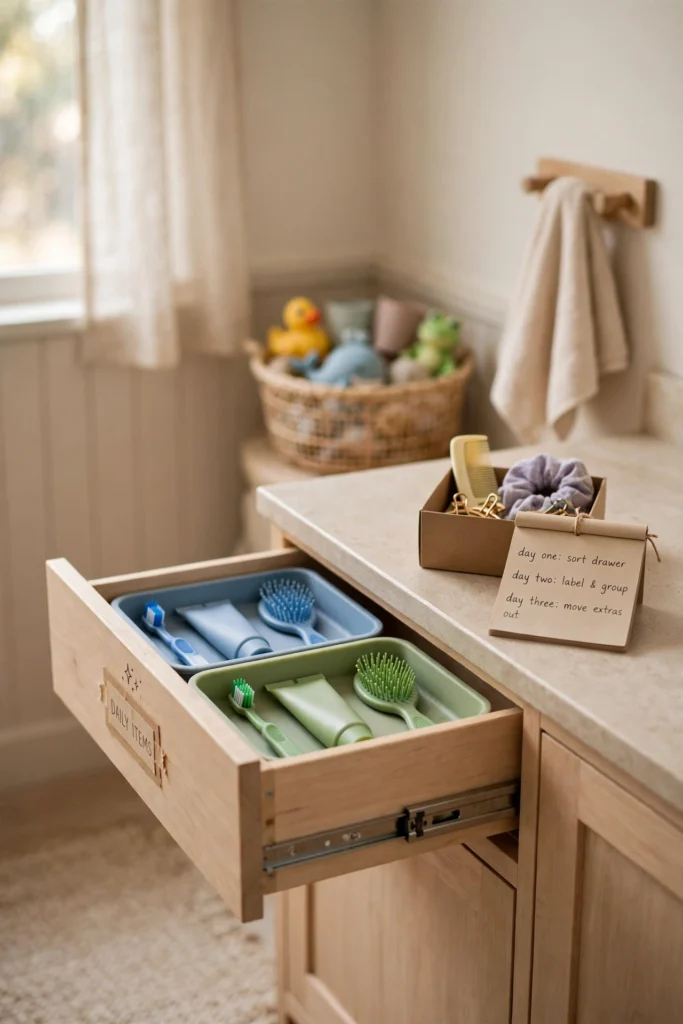
When the four zones are set, the bathroom stops asking children to guess. They know where the brush lives, where the towel hangs, where the toys drain, and where the paper sits. Mornings still have their busy moments, but the search for missing things gets smaller, and the reset at night gets shorter. Start with one drawer tonight. Tomorrow at 7am, you will know whether that drawer was the right place to begin.
Frequently Asked Questions
How do I organize a kids bathroom?
Divide the bathroom into four zones: sink, bath, toilet and door. Give every item one home inside only one zone, keep daily items where small hands can reach, move spares and adult items out of reach, label each spot with words or pictures, and finish with a two minute reset at night.
Where should I start?
Start with the sink, because that is where the morning rush happens. Empty one drawer or cup, keep only the daily items, give each child one spot and label it. Then move on to the bath, the toilet area and the door.
What should stay on the sink counter?
Only items used at least once a day: a toothbrush, toothpaste, hand soap and a face cloth. Spare toothpaste, extra soap and new brushes belong in a higher cabinet or linen cupboard.
How do I stop siblings arguing over shared things?
Make ownership visible. Give each child their own colour, such as a blue cup and a green cup, plus their own towel colour and hook. When it is clear whose item is whose, arguments drop.
What if two children share one sink?
Divide the space with a tray on each side. If the sink is truly single, divide by time instead: one child brushes while the other washes or combs, then they swap. A short picture routine on the mirror helps younger children follow the order.
How many bath toys should stay in the tub area?
Fewer than you think. Use one basket or mesh bag that drains, and when it is full a toy has to leave before a new one stays. Let your child pick which toys earn a spot and rotate the rest every few weeks.
How do I keep bath toys and washcloths from smelling?
Make sure everything in the bath zone can dry. Squeeze and hang washcloths, tip toys to drain, keep the basket where air can circulate, and check that the extractor fan is running.
How much toilet paper should I keep in the bathroom?
Only the roll in use plus a few spares in a small basket. Store the bulk supply in a linen cupboard or on a higher shelf, and never keep rolls on the tank or floor where they can get splashed.
How do I handle towels?
Give each child one hook and one towel, placed low enough for the youngest child to reach alone. Add a colour, picture or name tag so it is easy to see whose hook is empty.
How often should towels go in the hamper?
Put them in on laundry day unless they are muddy or smelly, rather than after every wash, so you are not washing towels all week for no reason.
What if there is no room for a hamper?
Use the back of the door. A hanging laundry bag, a set of hooks with a small bag or a slim basket on a shelf works well, as long as it is emptied often.
What kind of labels work best?
Short, specific labels placed directly on the bin, drawer or hook where the item lives. Use pictures for younger children, add words as they learn to read, and keep the word when the picture is no longer needed.
How do I keep labels useful as children grow?
Review them twice a year, at the start of a school term or after a growth spurt. Ask your child what still makes sense and let older children help relabel.
What is the nightly two minute reset?
A short timed tidy where each child resets their own zone: toys back in the basket, towels hung, counter wiped, toothbrush back in its cup. A parent checks the toilet zone and empties the bin if needed.
What if the reset takes longer than a few minutes?
It is a clue that a zone has collected items that do not belong there. Remove the extras and the reset gets short again.
Do I need to buy new containers?
Not at first. Sort what you already own, live with the layout for a few days, then buy only what solves a clear problem, after measuring your drawers and shelves.