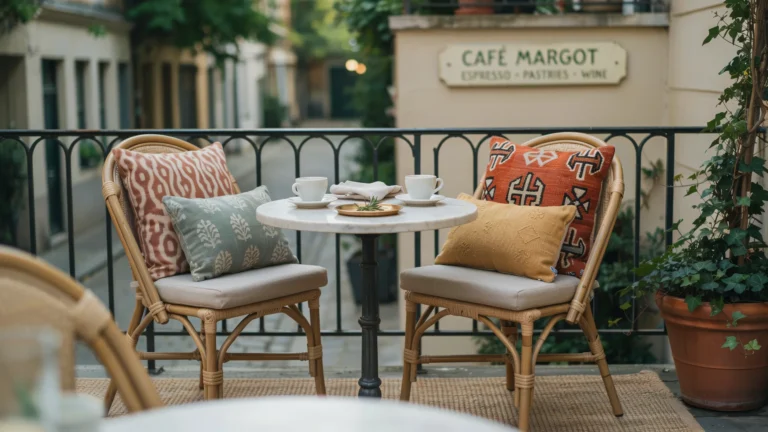
When was the last time you stayed outside after sunset because you wanted to, not because you were waiting for someone or finishing a chore? That is the real test of a warm and inviting outdoor space. It is not whether the patio photographs well at noon. It is whether, on an ordinary evening, you carry your drink outside without thinking, sit down, and stay.
Most patios fail that test for small, fixable reasons. The chairs look fine but hurt after twenty minutes. The only light is a bright bulb by the door that makes everyone squint. The fire pit is too close to the seating, or too far away to warm anyone. The space has furniture, but no clear reason to sit in one spot rather than another. None of these problems needs a rebuild. Each one comes from skipping a single essential, or getting one essential half right.
This guide works through the eight essentials in the order that matters most in daily life: seating, lighting, heat, plants, personal touches, shade, sound and scent, and layout. For each one you will find a plain contrast, what getting it right looks like and what getting it wrong looks like, plus the sizes, materials and placement rules that make the difference. Use it as a checklist. Tick off what your space already does well, fix the weakest essential first, and leave the rest for later. A patio that does five essentials properly will feel better than a patio that does all eight badly.
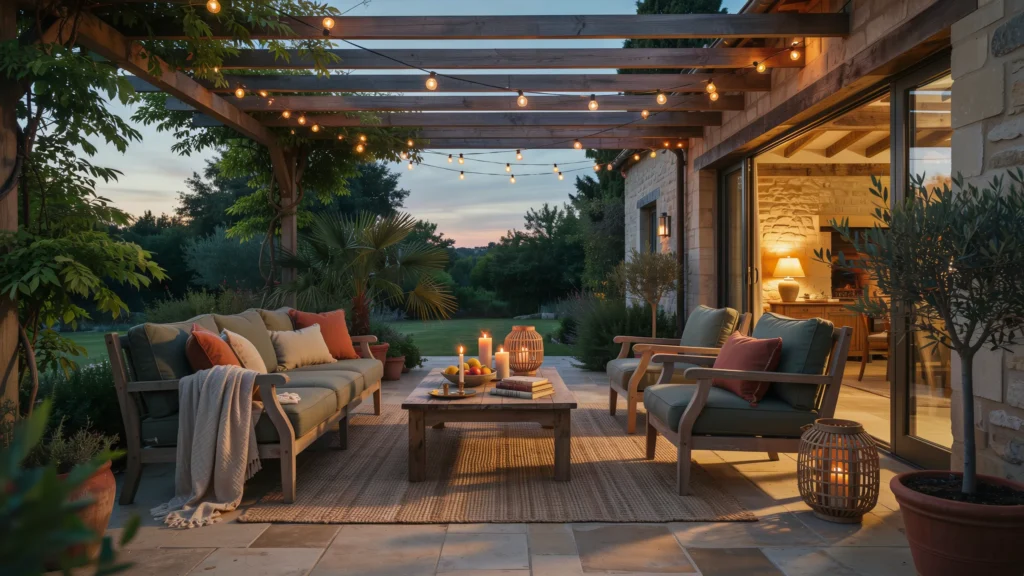
Before the detail, it helps to see the whole list at once. If you only have ten minutes, read the table, walk outside with it in mind, and note the two rows where your space is weakest. Those two rows are your starting point, and they will tell you more than any shopping list.
Warm and Inviting Outdoor Space: The 8 Essentials at a Glance
| Essential | Get it right | First check tonight |
|---|---|---|
| 1. Seating | Deep enough to relax in, with a place for a drink within reach | Sit for twenty minutes. Do you shift, or stay put? |
| 2. Lighting | Warm, layered light at several heights, not one harsh bulb | After dark, is the seating lit softly, or only the doorway? |
| 3. Heat | A heat source close enough to feel, with safe clearance | On a cool evening, can everyone feel the warmth where they sit? |
| 4. Plants | Plants suited to your sun and water, grouped by need | Are pots clustered with purpose, or scattered and half empty? |
| 5. Personal touches | A rug, textiles and a few chosen objects that mean something | Does the space look like yours, or like a furniture display? |
| 6. Shade and shelter | Shade over the seats you use at midday, not over empty ground | At midday, is there a shaded seat, or only sun? |
| 7. Sound and scent | Gentle water or music, plus scented plants near seating | Close your eyes. Do you hear and smell anything pleasant? |
| 8. Layout and flow | Clear zones and clear paths, with storage close at hand | Can two people pass without moving a chair? |
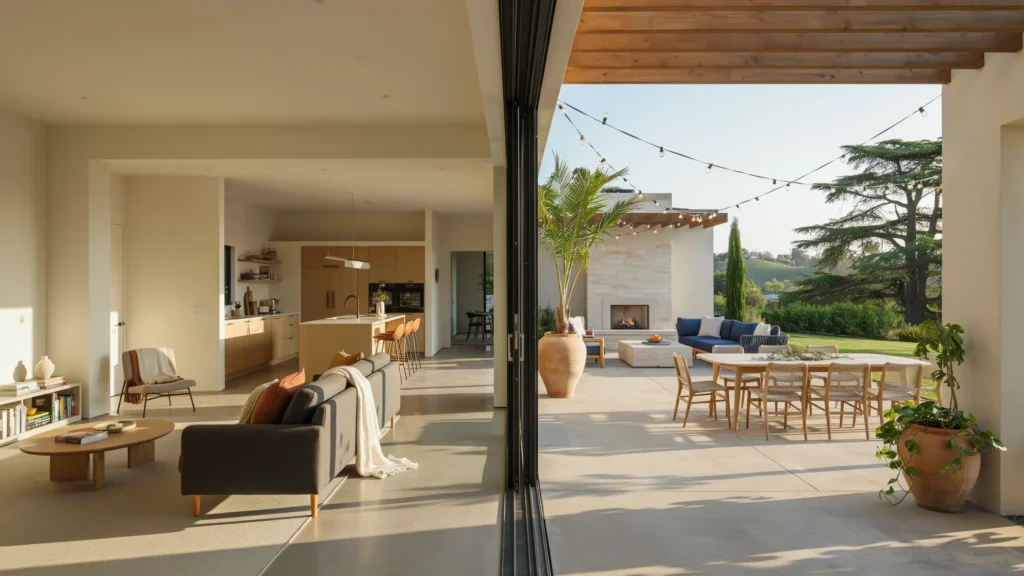
Essential 1: Seating people actually sit in
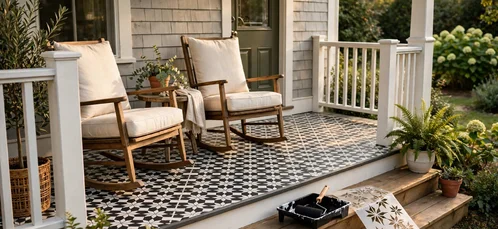
Seating decides everything else. A beautiful patio with uncomfortable chairs is a patio you walk through, not a patio you live in. Start here, and start by thinking about how you really use the space. A dining setup needs upright chairs and a table at the right height. A lounging corner needs deeper seats, lower tables and room to put your feet up. A space that tries to do both jobs with one stiff set of chairs will do neither job well.
Get it right: choose seating that fits the way you sit, then place it so people face each other. A seat depth of about 20 to 22 inches suits upright sitting, reading and talking. A depth of about 23 to 26 inches suits lounging with legs tucked up or stretched out. Seat height matters too.
Most adults sit comfortably when their feet rest flat on the ground, which usually means a seat height of about 17 to 19 inches for dining chairs and a little lower for lounge seating. Leave a side table or a coffee table close enough that no one has to stand up to set down a mug.
About an arm’s length, roughly 18 to 24 inches from the seat edge, is a good guide for a side table. For a coffee table in front of a sofa, leave about 14 to 18 inches so legs have room but drinks stay within reach.
Get it wrong: buy the largest set that fits the patio, push it against a wall, and fill every gap with extra chairs. Oversized furniture on a small patio leaves no walking space, so people edge sideways past the table. Chairs that all face the same way, usually toward a wall or a fence, make conversation awkward, so guests perch rather than settle. Thin cushions on a hard frame look tidy in a photo and feel tiring after half an hour. If your current seating fails, ask a simple question before you replace anything: would I choose this chair for a long phone call? If the answer is no, the chair is decoration, not seating.
Materials decide whether good seating stays good. Powder coated aluminium resists rust and stays light enough to move. Teak weathers to a soft grey if left untreated, and keeps its strength outdoors for years when it is cleaned and allowed to dry.
All weather wicker, made from a synthetic weave over a metal or resin frame, copes with rain far better than natural wicker, which can weaken and sag when it stays damp. For cushions, look for quick dry foam inside a fade resistant outdoor fabric.
A cushion that holds water after rain will stay damp, smell musty and stop being used, however pretty the cover looks. Store cushions in a dry box or bring them in during long wet spells, even if the fabric is rated for outdoor use. That one habit adds seasons to their life.
How many seats do you actually need? Count the people who sit outside on a normal week, not the people who might come to a once a year gathering. Two or three well chosen seats that get used daily beat six chairs that block the path and gather leaves. If you do host larger groups sometimes, keep two folding or stackable chairs stored nearby rather than crowding the patio all year. The same seat depth thinking that shapes indoor comfort applies outside, and guidance on comfortable sofas for a living room explains cushion fill and seat depth in detail that transfers neatly to outdoor sofas and sectionals.
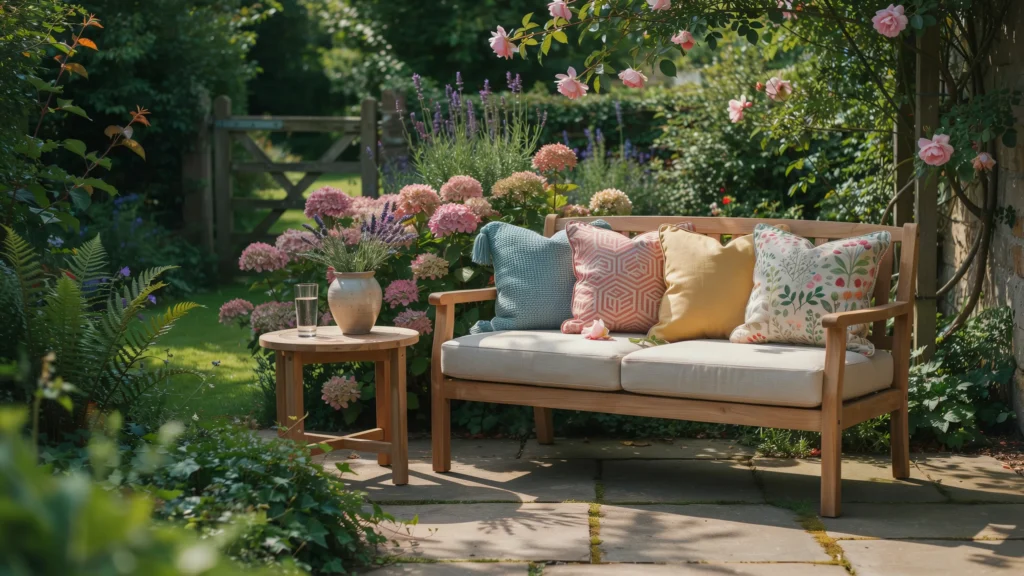
The quick answer for the whole guide is this: pick seating you can sit in for an hour, light it warmly at more than one height, add heat and shade where you actually sit, and keep a clear path through the space. Get those four things right and the rest becomes finishing detail.
Essential 2: Lighting that makes evening feel inviting
Lighting is the essential that most often separates a daytime patio from an evening retreat. During the day, sunlight does the work. After sunset, one bright overhead bulb makes a patio feel exposed, like a car park. Warm, layered light does the opposite. It pulls people toward the seating, softens faces and makes the space feel smaller and safer, in a good way.
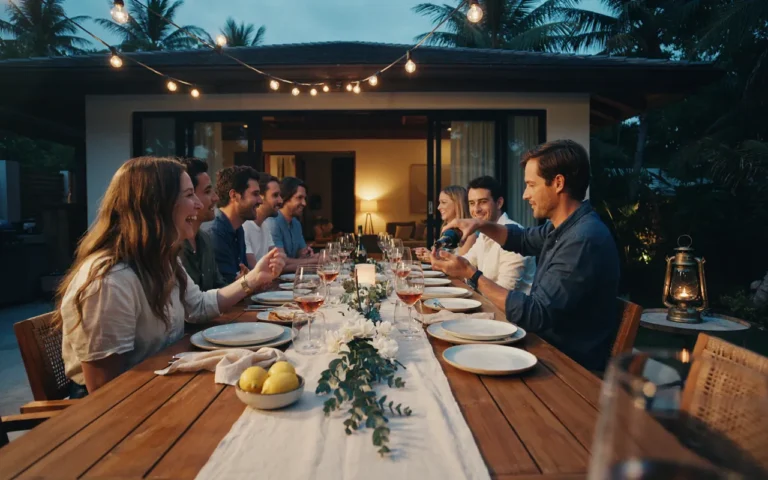
Get it right: layer three kinds of light at different heights. Overhead light, such as string lights or a pendant under a covered patio, gives a gentle overall glow. Low light, such as lanterns on a table or beside a chair, warms the seating zone itself. Ground level light, such as solar path lights or small uplights near plants, guides feet and shows off planting without glaring. Keep the colour warm, around 2200K to 2700K for string lights and lanterns, and no cooler than about 3000K for task areas. Warm light flatters skin, food and wood. Cool white light, by contrast, can make a patio feel clinical, however bright it is.
Get it wrong: rely on a single floodlight by the back door, or on one string of lights hung so high that it lights the fence and leaves the table in shadow. Another common mistake is mixing bulb colours without noticing. A warm lantern beside a cool white wall light makes the space look uneven, even when both lights are bright enough on their own. Choose one warm range and keep it consistent. Also avoid bare bulbs at eye level. A bulb you stare straight into will dominate the evening, while a shaded lantern or a frosted globe spreads the same light softly.
Placement rules help more than extra brightness. Hang string lights so the lowest point sits well above head height, typically about 7 feet or higher over a walkway, and a little lower over a fixed seating area where no one walks beneath them. Put lanterns on the table, not just at the edges of the patio, so faces are lit when people talk. Light steps, changes in level and the edges of paths, because a warm patio that hides a step is not a safe patio. Keep cords away from water, use fixtures rated for outdoor use, and choose solar lights for paths where running a cable would cross a walkway.
Do you need to light the whole garden, or only the part you use? Light the part you use first. A softly lit seating area with a dark garden beyond it feels intimate. A brightly lit garden with a dark seating corner feels like a stage with no audience. If you want to highlight one tree or one planter, use a small uplight tucked at its base, aimed up through the leaves.
One lit feature is enough. Five lit features compete and the eye does not know where to rest. The zone thinking behind good indoor entry lighting applies outside too, and ideas for mudroom lighting ideas show how lighting a bench, a doorway and storage separately beats one bright fixture in the middle of a room.
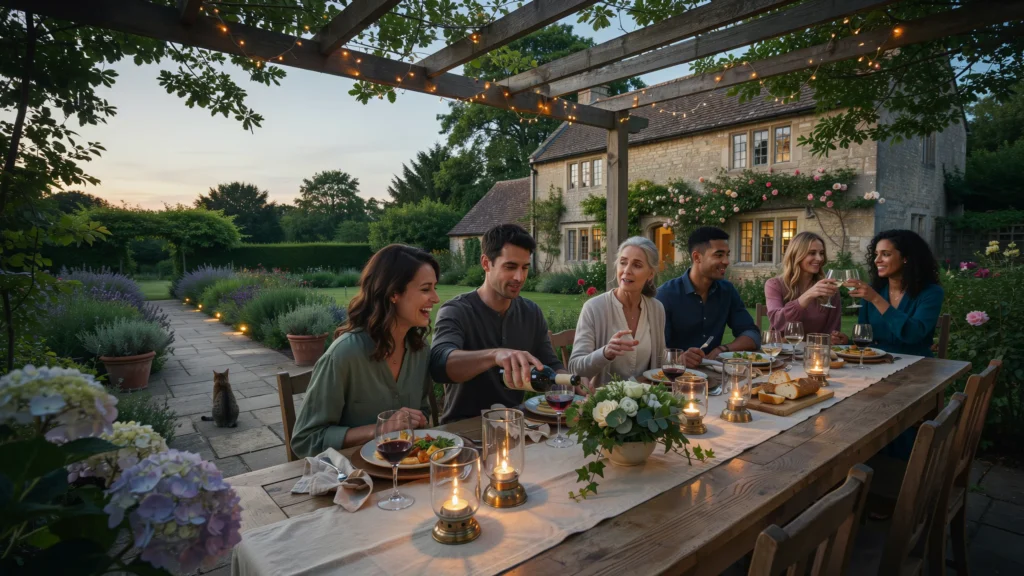
Essential 3: Heat that reaches the people sitting down
Heat is what turns a patio from a summer only space into a space you use for much more of the year. Without it, the first cool evening sends everyone indoors, even when the seating and lighting are perfect. With it, a crisp evening becomes one of the best times to sit outside. The mistake is not choosing the wrong heater. It is placing heat where it looks good in a photo but cannot be felt from a chair.
Get it right: put the heat source close to the seating, at a safe distance from anything flammable, and choose the type that fits how you gather.
A fire pit works best as a centrepiece for a circle of chairs, with about 24 to 36 inches between the edge of the pit and the front of each seat, so people feel warmth without feeling scorched or crowded. A fire pit table suits dining, because it gives a surface for drinks while the flame stays in the middle, guarded and contained.
A tall patio heater suits a dining table or a narrow patio, because it throws heat downward over a defined area without taking up floor space in the middle of the group. An electric wall mounted heater suits a covered patio or a balcony where open flame is not allowed, because it needs only a socket and a clear wall.
Get it wrong: place a fire pit ten feet from the chairs as a garden ornament, or squeeze a tall heater into a corner where it warms the fence. Both look finished and both fail. Another mistake is choosing a wood burning pit for a small, enclosed patio where smoke will sit in the seating area and drift into the house.
In that setting, a gas pit with an adjustable flame, or an electric heater, is usually the kinder choice, because you can control the heat and stop it quickly. Never leave an open flame unattended, keep cushions, throws and dry plants well clear, and keep a bucket of water or a fire extinguisher within easy reach, not locked in a shed.
Clearance rules are not optional detail. Keep a fire pit at least ten feet from walls, fences, overhangs and low branches, and check the rules for your home and local area before you buy, because some flats and housing rules ban open flame on balconies entirely. For gas units, check connections regularly for wear and store fuel exactly as the maker directs, away from heat and out of reach of children. For electric heaters, keep the cord out of walkways and away from water, and do not run a heater under a low fabric canopy unless the maker says it is safe to do so.
Heat also comes from textiles, and this is where a small, cheap fix helps a lot. Keep a basket of throws by the seating, with one throw per regular seat, so a cool evening does not end the night.
A standard throw of about 50 by 60 inches suits most outdoor chairs and loveseats, and a heavier knit holds its warmth better than a thin decorative throw that slides off at the first move. Ideas for throw blanket living room ideas show drape methods and sizes that work just as well on a patio chair, from a folded arm drape to a loose corner drape that stays put when you sit down.
Would you stay outside longer if a warm throw was already waiting on your chair? Most people would, and that is the point. Heat is not only about a heater. It is about removing the small reasons to go inside.

Essential 4: Plants that soften the space and survive it
Plants do a job no furniture can do. They soften hard edges, add movement, bring colour through the seasons and make a patio feel like a living place rather than an outdoor room with a floor. They also give privacy, shade and scent when they are placed with intent. A patio with no plants feels exposed. A patio with plants in every spare inch feels like a plant shop with nowhere to sit. The balance sits in between, and it starts with matching plants to your actual sun, wind and watering habits.
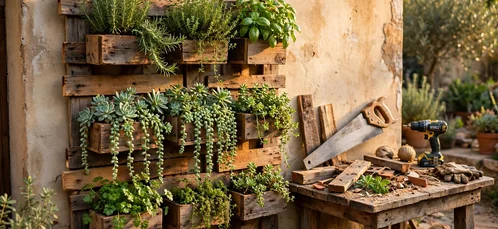
Get it right: group plants by what they need, not by what they look like in the shop. Sun loving plants, such as lavender, rosemary and many succulents, need several hours of direct sun and soil that drains freely. Shade loving plants, such as ferns and hostas, need shelter from harsh midday sun and soil that stays lightly moist.
Put plants with similar water needs in the same area, or in the same large planter, so one watering routine suits the whole group. Use a mix of heights: one taller plant or small tree in a large pot to anchor a corner, medium plants at seat height to frame the seating, and trailing plants on a wall or railing to soften edges without taking floor space.
Get it wrong: buy a dozen small pots on impulse, spread them around the edges, and water them all the same way. The sun lovers in shade stretch and weaken. The shade lovers in full sun scorch. Small pots dry out fast in wind and heat, so a plant that would thrive in a large pot struggles in a small one. Another mistake is placing a tall plant where it blocks the view from the seats, or a thorny plant beside a narrow path where everyone brushes past it. Plants should frame the seating and the view, not block either one.
Privacy is a plant job worth planning separately. If neighbours overlook your seating, a row of tall planters with bamboo in containers, tall grasses or a climber on a trellis can screen the view without building a solid wall. Leave gaps for air and light, because a fully enclosed patio can feel like a box. Place screening plants where they block the overlooked angle from the seated position, not where they look best from the house. Sit in your chair, look toward the neighbour’s window, and put the screen on that line of sight. That simple check saves you from planting a beautiful screen in the wrong place.
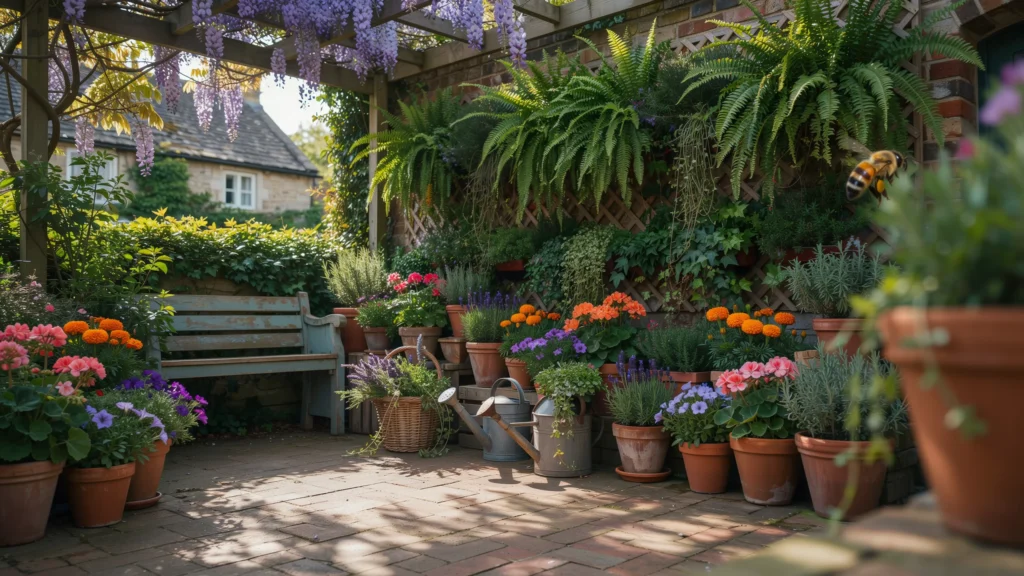
Essential 5: Personal touches that make it yours
Personal touches are the difference between a patio that could belong to anyone and a patio that feels like yours the moment you step onto it. They are also the essential most people overdo first, because shopping for decor is more fun than measuring a path or fixing drainage. The rule is simple: add touches that you use, or that mean something to you, and stop before the space starts to look like a shop window.
Get it right: start with one outdoor rug, then add textiles, then add one or two objects with a story. A rug defines the seating zone at once. For a two seat arrangement, a rug of about 5 by 7 feet usually anchors the chairs and a small table without swallowing the patio.
For a sofa and coffee table, a rug of about 8 by 10 feet lets the front legs of the seating sit on the rug, which is what makes the group feel like one room rather than furniture on a floor.
Choose a flat weave outdoor rug in polypropylene or a similar weather resistant fibre, because it resists moisture, cleans with a hose and dries fast. Place it so it does not curl at a walkway edge, and use a rug pad or tape made for outdoor use if it slides on a smooth floor.
Get it wrong: cover every surface with matching decor bought in one trip, so the patio looks styled but feels impersonal. Ten small ornaments on a small table leave no room for a mug. A rug that is too small floats under the coffee table and makes the seating look scattered. Pillows in four unrelated colours, bought because each one looked nice alone, fight each other on the sofa. If you step back and your eye jumps from object to object without resting, you have too many touches, or touches that do not share a colour or material.
Textiles are the easiest personal touch to get right, because they are cheap to change and they carry colour and softness at once. Keep the palette tight: one main neutral from your furniture or house, one secondary colour from your rug or cushions, and one accent that appears in small amounts only.
Pillow size matters here too. On an outdoor sofa, a 20 inch square pillow suits most standard seats, while an 18 inch square suits a loveseat or a compact chair. A lumbar pillow, about 12 by 20 inches, breaks up a row of squares and supports your lower back at the same time.
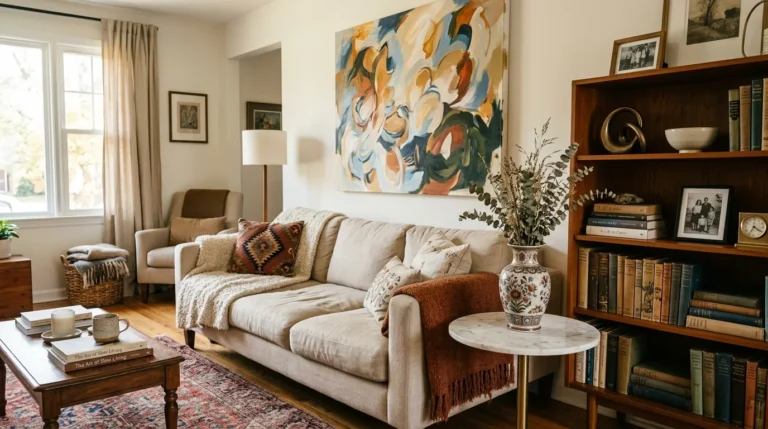
Guidance on mixing and matching throw pillows explains how to limit colours and pattern scales so a group looks planned rather than random, and the same three colour rule works outdoors, where strong sunlight makes clashing colours look even louder.
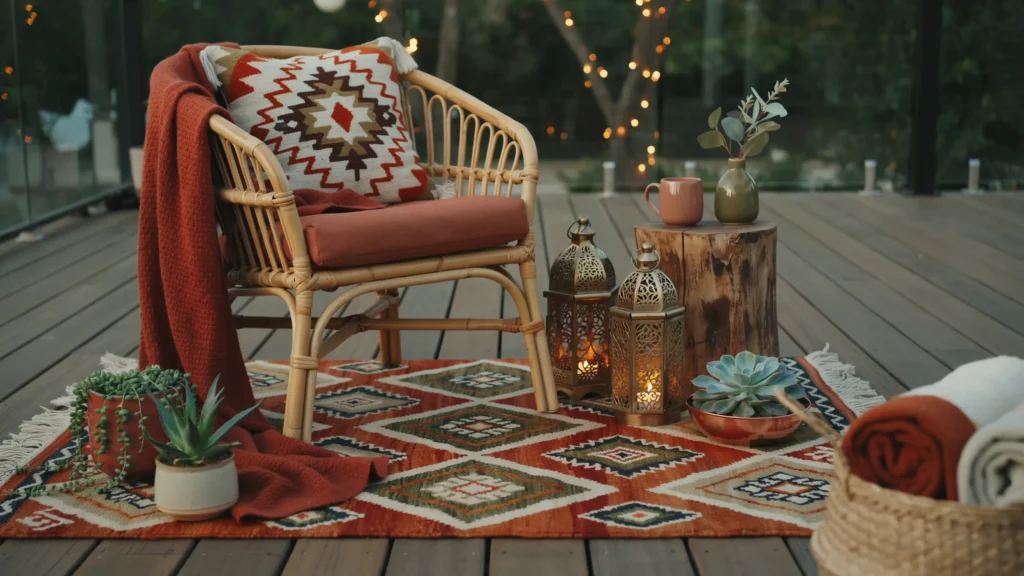
Essential 6: Shade and shelter where you actually sit
Shade decides whether a patio is usable at midday. Without it, the most comfortable chairs in the world sit empty from late morning to late afternoon in summer, and the space becomes a morning and evening only room. With shade in the right place, the same patio works all day. The key phrase is “in the right place”. Shade over an empty corner is wasted. Shade over the seats, the dining table or the reading chair is what counts.
Get it right: match the shelter to how long you sit and how much sun the spot gets. A cantilever or centre pole umbrella suits a dining table, because you can tilt it as the sun moves and move it when the table moves.
For a typical four person table, an umbrella of about 9 to 11 feet across shades the table and the chairs around it, while a smaller umbrella leaves shoulders in sun. A pergola suits a fixed seating area, because it defines the room and gives dappled shade that feels open rather than enclosed.
Add a retractable canopy or climbing plants to a pergola if you want deeper shade in high summer and lighter shade in cooler months. A shade sail suits an odd shaped patio, because it can span between a house wall, a post and a fence at different heights, creating shade exactly where the seats are.
Get it wrong: buy a small umbrella for a large table, or build a pergola over a walkway while the seating bakes in full sun. Another mistake is choosing shelter by looks alone, without checking wind. A large umbrella on a light base will topple in the first strong gust, and a shade sail fixed to a weak fence post will pull the post over time.
Use a base heavy enough for the umbrella size, usually a base of about 50 pounds or more for a large cantilever umbrella, and fix sails to solid walls or properly set posts, not to gutters or thin fence boards. Retract or close umbrellas and sails in high wind, even if they look sturdy. The cost of a broken umbrella is small beside the cost of a damaged fence or a hurt guest.
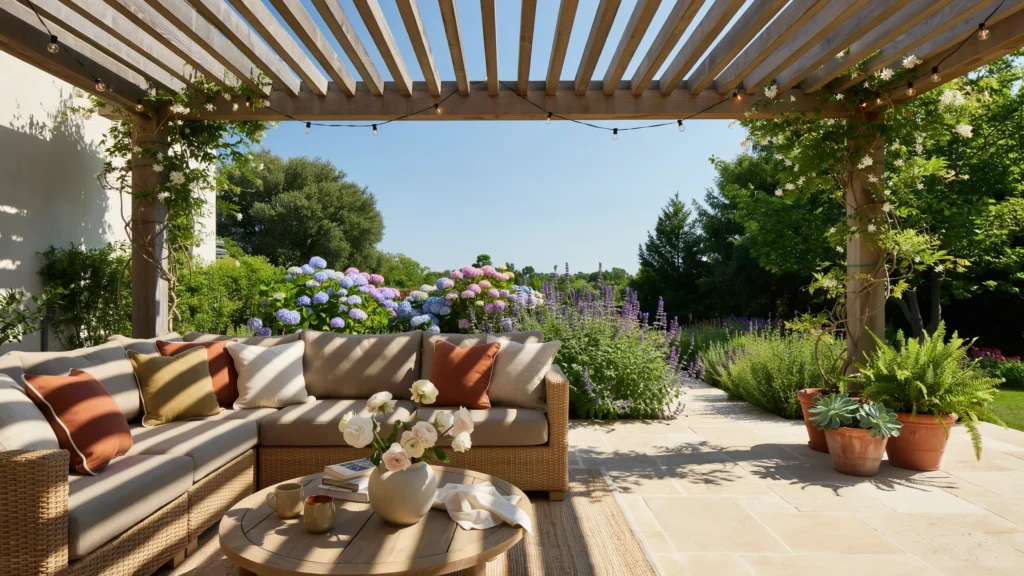
Essential 7: Sound and scent, the quiet essentials
Sound and scent work quietly, which is why they are easy to skip and why they make such a difference once they are present. You notice them most when they are wrong: traffic noise with nothing to soften it, or a patio that smells of nothing at all, like a car park with chairs. Get them right, and the patio starts to feel like a retreat the moment you step outside, before you have even sat down.
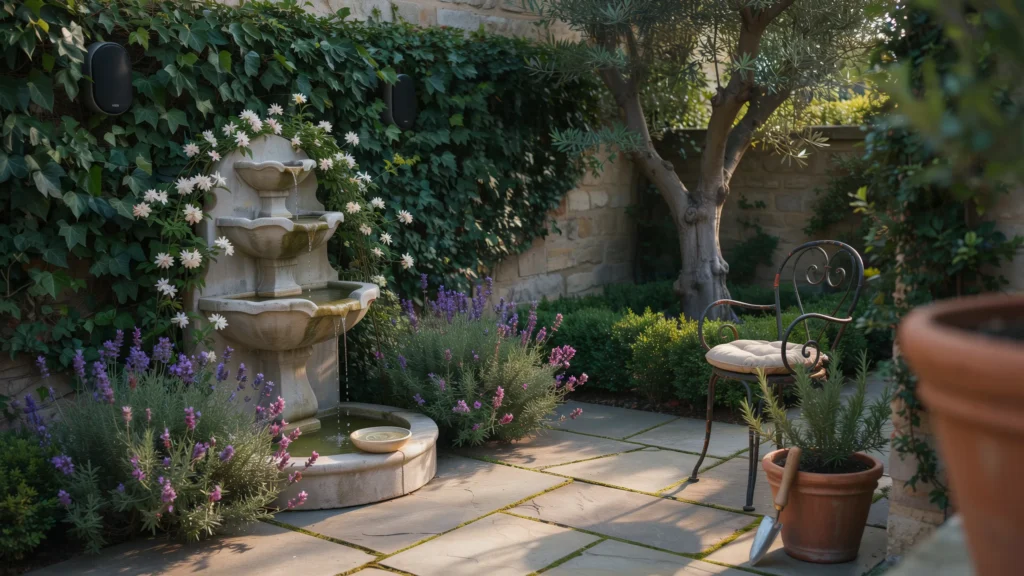
Get it right: add one gentle sound and one or two scented plants near the seating, not across the garden. A small fountain, even a tabletop model, gives a steady trickle that masks distant traffic and gives the ear something pleasant to follow. Place it where you can hear it from the seats without it dominating conversation, usually a few feet to one side of the seating, not directly behind someone’s head.
Outdoor speakers, hidden among plants or mounted under a covered edge, let you play soft music at a low volume that stays in the seating zone. Keep the volume low enough that two people can talk without raising their voices. If you have to raise your voice, the sound is too loud, however pleasant the music is.
Get it wrong: install a large, loud water feature that splashes onto the path, or play music loud enough for the whole garden, so neighbours hear it before you do. Another mistake is planting scented plants far from the seats, where their scent drifts away before it reaches anyone. Lavender, jasmine and rosemary release scent best when they are close to where you sit, warmed by sun and brushed by passing air.
Plant them in pots beside the chairs, or along the edge of the seating, rather than in a far bed. Evening scent matters most, because that is when many people sit outside, so choose at least one plant that releases scent in the evening, such as jasmine, and place it near the evening seating spot.
Essential 8: Layout and flow that let the space work
Layout ties the other seven essentials together. A patio can have good chairs, good light, good heat and good plants, and still feel awkward if people cannot move through it, or if every activity happens in the same crowded spot. Flow is not about a large space. Small patios often flow better than large ones, because every zone has to earn its place and paths stay clear by necessity.
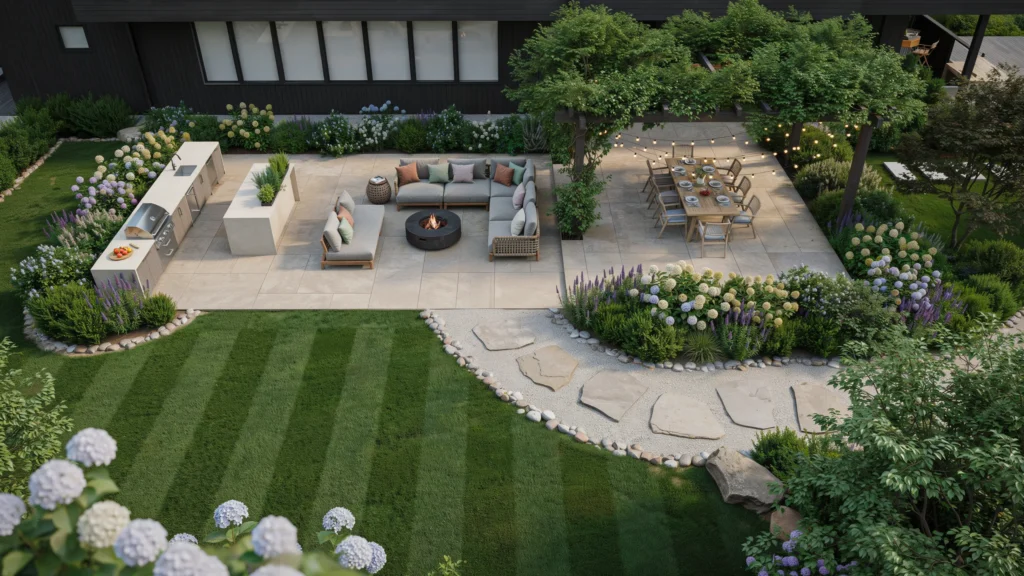
Get it right: divide the space into zones by activity, then connect the zones with clear paths. A typical patio needs two or three zones, not six. A dining zone needs a table, chairs and shade. A lounging zone needs deep seating, low tables and soft light. A cooking or serving zone, if you have one, needs a clear surface, heat safety clearance and a short route to the house.
Define zones with a rug, a planter row or a change in furniture direction, not with bulky dividers that block movement. Leave at least 36 inches of clear width on main paths, and at least 24 inches beside a dining chair so someone can pull the chair out without hitting a planter. Those two numbers prevent most patio frustration.
Get it wrong: push all furniture to the edges to leave a large empty middle, so the patio feels like a waiting room, or cram every zone into one corner so people trip over planters to reach a chair.
Another mistake is placing the dining table far from the house door, so every meal becomes a long carry with hot plates across the garden. Put dining close to the door if you can, lounging a little further out where the view is best, and storage close to both, so cushions, throws and tools are within a few steps.
If you are working with a balcony or a very small patio, the same zone thinking still applies at a smaller scale, and ideas for balcony kitchenette ideas for small homes show how one wall, a foldaway surface and a clear walkway can carry cooking, serving and sitting without crowding the floor.
Storage is part of layout, not an afterthought. A weatherproof storage box, a bench with storage inside, or a small shed near the patio keeps cushions dry, keeps tools out of sight and keeps the seating clear. Without storage, cushions pile on chairs, tools lean against walls and the patio slowly fills with things that are not seating, lighting or plants. With storage, the patio resets in five minutes at the end of an evening, which makes you far more likely to sit outside the next evening too. Put storage where you use it: cushion storage beside the seating, tool storage near the plants, and serving storage near the dining zone.
Tonight, fix the light first
If you do only one thing after reading this guide, fix the light tonight, because light is the fastest essential to change and the one that most often decides whether you stay outside after dark. You do not need a new fixture to start. Move a lantern onto the table where you sit. Swap a cool white bulb by the seating for a warm one.
Hang one string of warm lights low enough to glow over the chairs, not high enough to light the fence. Then sit down at dusk and see how the space feels. That single evening test will tell you whether the rest of the checklist feels like a chore or like a plan worth finishing.
After light, work through the essentials in the order of your own weakest checks. Fix seating if your chairs hurt. Add shade if midday sun drives you inside. Add plants if the space feels bare, and add storage if clutter keeps creeping back. Work one essential at a time, live with each change for a few evenings, and only then move to the next. A warm and inviting outdoor space is not built in one weekend. It is built by a series of small, right choices, each one making the next evening a little easier to spend outside.
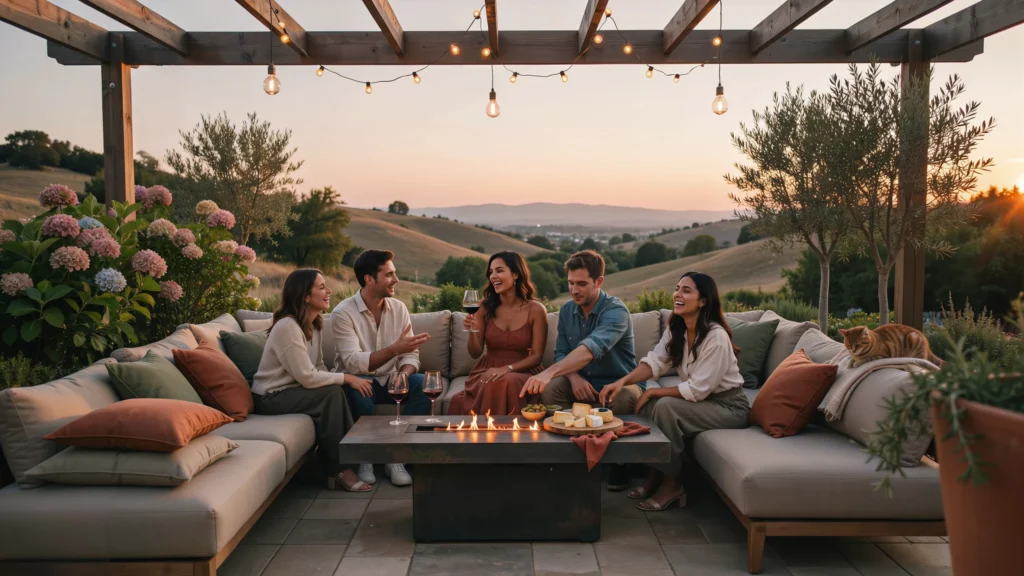
Start tonight, with light, with one chair pulled into the warm glow, and with a drink in reach. The patio does not need to be finished to be used. It needs to be comfortable enough, lit softly enough and clear enough that sitting outside becomes the easy choice.
Build from there, one essential at a time, and the space will grow into the retreat you pictured when you first imagined it. If I had to pick one essential to fix first, it would always be the light, because everything else feels better once the evening glow is right.