Light your mudroom by zone, not by buying one bright fixture and hoping it covers everything. Start at the bench, where you sit, tie shoes and sort bags, then light the door so you can see faces and keys the second you walk in, then add light inside storage so nothing hides in a dark cubby.
Keep the colour warm, around 2700 to 3000K, size the main fixture to the room with the length plus width rule below, and hang pendants low enough to light the bench without shining in your eyes. That simple order fixes most dark, patchy mudrooms.
I used to think my mudroom was just dark because it was small. It was not. One bare bulb in the middle left the bench in shadow, the hooks looked grey, and the bottom cubbies were basically caves. Once I stopped treating it as one room with one light and started thinking in zones, the same small space felt completely different in the evening. Shoes were easy to find, coats did not blend into one dark lump, and coming home felt calmer.
That is the plan behind the 16 ideas below. They are grouped by where you actually use light: the door zone, the bench zone and the storage zone. You do not need all 16. Pick one solid light for each zone, keep the colour consistent, and you will have a mudroom that works on a rainy school morning and still feels welcoming at night.
How to Size a Mudroom Fixture Without Guessing
For a ceiling fixture, add the room length and width in feet, then use that total as the fixture diameter in inches. A mudroom that is 6 feet by 8 feet adds up to 14, so a fixture around 14 inches across is a sensible starting point. For a long, narrow mudroom, two smaller fixtures often beat one large one, because light reaches both ends instead of pooling in the middle.
Brightness is easier if you think in layers rather than one number. A small mudroom typically feels comfortable with a main light that gives a clear, even wash, plus a lower, warmer light near the bench for evenings. If a space still feels gloomy after you change the bulb, the problem is usually placement, not power. Light that only comes from above will always leave the insides of cubbies and the area under a shelf in shadow.
| Ceiling height | Best main fixture | Typical hanging rule | Zone to add next |
|---|---|---|---|
| Under 8 feet | Flush mount | Flat to the ceiling, no drop | Bench sconces or a table lamp |
| 8 to 9 feet | Semi-flush mount or small pendant | Pendant bottom about 7 feet above the floor in a walkway | LED strips inside storage |
| Over 9 feet | Pendant, lantern or small chandelier | Bottom of fixture well above head height, with light washing the walls | Spotlights for art or hooks |
| Sloped or awkward ceiling | Adjustable spotlights or flush mount | Aim light at the bench and door, not at the ceiling peak | Mirror opposite a window |
Use 2700 to 3000K bulbs through the whole mudroom if you can. Mixing a cold white ceiling light with a warm bench lamp makes the room look uneven, even when both lights are technically bright enough. Stick to one warm range and let dimmers, not colour changes, do the evening softening.
The Door Zone: See Clearly the Second You Walk In
The door zone does the hardest job in the shortest time. You arrive with full hands, wet shoes and no free hand for a switch, and you need to see the floor, the hooks and the faces around you. Light here should switch on easily, reach the floor without glare, and make the entry feel open rather than like a tunnel.
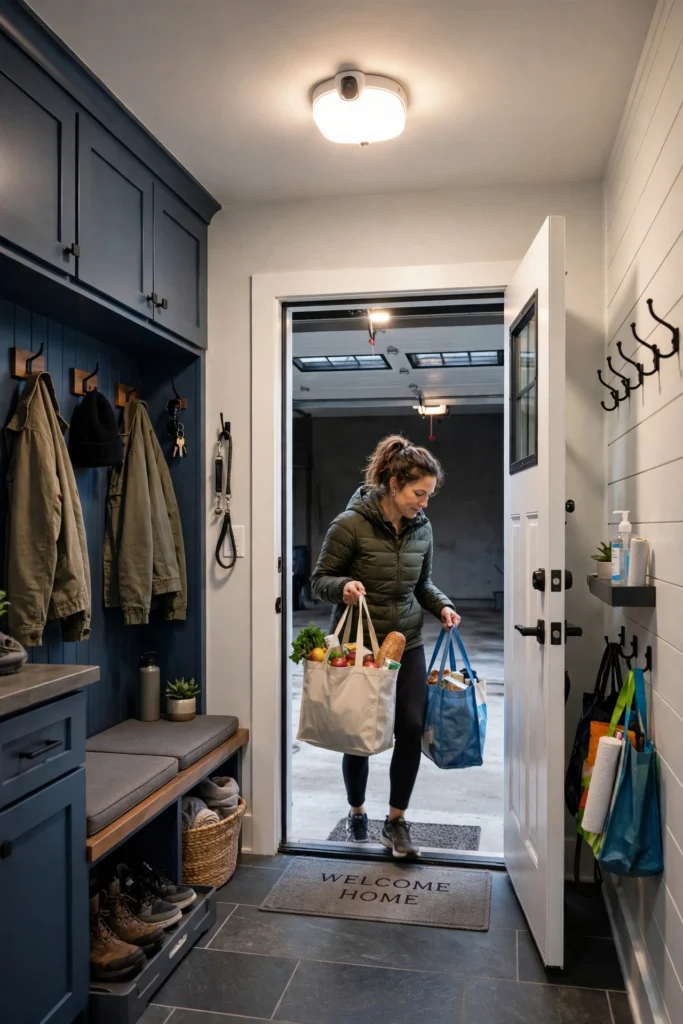
1. Motion Sensor Lighting for Hands Full Arrivals
A motion sensor light is the least glamorous idea on this list and the one I would fit first in a mudroom off a garage or side door. It switches on as you step in and switches off after you leave, so you are not fumbling for a switch with grocery bags or a dog lead in your hands.
Place the sensor so it sees the doorway, not the whole hallway beyond it, or it will trigger every time someone walks past. Set the timer short, typically a few minutes, and keep the bulb warm at 2700 to 3000K so a midnight arrival does not feel like a security light. Avoid pointing a bare sensor bulb straight at eye level by the door. A shaded fixture or a sensor paired with a ceiling light gives you the convenience without the harsh blast.
2. A Dutch Door That Lets Daylight Do Some Work
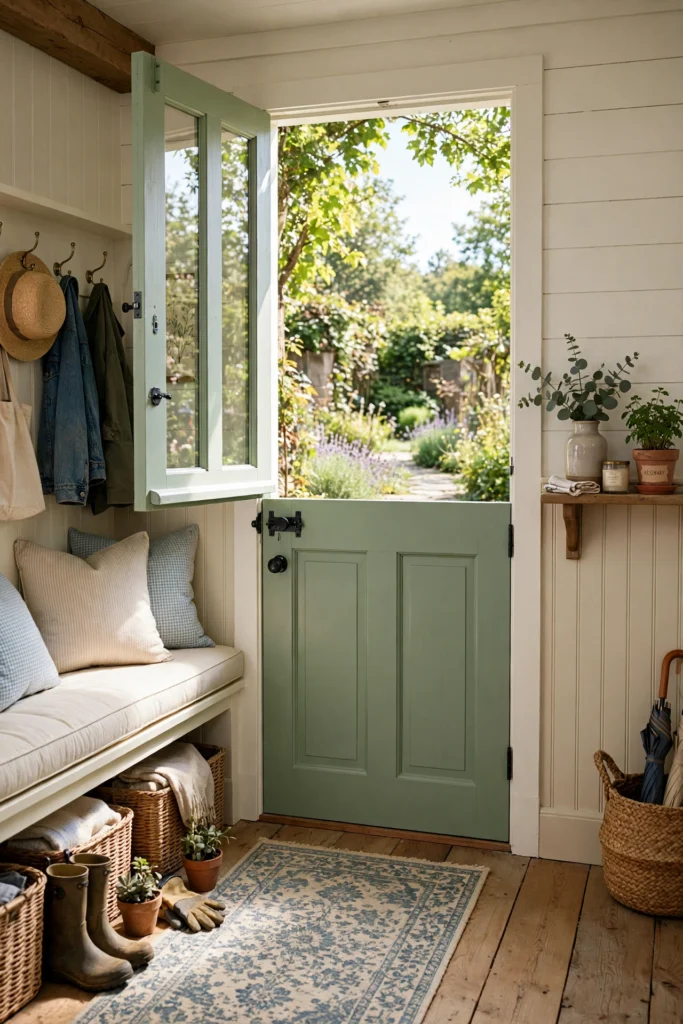
If your mudroom stays dark even with good bulbs, the door itself may be part of the problem. A Dutch door splits into an upper and lower half, so you can open the top for daylight and fresh air while the bottom stays shut. That is useful with small children or pets, and it changes how the whole entry feels during the day.
Daylight from a half open door is soft and sideways, which is flattering and practical. It lights faces and the bench without the flat look of a single ceiling bulb. Keep the wall opposite the door light in colour if you can, and avoid a dark, glossy paint right by the door, because it will show every scuff and absorb the light you just gained. A Dutch door is a bigger job than changing a bulb, so treat it as a daylight fix first and a style choice second.
3. Lantern Fixtures That Make a Small Entry Feel Considered
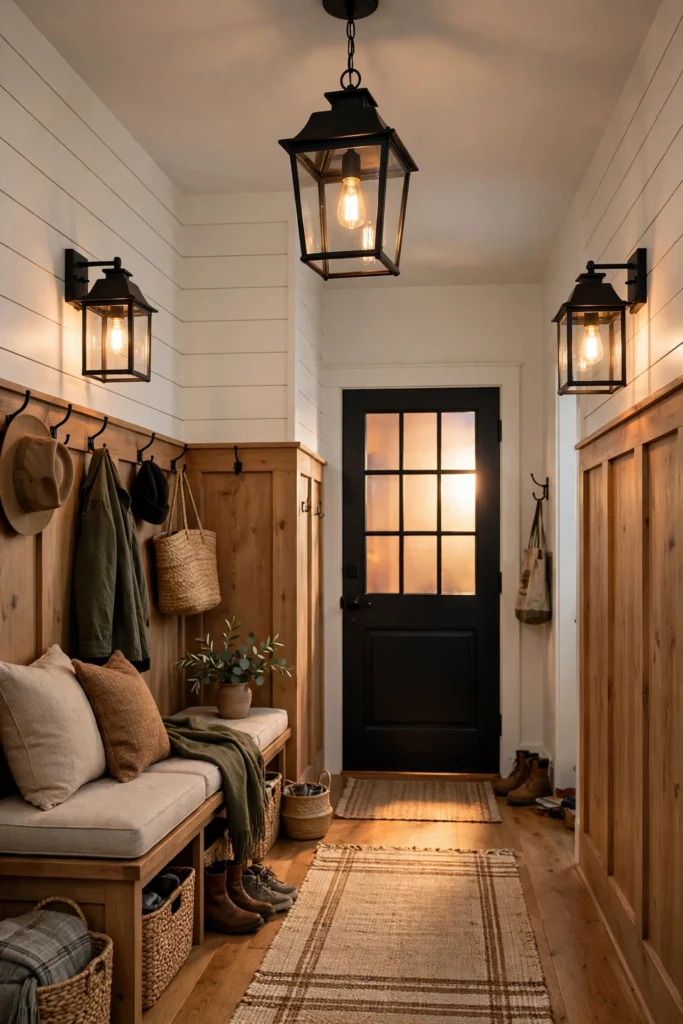
Lantern fixtures suit mudrooms because their shape reads clearly even in a small space. A ceiling lantern gives a central glow, while a pair of wall lanterns can mark the path from the door to the bench. Matte black feels traditional and grounding, brushed nickel feels a little lighter and more modern.
Size matters more than style here. A lantern that is too large over a narrow door will dominate the entry, while a tiny one will look lost. Use the length plus width rule from the table above for a ceiling lantern, and for wall lanterns keep the glass at or just above eye level when you stand by the door, so the bulb is shaded by the frame rather than glaring at you. Avoid clear, unshaded bulbs in a lantern at face height. Frosted or seeded glass softens the light and still keeps the lantern shape.
4. A Mirror Opposite the Window to Double What Daylight You Have
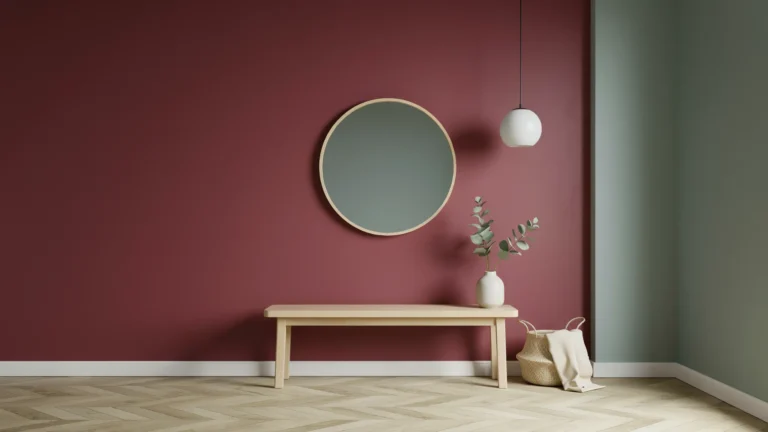
A mirror is the cheapest lighting upgrade in this whole post, because it does not use electricity at all. Hang it on the wall opposite a window and it bounces daylight back into the room, which can make a narrow mudroom feel wider and less like a corridor. It also gives you a last check before you leave, which is honestly why most of us end up loving it.
Keep the mirror at a height where most adults in the house can use it without crouching, with the centre roughly at eye level, and avoid hanging it where it reflects a messy shelf or a bright bulb straight back at you. If you are working with a very small entry, these entryway decoration looks for small spaces show how a mirror, a bench and a few hooks can share one wall without crowding it. Avoid a mirror directly opposite the front door if it catches the sun at a harsh angle in the afternoon. Slightly to one side still gives you the brightness without the glare.
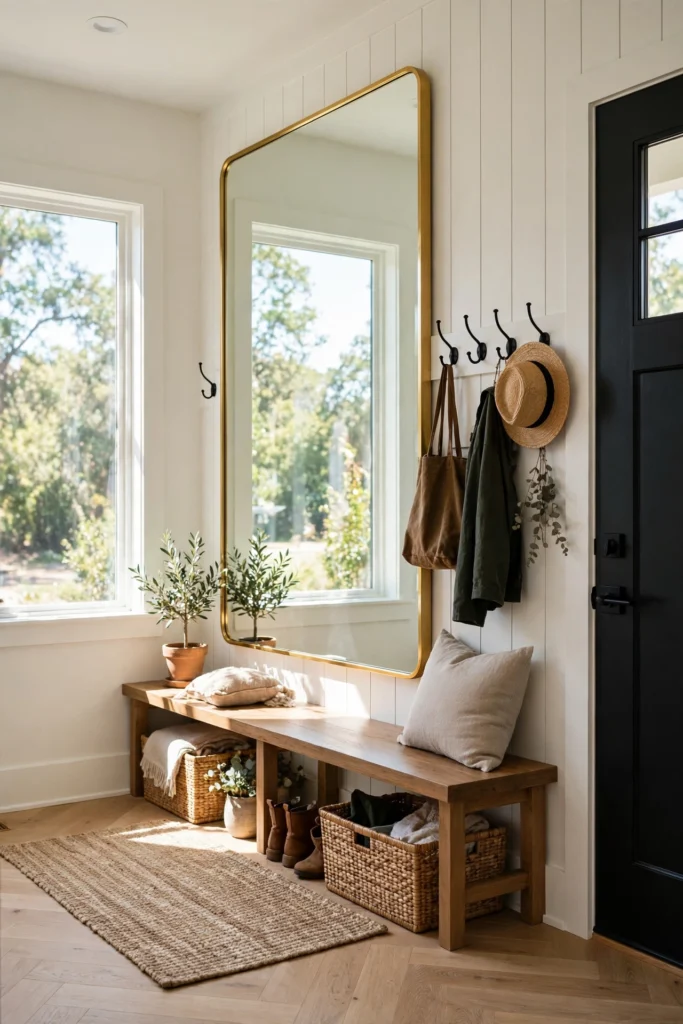
5. Mix Metals on Purpose, Not by Accident
Mixing metals works when it looks chosen. Pick one dominant finish for the mudroom, often matte black or brushed nickel, and one accent finish, often brass or bronze, then repeat each finish at least twice. A black ceiling fixture with black hooks and brass bench hardware reads as intentional. One brass item floating alone among black fixtures just looks like a mistake.
Keep the finish story tight around the door, because that is where eyes land first. Door hardware, hook rail and light fixture should relate to each other, even if they are not an exact match. The same rule helps in darker rooms, where black wall ideas with beautiful lighting show how a dark surface needs warmer, well placed light to avoid feeling heavy. Avoid three or more competing finishes in a space this small. It splits attention and makes the lighting look scattered rather than layered.
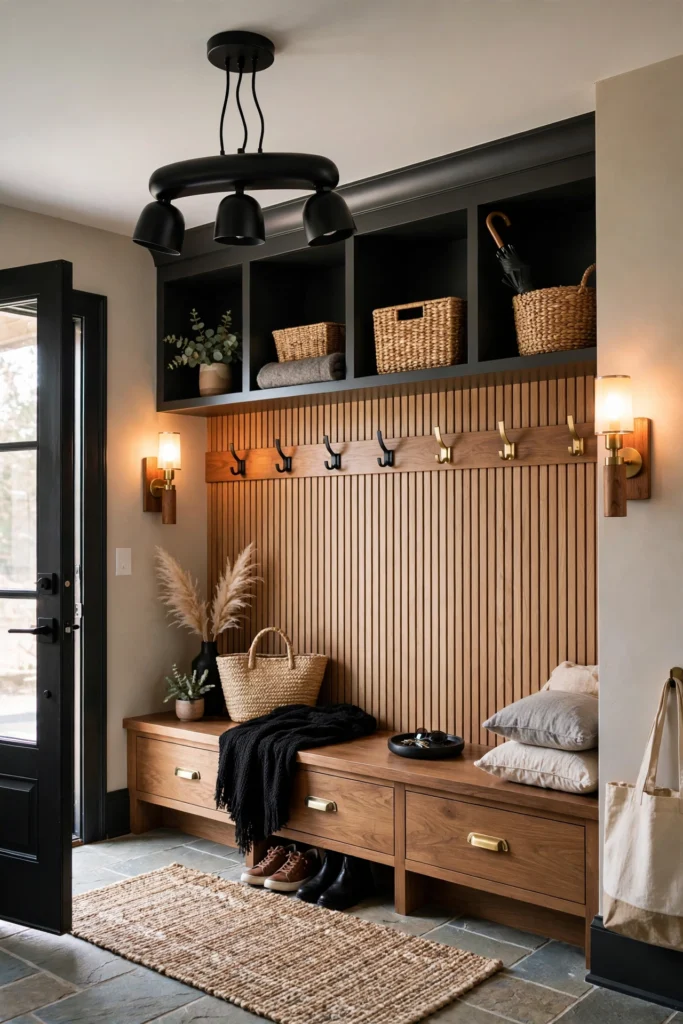
The Bench Zone: Where You Sit, Sort and Get Ready
The bench is where mudroom lighting earns its keep. You sit here to put shoes on, children drop bags here, and keys, mail and sunglasses all end up in a small pile. Light at the bench should be lower and warmer than the main ceiling light, so it feels comfortable to sit under, and it should fall on hands and laps, not just on the wall behind you.
6. A Statement Pendant Over the Bench
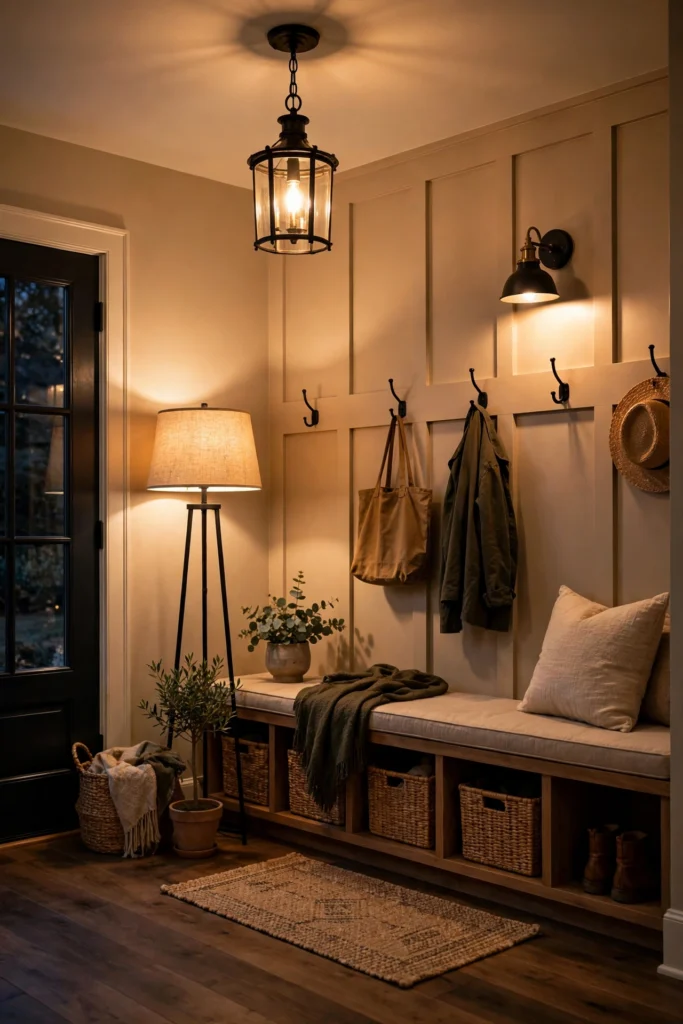
A pendant over a bench gives the mudroom a centre, which matters in a room that can easily feel like leftover hallway. Clear glass keeps the space feeling open, coloured glass adds a focal point, and a sculptural metal shade adds shape even when the light is off. Choose the pendant for the bench length, not just for looks. A shade around one third to one half the bench length usually looks balanced.
Hang it so the bottom sits well above head height if people walk under it, and lower, with the light pooling on the bench surface, if it hangs over a bench against a wall where no one walks beneath it. A useful starting point in an 8 foot ceiling room is a pendant bottom around 7 feet above the floor in a walkway, and a little lower over a fixed bench that is pushed to the wall. Keep the bulb warm at 2700 to 3000K and dimmable if you can, because a pendant that cannot dim will feel too bright in the evening. Avoid a bare, clear bulb at eye level. It will glare every time you sit down.
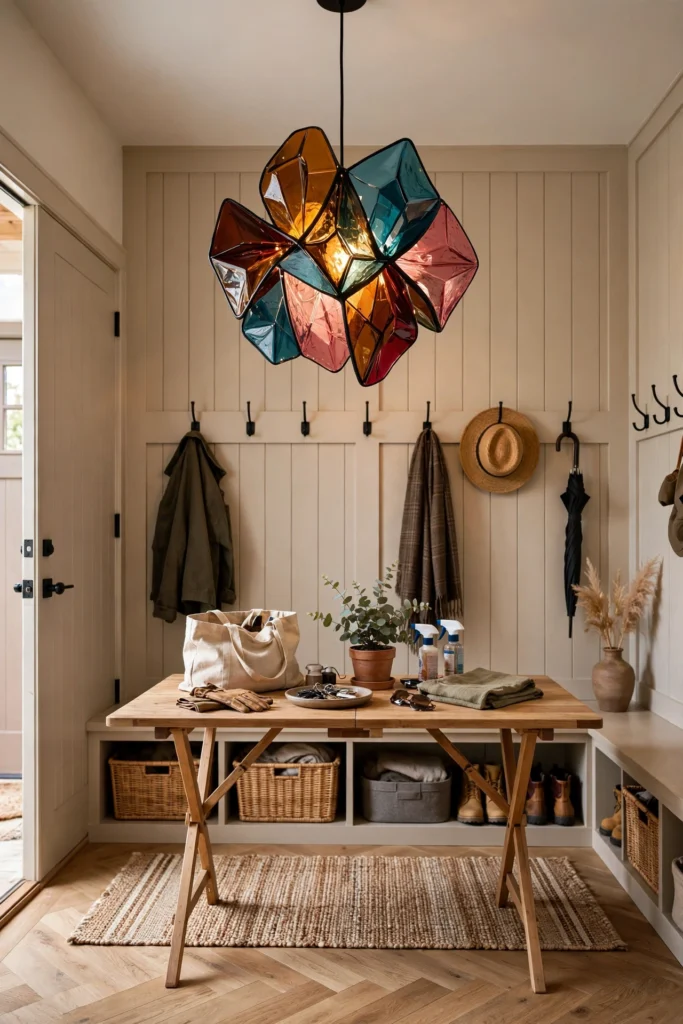
7. A Tall Floor Lamp for a Corner That Needs No Wiring
A tall floor lamp is the easiest bench light to add, because it needs only a plug socket. It adds height to a low room, gives a soft downward wash for reading a label or tying laces, and it can move if you rearrange the bench. Place it at the end of the bench, not in the main walkway, and tuck the cord against the wall so it never becomes a trip hazard.
Look for a lamp around 58 to 64 inches tall for most mudrooms, with a shade that directs light down and out rather than straight up at the ceiling. A warm bulb, typically around 2700K, keeps the corner feeling like part of the home rather than a waiting area. Avoid a floor lamp with a very wide base in a narrow mudroom. It will eat the exact floor space you need for shoes.
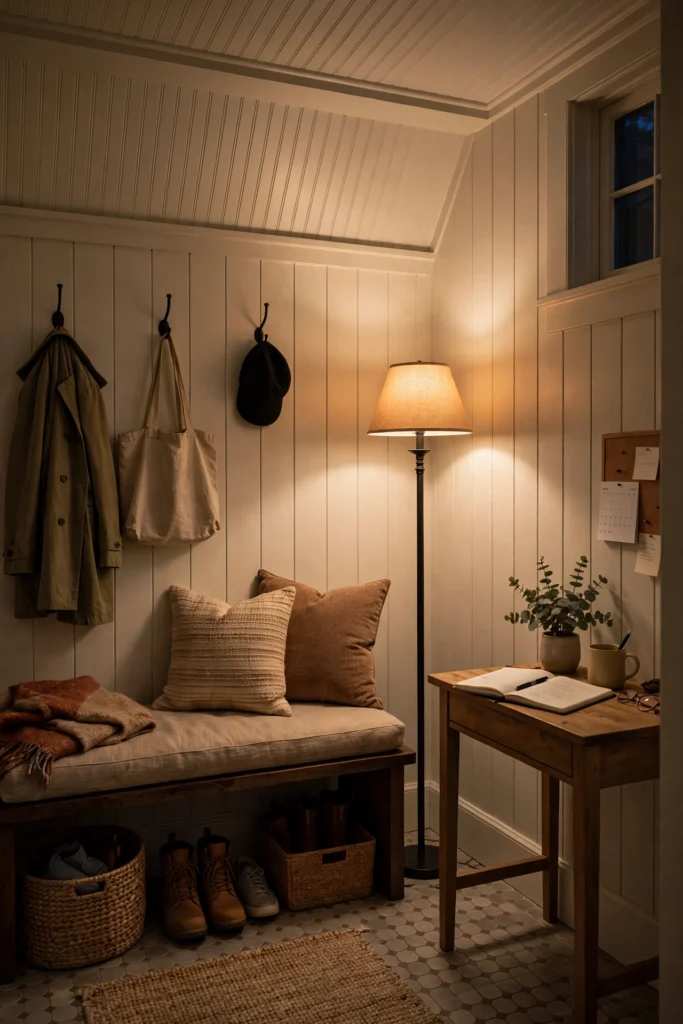
8. Wall Sconces Beside the Bench or Mirror
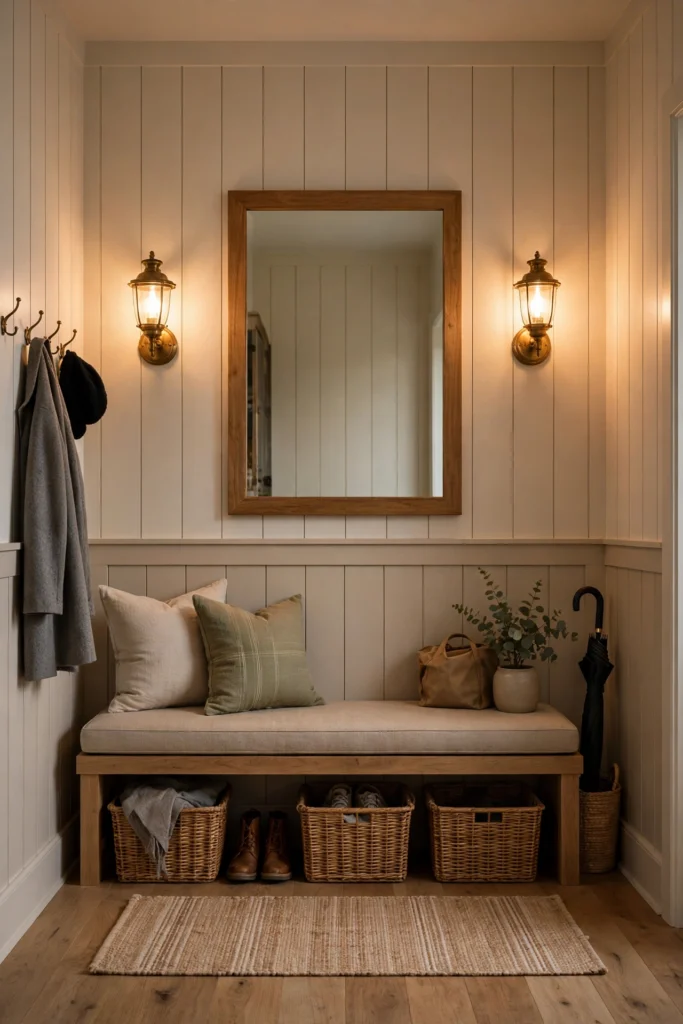
Sconces are brilliant in mudrooms because they use wall space, not floor or shelf space. A pair flanking a bench or a mirror gives balanced light on both sides of your face, which is far more flattering and useful than a single light from above. A single sconce by the door works as a soft night light for late arrivals.
Mount sconces with the centre of the shade around 60 to 66 inches above the floor in most homes, and a little lower if the bench is low and the sconce sits close to it. Keep both sconces at the same height and the same bulb colour, or the symmetry falls apart. If your entry wall is dark, take a cue from black accent wall ideas that create a dramatic focal point, where light is placed to wash the wall gently rather than spotlight one spot. Avoid sconces that stick out too far over a narrow bench. You will bump them with bags and coats every day.
9. A Small Table Lamp on the Bench or Shelf
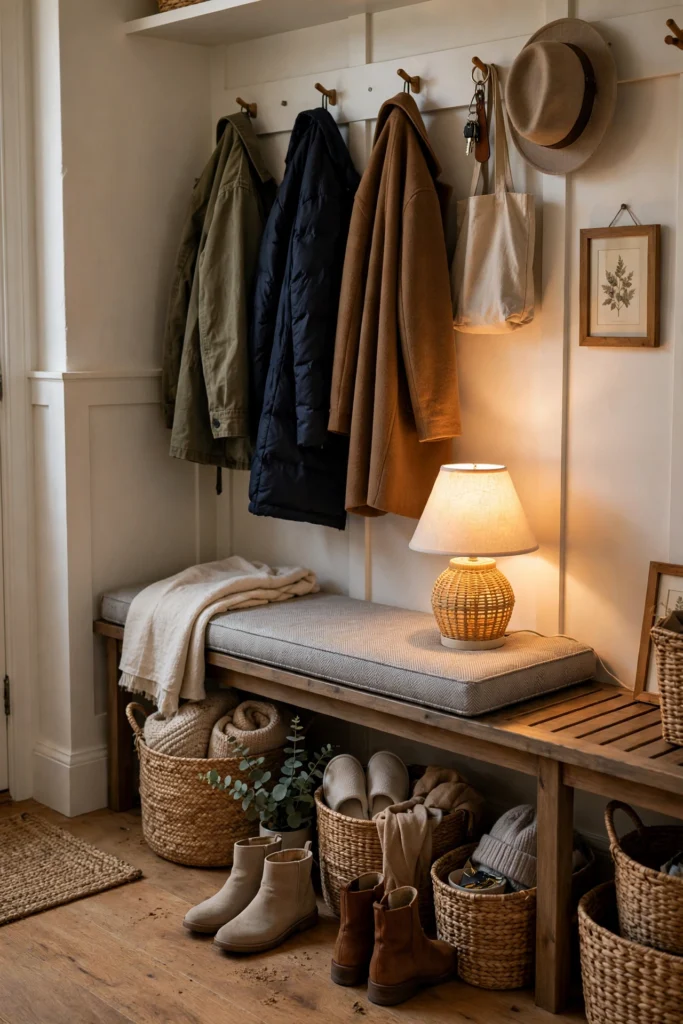
A small table lamp is the most renter friendly light on this list. No wiring, no holes in the ceiling, just a warm pool of light exactly where you drop keys and sort mail. It works on the end of a bench, on a console shelf, or on a cubby shelf that is wide enough to hold it safely.
Choose a lamp short enough that it does not block the hooks above it, typically under 20 inches tall for a bench shelf, with a stable base that will not topple when a bag is dropped beside it. A ceramic or woven base adds texture without needing a big footprint. Keep the bulb warm and modest in brightness, because this lamp is for close work and evening calm, not for lighting the whole room. Avoid placing a table lamp where coats will hang over it. Heat, fabric and a shaded bulb are a poor combination.
10. Soft Mood Lighting for the Evening Wind Down
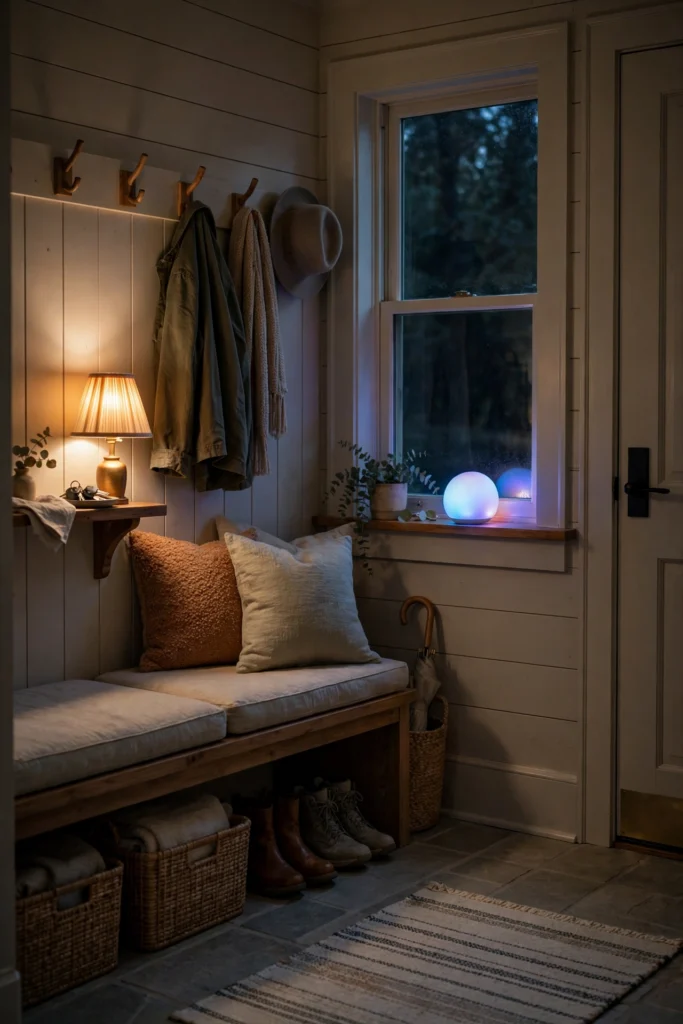
Not every mudroom light has to be for a task. A small warm accent light tucked into a cubby or on a windowsill changes how the entry feels when you come home at night. It says the house is awake and welcoming, without turning on the full ceiling light and waking the whole household.
Use mood lighting as a second layer only, never as the only light in a mudroom you use for shoes and bags. A colour changing orb or a dimmable warm lamp works best when it stays in the warm range in normal use, around 2700K, with any colour setting kept for occasional fun rather than daily use. Avoid bright, cool mood lights by the door. They make skin tones look washed out and make the entry feel more like a shop than a home.
The Storage Zone: Light Inside Cubbies, Shelves and Hooks
Storage is where mudrooms fail quietly. The ceiling light looks fine from the doorway, but inside each cubby it is dark, under each shelf it is shadowed, and the back of the hook rail disappears. Lighting this zone is less about a beautiful fixture and more about putting small amounts of light exactly where hands go.
11. Layer Light Instead of Relying on One Bulb
Layering is the principle behind the whole zone plan. Ambient light from the ceiling gives general brightness, task light at the bench helps with shoes and bags, and accent light inside storage or on art adds warmth and depth. No single bulb has to do all three jobs, which is why a layered mudroom feels brighter even when the total wattage is similar.
Start with the ceiling light, add the bench light, then add one storage light, and stop to live with it for a few evenings before adding more. That pause matters, because it is easy to over light a small room until it feels clinical. Dim the ceiling light in the evening and leave the bench or storage light on low, and the mudroom will feel like a room, not a corridor. Avoid layering with mixed bulb colours. One warm range across all layers keeps the layers feeling like one plan.
12. A Flush Mount Fixture for Low Ceilings
If your ceiling is under 8 feet, a flush mount is usually the safest main light. It sits flat against the ceiling, so no one bumps their head carrying a tall box, and it still throws an even wash across the room. Modern flush mounts come in ribbed glass, brushed brass frames and simple linen shades, so flat to the ceiling no longer has to mean plain.
Size it with the length plus width rule, and check the diameter against the narrowest part of the room. In a mudroom that is only 4 feet wide, a very wide flush mount can feel heavy overhead, even if the length plus width total suggests it. Choose a fixture that spreads light sideways as well as down, and avoid a single exposed bulb flush mount that creates a harsh spot in the middle and shadows at the edges.
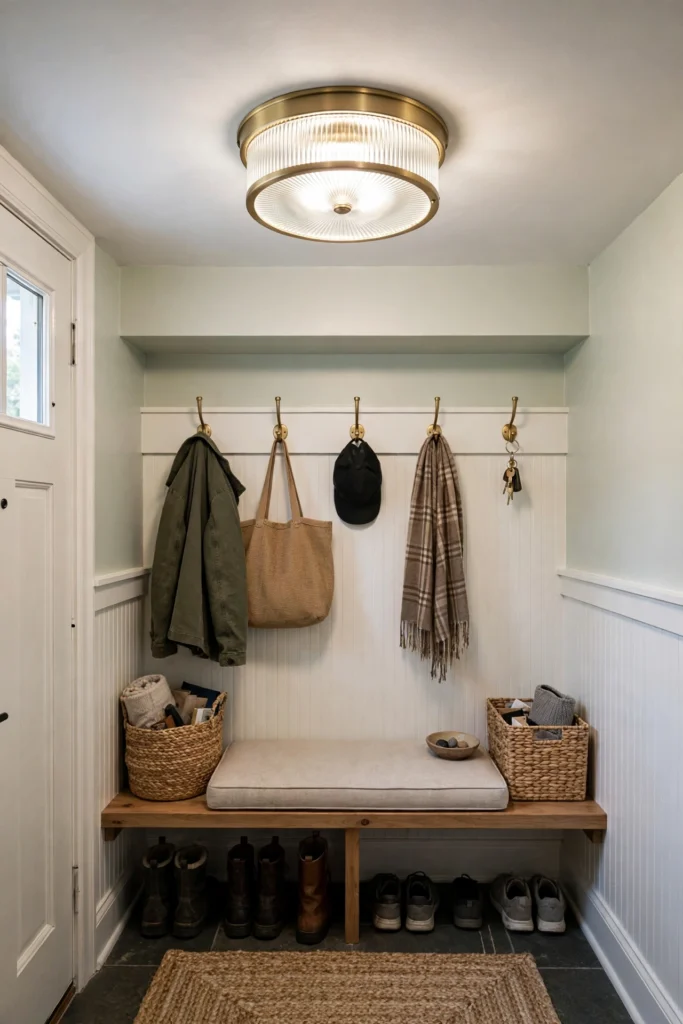
13. A Semi-Flush Mount for a Little More Presence
A semi-flush mount hangs a few inches below the ceiling, which gives it more presence than a flush mount without needing pendant height. It suits ceilings around 8 to 9 feet, where a flat fixture can feel a bit lost but a pendant would hang too low. Fluted glass, woven rattan and sculptural metal versions all work, as long as the shape suits the rest of the mudroom.
Keep the drop short, typically 4 to 8 inches below the ceiling for this kind of fixture, and make sure the lowest point stays well above head height in any walkway. Pair it with a warm dimmable bulb so you can brighten it for cleaning and sorting, then soften it in the evening. Avoid a semi-flush mount with downward only light in a mudroom with dark cubbies. You will still need a storage light to fill those shadows.
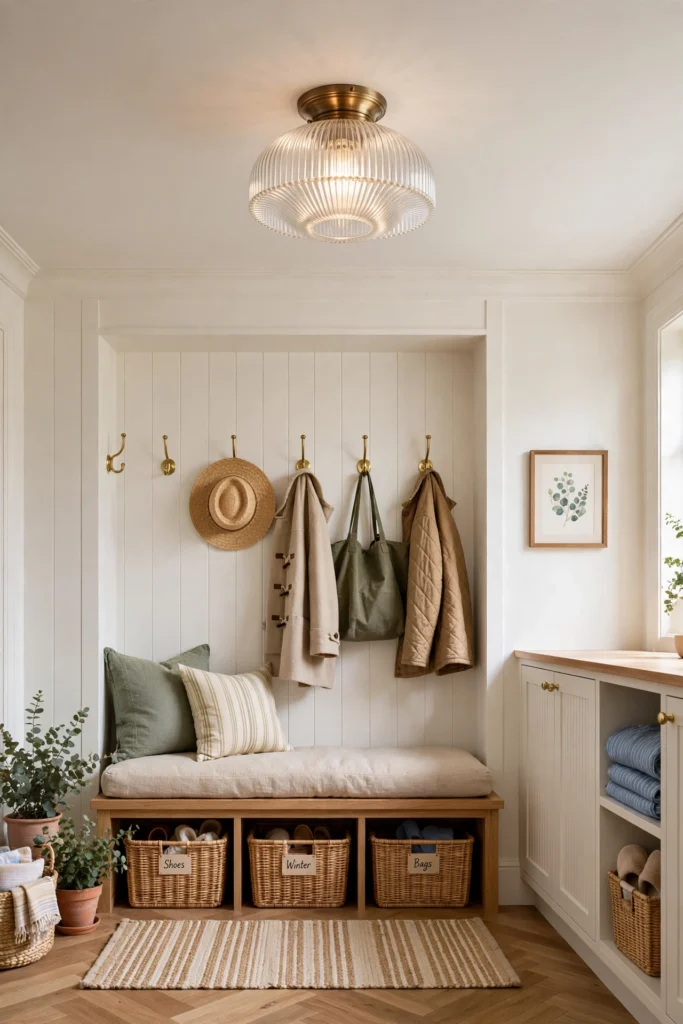
14. LED Strips Under Shelves and Inside Cubbies
LED strips fix the exact shadows ceiling lights cannot reach: under a shelf, inside a cubby, along the back of a bench. They are slim, flexible and often adhesive backed, so they fit where a normal fixture never could. A strip under each shelf turns a dark row of cubbies into usable storage, because you can actually see which pair of shoes is which.
Mount the strip toward the front edge of the shelf, set back just enough that you do not see the bare diodes from standing height, and aim the light back into the cubby. Warm white, around 2700 to 3000K, keeps shoes, bags and coats looking natural. If you like the storage thinking here, the same hide it in plain sight approach works in smart storage solutions for a small laundry room, where light and shelf depth do more work than extra furniture. Avoid cool white strips in a mudroom with wood tones. They make wood look grey and make the space feel colder than it is.

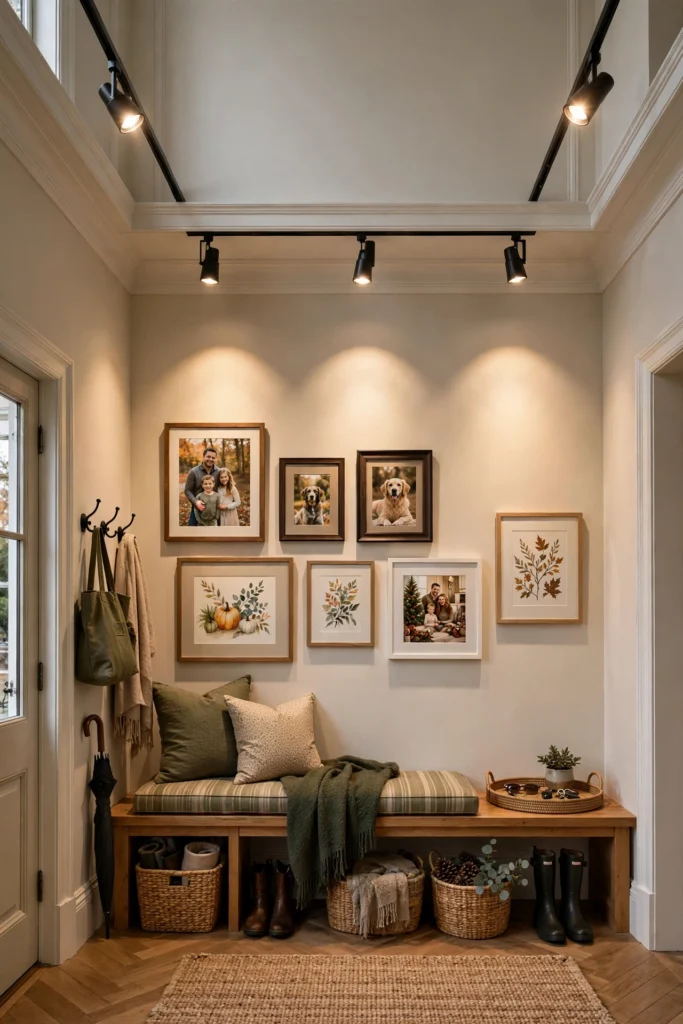
15. Ceiling Spotlights for Art, Hooks and the Wall You Love
Spotlights let you point light where the ceiling fixture cannot. Aim an adjustable spotlight at family photos, seasonal art or a gallery wall above the bench, and that wall becomes a focal point instead of a flat backdrop. This works especially well in larger mudrooms, where a central light alone leaves wall decor looking dull.
Angle spotlights at about 30 degrees from the wall for art, so the light washes the piece without creating a hard hotspot, and keep the beam narrow enough that it does not spill onto the ceiling. If you have already dressed the wall, these mudroom wall decor ideas for a welcoming entryway pair naturally with a spotlight plan, because the light should follow the decor, not fight it. Avoid aiming spotlights straight down at a glossy frame or mirror. The reflection will bounce straight back into your eyes.
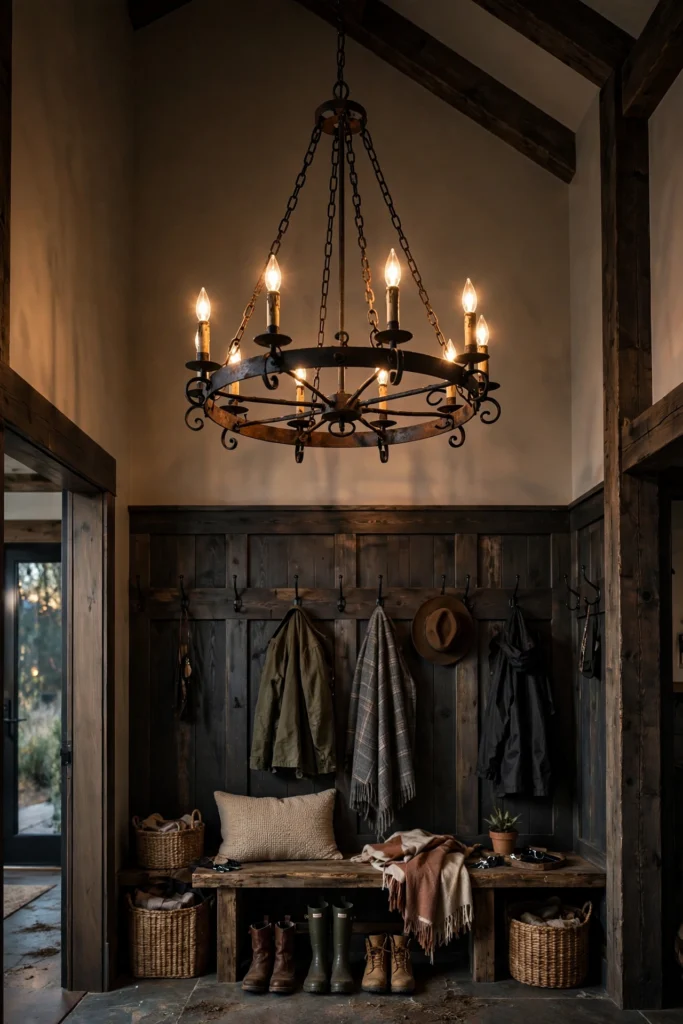
16. A Rustic Chandelier When the Ceiling Allows It
A chandelier in a mudroom sounds extravagant until you see one in a room with the height for it. In a mudroom with a ceiling over 9 feet, a small rustic iron chandelier or a simple crystal version turns a drop zone into a room that feels finished. It works because the height gives the fixture room to breathe, and the multiple bulbs spread light more evenly than a single pendant.
Size a chandelier by the room, not by drama. Use the length plus width rule as a starting diameter, then check that the bottom of the fixture stays at least 7 feet above the floor in any walkway. Keep the bulbs warm and dimmable, because a chandelier at full brightness in a small entry can feel harsh. Avoid a chandelier in a low ceiling mudroom, no matter how much you love the look. Head height and safety come first, and a semi-flush mount will give you a similar feel without the risk.
Mudroom Lighting Questions, Answered Plainly
What is the best lighting for a mudroom?
A layered plan works best: a ceiling fixture for general light, a bench light for close work, and a small storage light for cubbies and shelves. One bulb alone will always leave part of the room in shadow.
How bright should mudroom lighting be?
Bright enough to find shoes, read labels and see the floor clearly, but not so bright that the entry feels like a workspace at night. A dimmable ceiling light plus a warm bench light gives you both settings without changing bulbs.
What colour temperature should I choose?
Choose 2700 to 3000K through the whole mudroom. That warm white range flatters wood, coats and skin tones, and it keeps the entry feeling like part of the home. Avoid mixing warm and cool white bulbs in the same small room.
Can I add mudroom lighting without hardwiring?
Yes. Plug in sconces, battery LED strips, table lamps and floor lamps all add useful light without an electrician. They are a good first step in a rental, and you can keep them if you later add a wired fixture.
How high should I hang a pendant in a mudroom?
In a walkway, keep the bottom of the pendant around 7 feet above the floor so no one walks into it. Over a bench pushed against a wall, you can hang it a little lower so the light pools on the bench, as long as it stays above head height when you sit down.
How do I brighten a mudroom with no window?
Layer warm light, use a mirror to bounce what light you have, keep walls light in colour, and add LED strips inside storage. Those four moves together usually do more than simply fitting a brighter ceiling bulb.
Light the Bench First, Then the Rest Follows
If you take only one idea from this post, make it this: light the bench first. Sit on the bench in the evening, turn on the lights you already have, and notice where the shadows fall. Is your lap dark? Are the cubbies black holes? Is the door area too dim to see keys? Fix those three spots in that order, and the mudroom will start to work.
Keep the colour warm, keep the sizes honest to the room, and resist the urge to buy every fixture at once. One good ceiling light, one kind bench light and one small storage light, all in the same warm range, will beat a room full of mismatched bright fixtures every time. Your mudroom does not need to look like a showroom. It just needs to welcome you home, help you find what you need, and let you leave in the morning without hunting for a shoe in the dark.
- Start with the bench light, then the door light, then storage light.
- Keep all bulbs in the 2700 to 3000K warm range.
- Size ceiling fixtures with length plus width in feet, read as inches.
- Check hanging heights before you buy, not after you install.