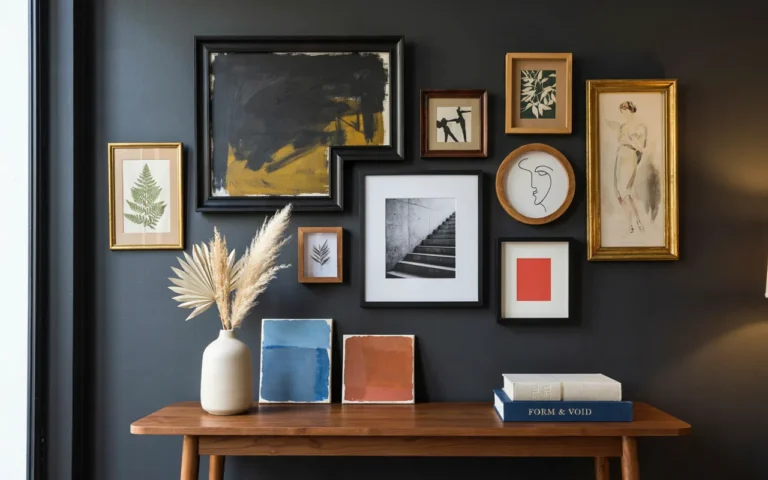
Most reading corners fail for a simple reason. The chair looks good in a photo, but nobody wants to sit in it for an hour. The light is pretty, but it falls on the wrong shoulder. The shelves are full, but the book you are halfway through is in another room. A nook that gets used every day is not about buying more things. The reading nook ideas that work best are about putting the seat, the shelves and the light in the right relationship to each other, then leaving enough breathing room around them for a cup, a blanket and a second book.
This guide works through 18 reading nook ideas with bookshelves, from a corner bookcase to a full wall of built-ins, and gives you the measurements that matter for each one. You will find chair sizes, shelf depths, lighting positions and the mistakes that make each layout awkward, so you can pick the version that fits your room instead of forcing a look that only works in a showroom.
The best reading nook has three parts working together: a seat you can sit in for at least an hour without shifting around, bookshelves within arm’s reach, and a light that lands on the page from over your shoulder, not from behind your head. A typical target is 450 to 800 lumens of warm light, around 2700K to 3000K, aimed at the book. If you only have room for one change, fix the light first. A good chair in bad light still goes unused.
For shelves, a depth of 10 to 12 inches suits most novels and hardcovers, with about 10 to 12 inches of clear height between shelves for standard books. Keep your current reads at hand height, heavier books low, and leave a little empty space on every shelf so the nook looks calm instead of crowded.
Reading Nook Ideas: Four Measurements That Save You a Return Trip
Measure the wall before you fall for a bookcase. A freestanding unit that is 30 to 36 inches wide fits most rooms, while a full wall of built-ins needs the whole wall measured in sections, including skirting boards, plug sockets and door swings. Leave at least 30 inches of clear walkway in front of a chair that you pull out to sit in, and check that a recliner or a deep armchair will not block a radiator or a doorway when it is in use, not just when it is pushed back.
Seat depth matters more than seat width. A chair with a seat depth of 20 to 22 inches suits most adults for upright reading, while a deeper seat of 23 to 25 inches works better if you like to tuck a leg up or curl sideways. Sit in the chair with a book before you buy it, if you can, and notice where your lower back lands. A chair that forces you to perch on the edge will not become a habit, no matter how good it looks next to the shelves.
Light deserves the same attention as furniture. Put the lamp on the side of your non-dominant hand, or slightly behind that shoulder, so your own hand and head do not throw a shadow across the page. A floor lamp for a chair usually works best when the bulb sits at or just above your seated eye level, roughly 55 to 65 inches from the floor for a standard armchair. A dimmer helps more than a brighter bulb, because you can turn the light up for small print and down again when you switch to a tablet.
Finally, count your books before you choose shelf space. A single shelf row about 30 inches wide holds roughly one row of standard paperbacks standing upright, and double stacking books in front of each other looks tidy for a week and then becomes a chore. Plan one shelf row for books you are reading now, one for books you reach for often, and let the rest of the collection live higher up or in another part of the room.
| Nook type | Minimum space | Seat that fits | Light that works |
|---|---|---|---|
| Corner L-shaped bookcase | About 4 feet by 4 feet of floor | Compact armchair, 28 to 32 inches wide | Floor lamp behind one shoulder |
| Window seat with shelves | Window wall at least 4 feet wide | Built-in bench, 18 to 22 inches deep | Daylight plus a small wall light for evenings |
| Closet conversion | Standard closet, about 24 inches deep | Bench cushion or small slipper chair | Plug-in sconce or clip-on shelf light |
| Sliver nook for tiny rooms | A strip about 3 feet wide | Armless chair or floor cushion | Wall sconce to save floor space |
| Under-stairs nook | Lowest point at least 4 feet high where you sit | Low bench with drawers underneath | Two small sconces or a strip light under the slope |
| Floor-to-ceiling built-in | A full clear wall, 6 feet or wider | Armchair or chaise in front of the wall | Picture lights or a floor lamp, plus shelf lighting |
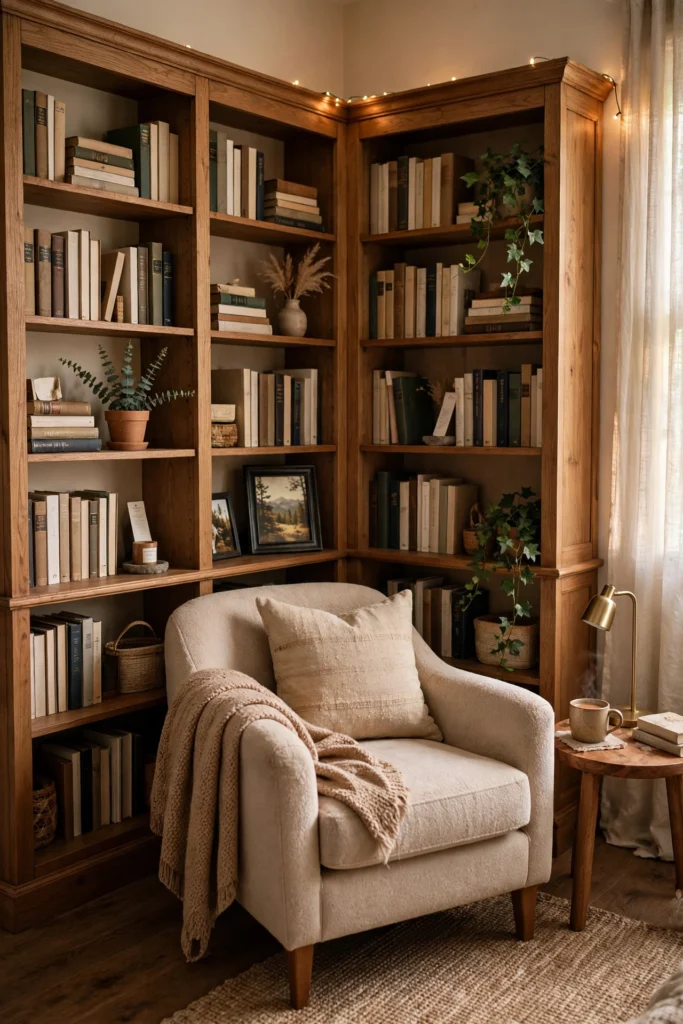
1. Corner L-Shaped Bookcase Nook
An L-shaped arrangement turns the most ignored part of a room into a proper reading spot. Two bookcases meet at a right angle, the chair sits diagonally across from the join, and suddenly you have shelves on both sides without losing the middle of the room. The trick is to angle the chair slightly, about 45 degrees to the corner, instead of pushing it flat against one wall. That angle opens up legroom and stops the nook from feeling like a punishment corner.
Keep the taller case on the side where you need less light, and the lower one on the window side if there is one, so daylight still reaches the chair. Put a small round side table on the open side of the chair, not wedged behind it, and keep the top shelf of the nearer case for books you are actually reading. What to avoid here is filling both cases to the brim. One or two gaps with a small plant or a framed photo make the corner feel like a room, not a storage wall.
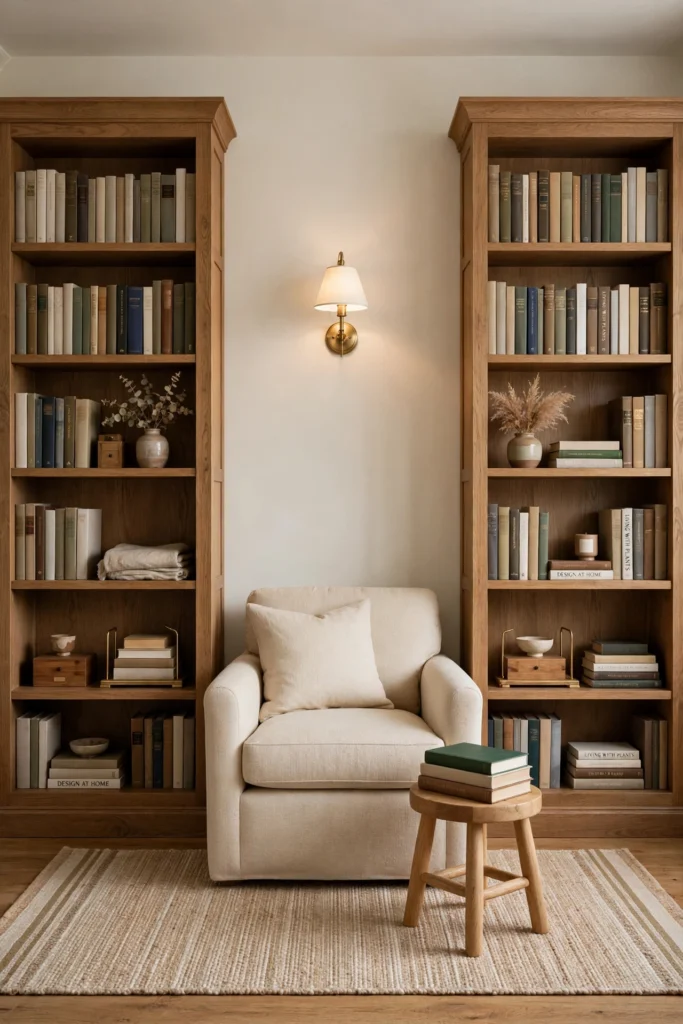
2. Nook Between Symmetrical Bookshelves
Two matching bookcases with a chair in the middle give a room instant order. The symmetry does the decorating for you, which is why this layout suits living rooms that already have a lot going on. For the proportions to work, the gap between the cases should be at least 36 inches wide, enough for a standard armchair plus a few inches on each side so you are not brushing the shelves when you sit down. If the gap is narrower, choose a slipper chair with slim arms or no arms at all.
Match the cases in height as well as width, or the eye will keep sliding to the taller side. A low bench or a small stool between the chair and the shelves can hold a stack of books in progress, and a rug that stretches from one case to the other ties the whole arrangement together. Avoid putting a tall lamp in the gap as well. With shelves on both sides, a wall light or a clip-on shelf light keeps the space open and the light close to the page.
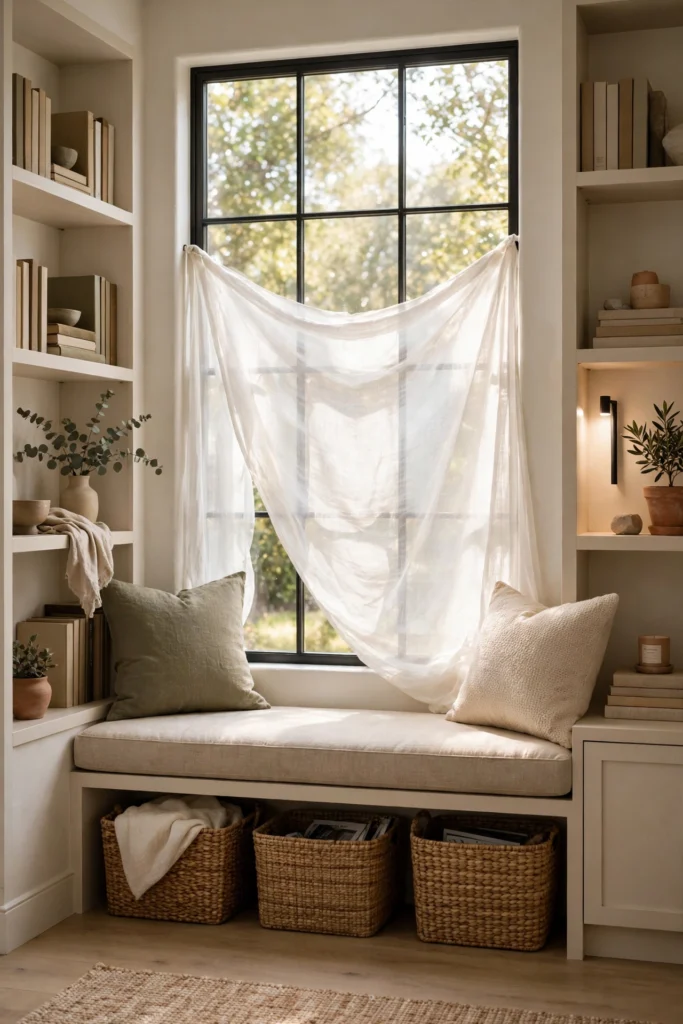
3. Window Seat With Flanking Shelves
A window seat earns its keep twice, once as a seat and once as storage. A bench depth of 18 to 22 inches lets most adults sit with their back against the wall and their feet on the bench, while a cushion 3 to 4 inches thick keeps the seat comfortable without raising you so high that your knees hit the window frame. Shelves on either side of the window hold the books, and the bench base can hide blankets, board games or out-of-season reads behind doors or in baskets.
Daylight is the main advantage here, but it needs managing. Sit sideways to the window rather than facing straight into it, so glare does not wash out the page, and add a sheer curtain if the afternoon sun is strong. For evenings, a wall light on one of the flanking shelves, or a slim floor lamp at the end of the bench, matters more than a ceiling light. The common mistake is building the bench too deep. Past 24 inches, the seat stops feeling like a bench and starts feeling like a bed you have to climb across.
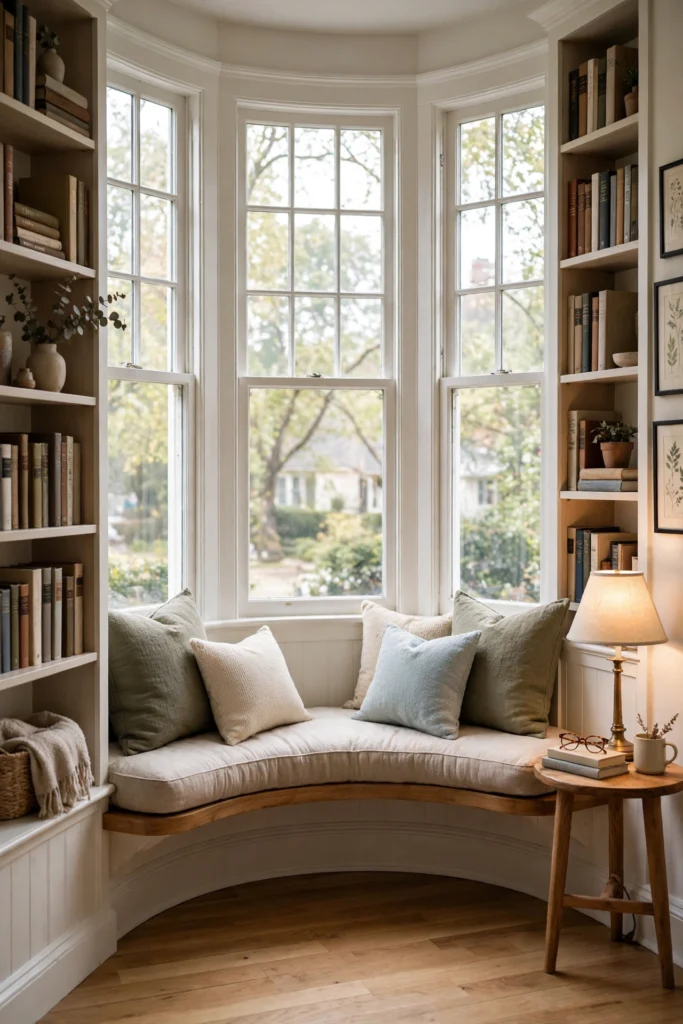
4. Bay Window Library Bench
A bay window already gives you three walls of light and a natural curve to sit in, so the bench just needs to follow that shape. Measure each section of the bay separately, because bays are rarely perfect, and build or buy the bench in sections that meet at the angles rather than forcing one straight bench into a curved space. A seat height of about 18 to 19 inches, cushion included, lets you sit down and stand up without a struggle, and it lines up well with standard side tables if you add one at the end.
Bookshelves work best at the ends of the bay, where the wall returns to the main room, rather than across the windows themselves. That keeps the light coming in and gives you a solid surface for a reading lamp. Use the bench base for the books you read least often, since lifting a cushion to reach a book you want every night gets old fast. Keep the books you are reading now on the end shelves, at arm height, and save the bench storage for the overflow.
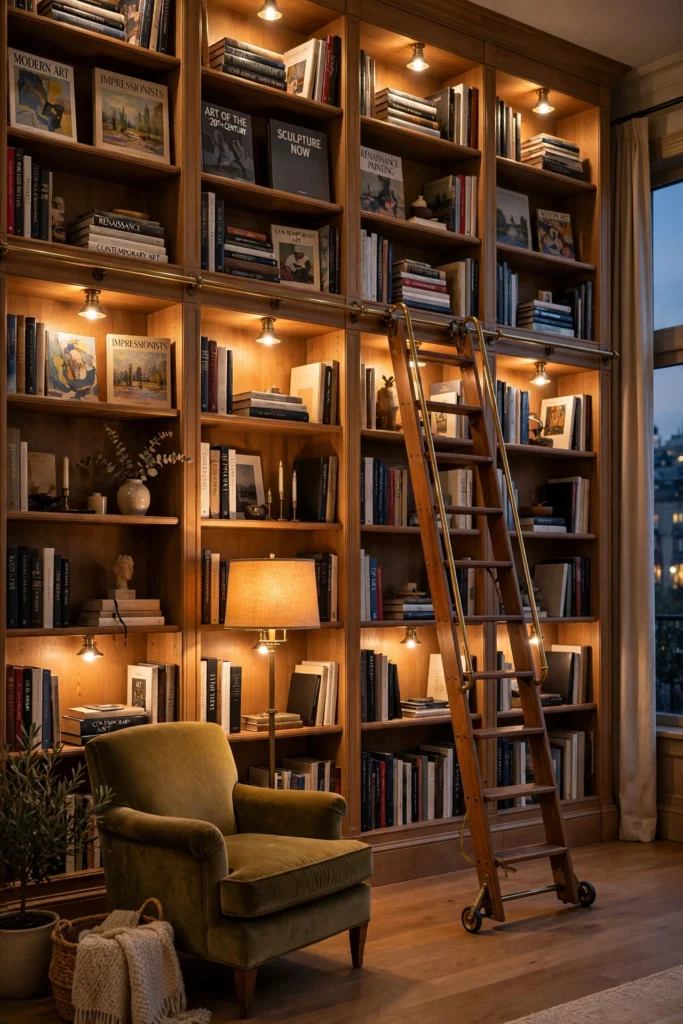
5. Floor-to-Ceiling Built-In With a Rolling Ladder
A full wall of shelves with a ladder looks dramatic, but it only works if the top rows are planned, not just filled. Keep everyday books between knee and eye height, put oversized art books and rarely opened sets up high, and use the ladder for those rows only. A rolling ladder needs a clear rail run and a floor that lets it move, so keep the rug out of its path or choose a rug thin enough for the wheels to roll over.
Tall units like this must be anchored to the wall, especially in a home with children, and the ladder should lock in place before anyone climbs it.
For the chair, pull it at least 3 feet out from the shelves so you can stand, turn and reach a book without shuffling furniture. A floor lamp beside the chair does the real reading work here, while small shelf lights or picture lights on the built-in add warmth in the evening. If you are planning lighting for a dark wall, the same thinking applies as in black TV wall ideas with layered lighting, where the light is aimed at what you are looking at, not scattered across the ceiling.
What to avoid is a ladder that becomes decoration only. If the top two rows are unreachable in practice, they are just dust collectors, so either commit to using the ladder or cap the shelves at a height you can reach with a small step stool.
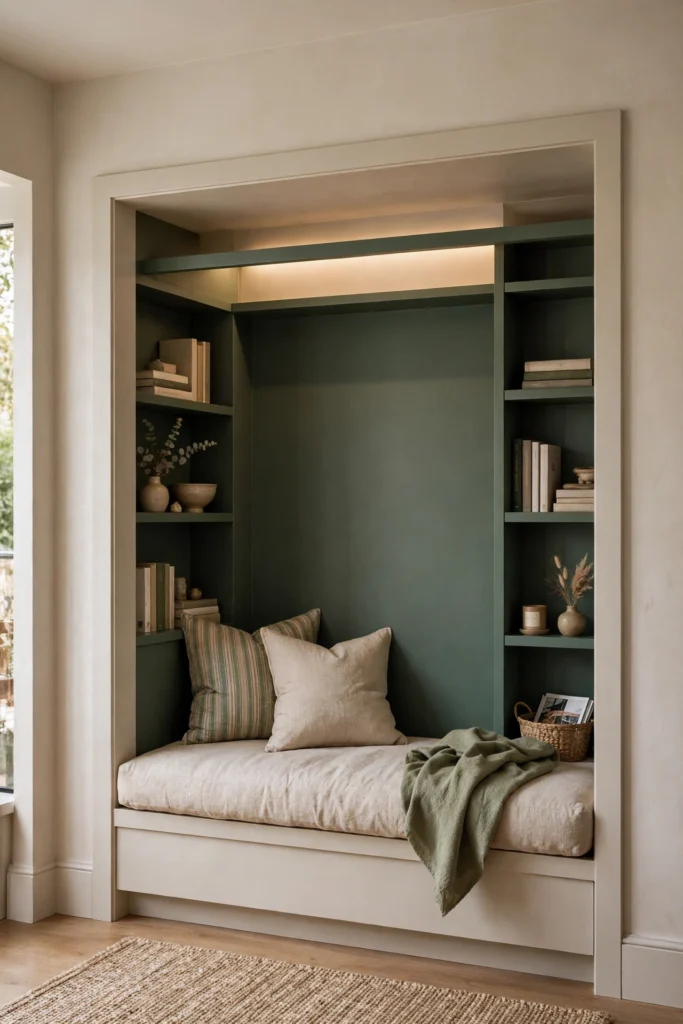
6. Recessed Alcove Built-In
An alcove is a gift, because the walls already frame the nook for you. A bench built wall to wall inside the recess, with shelves above and on the sides, uses space that would otherwise hold nothing but a plant stand. Measure the alcove at the front, the middle and the back, since older walls are rarely straight, and size the bench to the narrowest measurement so it slides in without forcing. A bench depth of 20 to 24 inches works well in a recess, because the side walls give you something to lean against.
Painting the inside of the alcove a slightly deeper shade than the room helps the nook read as its own place, even without a curtain or a screen. Add a cushion with a washable cover, because a bench you sit on daily will collect crumbs, tea and pencil marks, and choose shelf lighting that sits under the top shelf rather than a single bulb in the middle of the recess. One bulb in a deep alcove lights the back wall and leaves the reader in shadow, which is exactly the wrong way round.
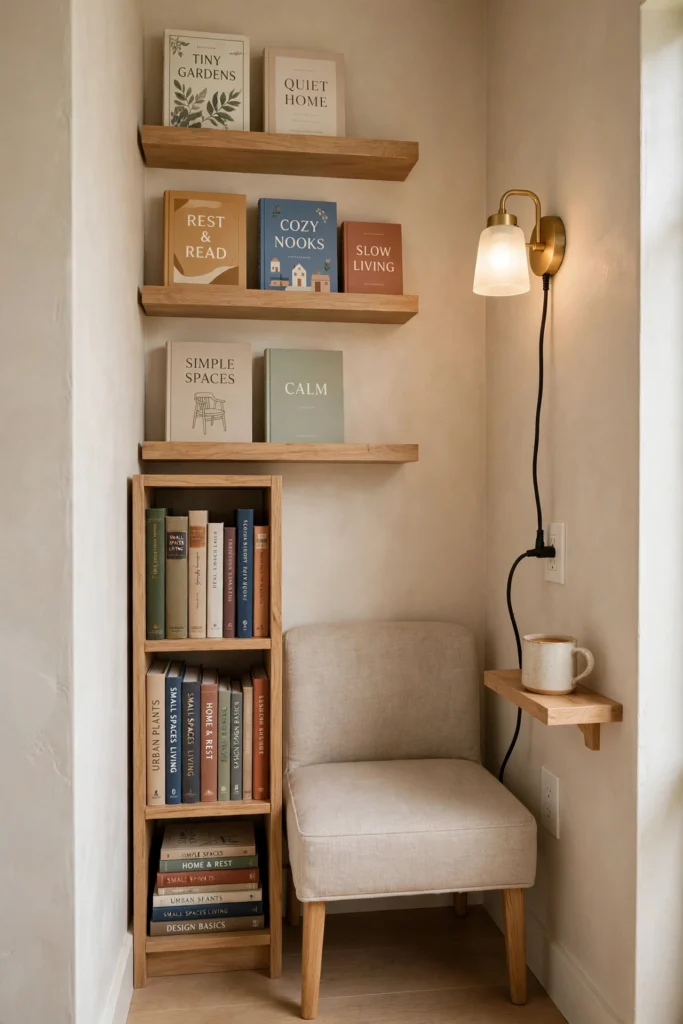
7. Small Sliver Nook for Tiny Spaces
A sliver nook is proof that you do not need a spare room, only a strip of wall about 3 feet wide and a chair that does not fight the space. An armless slipper chair, a small tub chair or even a sturdy floor cushion can work here, provided the seat is deep enough to sit in properly.
Keep the bookshelf narrow, about 12 to 15 inches wide, or use two or three floating ledges stacked vertically. Ledges hold a row of books each, take up almost no floor space, and let you see the covers, which makes choosing the next book part of the pleasure.
Floor space is the currency in a tiny nook, so do not spend it on a floor lamp. A plug-in wall sconce above and slightly behind the chair gives you reading light without a base on the floor, and a small wall-mounted shelf at elbow height can hold a mug. If you live in a studio or a small flat, the same squeeze-every-inch thinking runs through studio apartment layout ideas, where zones are made with furniture placement rather than walls.
The mistake to avoid in a sliver nook is buying a chair first and measuring second. In a 3 foot gap, two inches of extra chair width is the difference between a nook and a traffic jam.
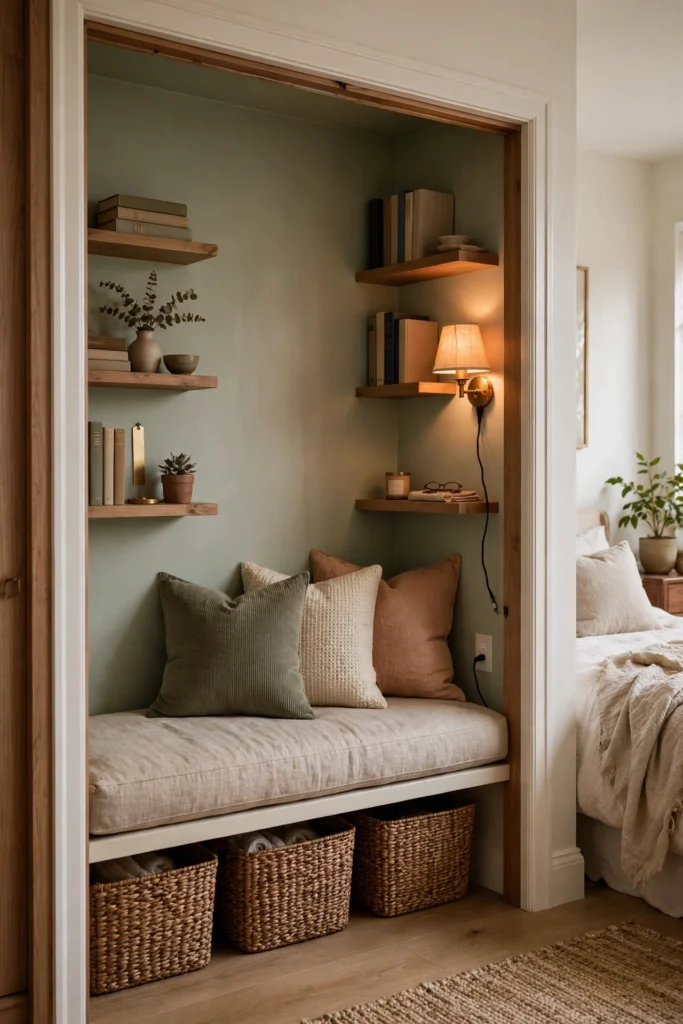
8. Closet-to-Reading-Nook Conversion
Taking the doors off a closet you barely use is one of the cheapest ways to gain a reading room. A standard closet is about 24 inches deep, which is enough for a bench seat with a cushion, and the side walls are ready-made for narrow shelves. Build the bench at a sitting height of 18 to 19 inches, leave the space underneath for baskets or drawers, and put shelves on the side walls at a depth of 8 to 10 inches so books sit securely without crowding your shoulders.
Keep the top shelf for storage you rarely touch, and the shelves at hand height for current reads.
Ventilation and light are the two things people forget in a closet conversion. A small closet can feel stuffy, so leave a gap above the bench back or choose a curtain instead of a solid door if you want to close it off. For light, a plug-in sconce on a side wall or a battery light under a shelf works well, but test it at night before you commit, because a closet has no daylight to fall back on.
And be honest about what lives in that closet now. If the coats and boxes just move to a pile on the bedroom floor, the nook has solved one problem by creating another.
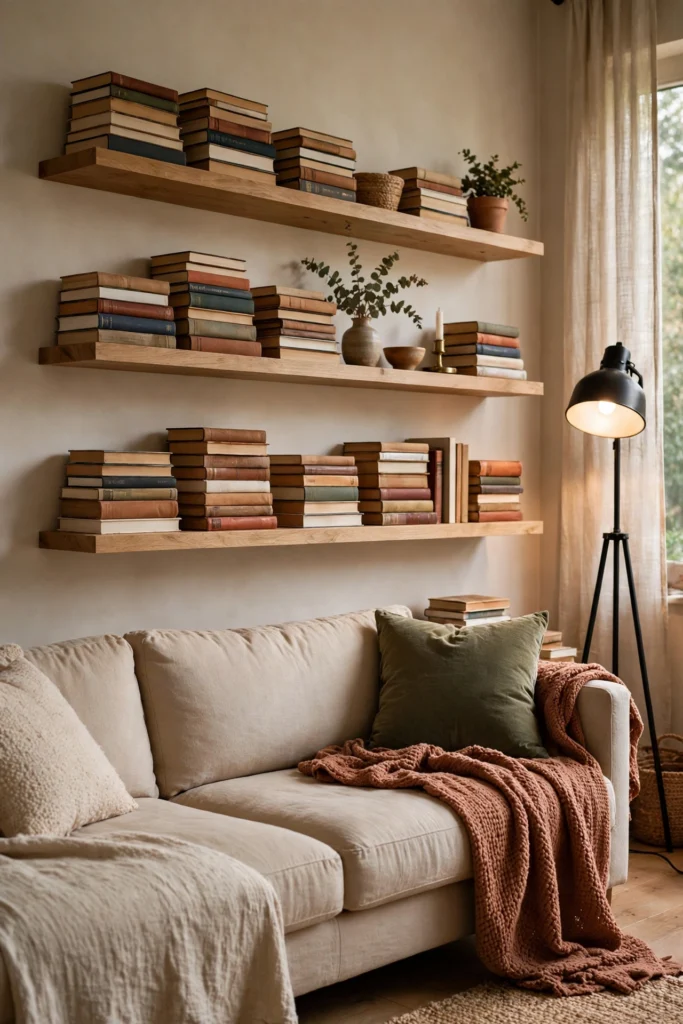
9. Floating Shelf Behind the Sofa
If your sofa already sits against a wall, the wall behind it is a bookshelf waiting to happen, and you do not need to move a single piece of furniture to start. Floating shelves above sofa height, with the lowest shelf about 12 to 18 inches above the sofa back, keep books within reach from a seated position without anyone bumping their head when they stand up. A shelf depth of 8 to 10 inches holds paperbacks and standard hardcovers, and brackets rated for the weight matter here, because a shelf full of books is heavier than it looks.
This layout works best when one end of the sofa becomes the reading end. Add a good cushion, a throw and a floor lamp at that end, and let the other end stay as the television or conversation end. The sofa itself has to support long sitting, so if yours is too firm or too low, it is worth reading comfortable sofa ideas for relaxing spaces before you blame the shelves.
What to avoid is loading every shelf to the edges. Leave breathing room, mix in a few horizontal stacks, and keep the books you are reading now on the lowest shelf, where you can grab them without standing.
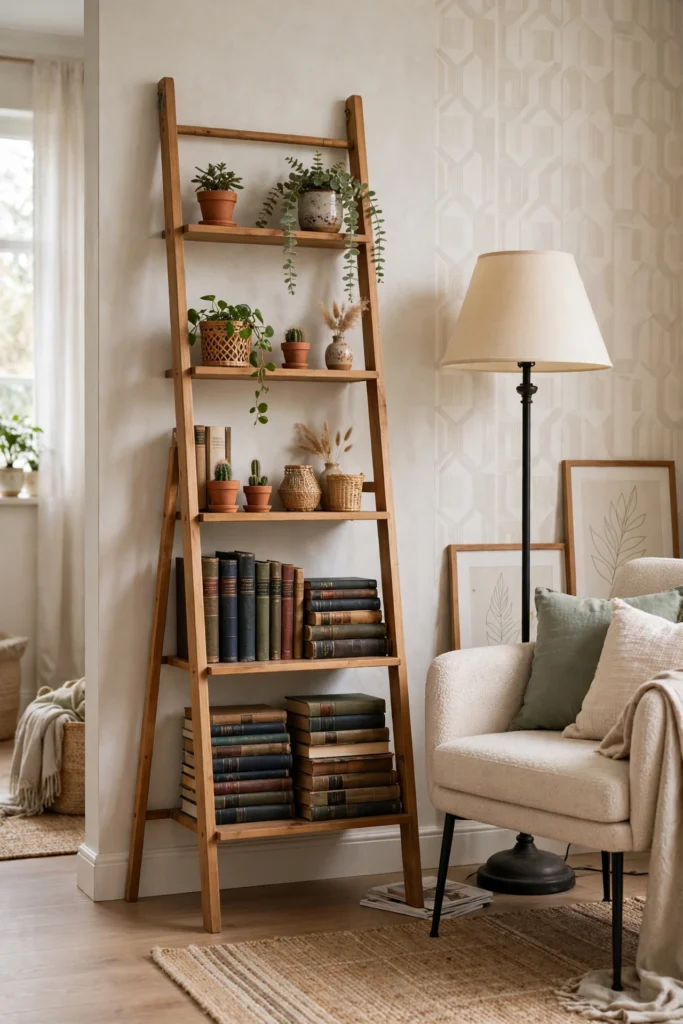
10. Leaning Ladder Bookshelf for Rentals
A leaning ladder shelf is the renter’s answer to a built-in, because it needs no drilling into the wall beyond a small safety strap, and it moves with you. The shelves get shallower toward the top, typically 8 to 10 inches deep at the bottom and less above, so plan accordingly. Put heavier hardcovers on the bottom two shelves, paperbacks in the middle, and light objects or small plants up top, where a deep shelf would be hard to reach and easy to overload.
Pair it with a chair that is easy to move too, since a rental nook often shifts when the room layout changes. A small armchair with a slim profile, plus a floor lamp with a heavy base, makes a nook you can rearrange in an afternoon. Check that the top of the ladder shelf rests flat against the wall and does not wobble when you pull a book out.
If it rocks, a felt pad or a small wall strap fixes it, and that strap is worth fitting even in a rental, because a shelf that tips is a safety issue, not a decorating detail.
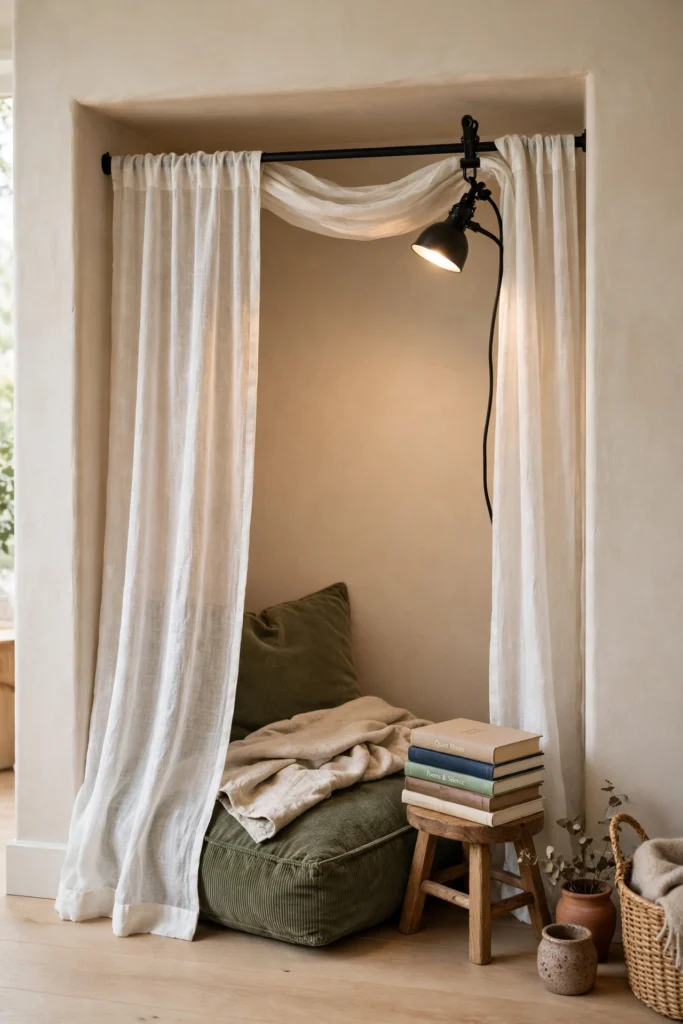
11. Tension Rod Curtain Canopy Nook
A curtain canopy is less about the curtain and more about what it signals. Pull it closed and the rest of the house fades a little, which is exactly what a reader wants at the end of a noisy day. A tension rod works between two walls, across an alcove or inside a wide window recess, and it needs no screws, so it suits rentals and anyone who changes their mind often. Choose a light fabric that lets some light through rather than a heavy blackout curtain, or the nook will feel dark even in the daytime.
Inside the canopy, keep the setup simple. A floor cushion or a small chair, one narrow shelf or a stack of books on a stool, and a clip-on light that attaches to the shelf or the chair arm. The light matters more here than anywhere else, because the curtain cuts ambient light from the room. Test the curtain length too. A curtain that pools on the floor will trip you every time you step in, so hem it to just above floor level and keep the entrance side easy to push aside with one hand while you hold a book in the other.
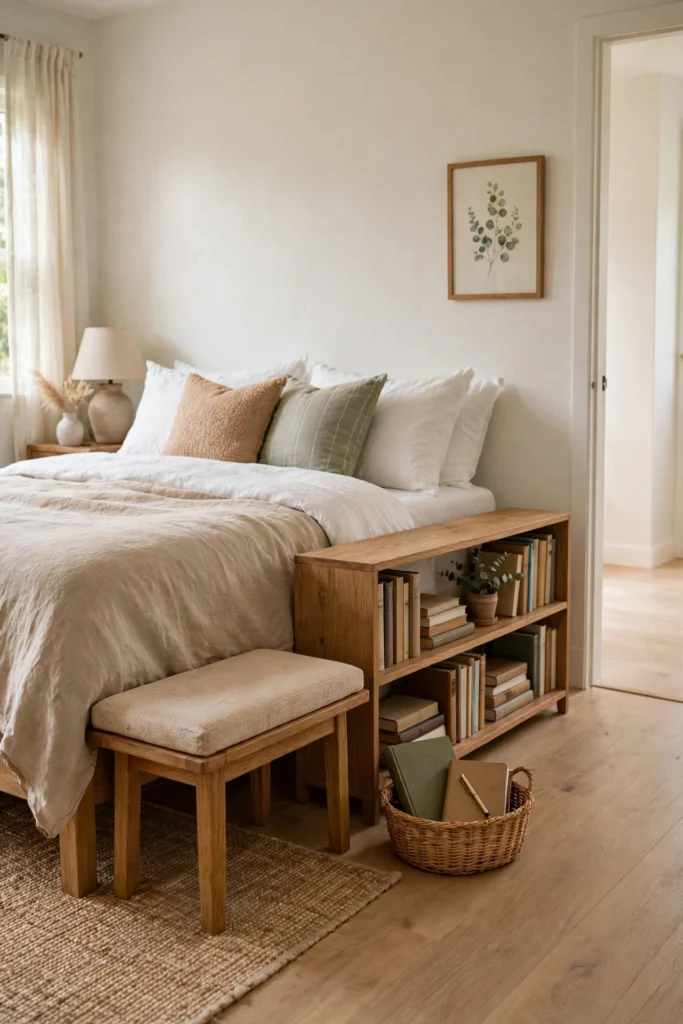
12. Foot-of-Bed Bench With Low Bookshelf
The foot of the bed is often dead space, but a low bench there can hold books and give you a place to sit while you choose what to read. A bench height of 18 to 20 inches works, with a low shelf unit beside it or underneath it for the books themselves. Keep the shelf low, no higher than about 30 inches, so it does not block light or make the bedroom feel boxed in, and leave at least 24 inches of walkway between the bench and the nearest wall or dresser so you can pass without turning sideways.
This nook suits readers who read in bed as well as in a chair. Keep a small basket or a shelf section for the book you are reading now, a notebook and a pen, so you do not have to cross the room in the dark to put things down. The pitfall here is turning the bench into a dumping ground for laundry. If clothes start living on the bench, the books move to the floor and the nook quietly stops existing. Give laundry its own basket elsewhere, and let the bench keep its one job.
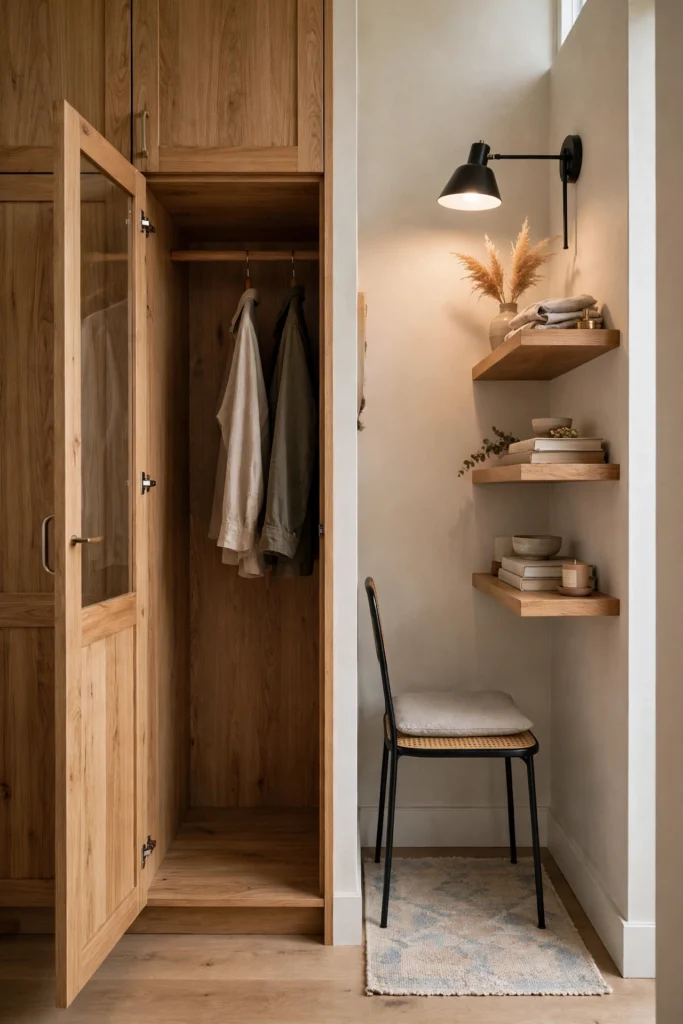
13. Beside-the-Wardrobe Tuck-In
Most bedrooms have a gap beside the wardrobe that is too narrow for a dresser and too wide to leave empty. That gap is a nook in disguise. A slim chair or a bench, plus a narrow bookcase or a stack of floating shelves on the wall beside it, turns wasted inches into a reading spot without moving the wardrobe at all. Measure the gap carefully, including the wardrobe door swing, because a chair that blocks a door you open every morning will be moved out of the way within a week.
Wardrobe gaps are often near a bedroom door or a hallway, so they can feel exposed rather than tucked away. A small rug under the chair helps mark the spot as separate, and a wall light instead of a floor lamp keeps the walkway clear. Keep the shelves shallow here, 8 to 10 inches deep, so they do not eat into the passage. If the gap is under 30 inches wide, skip the chair entirely and use a padded bench that slides partway under a shelf, or a floor cushion you can pull out when you want to read and tuck away after.
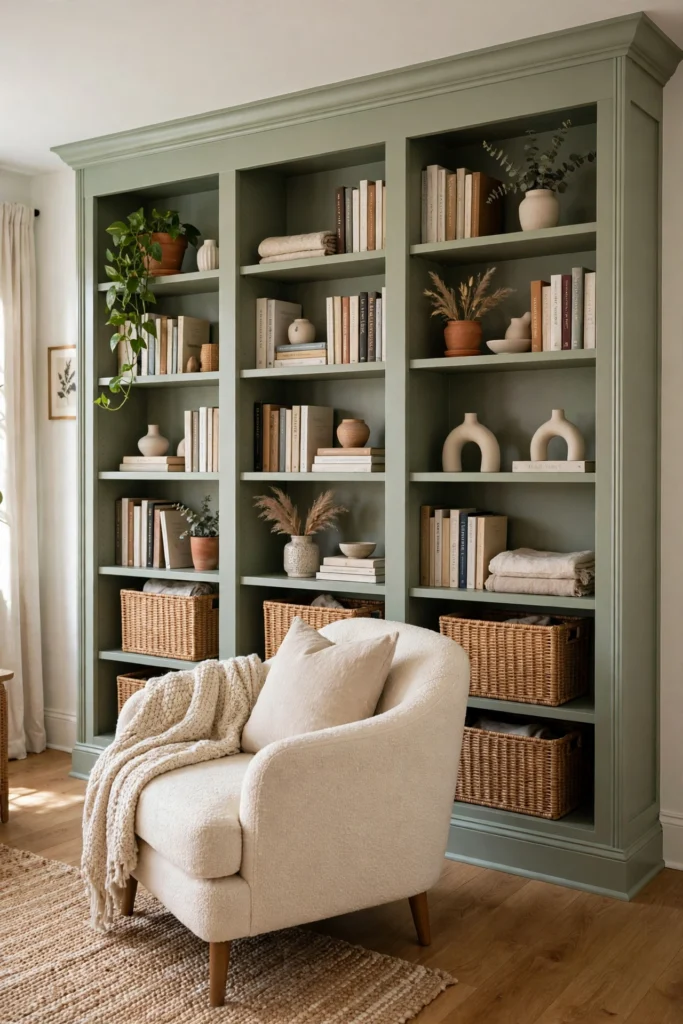
14. Budget-Friendly Built-In Bookcase Hack
You do not need a carpenter to get the built-in look. Two or three standard bookcases pushed together, with a strip of trim across the top and down the sides and a coat of paint in one colour, read as a single unit from across the room. The key detail is the top trim. Without it, the eye sees separate boxes.
With a simple board bridging the gap to the ceiling, or a cornice strip if there is a gap, the units look intentional. Anchor every case to the wall before you add the trim, since a row of bookcases is heavier and easier to tip than a single unit.
Choose cases with adjustable shelves so you can set one row tall enough for art books and another row tighter for paperbacks, instead of wasting a whole shelf height on short books. Paint the backs of the shelves the same colour as the wall behind the chair if you want the books to stand out, or the same colour as the cases if you want a calmer wall.
The budget trap here is buying the cheapest cases and then overloading them. Check the shelf weight guidance for the cases you buy, and keep the heaviest books on the lowest shelves, where sagging shows least and tipping risk is lowest.
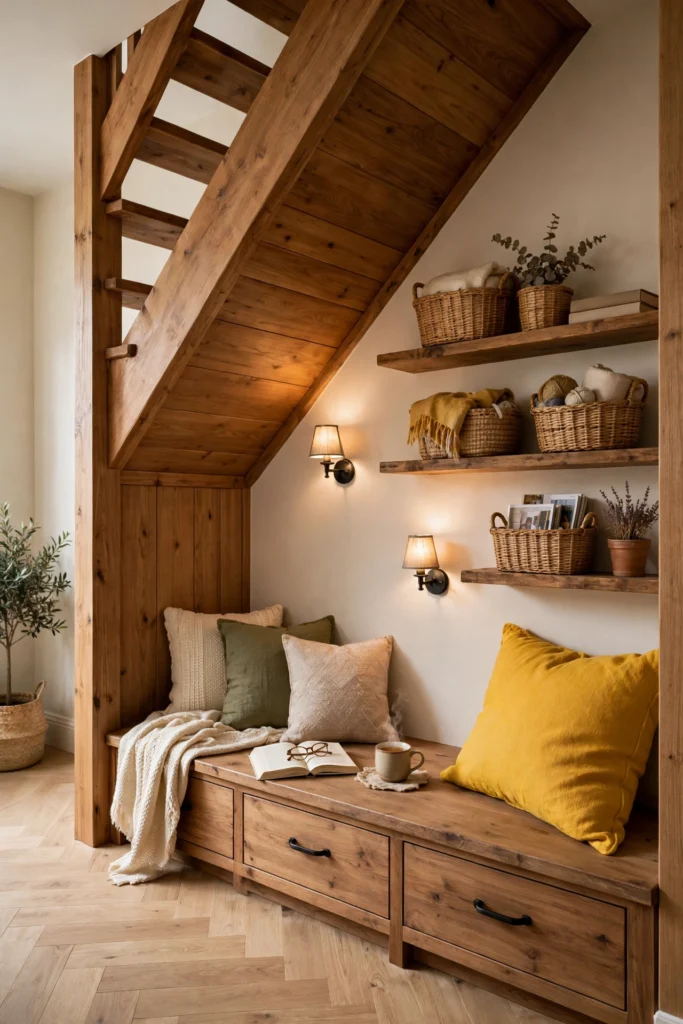
15. Under-the-Stairs Reading Nook
The space under a staircase is awkward for storage and perfect for sitting, because the slope gives you a low ceiling that feels enclosing rather than cramped, provided you sit where the height allows it. Put the bench where the ceiling is at least 4 feet high, and use the lower, sloping part for shelves, drawers or baskets. A bench with drawers underneath is the best use of this space, since it hides blankets and spare books without adding another piece of furniture to the hallway.
Lighting under stairs needs planning, because there is rarely a handy plug socket or a window nearby. Two small wall lights, one at each end of the bench, beat a single bright light in the middle, which creates harsh shadows on the slope. A strip light under the lowest shelf can work as well, as long as it is paired with a proper reading light for the page itself.
Since under-stair nooks often sit near an entryway, the storage thinking in mudroom wall decor ideas for a welcoming entryway is useful here too, especially for keeping shoes, bags and books from piling into one messy corner. Watch your head on the way in and out. A cushion in a bright colour on the lowest part of the slope is a simple visual warning that the ceiling drops there.
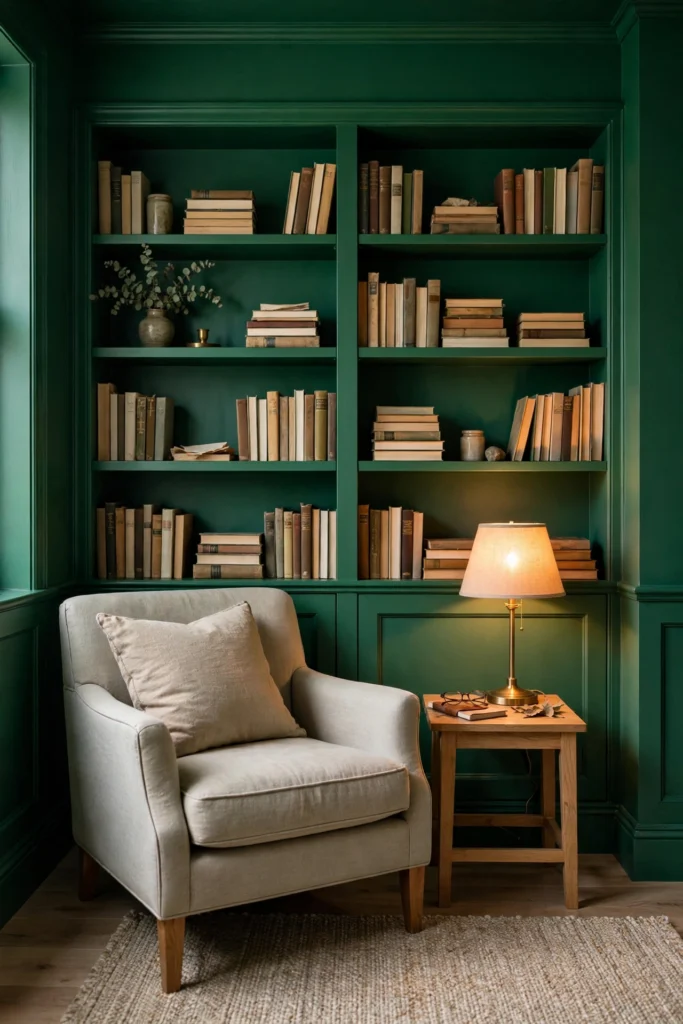
16. Color-Drenched Reading Nook
Painting the walls, the shelves and the trim in one colour makes a small nook feel deliberate instead of leftover. The colour wraps around you, the shelves blend into the wall, and the books themselves become the decoration. This works best in a defined area, like an alcove or one corner, rather than across a whole open-plan room, where a single strong colour can feel like it has nowhere to stop.
Pick a colour you genuinely like to sit inside for an hour, not just a colour that photographs well, and test it on the wall at night under your reading lamp, because artificial light changes colour more than daylight does.
Keep the chair and the cushion in a softer tone so the seat stands out from the wall, and let the books provide the contrast. If a fully drenched look feels like a big step, a softer version works just as well. The muted grey and warm neutral palette in grey boho living room ideas shows how a calm base colour can still feel layered once cushions, throws and wood tones are added.
The mistake with colour drenching is painting first and choosing the light second. A dark colour with a dim, cool light feels gloomy, while the same colour with a warm light at the right brightness feels snug. Fix the light before you open the paint tin.
17. Dark and Moody Bookshelf Nook
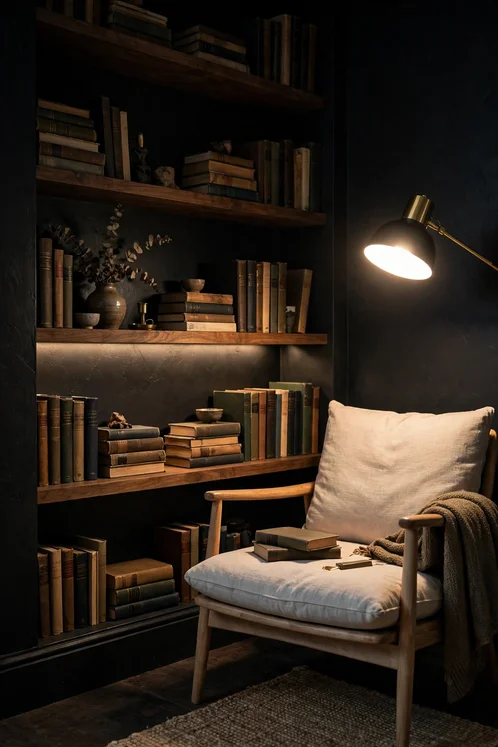
A dark nook is not about making a room gloomy. It is about contrast. Deep wall colour, warm wood shelves and one strong pool of light on the page make the rest of the room fall away, which is exactly what you want when you are trying to focus on a book. The chair should be lighter than the walls, or at least carry a light cushion or throw, so the seat is easy to find in a dim corner and the nook does not read as one dark block.
Light is non-negotiable in a dark nook. You need a brighter task light than you would in a white room, because dark walls absorb light instead of bouncing it back. Aim for the upper end of the typical reading range, with the light close to the page and a dimmer so you can adjust it. Add a second, softer light source, like a small shelf light or a candle-style lamp, so the contrast between the bright page and the dark room is not so sharp that your eyes tire.
Avoid glossy dark paint if the nook faces a window, since glare on a shiny wall is distracting, and choose a flat or eggshell finish instead.
18. Outdoor or Sunroom Reading Nook
A sunroom or a covered porch gives you the best reading light there is, daylight, but it also gives you the hardest conditions for books. Sun fades spines, humidity warps pages, and a sudden shower ruins a paperback in minutes. So the shelves here need a roof over them and a wall behind them, not an open railing. Put the bookcase against the house wall, under cover, and keep the chair closer to the light. Bring only the books you are reading now outside, and keep the main collection indoors.
Choose outdoor-friendly seating with cushions you can carry inside, and a small side table heavy enough not to blow over. A shelf depth of 10 to 12 inches still applies, but check that the shelf material handles damp air, since untreated wood swells and painted surfaces peel in a sunroom that is not climate controlled.
The pleasure of this nook is reading with fresh air and birdsong, so do not over-furnish it. One chair, one shelf, one light for evenings, and a throw for cooler air are enough. Anything more turns a breezy corner into another indoor room that happens to have a roof leak.

Questions Readers Ask About Reading Nooks
How much space do I really need for a reading nook?
A workable nook fits in about 3 feet by 3 feet of floor space, with a small chair, a wall light and a narrow shelf. A more comfortable version, with a proper armchair and a side table, needs closer to 4 feet by 4 feet. Measure the chair you plan to use, including legroom when you sit and stand, before you decide the spot is big enough.
How bright should a reading light be?
A typical target is 450 to 800 lumens of focused light on the page, in a warm white range around 2700K to 3000K for evening reading. Brighter is not automatically better. A dimmer lets you raise the light for small print and lower it again when you read on a screen, which is more comfortable than a single harsh bulb.
What shelf depth is best for books?
A depth of 10 to 12 inches suits most novels and hardcovers. Shallower shelves of 6 to 8 inches work for paperbacks and display, while oversized art books need 13 to 16 inches. Leave about 2 inches of finger room above the tallest book on each shelf so you can tilt a book out without scraping the shelf above it.
Can I make a reading nook in a rental without drilling?
Yes. A leaning ladder shelf, a freestanding bookcase, a tension rod curtain and a plug-in wall sconce all work without permanent fixings. Use a small safety strap on tall shelves even in a rental, and choose a floor lamp with a heavy base so the light does not depend on a wall fixing at all.
How do I stop my bookshelves from looking cluttered?
Leave empty space on purpose. Keep one shelf in three partly empty, mix a few horizontal stacks among the upright rows, and put your current reads at hand height. Group books by size or colour only if you will keep it up. A system you abandon in a month looks messier than a simple arrangement you actually maintain.
Is a window seat good for reading, or does glare ruin it?
A window seat is excellent in daylight if you sit sideways to the window instead of facing into it, and add a sheer curtain for strong afternoon sun. For evenings, you still need a dedicated reading light, because daylight is gone and a ceiling light alone will not light the page well enough.
What chair size should I look for?
Look for a seat depth of 20 to 22 inches for upright reading, or 23 to 25 inches if you like to curl up. The chair width should leave a few inches clear on each side inside your nook, and the seat height should let your feet rest flat on the floor. If your feet dangle, add a footstool rather than buying a taller chair.
Start Tonight: Pick Your Corner and Build From There
You do not need to build all 18 of these nooks, and you do not need to buy everything at once. The readers who actually use their nooks start small and add one layer at a time, testing each change before spending on the next. That is a kinder way to spend money, and it means the nook grows around your habits instead of around a photo you liked once.
Try this order. First, choose the corner or wall and measure it, including door swings and plug sockets. Second, put a chair you already own in that spot for a few evenings and notice whether you reach for a book there or walk past it. Third, fix the light, because a chair in bad light will not become a habit.
Fourth, add the shelves, starting with the books you are reading now, and only then buy the cushions, the throw and the small table. If the chair test fails, move the chair before you buy shelves for a corner you will never sit in. If I had to pick one layout to start with, it would be the window seat, because daylight does half the work and the shelves on either side keep the book I am reading now within reach.
Keep the books you love where you can see them, keep the light where it helps your eyes, and leave a little room on every shelf for the next book you bring home. A reading nook is not finished when it looks complete in a photo. It is finished when you find yourself sitting in it without thinking about it, book open, cup nearby, and the rest of the house quietly out of mind.