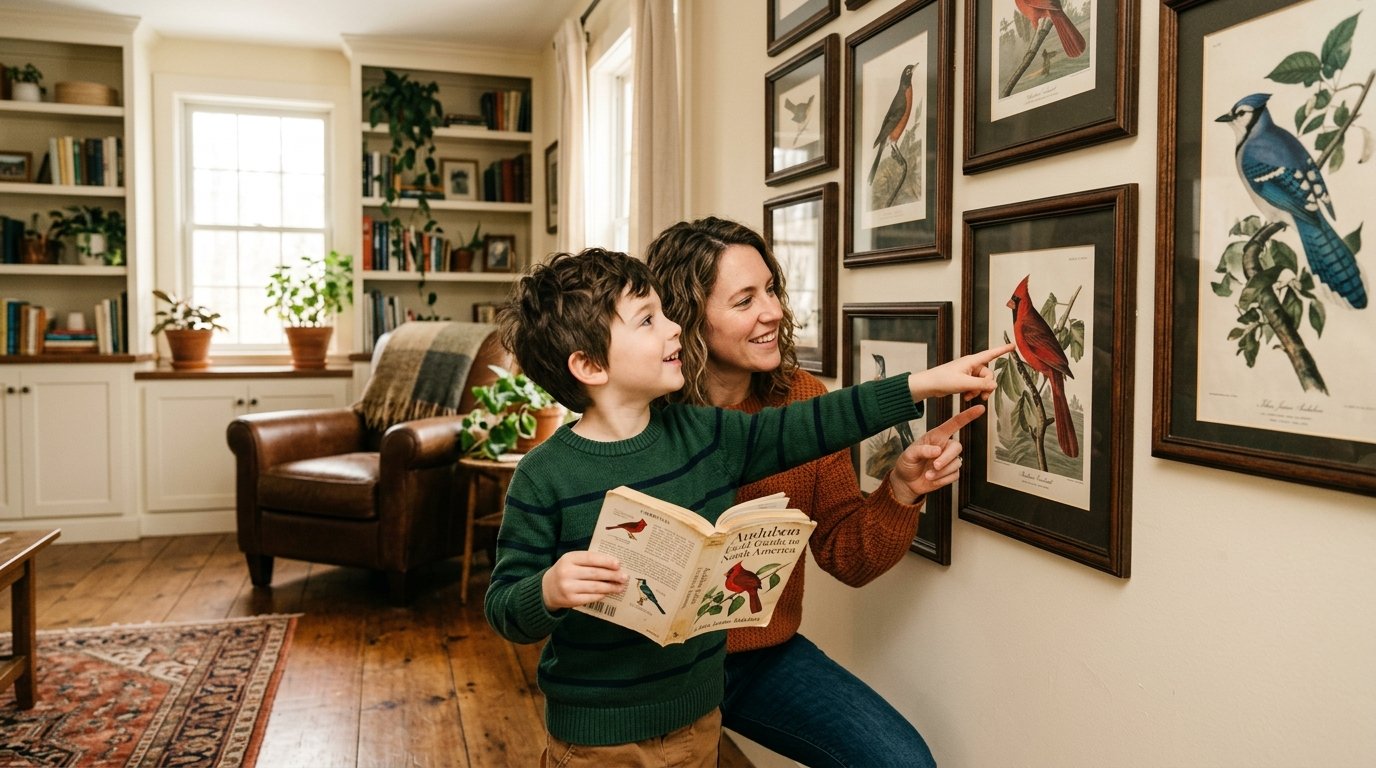
I found the first print for my Audubon bird gallery wall by accident, in a secondhand bookshop on a rainy afternoon when I had gone in looking for nothing at all. The shop smelled of old paper and damp wool. The owner kept a stack of loose art prints near the window, the kind of pile you have to kneel down to look through properly, and halfway down I stopped at a blue jay.
It was not a photograph. It was a watercolour with soft edges and a branch that bent under the bird as if the bird had just landed. The blue was deep but not bright. The white of the belly was warm, not stark. I stood there holding it for longer than made sense, because it felt less like a picture of a bird and more like a small window into a garden I had never visited.
That is how most good Audubon bird gallery walls begin, I think. Not with a shopping list or a grand plan, but with one bird that stops you. Then another. Then a wall that slowly starts to make sense. The prints in this guide cost nothing to download, because the artwork is old enough to belong to everyone now. The skill is not in spending money. It is in choosing well, printing carefully, and hanging with a steady hand. Get those three things right and a set of free prints can look like a collection you built over years, not a weekend project you rushed through on a Sunday.
What Is an Audubon Bird Gallery Wall, and Why Do These Prints Still Work?
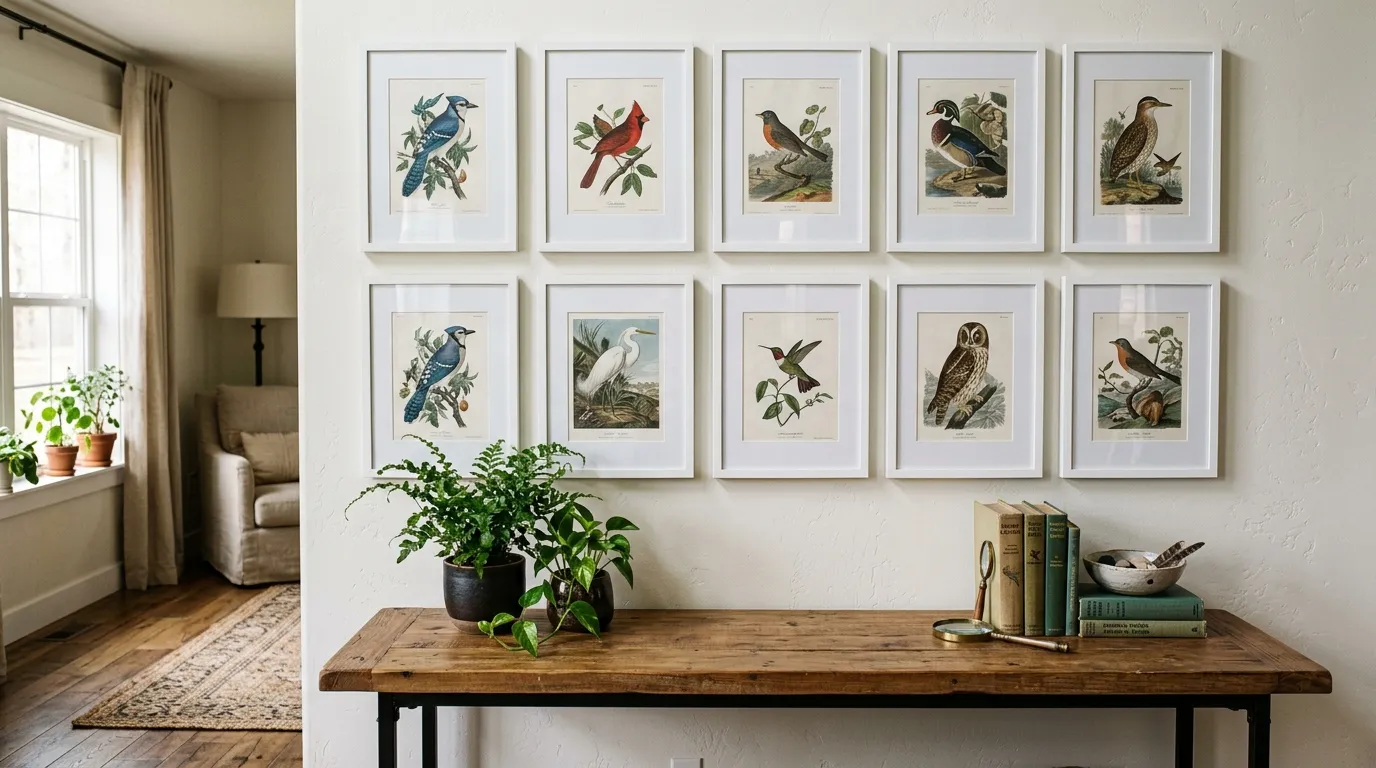
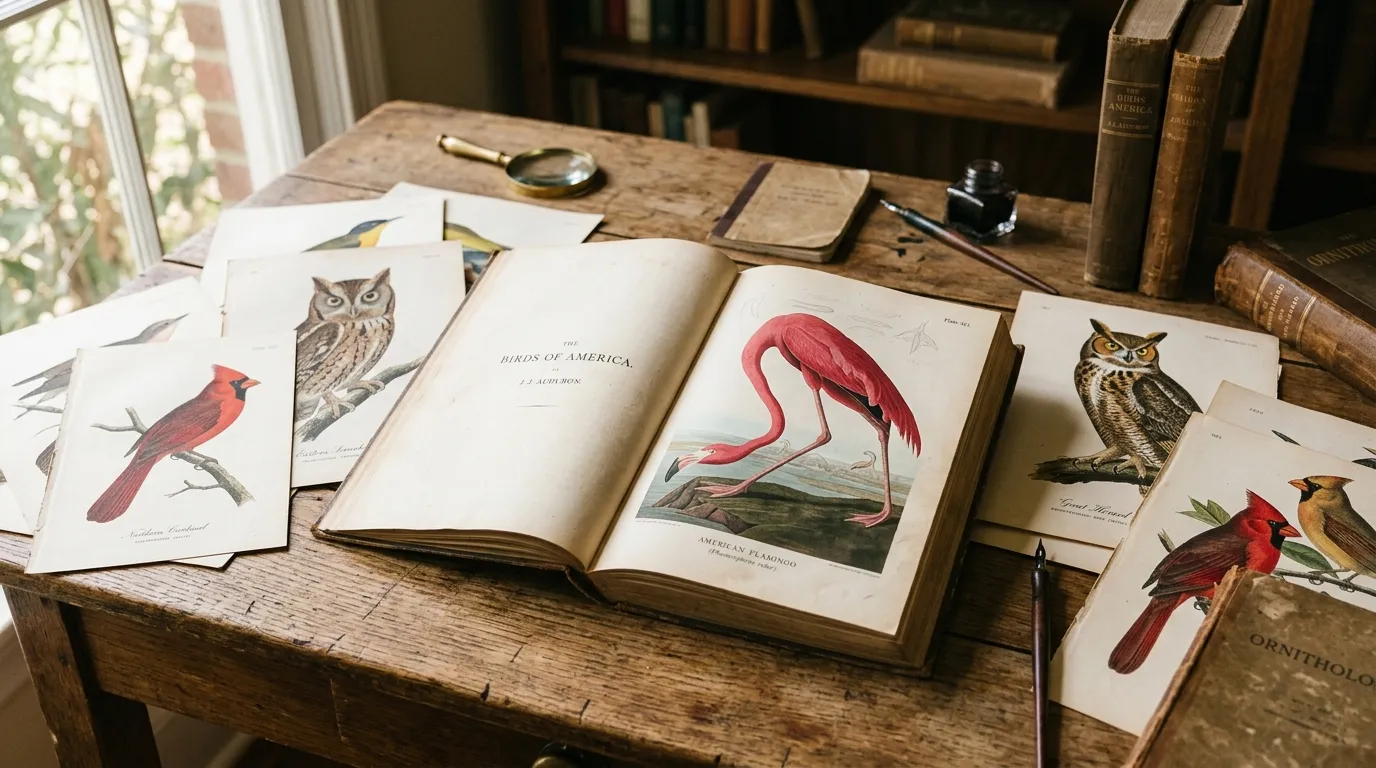
An Audubon bird gallery wall is a group of framed bird prints from John James Audubon, arranged together on one wall so they read as a single display. The prints come from his great work, The Birds of America, which was published between 1827 and 1838. Audubon painted 435 watercolours for the book, showing 497 bird species in lifelike poses, often with the plants and branches the birds lived among. A gallery wall borrows that sense of a natural history collection and brings it into a hallway, a bedroom, a living room, or a reading corner.
The reason these prints still work in a modern home is that they were never really about fashion. Audubon painted birds as he saw them, feeding, perching, turning their heads, stretching a wing, or watching for danger. A flamingo stands tall and pink against a pale sky. A snowy owl looks straight out of the page with quiet authority. A small warbler sits lightly on a branch, all soft yellow and fine detail. The poses feel alive because Audubon spent years watching real birds, not copying stuffed specimens in a drawer. That life is still there in the prints, almost two hundred years later.
Today the original prints are rare and valuable, and a complete copy of The Birds of America has sold at auction for many millions of dollars. You will not be hanging an original on your wall, and that is fine. The images themselves are in the public domain, which means anyone can download, print, and display them at home without paying a licensing fee. The National Audubon Society offers high resolution files free for personal use, and several digital library archives hold the same plates. That is the quiet gift at the centre of this project. The art is free. Your job is to treat it well.
An Audubon bird gallery wall works best when you keep the plan simple. Pick one clear theme, such as birds from your region, one colour family, or one type of bird, and choose three to seven prints to start. Print the largest frames at 11 by 14 or 16 by 20 inches, keep smaller accents at 5 by 7 or 8 by 10, and use matte or fine art paper so the watercolours look soft instead of shiny.
Check each file before you print, aim for at least 1500 to 2000 pixels on the smallest side for an 8 by 10 print and 2500 to 3000 pixels for larger sizes, and crop gently, because most vintage plates need a small trim to fit a standard frame.
Choose Your Birds First, Then Your Wall
The most common mistake with a gallery wall is starting with frames. People buy six matching frames, then hunt for six prints to fill them, and the wall ends up looking like a set rather than a collection. Start the other way round. Spend an evening looking at the birds first. Save the ones that make you stop and look twice. Then look at your saved pile and ask what ties them together. The answer is usually there already, in the colours you kept choosing or the birds you kept returning to.
A theme gives the wall its calm. Without one, a wall of mixed birds can feel scattered, even when every print is beautiful on its own. Birds from your own region make a lovely theme, because the wall starts to feel like a record of the garden outside your window. Birds of one colour family work well too. Blues and greens calm a bedroom down. Warm reds, oranges, and golds wake up a hallway or a home office. Birds of one type, all songbirds or all waterfowl or all birds of prey, give the wall a clear identity that guests notice at once.
Colour is the thread that holds the wall together, so look at your wall colour and your furniture before you print. Cream and warm white walls flatter almost every Audubon print. Soft grey walls suit blue and green birds and make the white mats glow a little. If your wall is a deep, dramatic colour, pale birds with light backgrounds will stand out, while dark birds may sink into the paint.
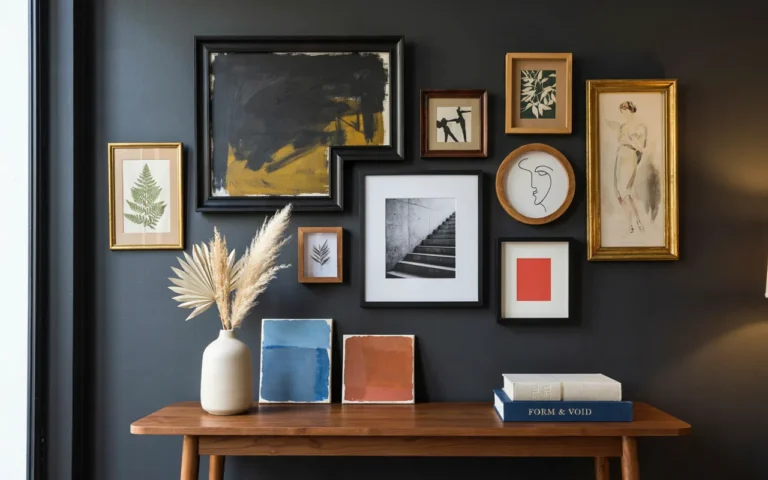
A dark wall can be a strong backdrop for bird prints if you plan the frames around it, and the black accent wall ideas that create a dramatic focal point show how much a deep wall can lift pale artwork when the frames are kept simple and the spacing stays even.
Size and visual weight matter as much as colour. A great blue heron or a flamingo carries a lot of visual weight. It is tall, it has strong shapes, and it draws the eye first. A warbler or a finch is light and detailed, and it rewards a closer look. Pair one strong bird with two or three lighter ones. Put the strong bird slightly off centre, not dead in the middle, and let the smaller birds gather around it. The wall will feel balanced without feeling rigid.
Count your wall before you count your prints. A small accent wall above a chest of drawers suits three to five prints. A wall above a sofa can carry five to nine, depending on the sofa width and the frame sizes you choose. A large empty wall in a hallway can hold eight to twelve, but only if you plan the layout on paper first. Odd numbers tend to look natural, because the eye finds a centre without the wall feeling split in half. Three prints in a row feel calm. Five in a loose cluster feel collected.

Print Sizes and Paper: the Part That Decides Whether It Looks Real
Printing is where a free Audubon bird gallery wall either starts to look like real art or starts to look like a printout. The difference is rarely the printer. It is the size you choose for the file you have, and the paper you put through the machine. A small file stretched to a large frame will look soft and tired. A good file printed on thin, shiny paper will glare under the lights and cheapen the watercolour. Get size and paper right and even a home printer can produce something you would be proud to frame.
Start by checking the file before you fall in love with a print size. Open the image details and look at the pixel dimensions. For an 8 by 10 print, aim for at least 1500 to 2000 pixels on the smallest side. For larger prints, aim for 2500 to 3000 pixels on the smallest side. If the file is smaller than that, print it smaller. A crisp 5 by 7 beats a blurry 11 by 14 every time, and a small sharp print in a good frame looks intentional, while a large soft print looks like a mistake.
| Frame size | Print size with a mat | Print size without a mat | Smallest side, in pixels | Best use on the wall |
|---|---|---|---|---|
| 5 by 7 inches | 4 by 6 inches | 5 by 7 inches | 1500 pixels | Small accents and narrow hallway runs |
| 8 by 10 inches | 5 by 7 inches | 8 by 10 inches | 1500 to 2000 pixels | The workhorse size for most gallery walls |
| 11 by 14 inches | 8 by 10 inches | 11 by 14 inches | 2000 to 2500 pixels | Anchor frames and the centre of a cluster |
| 12 by 18 inches | 8 by 12 inches | 12 by 18 inches | 2500 pixels | Tall birds such as herons and flamingos |
| 16 by 20 inches | 11 by 14 inches | 16 by 20 inches | 2500 to 3000 pixels | Statement pieces above a sofa |
| 18 by 24 inches | 12 by 18 inches | 18 by 24 inches | 3000 pixels | One large anchor only, on a wide wall |
Paper is the second half of the decision, and it deserves as much care as size. Matte paper suits Audubon prints beautifully. It gives a soft, classic look, it keeps the watercolour texture visible, and it does not throw glare back at you when the sun moves across the room. Fine art paper or watercolour paper adds a little texture and weight, and it can make a print feel closer to the original plate.
It costs more, so save it for your two or three best prints and use good matte paper for the rest. Avoid thin glossy paper for this project. It boosts the colour at first glance, then catches every light in the room and makes the wall hard to look at from an angle.
Home Printing or a Print Shop? How to Decide Without Regret
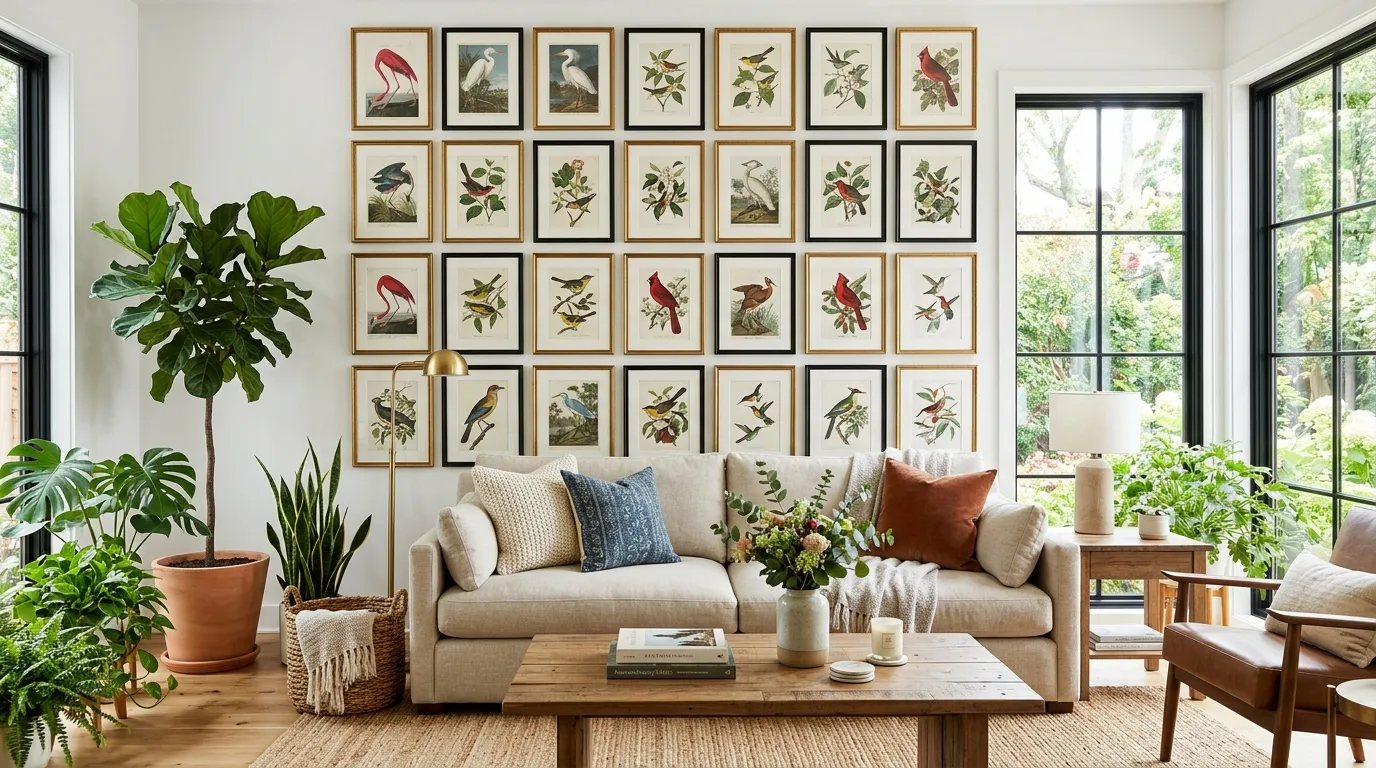
Home printing suits small prints and quick experiments. If you want three 8 by 10 prints this weekend, a home printer with good matte paper will do a lovely job, and you can reprint a bird at once if the colour is off. Home printing also lets you test sizes cheaply. Print a bird at 5 by 7, then at 8 by 10, hold both against the wall, and see which one the space wants.
The limits are size and cost. Most home printers stop at A4 or letter size, and ink for large prints adds up fast. If your printer struggles with a full colour plate, do not force it. A soft, streaky print will bother you every time you pass the wall.
A print shop suits larger prints and the final versions you plan to keep for years. A local copy shop or photo printing service can handle 11 by 14 and 16 by 20 prints on proper matte or fine art paper, with colour that stays true to the file. Ask for a test strip first if you are printing large, so you can check the colour before the full print runs. If you are ordering online, order one print first, check it in daylight when it arrives, and only then order the rest. That one pause saves the cost of reprinting a whole set.
Framing Choices That Make Free Prints Look Collected
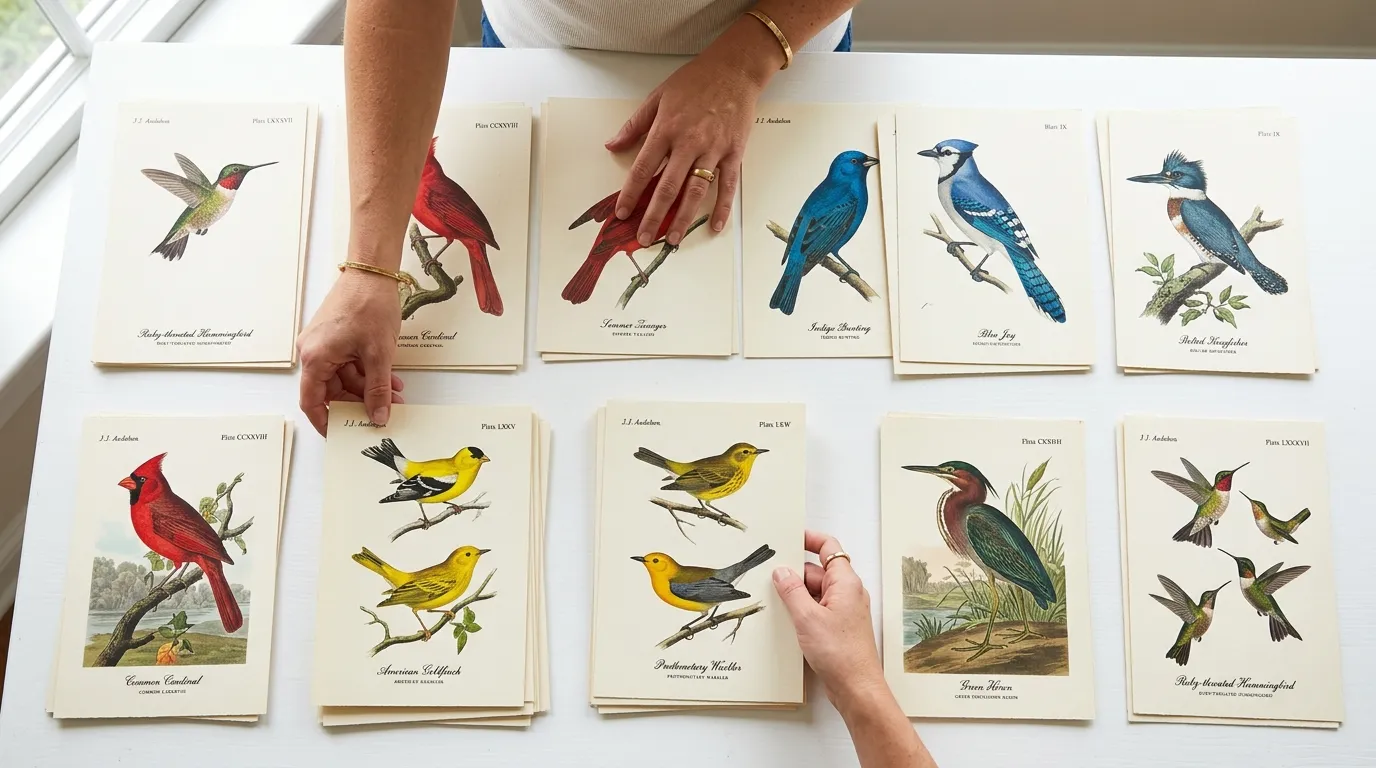
Framing is the step that turns a printout into a picture. The right frame does two jobs at once. It protects the print, and it tells the eye how to look at it. A thin black frame with a wide white mat says calm and modern. A warm wood frame with a cream mat says collected and classic. A gold frame with a narrow mat says traditional and a little grand. None of these is better than the others. The right one is the one that suits your room and your birds, and that you can repeat across the wall without it feeling forced.
Mats are the quiet hero of a gallery wall. A white or cream mat adds breathing room around each print and gives a museum quality feel, even when the frame cost very little. Mats also solve the size problem neatly. If your prints are slightly different sizes, a mat lets the frame openings stay uniform while the prints inside vary, so the wall still reads as a set.
Choose a mat that is wide enough to matter, at least an inch and a half on each side for an 8 by 10 frame, wider for larger frames. Keep the mat colour simple. White suits most Audubon prints and keeps the wall bright.
Cream or ivory suits warmer rooms and older, softer plates. Avoid coloured mats for this project. A blue mat under a blue bird can look clever in the shop and tiring on the wall, because it pulls the eye to the mat instead of the bird.
Glass matters more than people expect. If your wall gets direct sunlight for part of the day, choose frames with UV protective glass or acrylic to slow fading. The colours in a watercolour print are soft, and soft colours fade first in strong sun. If your wall is shaded, standard glass is fine. Acrylic is lighter than glass and safer in a child room or above a bed, because it does not shatter if a frame falls. Wipe the glass before you hang each frame, inside and out, because dust trapped behind glass is hard to ignore once the frame is on the wall.
Hanging and Layout: Plan on Paper Before You Touch a Nail
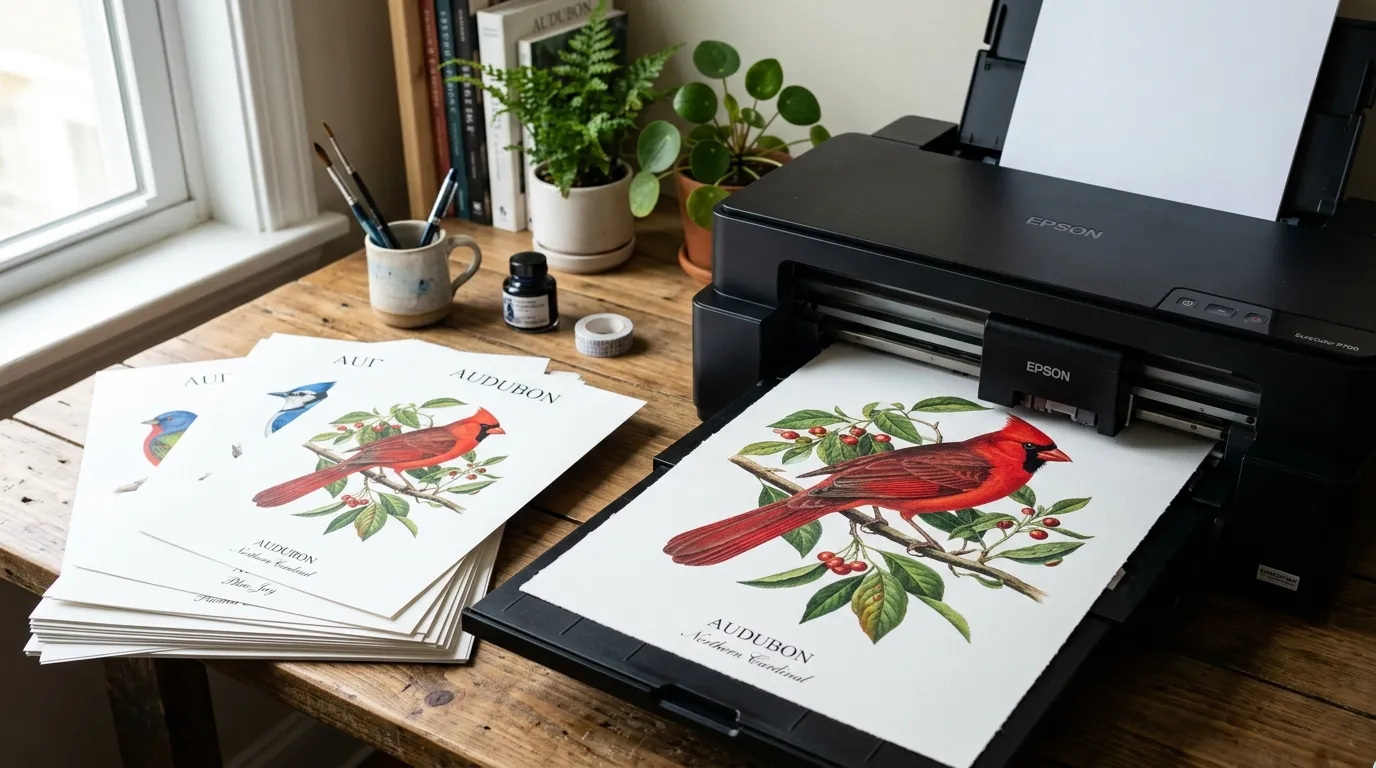
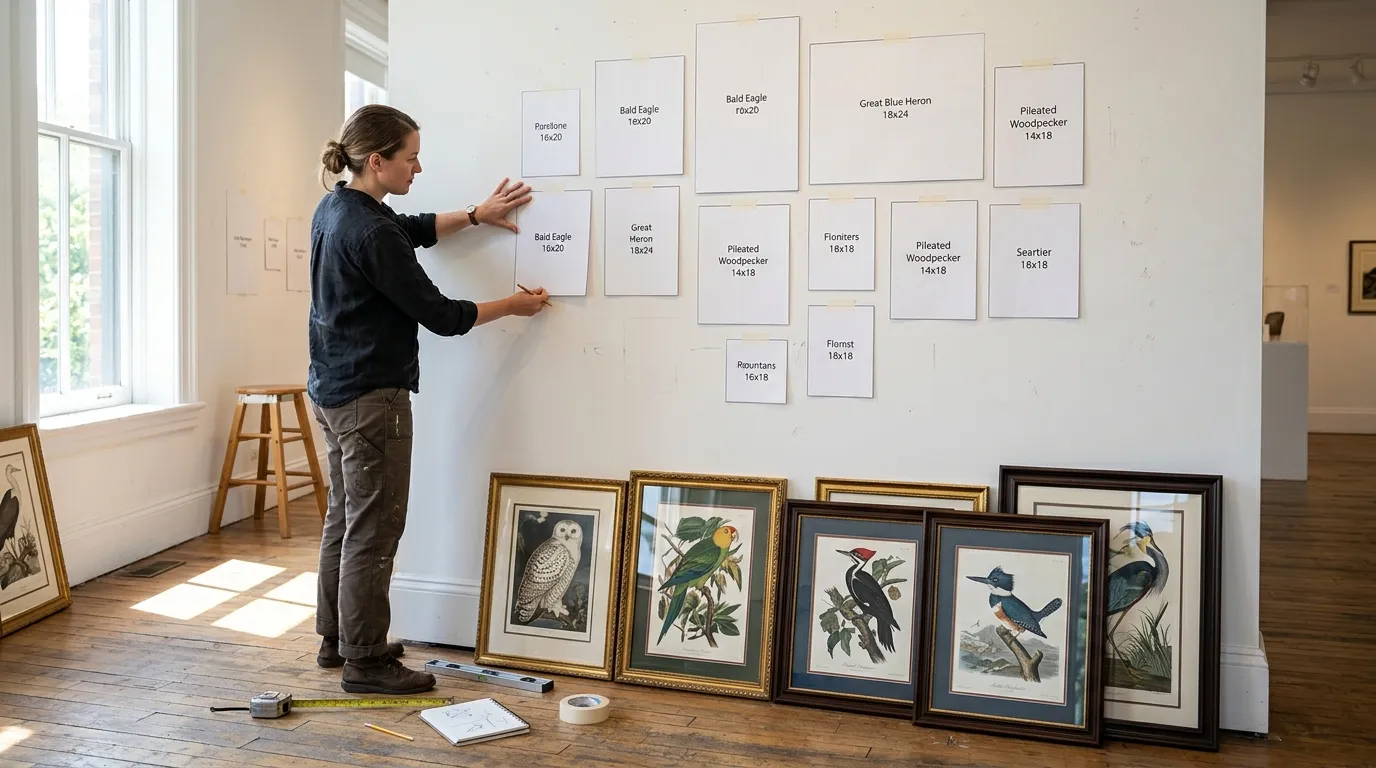
Start on the floor. Lay your frames face up on a rug or a clean sheet, in the rough shape you have in mind. Leave a gap of two to three inches between frames, the same gap you will use on the wall, and step back to look from the doorway. A layout that looks fine from two feet away can look cramped or lopsided from across the room, so always judge it from the distance you will actually see it. Move the anchor bird first. Try it slightly left of centre, then slightly right. The right spot usually shows itself quickly, because the other frames start to settle around it.
There are four layouts that work well for Audubon prints, and each suits a different wall. A grid uses equal sized frames in straight rows and columns. It is clean, modern, and symmetrical, and it suits a hallway or a wall above a desk where order feels right. A salon style uses a dense, organic cluster of mixed sizes, packed close together with a shared outer edge that feels roughly rectangular.
It is eclectic and full of character, and it suits a living room wall where you plan to add more prints over time. A linear row lines frames up along a single horizontal line, which suits a long hallway and the wall above a sofa. An asymmetrical balance anchors a large piece on one side and balances it with smaller groupings on the other, which suits a wide wall that needs a little movement.
Paper templates are the best tool you will use in this whole project. Trace each frame onto kraft paper or old wrapping paper, cut out the shapes, and tape them to the wall with painter tape. Mark the centre of each template with a small cross, and mark where the nail or hook will go. Live with the templates for a day if you can.
Walk past them in the morning and in the evening, sit on the sofa and look at them, check them from the hallway. A template that looks too high at breakfast will still look too high at dinner, and you can move paper in seconds. Moving a framed print takes much longer, and it leaves a hole you have to fill.
Eye level is the rule that holds the whole wall together. The centre of your gallery wall should sit around 57 to 60 inches from the floor, which is roughly eye level for most adults standing in a room. If the wall is above a sofa, the bottom of the lowest frame should sit about six to eight inches above the top of the sofa back, so the birds feel connected to the furniture below them.
If you hang too high, the birds feel disconnected from the room, as if they belong to the ceiling. If you hang too low, they feel cramped by the furniture. Measure from the floor, mark it lightly in pencil, and trust the tape measure more than your eye.
Spacing deserves the same care. Keep a consistent gap, usually two to three inches between frames, across the whole wall. Even spacing creates a tidy, intentional look, and it lets the eye move from bird to bird without stopping at a wide gap or a tight squeeze. For a grid, measure each gap with a small spacer, a piece of card cut to the exact width, and use it every time.
For a salon cluster, keep the gaps a little tighter, around two inches, so the cluster reads as one display. The above couch wall decor ideas you will actually love show how much a steady gap and a clear centre line matter when a wall sits over a long piece of furniture.
Use the right fixings for your wall. A small frame will hang happily on a single picture hook or a sturdy nail. A large frame needs two hooks, spaced apart, so it sits level and does not tilt over time. In a rental, use removable picture hanging strips rated for the frame weight, and check the weight limit on the packet before you trust it. For heavy frames, or for walls with textured plaster, a proper picture hook is safer than a strip. The renter friendly upgrades and decor ideas include several ways to hang art without damage, which is worth reading if your landlord is strict about holes.
| Wall width | Best layout | Number of prints | Frame sizes to try | Overall width of the display |
|---|---|---|---|---|
| 36 to 48 inches | Grid of four, or a short linear row | 3 to 4 prints | 8 by 10 inches, with one 11 by 14 anchor | 30 to 40 inches |
| 48 to 60 inches | Grid of six, or a salon cluster | 5 to 6 prints | 8 by 10 inches, plus one or two 11 by 14 frames | 40 to 50 inches |
| 60 to 72 inches | Salon cluster, or a linear row above a sofa | 6 to 8 prints | Mix of 8 by 10 and 11 by 14, one 16 by 20 anchor | 48 to 60 inches |
| 72 to 96 inches | Asymmetrical balance, or a wide salon cluster | 8 to 10 prints | Mix of 8 by 10, 11 by 14, and one 16 by 20 anchor | 60 to 78 inches |
| Over 96 inches | Wide salon cluster, or two linked groupings | 10 to 12 prints | Mix of all sizes, two anchor frames spaced apart | 72 to 84 inches |
Matching the Birds to Your Room Without Redecorating
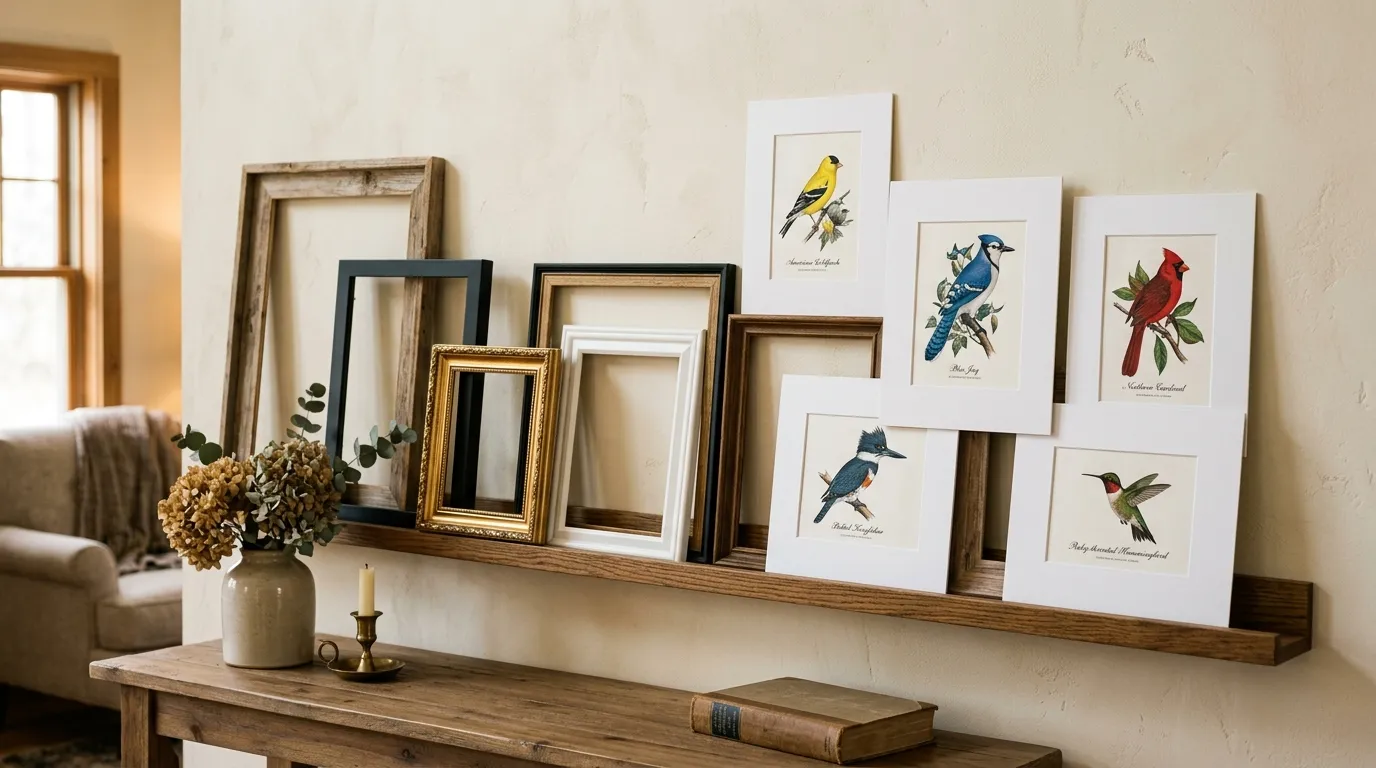
Audubon prints are forgiving guests. Their soft palette and natural subject matter let them settle into almost any room without demanding that you change the furniture or repaint the walls. The trick is to let the room lead. Look at what is already there, the wood tones, the fabric colours, the light, and choose frames and birds that sit comfortably beside them, rather than fighting them.
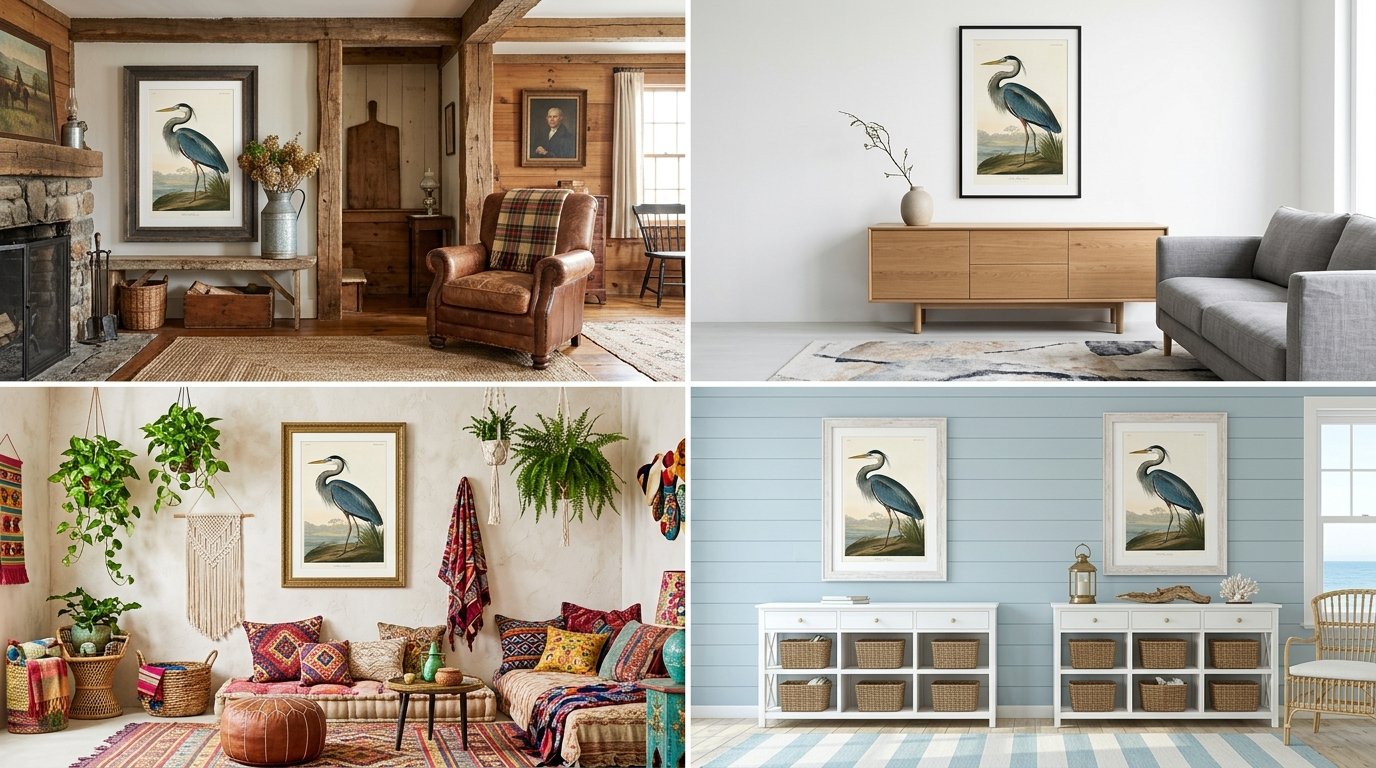
A farmhouse room suits distressed wood frames and neutral walls, with birds that feel warm and familiar, a robin, a bluebird, or a mallard. In a modern and minimal room, thin black frames, wide white mats, and plenty of space between prints let each bird breathe. A traditional room suits gold or dark wood frames and a dramatic bird or two, a turkey or an owl, to match the mood.
A bohemian room suits mixed wood frames, woven textures nearby, plants on the shelf below, and a looser salon cluster that feels gathered rather than arranged. A coastal room works best with shorebirds and waterfowl, light wood or white frames, and pale walls that echo the sky in the prints.
Colour trends can help you choose, but they should not rule the wall. If your room already has a clear palette, match the birds to it. If you are still finding the palette, the interior colour trends for cozy homes give a useful sense of which warm and muted tones sit well with vintage art right now, from soft sage to warm terracotta. A bird print in a colour you already love will look at home at once. A bird in a colour that clashes with the sofa will fight the room every day, even if the print is beautiful on its own.
Think about where the wall will be seen from, not just where it hangs. A gallery wall in a hallway is seen in passing, so bold birds and a clear layout work best there. A gallery wall in a bedroom is seen slowly, in the morning and at night, so softer birds and a calmer layout suit it better.
A gallery wall in a reading corner is seen up close, from a chair a few feet away, so small detailed birds reward that closeness. If your reading corner needs a little more warmth around it, the reading nook ideas with bookshelves show how a small cluster of bird prints can sit beside books and a lamp without crowding the chair.
Seasonal Swaps, Small Projects, and Care That Keeps the Wall Fresh
One of the best things about a printable gallery wall is that it never has to stay the same. The frames stay on the wall. The prints inside them can change with the seasons, with your mood, or with a new bird you fall in love with. That flexibility lets the wall stay alive without a new project every time you want a change.
Seasonal swaps are the simplest way to keep the wall fresh. In spring, bring in warblers and bluebirds with soft green branches, and the wall will feel light and hopeful. In summer, try shorebirds and waterfowl with pale skies, and the wall will feel open and breezy. In autumn, choose cardinals and jays with warm red and gold tones, and the wall will feel rich as the light turns golden.
In winter, bring in a snowy owl or a chickadee against a pale background, and the wall will feel calm and quiet. You only need to swap two or three prints to change the mood. The rest of the wall stays put, and the new birds feel like guests rather than a full redecoration.
Care for the framed prints is simple, and it mostly comes down to light, dust, and damp. Dust the frames once a month with a soft, dry cloth, and wipe the glass gently when you see fingerprints or dust building up. Do not spray cleaner directly onto the glass, because it can seep under the edge and mark the print.
Spray the cloth, then wipe. Keep the wall away from damp, so avoid hanging prints in a bathroom with no ventilation or directly above a radiator, where heat and steam can warp the paper. If a print does fade or a frame gets damaged, do not panic. The file is still on your computer, and a fresh print costs very little.
Questions I Get Asked About Audubon Bird Gallery Walls
Are Audubon bird prints really free to use?
Yes, for personal home decor. The original illustrations from The Birds of America were published in the 1800s, so they are in the public domain. You can download, print, and display them in your home without paying a licensing fee. The National Audubon Society offers high resolution files free for personal use, and digital library archives hold many of the same plates. If you plan to sell prints or use them on products for sale, check the terms of the source you downloaded from first, because commercial use has different rules from hanging art in your own living room.
Where can I download high resolution Audubon prints?
Start with the National Audubon Society website, which offers high resolution files free for personal use and is a trusted source for the plates. Digital library archives also hold scans of The Birds of America, and many of those files are free to download. Look for the largest file size available, and check the pixel dimensions before you print. A file with at least 1500 to 2000 pixels on the smallest side will print well at 8 by 10, while larger frames need 2500 to 3000 pixels on the smallest side.
What size should I print Audubon art for a gallery wall?
Most gallery walls work best with a mix of sizes. Use 8 by 10 inches for most prints, 5 by 7 for small accents, and 11 by 14 or 16 by 20 for one or two anchor pieces. The right size depends on your wall width and your file resolution, so check the table earlier in this guide and match the print size to the pixels you have. A crisp small print always beats a soft large one, and a mix of two or three sizes adds visual interest without making the wall feel messy.
How many prints do I need for an Audubon bird gallery wall?
It depends on your wall. A small accent wall above a chest works well with three to five prints. A wall above a sofa suits five to nine, depending on the sofa width. A large feature wall can hold eight to twelve, but only if you plan the layout on paper first. Start with an odd number, three or five, and add more over time. Odd counts settle quickly on the eye, because the wall finds a centre without feeling split down the middle.
Can beginners make an Audubon bird gallery wall?
Yes, this is a genuinely beginner friendly project. You do not need design experience or special tools. Choose ready made frames in standard sizes, use the paper template method to plan your layout, and start with a simple grid or a linear row. Print one bird first, frame it, and hang it on its own for a week. If you like it, add a second and a third. The only tools you truly need are a tape measure, a level, a pencil, and a little patience.
How much does an Audubon bird gallery wall cost to make?
The prints themselves are free, so your costs are paper and ink or print shop fees, plus frames and mats. A small wall of four to six prints can be put together for a modest sum with ready made frames and home printing or a local print shop, and the exact total depends on the frame sizes you choose and whether you buy new or secondhand frames. Larger walls with big frames and fine art paper will cost more, but they still cost far less than buying the same number of framed art prints from a shop.
Print One Bird This Weekend
You do not need a finished wall to begin. You need one bird, one frame, and one free afternoon. That is the whole project, reduced to its simplest form. Pick the bird that stopped you when you first looked through the plates. Download the largest file you can find. Check the pixels. Print it at 8 by 10 on good matte paper. Frame it simply, with a white mat and a frame that suits your room. Hang it at eye level, step back, and let it sit for a week before you decide whether it stays.
If the bird earns its place, add a second one next weekend. Choose a bird that shares its colour or its mood, not one that fights it. Print it at the same size, frame it the same way, and hang it two to three inches from the first, at the same height. Two birds make a pair. Three make a wall. Five make a collection. You will know when the wall is full, because adding one more bird will start to feel like too much, and that feeling is worth trusting.