A boy’s bedroom has a hard job. It has to hold a bed, homework, hobbies, friends, and a growing collection of stuff, and still feel like a place he actually wants to be. The rooms that work best are rarely the ones with the most money spent on them. They are the ones where a few decisions were made in the right order.
Start with colour, because it sets the mood for everything else. Then sort the layout, so the bed, desk and chill spot each have a clear place. Choose furniture that stores things as well as it looks good. Add personality in a few deliberate spots, not on every surface. Finish with soft textiles and layered light, which is what turns a good-looking room into one that feels comfortable at the end of the day.
This guide walks through all 20 boys bedroom ideas in that order, as five decisions. Each one comes with sizes, placement rules and the mistakes worth avoiding, so you can use it whether the room is small, shared, or due for a full refresh.
Decision 1: Colour first, because it sets the whole mood
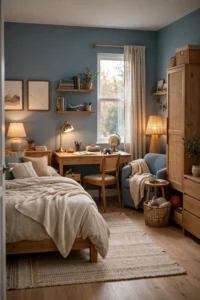
Colour is the cheapest big change you can make, and it is also the one that is hardest to undo once furniture is in place. So decide it before you buy anything else. A boy’s room does not need a theme painted on every wall. It needs one confident colour direction, a calm base to sit it on, and one wall or surface that carries the personality.
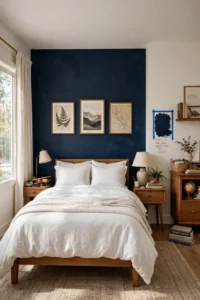
Paint on a moody, dramatic hue
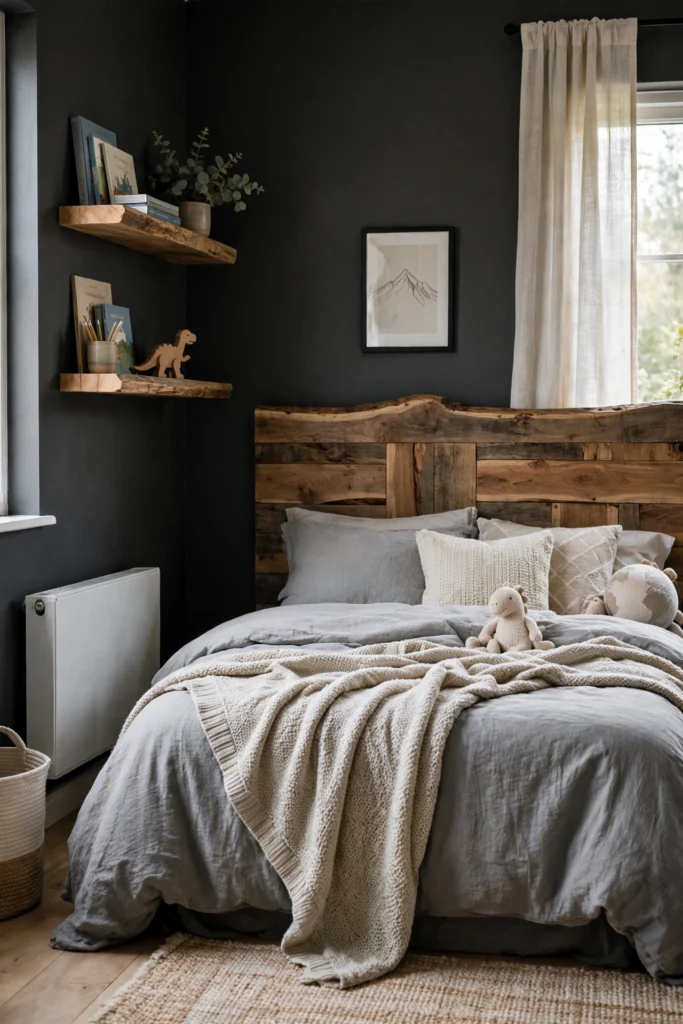
Deep navy, forest green and charcoal are popular in boys’ rooms for a good reason. They feel grown up without feeling cold, and they make wood furniture, white bedding and framed art stand out. The trick is knowing how much of the colour to use. In a room with one small window, paint a single accent wall, usually the wall behind the bed, and keep the other three walls warm white or pale grey.
In a brighter room with two windows, you can take the colour around all four walls and still keep the room feeling open, as long as the ceiling stays white and the bedding stays light.
Always test before you commit. Paint a swatch at least two feet square on the bed wall and look at it in daylight and at night under the room’s own bulbs. Colours shift a lot between the shop and a north facing room. Choose an
eggshell or matte finish for walls, because flat paint marks easily and gloss shows every bump. If dark walls feel like a big step, black bedroom wall ideas show how a dark feature wall pairs with lighter furniture and bedding so the room stays balanced.
Coat the ceiling in colour
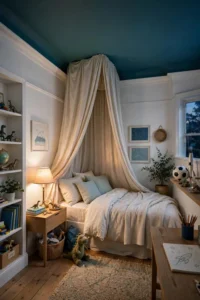
If four coloured walls feel like too much, paint the ceiling instead. Designers call it the fifth wall, and it is a clever move in a boy’s room because it adds drama without shrinking the walls around him. A deep blue or green ceiling over white walls feels cocooning from the bed, which is exactly where you notice it most.
Ceiling height decides how bold you can go. With a standard eight foot ceiling, use the wall colour mixed to about half strength, or pick a mid tone rather than the darkest shade, so the ceiling does not feel like it is pressing down. With nine feet or more, you can use the full colour. Keep the trim and coving white for a clean edge, and paint the ceiling before the walls so any drips land on surfaces you are about to paint anyway.
Play with subtle pattern
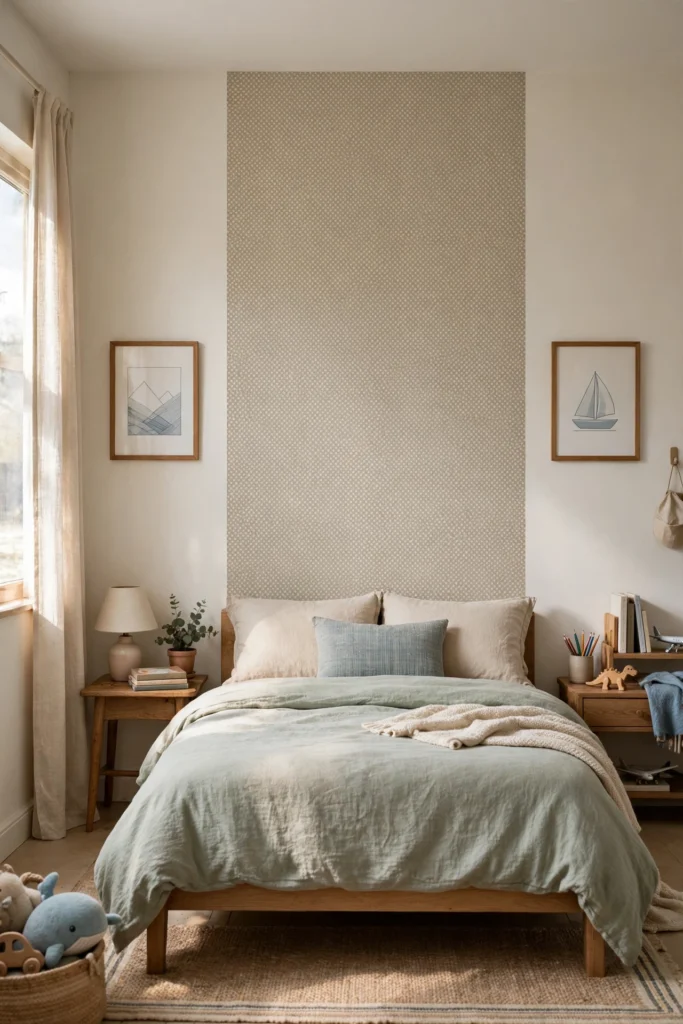
Bold wallpaper dates fast, especially in a room that has to last from childhood into the teen years. Subtle pattern lasts because it reads as texture from across the room. Think small dots, a fine stripe, a tiny geometric print, or a tone on tone design where the pattern is only one or two shades darker than the background. It adds interest without shouting, and it lets bedding, art and hobby displays change over the years without clashing.
Scale matters. Keep the pattern repeat small, typically under two inches, so it does not overwhelm a small wall. Use it on one wall only, again usually behind the bed, and keep the other walls plain. Peel and stick wallpaper is the practical choice here. It goes up without paste, it comes down without tearing plaster, and it lets you swap the pattern when tastes change.
Measure the wall properly first, order one extra roll beyond the calculator’s suggestion for pattern matching, and start hanging from the centre of the wall so the pattern sits symmetrically behind the bed.
Hang an impactful mural or wallpaper
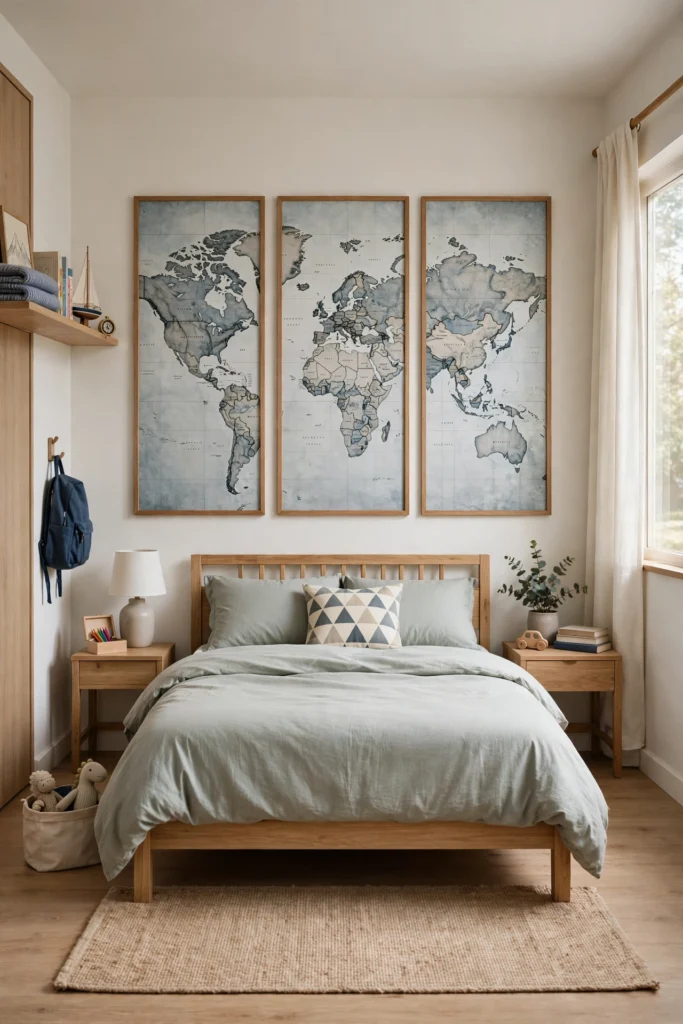
A mural is the one place in the room where you can go big. A map, a mountain scene, an abstract print or a city skyline turns a plain wall into the room’s talking point, and it costs far less than built in joinery. The key is restraint everywhere else. If the mural is busy, keep bedding solid, keep the rug plain, and keep the furniture simple so the eye has somewhere to rest.
Placement is simple: the mural goes on the bed wall or on the wall directly opposite the bed, never on a wall broken up by a door or a wardrobe.
Measure the full wall, including skirting and coving, and check the mural’s panel width before ordering, because most murals are sold in panels of about 18 to 24 inches. Avoid pairing a large scale mural with patterned curtains in a competing print. One hero pattern per room is the rule that keeps it stylish instead of chaotic.
Boys Bedroom Ideas, Decision 2: Layout and Zones Before You Buy Anything
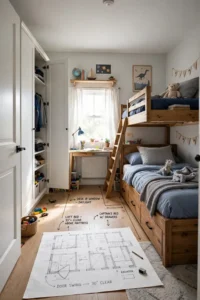
Most boys’ rooms fail on layout, not on style. The bed blocks the wardrobe door, the desk faces a blank wall in a dark corner, and there is nowhere for a friend to sit except the bed. Fix the layout first and the decorating gets easier, because every piece then has a reason to be where it is. Sketch the room on paper, mark the door swing, the window and the radiator, and plan around those fixed points.
Maximise every inch with smart layouts
Small rooms reward furniture that hugs the walls. Push the bed against the longest wall, ideally with its headboard on the wall opposite the door, so the room opens up as you walk in. Put the desk near the window for daylight, not jammed into the darkest corner. Keep walkways at least 24 inches wide, 30 inches where two people pass, and leave the wardrobe doors clear by their full swing.
Loft beds are a genuine space saver, but only with the right ceiling. You need at least eight feet of ceiling height, and at least 33 inches of clear space above the mattress so he can sit up without hitting his head. In a room with a lower ceiling, a captain’s bed with drawers underneath gives storage without the height problem. For more small room tactics, these small bedroom design ideas show how to make a tight footprint feel generous.
Delineate separate zones
A boy’s room is really three rooms in one: a place to sleep, a place to work, and a place to hang out. When those zones blur, homework spreads onto the bed and toys spread onto the desk. You do
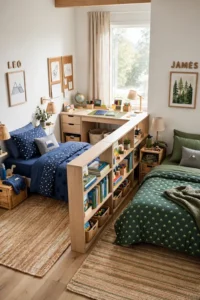
not need walls or dividers to separate them. A rug under the bed marks the sleep zone. A different rug, or a desk mat, marks the work zone. A low bookcase, about 12 inches deep, turned sideways can act as a gentle divider in a shared room without blocking light.
In a shared bedroom, give each boy his own zone with matching but distinct bedding, his own bedside storage, and a clear line down the middle that both can agree on. Matching rugs, one per bed, do this quietly and fairly. The goal is not a line down the room. It is that each boy can find his things, do his work, and sleep without tripping over the other’s life.
Leave room to chill and hang out
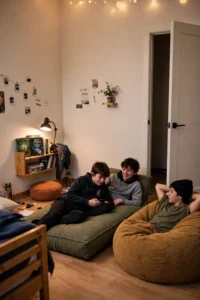
Friends will sit on the floor whether you plan for it or not, so plan for it. A corner with a large floor cushion, a bean bag, or a low lounge chair turns dead space into the room’s social spot. Keep about three feet square of open floor free for this, and keep it clear of the walkway to the door so friends are not blocking the exit.
What not to do is fill every inch of floor with furniture and then wonder why the room feels cramped. One empty corner is a feature, not wasted space. If reading is his way of chilling, a proper reading corner with a cushion, a small shelf and a clip on light works better than a chair shoved in a corner with nowhere to put a book.
These reading nook ideas with bookshelves show how a small corner becomes a spot he will actually use, with the books close at hand.
Keep things minimal and calm
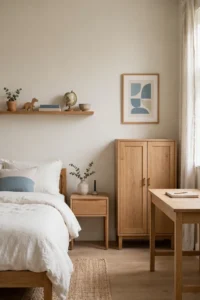
Some boys, especially busy teens, want their room to be the calmest place in the house. Minimal does not mean empty. It means every piece earns its place: a bed, a nightstand about 18 to 20 inches wide, a dresser or wardrobe, and a desk if homework happens here. Everything else is optional, and the room is better for it.
A calm palette helps: one wall colour, white or natural bedding, one accent colour repeated in a cushion and a piece of art. Avoid filling shelves for the sake of it. One shelf with five things he cares about looks intentional. Three shelves crammed full look like storage.
This approach also ages well. A simple, calm room adapts to a guest staying over far more easily than a heavily themed one, which is why elegant guest bedroom ideas are worth a look even for a boy’s room: the same calm base, good bedding and clear surfaces make any room feel welcoming.
Room size cheat sheet
Use this table before buying a bed or desk. It matches common room sizes to furniture that actually fits, with walking space left over.
| Room size | Bed that fits | Desk space | Walking space to leave |
|---|---|---|---|
| Small, about 9 by 10 feet | Twin bed, 38 by 75 inches | 36 inch wall mounted or fold down desk | 24 inches around the bed |
| Medium, about 10 by 12 feet | Twin XL or full bed | 42 to 48 inch desk with a drawer unit | 30 inches on the main walkway |
| Large, about 12 by 14 feet or bigger | Full or queen bed | 48 to 60 inch desk plus a reading chair | 30 to 36 inches on main walkways |
Decision 3: Furniture that earns its place
Boys outgrow furniture fast, and a room full of single purpose pieces runs out of space fast. The pieces worth spending on are the ones that do two jobs: a bed that stores, a desk that doubles as a nightstand, a seat that hides clutter. Buy the bed and the storage first, because those are the hardest to change later. Decorative pieces can wait.
Incorporate stylish storage solutions
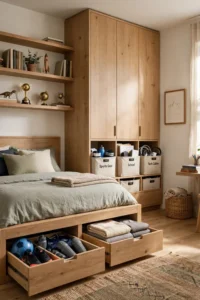
Clutter is the number one enemy of a boy’s room, and the fix is storage built into the room, not baskets piled in a corner. A platform bed with drawers underneath holds out of season clothes, sports kit and spare bedding. Built in wardrobes use the full wall height, where a freestanding wardrobe wastes the top two feet. Floating shelves, about 10 to 12 inches deep, hold books and collectibles without eating floor space.
Mount shelves with real fixings into studs or solid wall plugs, not adhesive strips, because books are heavy and a falling shelf at night is a safety issue. Keep everyday items between knee and shoulder height so tidying is easy. Label bins inside the wardrobe, one for sports gear, one for school, one for tech cables, because a labelled bin gets used and an unlabelled box becomes a junk drawer.
Choose double-duty furniture
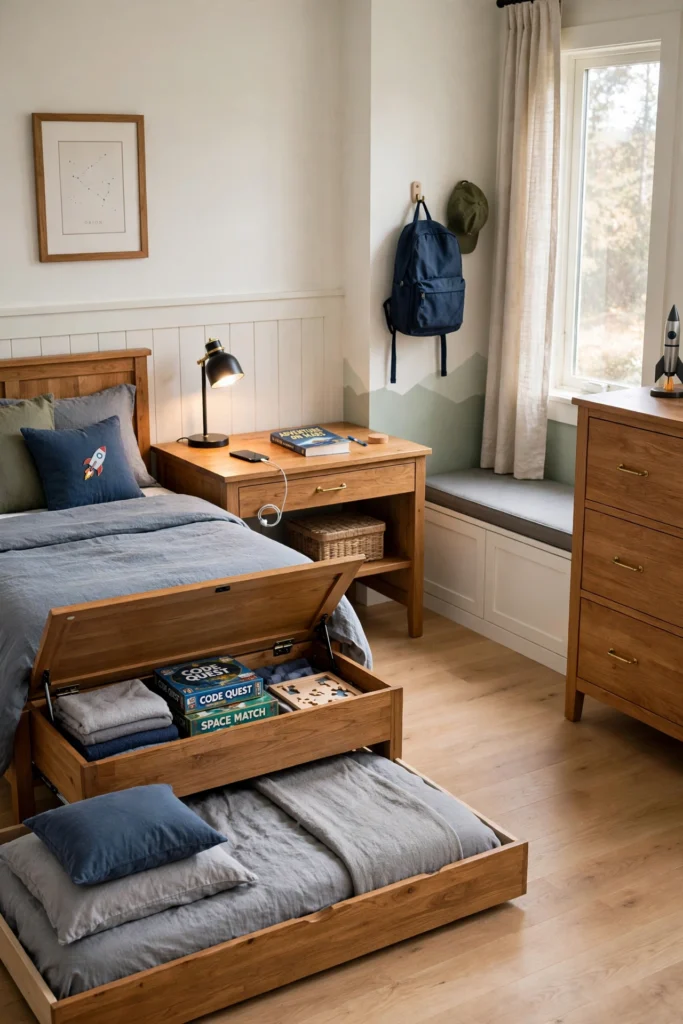
A desk that doubles as a nightstand, a storage ottoman that doubles as a seat, a bed with a trundle for sleepovers: these pieces are how a small room does everything. Look for furniture with hidden storage rather than visible clutter. A lift up storage bench at the foot of the bed holds games and spare blankets and gives a place to sit while putting shoes on.
Measure twice before buying double duty pieces. A storage bed needs about two feet of clear floor in front of its drawers to open them. A trundle bed needs the same clearance on its pull out side. A desk that serves as a nightstand should be at least 36 inches wide so a lamp, a phone charger and a book fit without crowding the sleep side of the bed.
Choose casual, comfortable furniture
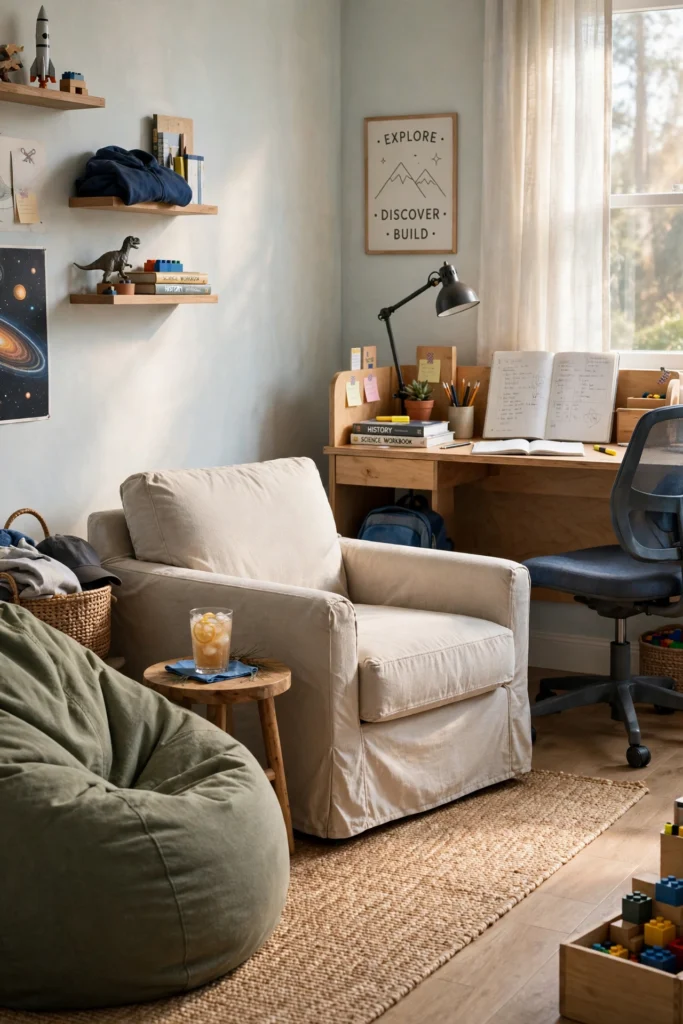
Formal furniture rarely survives contact with a boy. Low, soft, sturdy pieces do. A bean bag, a floor lounger, or a low profile armchair with a seat height of about 14 to 16 inches feels relaxed and is easy to move when the room gets rearranged for a gaming night. Choose fabrics that can be cleaned: removable, washable covers for anything that will hold snacks, drinks or muddy sports kit.
Comfort still needs support. A bean bag is great for an hour of gaming, but homework needs a proper chair with back support and a desk at the right height, about 29 to 30 inches for most teens. Pair the casual seating with a small side table, about 16 to 18 inches across, so there is somewhere to put a drink that is not the floor.
Incorporate flexible extra seating
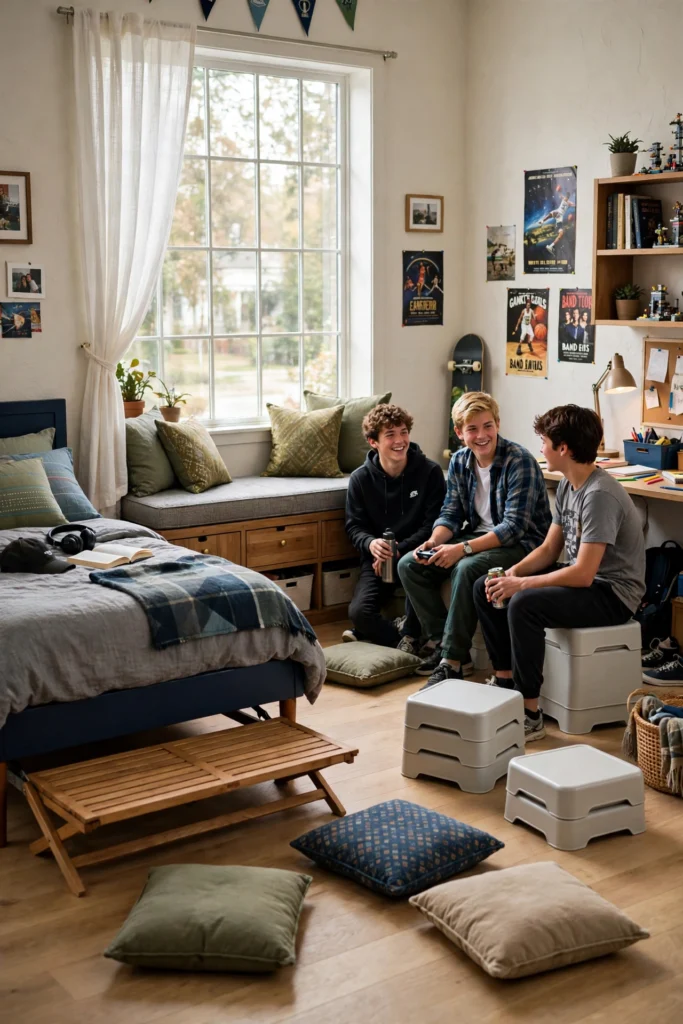
Friends come in groups, and a room with one chair cannot host them. Flexible seating solves this without permanently giving up floor space. Stackable stools, floor cushions about 24 inches square, or a folding bench can live in a wardrobe or under the bed and come out when needed. A window seat with storage underneath is the gold standard if the room has a suitable window, because it is seating, storage and a reading spot in one.
Count seats honestly. A twin bed sleeps one, a bean bag seats one, and a floor cushion seats one. For a room that regularly hosts two or three friends, you need at least three flexible seats stored somewhere accessible. Avoid buying seating that is too heavy to move, because seating that cannot be dragged out by a teenager will never be used. Light, wipeable and stackable beats stylish and heavy every time.
Design a dedicated creative zone
Homework, drawing, gaming and building all need the same thing: a surface, good light, and a place to leave a project mid flow. A desk 42 to 48 inches wide gives room for a laptop plus a notebook or sketchbook.
Put a task lamp about 12 to 18 inches above the desk surface, angled from the opposite side to his writing hand so his own shadow does not fall on the page. Keep the chair adjustable so it grows with him, with feet flat on the floor and knees at roughly a right angle.
Give the creative zone a back wall that works. A pinboard, a magnetic board or a single shelf for reference books keeps inspiration visible without cluttering the desk. Keep cables under control with a simple cable tray or clips along the desk leg, because a tangle of chargers is how desks become unusable.
Decision 4: Personality without clutter
This is where most boys’ rooms go wrong. Personality gets added everywhere at once, and the room ends up looking like a shop display for a hobby he may drop next year. The better rule is simple: a few deliberate pieces, each with a clear spot, and everything else kept calm. Personality should be the first thing you notice and the easiest thing to change.
Nod to his hobbies and passions
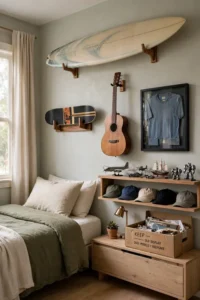
A guitar on a wall hanger, a skateboard on a display rack, a framed shirt or a shelf of model builds: these make a room feel like his in a way no shop bought theme can. Display the real thing, not a poster of the thing. A surfboard mounted horizontally on wall brackets becomes wall art and storage in one. A collection of caps looks sharp lined up on a single shelf, but messy scattered across three surfaces.
Rotate displays rather than adding to them. When a new interest arrives, one older display comes down into a keepsake box. That keeps the room current without it growing more crowded every year. And keep hobby gear off the floor. Wall brackets, hooks and racks cost little and protect the gear too. A guitar leaning in a corner gets knocked over. A guitar on a proper wall hanger gets played.
Add a touch of playful quirk
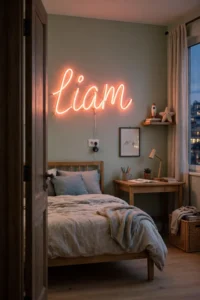
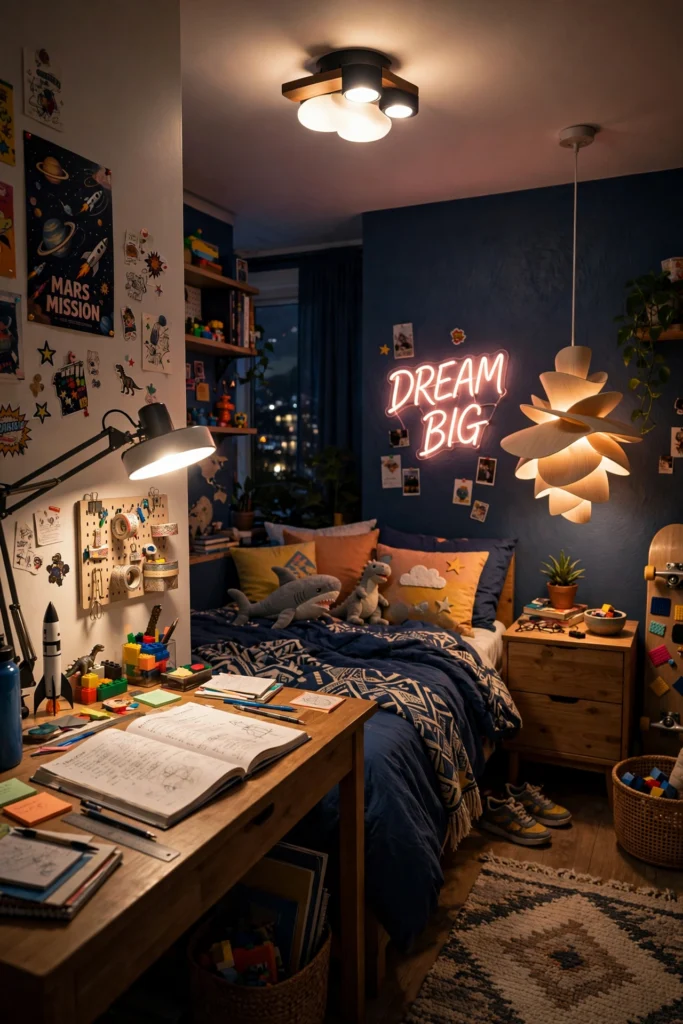
One unexpected piece keeps a room from feeling too serious. A neon sign with his name or a short word, a sculptural lamp, a quirky clock, or a vintage find from a market stall. The word to remember is one. One quirky piece is character. Five quirky pieces is clutter, and they start competing with each other instead of standing out.
Size the quirk to the wall. A neon sign about 24 inches wide suits a wall above a desk or bed. A sign twice that size dominates a small room and makes everything else look like an afterthought.
Place it where it is seen from the door, not hidden behind it. And check the practical side: a neon style LED sign should plug into a switched socket, not trail a cable across a walkway, and it should have a dimmer or a timer so it is not glowing all night.
Commission custom art or a themed mural
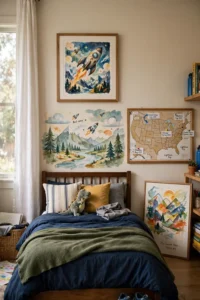
Custom art is the most personal thing a room can hold. It could be a mural painted by a local artist, a large print of his own artwork, or a map marked with places he has been. The difference between custom art that looks intentional and art that looks random is size and placement. As a guide, art above a bed or desk should span about two thirds of the width of the furniture below it.
Smaller than that, it looks lost. Wider than the furniture, it crowds the wall.
Hang art at eye level from where it is viewed. Above a bed, that usually means the centre of the piece sits about 60 inches from the floor, or 6 to 8 inches above the headboard. Above a desk, leave about 8 inches between the desk surface and the bottom of the frame so books and a lamp fit underneath.
The spacing rules used for art above a sofa transfer well to art above a bed, and these above couch wall decor ideas are a useful reference for getting height and width right. If a full mural feels permanent, a large framed canvas gives the same personal impact and moves with him.
Display personal mementos and keepsakes
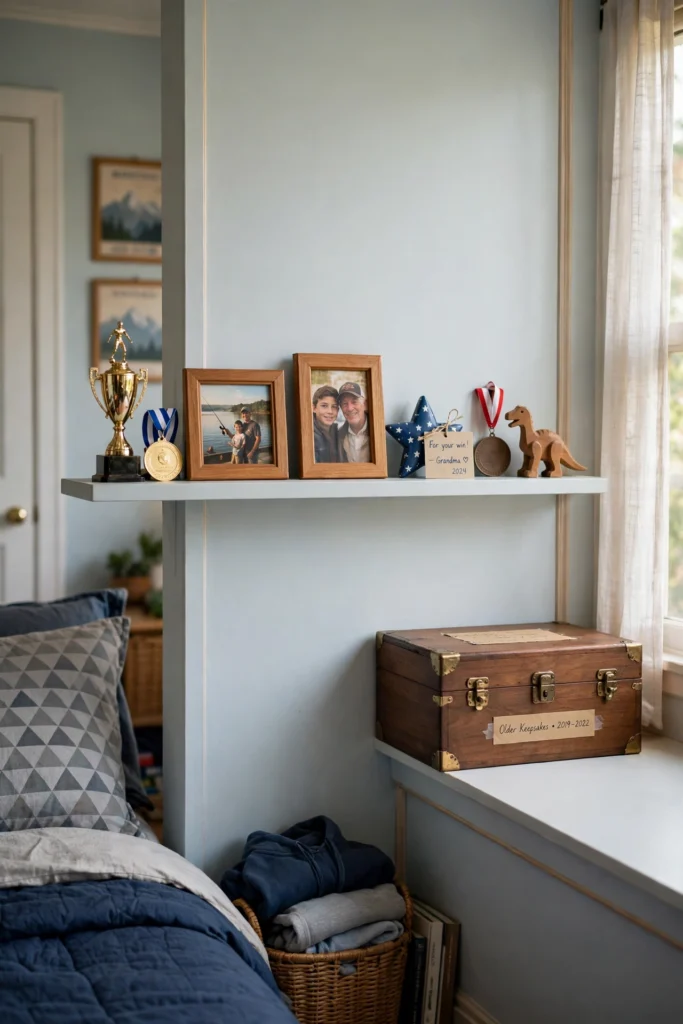
Trophies, medals, photos and gifts from people who matter: these are the pieces that make a room feel like his history, not just his hobbies. Give them one dedicated shelf, about 8 to 10 inches deep, at eye level, rather than spreading them across every surface. Limit the shelf to five to seven pieces. When it fills up, the oldest pieces move to a keepsake box, and the shelf stays a display, not a warehouse.
Group mementos with breathing room between them. A trophy needs about two inches of clear space on each side to read as an individual piece rather than part of a crowd. Photographs look best in matching frames, even simple ones, because mixed frames draw attention to the frames instead of the photos. And keep anything fragile away from the door swing and away from the bed’s pillow zone, where it is most likely to be knocked.
Lend a rustic, natural edge
Wood brings warmth to rooms that could otherwise feel cold, especially rooms with dark walls or grey bedding. A wood panelled headboard, reclaimed wood shelves, or exposed beams add texture that paint alone cannot. Natural materials also age gracefully, which suits a room meant to last through the teen years.
Use wood in one or two places, not everywhere. A wooden headboard plus wooden shelves is a scheme. Wooden headboard, shelves, desk, wardrobe and picture frames is a log cabin, and it darkens the room fast.
Balance wood with soft textiles and light bedding. Choose solid wood or good quality veneer for pieces that take daily use, and check that reclaimed wood is sanded smooth and sealed, because rough boards snag bedding and catch dust. Keep wood away from direct radiator heat, which dries and cracks it over time.
Keep, swap, skip
Use this table when the room starts filling up. It separates what to hold on to, what to update cheaply, and what to let go of.
| Item | Keep | Swap | Skip |
|---|---|---|---|
| Themed bedding set | One set he genuinely loves | Solid bedding with themed cushions | Matching curtains, rug and wall border in the same theme |
| Poster collection | Three framed favourites | Loose posters for framed prints | Posters covering every wall with no gaps |
| Trophy display | A shelf of his best wins | Medals into a display case | Every shelf lined with old participation trophies |
| Hobby gear | Gear he uses weekly, on display | Outgrown gear into a keepsake box | Broken or unused gear kept out of guilt |
Decision 5: Softness and light
Colour, layout, furniture and personality build the room. Softness and light are what make it feel good to be in. This is the decision people skip, and it is the one a boy notices most, because it decides whether the room feels warm at night, comfortable to sit in, and easy to wind down in.
Up the cosy factor with soft textiles
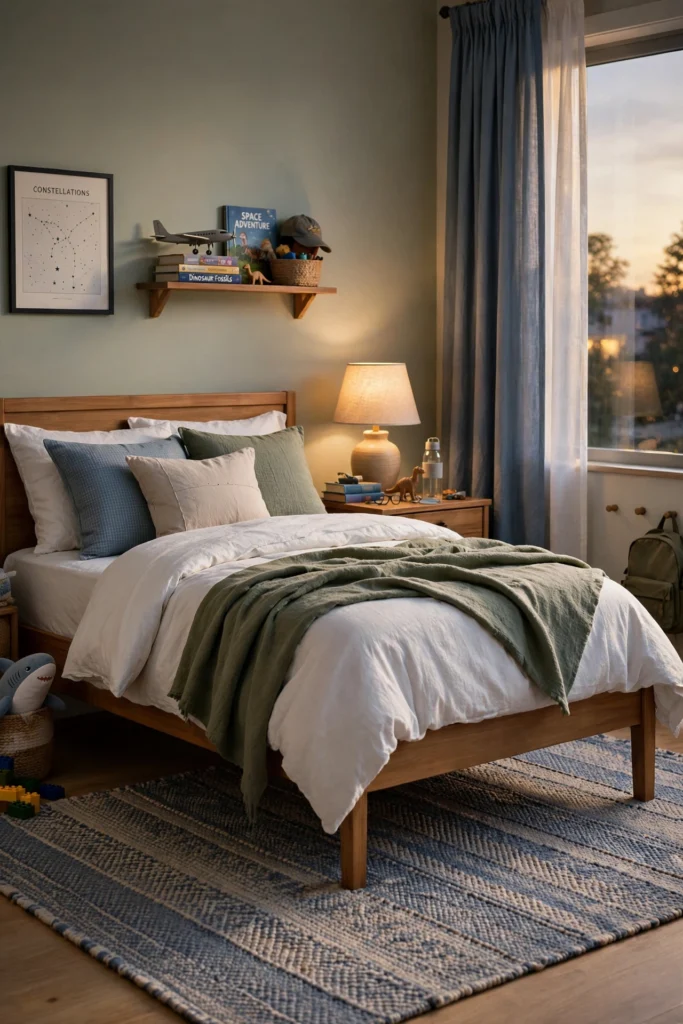
Textiles are the fastest way to warm a room, and they are the easiest to change when tastes shift. A rug under the bed, sized about 5 by 7 feet so the front legs of the bed and a nightstand sit on it, anchors the sleep zone and feels better underfoot than bare floor.
A throw across the foot of the bed adds colour without a full bedding change. Curtains in a midweight fabric soften a window and cut glare on a screen, which matters for homework and gaming alike.
Layer rather than pile. One rug, one throw, two or three cushions is plenty. More than that, and the bed becomes an obstacle course every night. Choose washable fabrics for everything at bed level, because textiles in a boy’s room get used hard.
Add funky, personality-packed lighting
One ceiling light makes a room feel flat and institutional. Three layers make it feel designed. Start with the ceiling light for general brightness. Add a task light at the desk, about 12 to 18 inches above the surface.
Then add one personality piece: a neon sign, a sculptural pendant, or a fun accent lamp. A pendant over a nightstand should hang about 30 to 36 inches above the nightstand surface, low enough to feel intentional, high enough not to block the view across the room.
Put the personality light on a dimmer or a smart plug so brightness can drop in the evening. This is the single cheapest upgrade to how a room feels at night. Avoid coloured bulbs as the only light source, because homework and reading need honest white light.
What parents get wrong in a boy’s bedroom
Is a dark colour a mistake in a small room?
Not on its own. A dark accent wall in a small room looks smart as long as the other walls stay light, the ceiling stays white, and the bedding is pale. What shrinks a small room is dark on every surface at once, plus heavy curtains and dark furniture. Keep two of those four light and the room holds up.
Should the room follow one theme?
A full theme works for a younger child and dates quickly for a teen. A better approach is a calm base with themed touches: bedding, art and one display that can change. When the interest changes, you swap cushions and art, not the whole room.
How do I make the room last as he grows?
Spend on the pieces that are hard to replace: the bed, the wardrobe and the desk. Keep personality in the cheap, changeable layer: bedding, art, lighting and displays. That way the room can move from age ten to age sixteen with a weekend of swaps instead of a full refit.
What if two brothers share the room?
Give each boy the same amount of personal space, even if the room is not symmetrical. Matching beds, matching storage and one personal display each prevents most arguments. Agree the shared rules early, like lights out times and who controls the speaker, because a shared room runs on agreements, not furniture.
How much wall decor is too much?
When every wall is covered, nothing stands out. Leave at least one wall mostly bare, usually the wall the door opens onto, so the eye has a resting place. Three strong pieces beat fifteen small ones scattered everywhere.
Is wallpaper a good idea, or will he outgrow it?
Peel and stick wallpaper is a good idea precisely because it comes down cleanly. Choose a subtle pattern or a mural on one wall, and it can stay for years or come down in an afternoon when tastes change.
Your first weekend: colour, bed, one wall
You do not need to redo the whole room to make it feel new. One focused weekend covers the three decisions that matter most.
- Friday evening: choose the colour. Pick one wall colour or one ceiling colour, buy tester pots, and paint two foot swatches on the bed wall. Look at them in daylight and at night before buying the full tin.
- Saturday: paint and move the bed. Paint the accent wall or the ceiling first. While it dries, move the bed to the longest wall, clear a three foot square corner for chilling, and set the desk near the window.
- Sunday: do one wall properly. Hang the mural, the framed art or the hobby display on the bed wall, following the two thirds width rule. Add the rug, the throw and one personality light, then stop. Give it a week of everyday use before buying anything else.
That is the whole method: colour first, layout second, one wall of personality, then softness and light to finish. Do those in order and the room stops being a collection of ideas and starts being a place he chooses to spend time in. If I had to pick one decision to get right first, it would be the layout, because a room that works on paper is the one that actually gets used.