The first evening home felt different from every evening before it. The light outside turned gold earlier, the air through the window felt cooler, and the house was quiet in a new way. We carried the car seat in, set it down in the middle of the nursery, and stood there for a moment, unsure where to put anything. The room looked ready in photos. In real life, it needed to work at two in the morning, with one hand free and a baby who had just woken up.
That is the test this room has to pass. Fall baby nursery ideas are not about filling a space with leaves and warm colours for a few weeks.
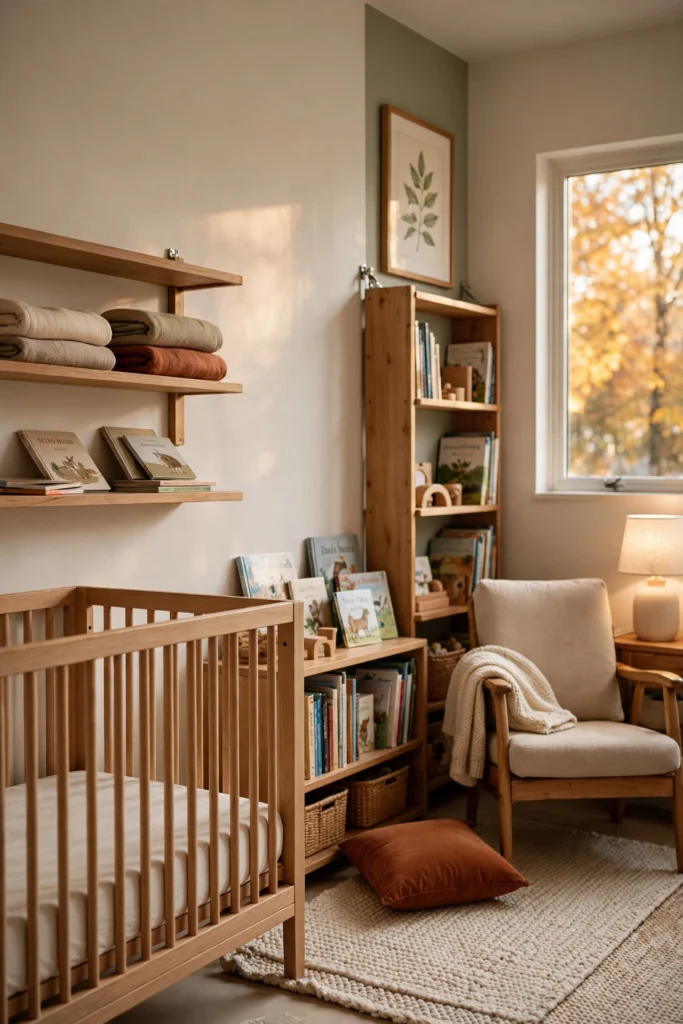
It is about building a room in layers, so the parts that keep a baby safe and comfortable stay put, and the parts that carry the season can change without a fresh coat of paint or a new set of furniture. When the base is calm and the autumn layer is easy to swap, the room stays useful long after the first leaves have fallen.
Start with a calm base of warm neutrals, add autumn warmth only through textiles, baskets, prints, and light that can be swapped, and keep the crib bare with a firm flat mattress and a fitted sheet only.
Use warm white light that dims low for night feeds, keep cords, loose fabric, and small objects out of reach and out of the sleep space, and place storage where an adult can reach it in the dark without waking the baby fully.
If you change one thing first, change the light and the crib setup. Those two choices affect sleep, feeding, and safety every single night, while colour and decoration can wait until you know how you actually use the room.
The base that stays all year
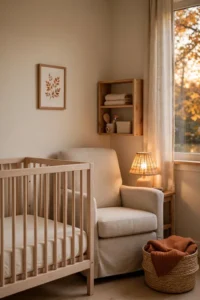
A good base does not shout. It gives the room a steady feeling, so a rust cushion or a leaf print can stand out without making the whole space feel busy. Warm white, soft cream, pale oatmeal, and a muted warm grey work well together because they reflect light in a small room and they do not compete with the baby for attention. Babies are still learning to focus, so a wall full of strong pattern can feel loud even when it looks pretty in a photo.
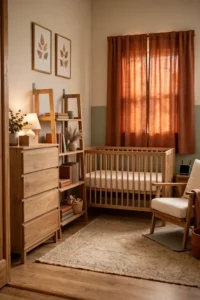
Pick one wall, or one part of the room, for a deeper colour if you want one. A warm clay, a soft sage, or a muted olive behind the crib or the chair can anchor the room without closing it in. Keep the other walls light.
That contrast also makes it easier to change the season later, because you only need to change what sits against that wall, not the wall itself. If you are choosing paint, look for low odour, low VOC options and let the room air fully before the baby sleeps in it.
Colour combinations work best when they follow a simple rule: most of the room light, some of it mid tone, and only a little of it deep or bright. Try cream walls with natural wood, a sage or clay accent, and small touches of rust or mustard in a throw, a basket, or a print.
Try oatmeal walls with warm white bedding, a wooden chair, and a deep green cushion in the feeding corner. Or try soft white walls with pale wood, terracotta in a rug border, and a muted gold in a lamp shade. Each of these keeps the room warm without turning it dark, which matters as daylight shortens.
For more ways to pair warm tones without overdoing them, see these interior color trends for cozy homes, and borrow only the combinations that still feel calm at night. A trend that needs bright daylight to look good will not help you during a night feed.
Choose colours that still feel right in dim light, because that is when you will spend a lot of time in this room. Texture is the second part of the base, and it matters as much as colour. A room can be warm in colour and still feel hard if every surface is smooth and cold.
Natural wood, woven baskets, a soft rug, and cotton bedding add warmth you can feel with your hands. The trick is to put texture where it helps and keep it out of the crib. A thick rug under the feeding chair, a woven basket beside the changer, and a soft throw folded over the chair arm all add comfort without adding risk.
Choose fabrics you can wash easily. Organic cotton is a sensible choice for sheets and sleep sacks because it is soft, breathable, and simple to launder. Wool blends and knitted throws feel warm in the chair, but they belong on you, not in the crib.
Velvet cushions look rich in rust or mustard, yet they collect dust and need more care, so keep them to one or two and choose covers you can remove and wash. If a fabric cannot be washed after a spit up or a nappy leak, it will not stay fresh for long.
Think about weight and warmth in practical terms. A room that feels cool in the evening does not need a heavier blanket in the crib. It needs a warmer room, a sleep sack suited to the room temperature, and a fitted sheet that stays smooth and tight. Check the room with your own hands: if the floor feels cold under bare feet, a rug with a non slip backing helps.
If the chair feels cold against your back during a long feed, a folded throw over the chair helps you, and it stays out of the sleep space when you stand up. Throws work in every room of the house, not only in a nursery, and the same rules apply: soft, washable, and kept away from the sleep space.
These modern throw blanket ideas for a cozy aesthetic show how a throw can add colour and texture without clutter, and the lesson transfers well. One good throw in the feeding corner beats three decorative ones draped where they can slip, bunch, or end up near the baby.
The autumn layer you can swap out
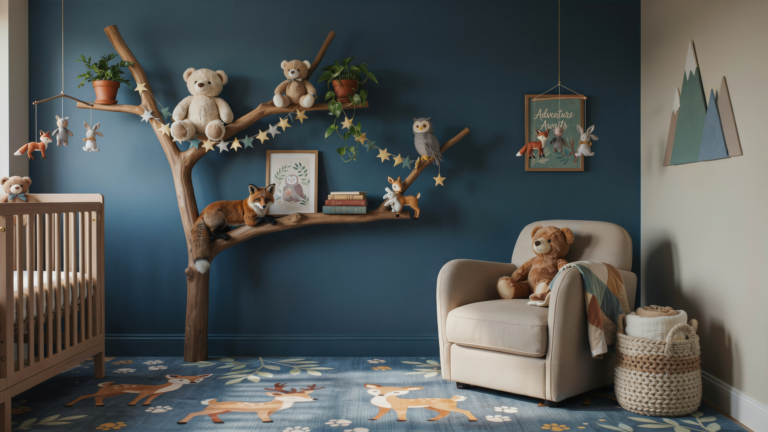
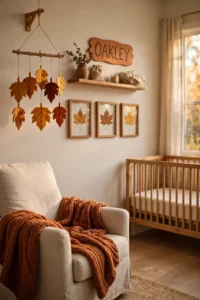
The autumn layer is where the season lives, and it should be light enough to lift out in one afternoon. Nature themed decor works best when it stays simple: a framed leaf print, a wooden shelf, a small branch in a tall vase placed well out of reach, or a curtain with a quiet leaf pattern. You do not need a woodland scene on every wall. One clear nature note, repeated in two or three small places, reads as autumn without turning the room into a theme park.
Wood does a lot of this work on its own. A natural wood crib, a wooden rocking chair, or a plain wooden shelf brings in the outdoors without any printed leaves at all. Pair wood with a botanical print in a simple frame, and the room feels connected to the season outside the window.
Keep dried flowers and seed heads on a high shelf, far from the crib and far from small hands. They look lovely, but they shed, they break, and small pieces can become a choking risk if they fall within reach. Storage is part of the autumn layer too, when you choose baskets and bins in warm tones.
Wicker and rattan baskets in natural, oatmeal, or warm brown tones hold blankets, toys, and spare clothes, and they look right in a fall room without any extra decoration. Open wooden shelving in warm white or sage gives books and soft toys a home, while fabric bins in rust, mustard, or deep green add colour that can be swapped later for a lighter set.
Label storage in a way that works when you are tired. A basket for clean sleep sacks, a basket for muslins, a bin for outgrown clothes, and a basket for toys you rotate will save more time than a pretty shelf with no system. Put labels where an adult can read them at a glance, and keep small items, such as clips, creams, and spare dummy parts, in a closed box on a high shelf or inside a drawer.
What looks tidy in daylight must also be safe and easy in the dark. Autumn light has its own character, and you can echo it indoors without making the room dark. Warm white bulbs, in the range often described as 2700K to 3000K, give a soft yellow white glow that suits evening feeds.
Cool white bulbs, which look bluish, feel bright and alerting, and they are a poor choice for a nursery at night. If you can dim the main light, do so. A dimmer, or a lamp with a low setting, lets you see well enough to feed and change without fully waking the baby or yourself.
Layer light the way you layer textiles. A ceiling light on a dimmer gives general light. A floor lamp or a table lamp beside the feeding chair gives focused light for feeds. A small night light, kept low and warm, gives just enough glow to move safely without turning the room bright.
Fairy lights can look warm, but only if they are fixed firmly along a shelf or wall, kept away from fabric and curtains, and kept well out of reach, with cords hidden and secured. If a string light cannot be fixed safely, leave it out.
Blackout curtains in a deep autumn tone, such as terracotta or forest green, help naps when daylight is strong, and they add colour without paint. Hang them so they close fully, without gaps at the sides, and choose cordless options. Any cord, loop, or long tie near a window is a risk once a baby can stand and reach. A curtain that looks beautiful but hangs near the crib or a climbing surface is not worth keeping in that spot.
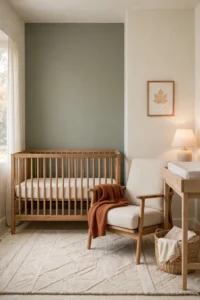
Light and sleep
Light and sleep belong together because the room has to do two jobs: help the baby settle, and help you stay calm during feeds. In the evening, keep the room dim and warm. During daytime naps, use blackout curtains to keep the room dark and steady, even if the sun is bright outside. That contrast, bright enough in the day and dim at night, helps the baby learn the difference between day and night over time, without any gadget doing the work for you.
For night feeds, use the lowest light you can still work in safely. A warm lamp turned low, or a dim night light, lets you check a nappy, offer a feed, and settle the baby without switching on a bright ceiling light.
Keep the feeding spot set up before bed: a muslin, a drink for you, and a clean sleep sack within reach, so you are not searching drawers in the dark. The fewer decisions you make at two in the morning, the easier it is to keep the room calm.
Room temperature matters as much as light. A room that feels comfortable in a light layer of clothing for an adult is usually a sensible guide, and a sleep sack suited to that temperature is safer than adding loose blankets. Do not place the crib beside a radiator, a cold draughty window, or a heater that blows directly onto the sleep space. Keep air moving gently, without a direct draught on the baby, and check the room with your hand near the crib, not only by looking at a monitor reading.
Safe sleep is simple, and it does not change with the season. The crib holds a firm flat mattress and a fitted sheet only. No pillows, no loose blankets, no bumpers, no stuffed toys, and no sleep positioners in the sleep space. That rule can feel strict in a room full of soft autumn textiles, which is why the room around the crib has to carry the warmth instead. Put the softness in the chair, on the floor, and on the walls, and keep the crib clear.
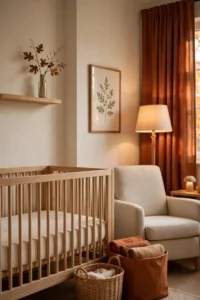
| Check | What to look for | How to check it |
|---|---|---|
| Crib frame | Sturdy, no broken slats, no cutouts a head could pass through | Shake it gently, run a hand over every joint, check the maker guidance |
| Slat spacing | Narrow spacing, with no wide gaps | Check the maker guidance and look for gaps a small head could fit through |
| Mattress fit | Firm, flat, snug, with no gaps at the edges | Press the edges and try to fit two fingers in any gap; there should be none |
| Sleep surface | Fitted sheet only, smooth and tight | Pull the sheet at the corners; it should stay tight and flat |
| Inside the crib | Nothing loose: no pillows, blankets, toys, or bumpers | Look inside before every sleep, not only when you set the room up |
| Above and beside the crib | Nothing that can fall in, and no cords within reach | Stand at the crib and look up and around, then move anything close |
| Mattress height | Lowered as the baby pushes up and stands | Lower it before the baby can sit up unaided, and again before standing |
Storage that survives the first year
The first year changes what storage has to do, almost month by month, without any calendar date printed on the wall. Newborn clothes give way to larger sizes. Muslins give way to bibs, then to small toys, then to books. A storage system that survives that change is one you can relabel and refill, not one you have to rebuild. Open cubbies with fabric bins work well for this, because a bin can change purpose without new furniture.
Work in zones. The changing zone holds nappies, wipes, creams, and clean clothes, all within arm’s reach of the changer, so you never leave the baby unattended to fetch something. The feeding zone holds muslins, sleep sacks, and a small basket for dummies or bottles, near the chair. The play and reading zone holds a small basket of toys and a few board books, where you can sit on the floor. When each zone has its own basket, tidying takes a few minutes, not a full afternoon.
Small rooms need this discipline even more. If the nursery is tight, use the height of the walls for books and display, keep the floor for the crib, chair, and one rug, and choose furniture that does two jobs, such as a dresser that also works as a changer with a secure top.
These small bedroom design ideas to maximize space and style are useful here, because they show how to keep a small room feeling open while still giving everything a place. The aim is not to fit more in, but to leave clear floor space for safe movement.
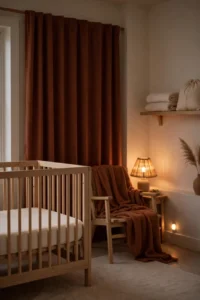
Handmade fall touches
Handmade decor adds a personal note that shop bought items rarely match, and it lets you control the materials you bring into the room. A felt leaf mobile in amber, rust, and gold, hung from a wooden dowel, can be a gentle focal point above a chair, not above the crib. Pressed leaves under glass, in simple wooden frames, make quiet wall art. A wooden name sign above a shelf, painted in a warm tone, marks the room as the baby’s without needing a full theme.
Finish matters more than skill. Use paints, glues, and sealants that are marked non toxic for indoor use, and let every piece dry and air fully before it goes on the wall. Sand wooden edges smooth, fix hanging pieces firmly, and check that no small part can break off. A handmade piece that sheds felt, flakes paint, or hangs loosely is not a keepsake in a nursery, it is a hazard waiting for a curious hand.
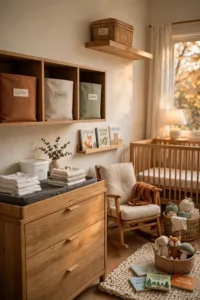
Safety woven through every layer
Safety in a nursery is not a checklist you finish once and forget. It is a habit woven through colour, light, storage, and decoration, and it changes as the baby grows. A paint choice becomes a safety choice when you pick a low odour option and air the room. A storage choice becomes a safety choice when you anchor a dresser to the wall and keep heavy items low. A decoration choice becomes a safety choice when you hang it where it cannot fall into the crib.
Anchor every tall piece of furniture to the wall: dressers, wardrobes, bookshelves, and changing tables. Babies pull up, climb, and open drawers sooner than most parents expect, and a piece that feels stable to an adult can tip when a drawer is used as a step. Fix cords and cables out of sight and out of reach, including monitor cords, lamp cords, and charger cables. Choose cordless blinds and curtains, and keep any remaining cord short, secured, and far from the crib.
Check the floor as carefully as the walls. Rugs need non slip backing, or a non slip pad underneath, so they do not slide when you step on them holding a baby. Small rugs near a door can bunch and trip you in the dark, so keep them flat and low. Keep the floor clear of bags, loose fabric, and small objects, especially near the path from the door to the crib and chair. At night, that path is your workplace, and it should be clear.
Repeat the safety check as the baby grows. What was safe for a newborn in a high crib is not safe for a baby who can stand, reach, and climb. Lower the mattress, move wall hangings higher, remove the mobile, secure low drawers, and recheck cords and small objects. Do this check before the baby reaches each new stage, not after. Safety woven through every layer means you do not have to redesign the room at each stage, you only adjust it.
Smart nursery technology
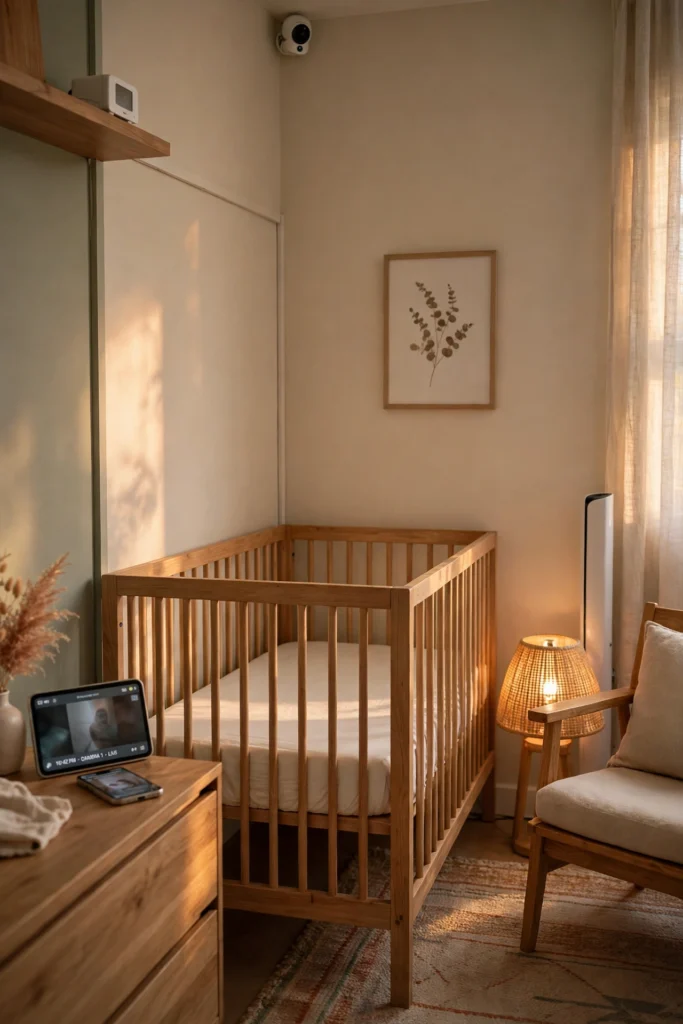
Technology can help in a nursery, but only when it stays quiet and out of the way. A video monitor lets you check without entering the room and waking the baby. A sound machine gives steady background sound for naps. A smart bulb lets you dim the light from the doorway, without fumbling for a switch in the dark. An air purifier can help in a freshly painted or newly furnished room, by moving and filtering air, but it does not replace airing the room and choosing low odour materials.
Choose one or two devices that solve a real problem, and skip the rest. A monitor that shows temperature and sound can be useful, yet it does not need to sit beside the crib or shine bright light into the room.
Keep screens dim, keep alerts soft, and keep the device itself out of reach. If a device needs a cable, run that cable behind furniture, fix it to the wall, and keep it at least an arm’s length from the crib. Loose cables undo every other safety choice in the room.
Eco friendly and sustainable choices
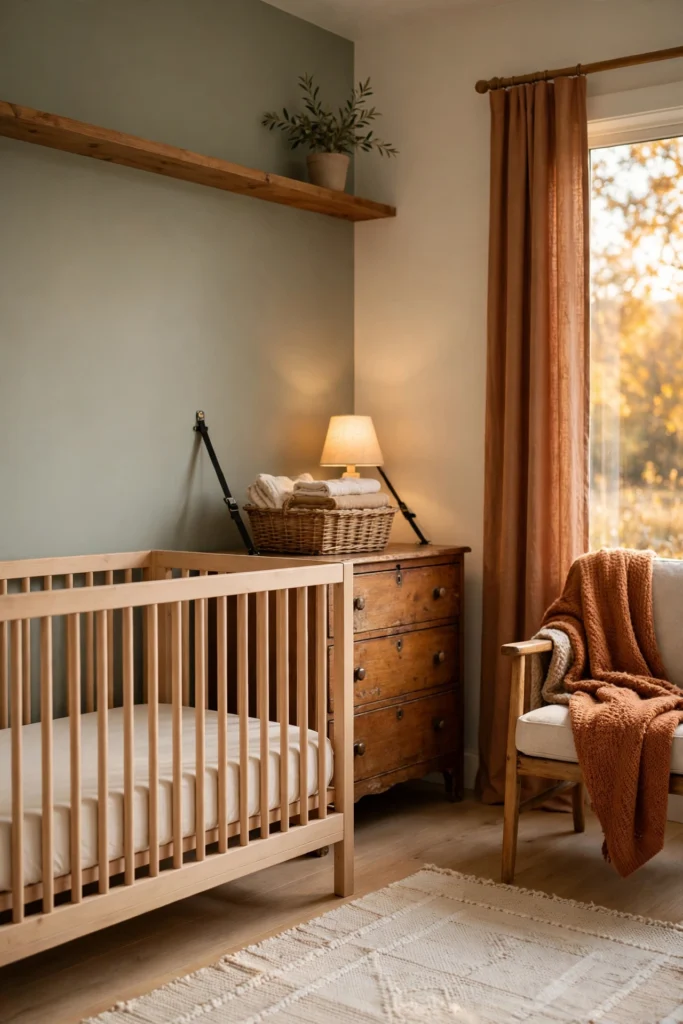
Eco friendly choices in a nursery often overlap with safe choices, because both favour natural materials, simple finishes, and fewer chemicals. Solid wood furniture, organic cotton bedding, wool rugs, and low odour paints are all sensible starting points. Look for clear maker information about materials and finishes, and prefer pieces you can clean, repair, and keep for years, rather than pieces that look new for a short time and then need replacing.
Secondhand and upcycled pieces can work well, with care. A vintage wicker basket, a solid wood frame, or a well made dresser can add character and reduce waste, as long as it meets current safety guidance and has no missing parts or damaged joints. Check secondhand cribs especially carefully, and skip any crib that does not meet current safety standards, has drop sides, or lacks maker guidance. Saving money matters, but a crib is not the place to compromise.
Fall Baby Nursery Ideas: A Room That Grows With the Child
A fall nursery grows well because its base is already timeless. Warm neutrals, natural wood, and nature notes do not belong to one age, and they do not need to be replaced when the baby becomes a toddler. A convertible crib that becomes a toddler bed, and later a larger bed, can anchor that growth, as long as you follow the maker guidance at each stage and lower the mattress on time. Open shelving adapts too, moving from nappies and muslins to books and small toys without new furniture.
Plan the next stage while you set up the first one. Leave a corner that can become a reading corner, with a low shelf and a small cushion, so books have a home from the start.
These reading nook ideas with bookshelves show how a small corner can grow into a place a child returns to, and the same shelf that holds board books now can hold picture books later. A rug that works for tummy time now will work for floor play later, if you choose a size that leaves room to move.
As the child grows, the room can take on more personality, and the same principles still apply. A girls bedroom, for example, can keep the warm base and add stronger colour through bedding and art, rather than through a full redecoration.
These kids bedroom ideas for girls with stylish decor show how a calm base can carry a more personal style later, which is exactly what a well built nursery should allow. The fall layer was never the whole room, it was only the first layer on top of a room built to last.
What to keep, what to swap when the season passes
When the season passes, you should not need to start again. Keep the walls, the crib, the chair, the rug, and the storage furniture. Swap the textiles, the prints, and the small colour accents, and the room will feel new without feeling different. Put the autumn baskets in a box, labelled and stored, so you can bring them back or pass them on, rather than throwing them away after one season.
| Keep all year | Swap with the season | How to swap it |
|---|---|---|
| Warm neutral walls and natural wood | Rust, mustard, and deep green cushions | Change covers only, keep the same cushion inserts |
| Firm crib, fitted sheet, and clear sleep space | Leaf prints and felt garlands | Lift frames off the wall, store flat, replace with lighter prints |
| Feeding chair, rug, and storage furniture | Autumn baskets and fabric bins | Relabel bins, swap bin colours, keep the same shelves |
| Warm dimmable light and blackout curtains | Throw over the chair arm | Fold and store the heavier throw, use a lighter washable one |
| Anchored furniture and cordless window coverings | High shelf vase and dried stems | Remove stems, leave the vase empty or replace with a plain object |
Fall nursery questions parents ask before the baby arrives
What colours work best for a fall baby nursery?
Warm neutrals as the base, with rust, terracotta, sage, and deep green as accents, work best. Keep large surfaces light and use deeper colours in cushions, baskets, prints, and a rug border, so the room stays warm without feeling dark.
How can I make the room cozy without putting soft items in the crib?
Put softness around the crib, not in it. Use a rug under the chair, a throw over the chair arm, and cushions in the feeding corner. Keep the crib to a firm flat mattress and a fitted sheet only, every time the baby sleeps.
What light is best for night feeds?
Warm white light that dims low is best. Use a lamp beside the chair on its lowest useful setting, or a small warm night light, so you can see safely without waking the baby fully or turning on a bright ceiling light.
Are nature themed decorations safe in a nursery?
Yes, when they are fixed firmly, placed well out of reach, and kept away from the crib. Hang prints high, keep dried stems on a high shelf, and remove a mobile once the baby can push up or reach it. Check for shedding, loose parts, and flaking paint.
How do I choose furniture that will last beyond the baby years?
Choose a convertible crib, a solid dresser that can work as a changer and later as a dresser, open shelving, and a good rug. Keep colours neutral and let baskets, prints, and bedding carry the changing style, so the furniture does not need to change.
Can a fall nursery work if the baby arrives in another season?
Yes. Fall baby nursery ideas in this layered sense are about warmth, texture, and natural tones, not about one season on the calendar. The base works all year, and the autumn layer can stay for as long as you like it, or be swapped when you are ready.
Keep the crib bare, warm the room around it
If you remember one rule from this room, make it this one. Keep the crib bare, and warm the room around it. That single choice lets you enjoy every autumn texture, colour, and handmade touch, without putting any of it where the baby sleeps. The chair can be soft. The floor can be soft. The walls can be warm. The crib stays clear, firm, and flat.
Start with the base, add the autumn layer in small swaps, and check safety each time the baby reaches a new stage. You do not need to buy everything at once, and you do not need to finish the room before the baby comes home. A calm base, warm light, reachable storage, and a bare crib will carry you through the first nights, and the rest can grow with you, one layer at a time.