Will this wallpaper still look right when your baby is three?
That is the question worth asking before you fall for a print in a shop or on a screen. A nursery changes fast. The tiny crib becomes a toddler bed, and the room starts to hold books, toys and a small person with strong opinions. Wallpaper that only suits a newborn can feel wrong long before you planned to redecorate.
Think of wallpaper as the room’s background, not its main event. The best designs give the room a mood, then step back and let furniture, bedding and light do the rest.
Choose a pattern you would still like in a toddler room, in a scale that suits the size of your room, on a material you can clean and later remove without a major repair job.
If you are unsure, put it on one wall only, behind the crib or the nursing chair, and keep the other walls plain. Order a sample first, tape it to the wall, and look at it in morning light, evening light and lamplight before you buy full rolls.
This guide keeps all 17 designs from the original post, grouped by style family so you can compare like with like. Each design gets practical detail: how large the pattern should be, which wall suits it best, how it behaves in bright or dim light, what furniture sits well against it, and what to watch out for. You will also find a material comparison, a scale guide for small rooms, safety notes for a baby’s room, and a short checklist to use before and after installation.
Peel and stick, traditional or mural: choose the material first
Parents often start with the pattern and only later realise the material matters just as much. Peel and stick suits renters and anyone who expects to change the room in a few years. Traditional paper gives a flatter, longer lasting finish, but asks more at installation and removal. A mural is one large picture made to fit a single wall, not a repeat you can cut anywhere.
Think about who will install it, how long you want it to stay, and how much cleaning the wall will need. A wall beside a changing table gets more wear than a wall behind a wardrobe.
| Type | Best use | Removal | Cleaning |
|---|---|---|---|
| Peel and stick | Rented homes, one accent wall, rooms you expect to update as your child grows | Peels away in panels, usually with little wall damage if the wall was sound to start with | Wipe with a damp cloth for most vinyl and coated finishes; check the maker’s guidance before scrubbing |
| Traditional pasted | A long term nursery, a home you own, a print you want to keep for several years | Needs steaming or soaking and often some patching and repainting afterwards | Often more durable and easier to wipe than uncoated peel and stick, depending on the finish |
| Mural | One feature wall, a scene or sky effect, a room where you want a clear focal point | Removal depends on whether it is paste or peel and stick backed; measure the exact wall first, as panels are made to order | Spot clean gently; large printed scenes can show marks more clearly than a small repeat pattern |
Accent wall or full room is the next decision, and it is tied closely to pattern scale. A bold print on one wall can lift a plain room without closing it in. The same print on four walls can feel loud in a small nursery. A small, quiet repeat is safer for all four walls.
Keep the crib wall as the feature wall only if the pattern is calm enough for sleep. A busy scene where a baby looks while settling can be stimulating at the wrong time. If you love a bold print, try it on the wall you see on entering, and keep the crib wall softer.

Calm and timeless
These six designs share one quality: they do not shout. They use soft colour, small to medium repeats or gentle washes of tone, and they leave room for the rest of the nursery to change. If you want a room that still feels right when the baby becomes a toddler, start here.
Soft Watercolor Botanical Print
A soft watercolor botanical in muted greens and creams is one of the easiest nursery wallpapers to live with. The edges of the leaves stay gentle, the background stays light, and the room feels like a garden without turning into a theme park version of one. Choose a medium repeat, with leaves roughly the size of your hand. A much smaller repeat can look busy, while a very large leaf can dominate a narrow wall.
It works best on the crib wall or across all four walls in a bright room. In a dim room, choose a warm cream ground rather than a cool white one. Pair it with natural wood, white or pale oak furniture, and plain bedding in cream, sage or soft white. Let the wallpaper carry the pattern and keep curtains and rugs quieter.
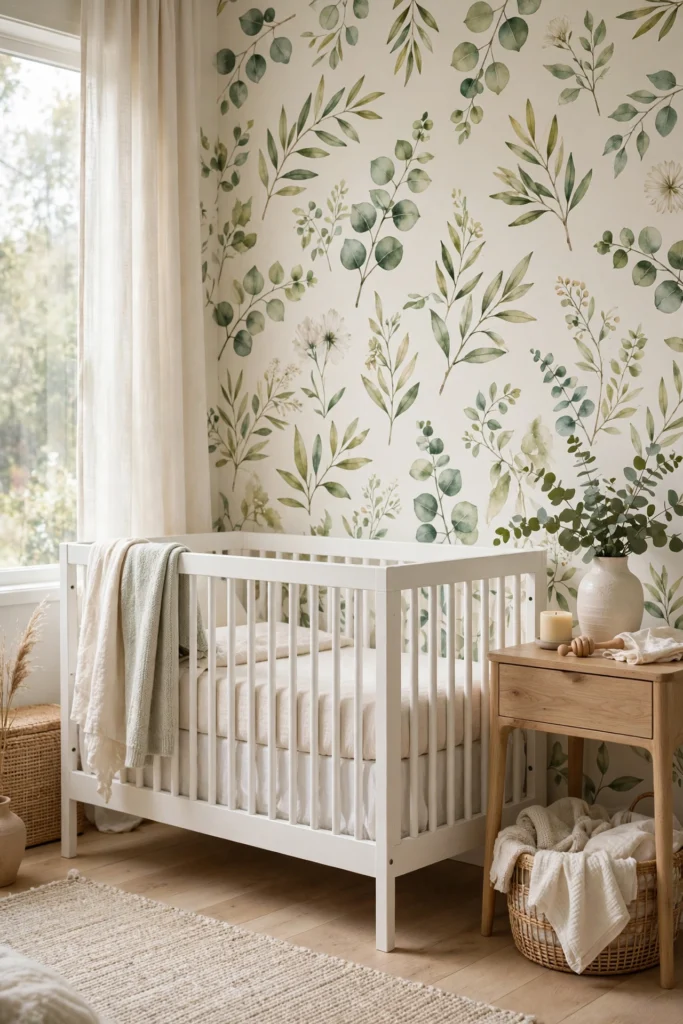
Watch out for a version with too much contrast between leaf and background. Dark green leaves on bright white can feel sharp in a sleep space, even if the print looks lovely in a photo. For cleaning, a coated finish wipes more easily than an uncoated paper, so check that detail if the wall sits near the changing table. Removal is straightforward with peel and stick, and a traditional version in this style usually ages well if the seams were well matched.
Gender-Neutral Cloud and Star Pattern
A small cloud and star repeat in soft grey or sage is a practical choice when you are decorating before you know the baby’s sex, or when you simply prefer a dreamlike room without pink or blue coding. The small scale is its strength. From the doorway it reads as texture, and only up close do the clouds and stars come into focus.
Use it on the crib wall for a gentle focal point, or across the room for a cocooned feel. It suits white, light grey or pale wood furniture. Because the pattern is small, you can add a patterned rug later without crowding the room, if it stays in the same muted palette.
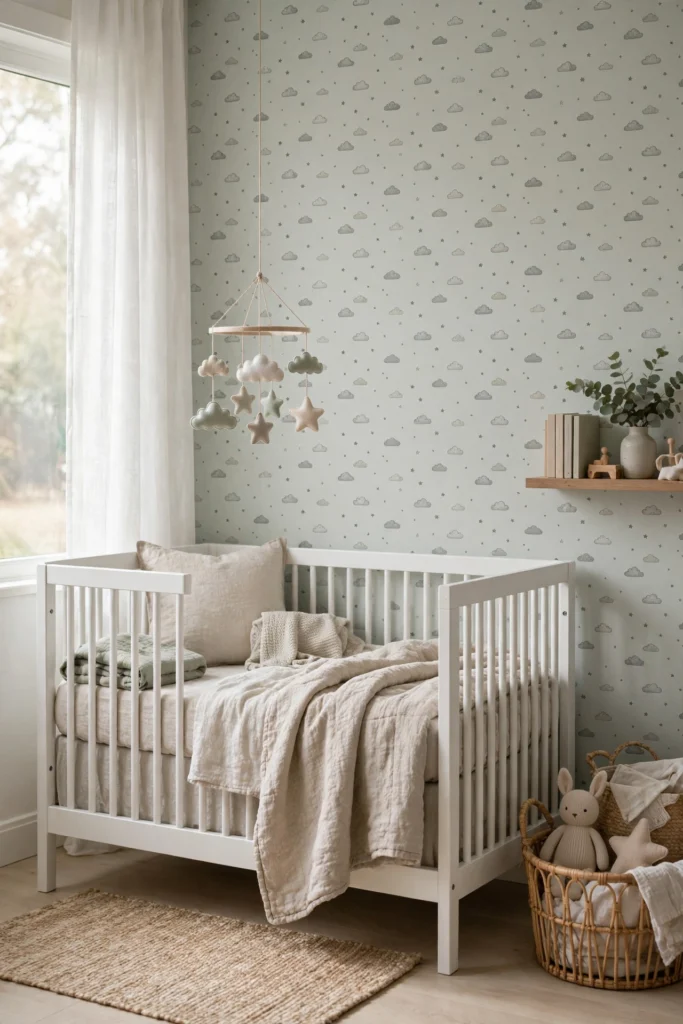
Watch out for stars that are too bright or too large. A big, high contrast star can feel playful in daylight and distracting at bedtime. Stick to a tone that sits close to the background colour. For cleaning, most versions in this style are easy to wipe, which helps near a cot where little hands reach the wall sooner than you expect.
Delicate Floral Trellis
A floral trellis pairs small flowers with a light geometric grid, and that structure keeps it from feeling too sweet. It suits a traditional home, beside classic furniture and painted wood.
A small to medium trellis works well on all four walls in a bright room, and as a single accent wall in a smaller or darker room. Keep furniture simple: a white or cream crib, a wooden dresser, and plain linen bedding. If you add a floral curtain, choose a very different flower scale so the prints do not compete.
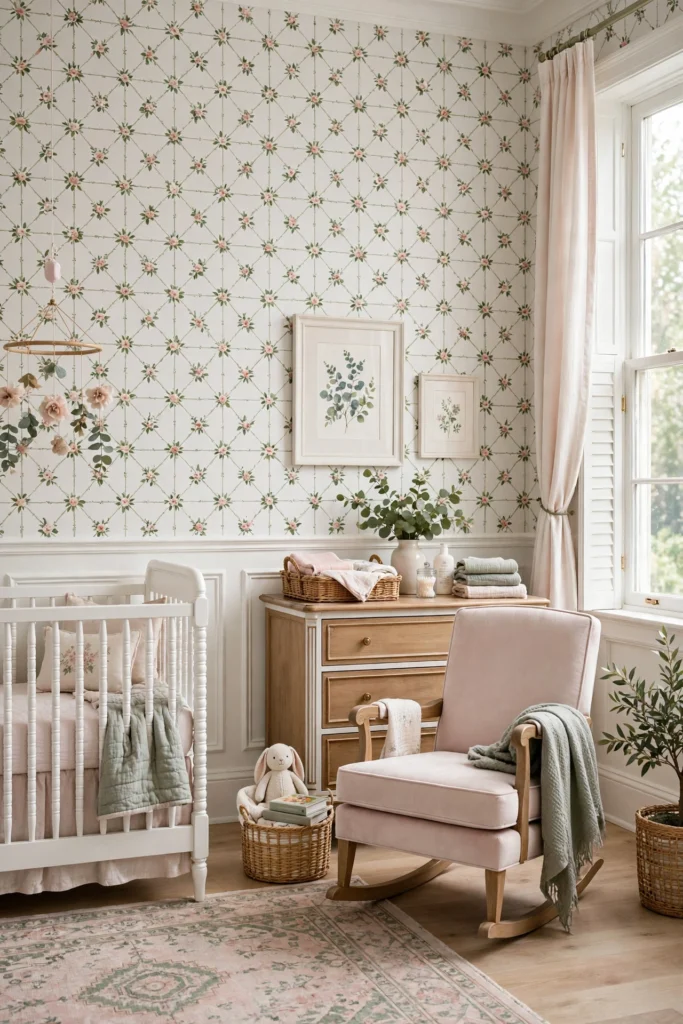
Watch out for trellis lines that are too dark. A heavy grid can make a small room feel boxed in. A soft grey, sage or pale gold line on cream keeps the effect light. For removal, a traditional trellis in a long term nursery is a good investment, while peel and stick suits you if you think you may swap to a bolder toddler theme later.
Textured Grasscloth in a Soft Neutral
Grasscloth is not a print at all. It is texture: fine natural fibres woven into a wall covering that adds warmth and depth without a picture to outgrow. In oatmeal, dove grey or pale sand it makes a nursery feel settled and grown up, and it lets patterned bedding, curtains and art do the talking.
Use it on all four walls if the room is bright, or on the crib wall and the wall behind the nursing chair if the room is small. It pairs beautifully with wood tones, rattan, linen and wool. If you are thinking about colour palettes for the rest of the house too, the current interior colour trends for cozy homes can help you pick curtain and rug tones that sit well against a neutral textured wall.
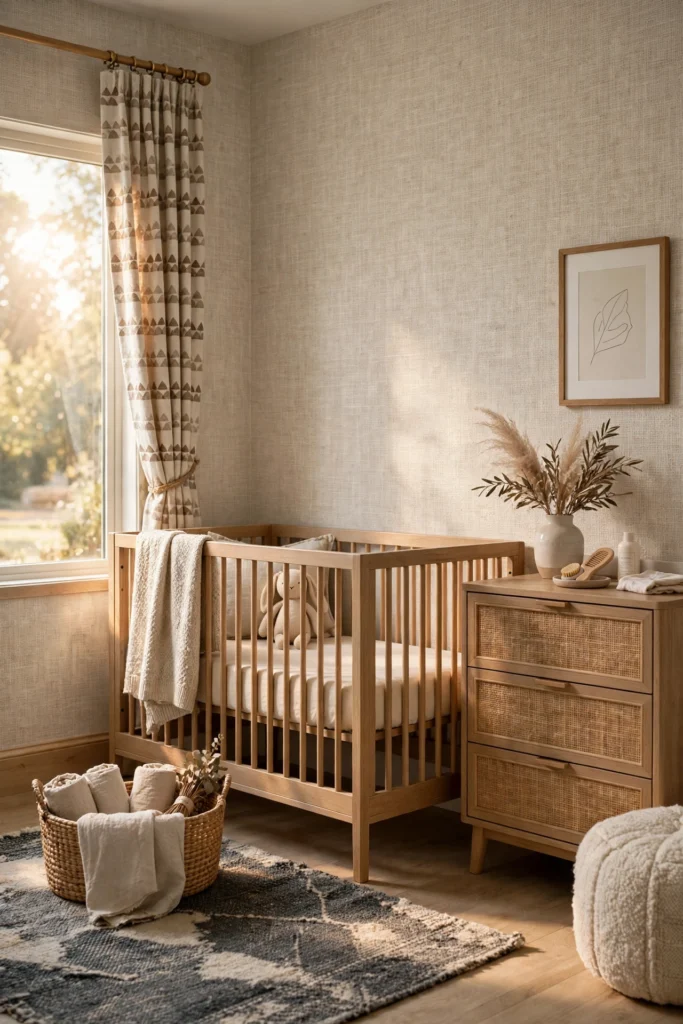
Watch out for cleaning. Grasscloth is harder to wipe than coated paper, and it can mark if it gets wet, so it is a poor choice for the wall directly beside a changing table or a sink area. It can also show seams more clearly than a printed pattern, so careful installation matters. Choose it for calm walls, not hardworking ones, and you will get years of quiet background from it.
Soft Stripe in a Muted Colourway
A soft stripe is the quiet workhorse of nursery wallpaper. Vertical stripes draw the eye upward, which can make a low ceiling feel a little taller, and a muted colourway keeps the effect gentle. It never reads as babyish, so it moves easily into a toddler room.
Use narrow stripes in a small room and wider stripes in a larger one. A tone on tone stripe, such as cream on warm white or sage on pale grey, works on all four walls. A stronger two colour stripe is better as one accent wall. Pair it with plain furniture and a soft throw over the nursing chair; ideas for layering that kind of texture can be found among modern throw blanket ideas for a cozy look, even though the room itself is a nursery, because the layering principle is the same.
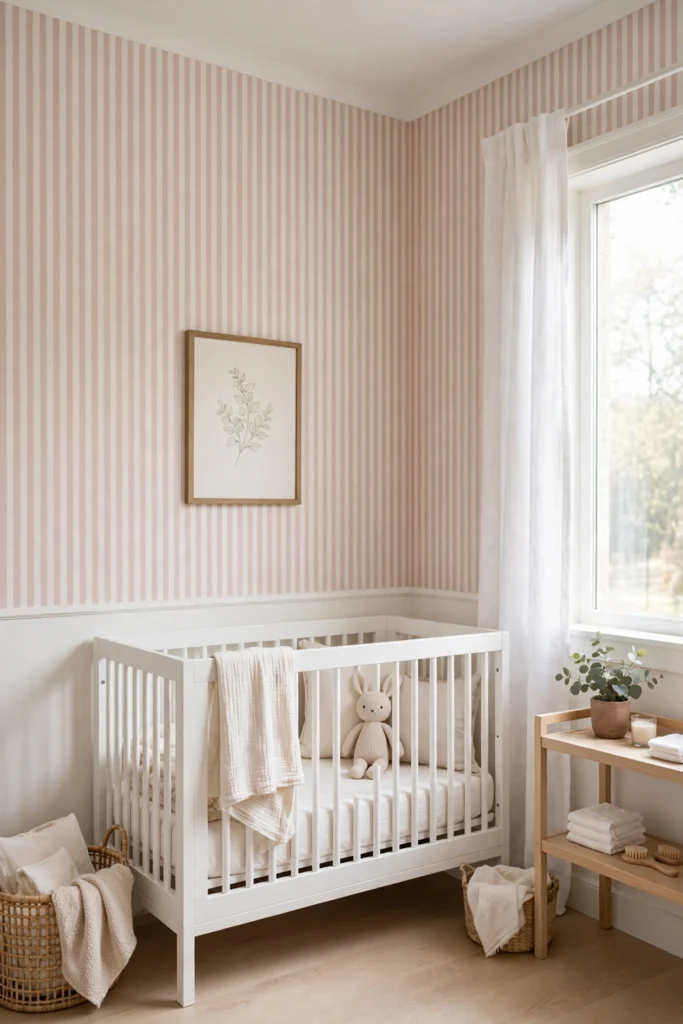
Watch out for stripes that are too narrow and too high in contrast. Thin dark lines on white can shimmer and feel busy, especially under artificial light at night. For cleaning, stripes in a coated finish are simple to wipe, and a peel and stick stripe is forgiving if a panel goes up slightly crooked, since you can lift and reposition it.
Abstract Watercolor Wash
An abstract watercolor wash has no picture to outgrow, only colour blending softly across the wall. That makes it one of the most flexible choices in this guide. A wash in sage, blush, dusty blue or warm sand can set the mood of the room without dictating the theme, and it works for a newborn nursery and later for a toddler bedroom with different bedding and art.
It suits all four walls in a pale version, and one feature wall in a deeper version. In a dim room, choose warm undertones; in a bright room, a cooler wash can calm the glare. Pair it with plain furniture and let one or two stronger accents, such as a rug or a framed print, provide contrast.
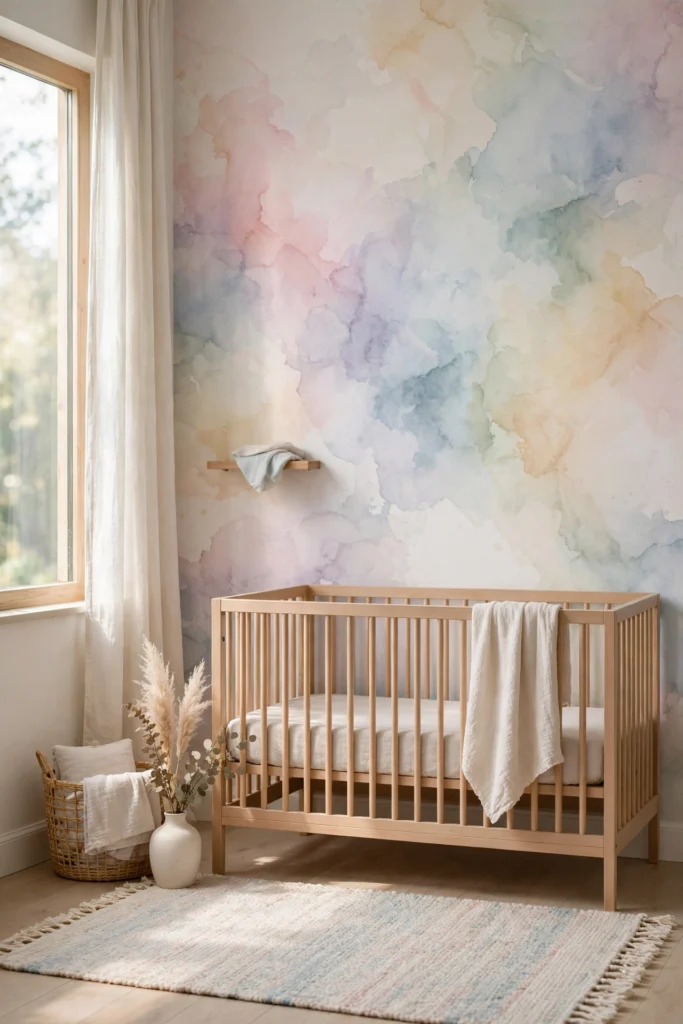
Watch out for washes that are patchy in an uneven way. A good wash should look intentional, with colour pooling gently, not like a wall that was half painted. Order a large sample, not a tiny swatch, so you can see how the colour moves across a full panel. Cleaning depends on the finish, so ask whether the wash is coated before you put it near a high traffic corner.
Bold and playful
These six designs bring energy. They are the ones children point at, and the ones that make a plain room feel finished in one move. The trick is placement. Most of them belong on one wall, with plain furniture and quiet bedding to balance them.
Large-Scale Tropical Leaf Print
An oversized tropical leaf in deep green turns a plain wall into a jungle backdrop, and it photographs beautifully. Scale is everything here. Large leaves need space, so this print wants a wide, clear wall, not one broken up by a door and a window. In a small nursery, keep it to the single wall you see on entering the room.
Pair it with simple furniture in white, rattan or light wood, and plain bedding in white or cream. The leaf is already doing a lot, so patterned curtains will fight it. In bright light the deep green looks lush; in dim light it can feel dark, so use it in a room with good daylight or add a warm lamp near that wall in the evening.
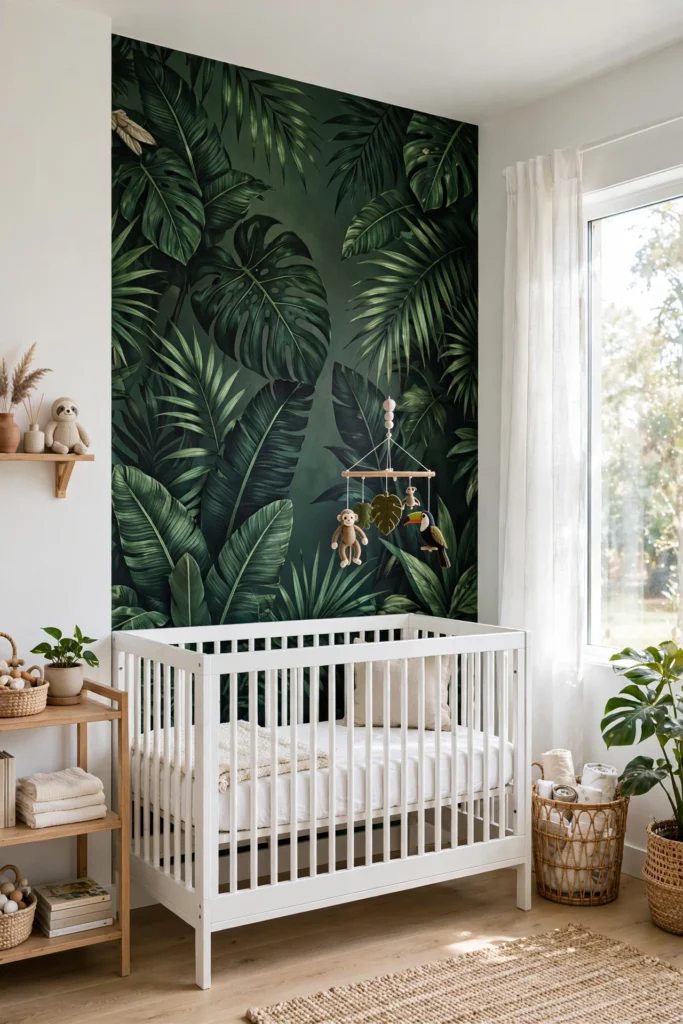
Watch out for covering all four walls with a large leaf. In a small room it can feel enclosing, and it makes the room harder to restyle later. For cleaning, a coated tropical print wipes well, which is useful because large dark leaves show dust and fingerprints more than a pale print does. Peel and stick is a sensible choice here if you are testing a bold look for the first time.
Abstract Rainbow Arch
A rainbow arch in muted pastels gives a nursery a modern, playful lift without primary colours or cartoon shapes. The arch shape itself is calming: it repeats, it curves, and it sits well above a crib, a dresser or a reading corner. It suits a pale wood, white furniture room with simple textiles.
Choose a medium arch, with bands wide enough to read from across the room but not so wide that one arch fills the whole wall. It works best as an accent wall, ideally the wall behind the crib or the nursing chair. Keep bedding plain in cream or one of the arch colours, pulled from the print rather than matched exactly, so the room feels gathered rather than colour matched to within an inch of its life.
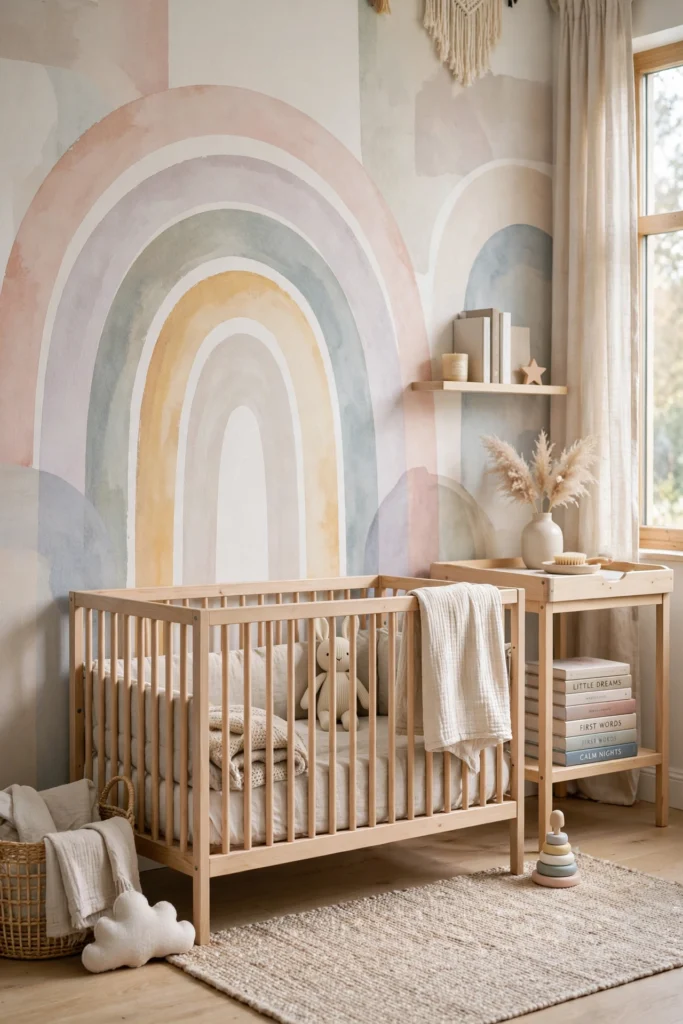
Watch out for arches in very bright, saturated colours. They can look cheerful in a shop and tiring in a sleep room. Muted terracotta, sage, dusty pink and soft ochre hold up better over time. For removal, peel and stick arches are popular for this design because many parents keep it for the baby years and then move to a plainer toddler wall.
Hand-Illustrated Alphabet or Number Print
An alphabet or number print in a hand drawn style adds learning to the walls without turning the nursery into a classroom. The key is the drawing style. Soft, artistic letters in muted ink tones feel like art. Bright block letters in primary colours feel like a school poster. Choose the first if you want the room to grow with your child into the early reading years.
It suits the wall beside a reading corner or the wall a toddler will face when playing on the floor, rather than the crib wall, where the detail can be too much at sleep time. Pair it with a low bookshelf, a small chair and plain bedding. As your child grows, a simple reading corner can be built around it, and ideas for shelving that corner are easy to borrow from reading nook ideas with bookshelves, scaled down to toddler height.
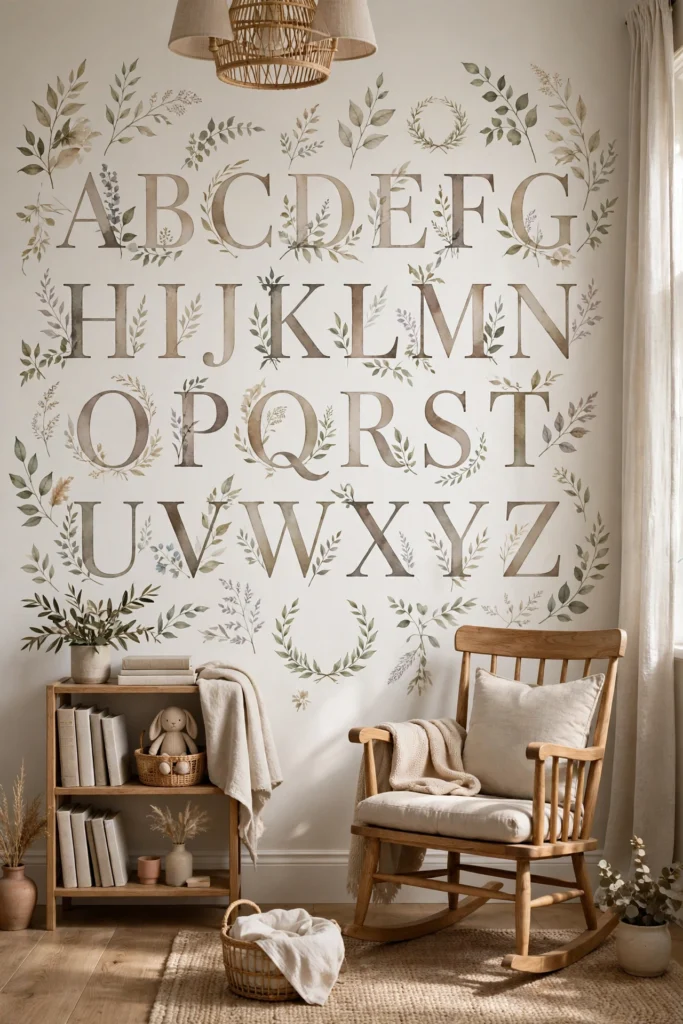
Watch out for a repeat that is too dense. Letters packed edge to edge can feel noisy, especially in a small room. A print with breathing space between characters reads more calmly and is easier for a young child to pick out one letter at a time. For cleaning, choose a coated finish, since this wall will be touched, pointed at and leaned on more than most.
Whimsical Moon and Stars Illustration
A moon and stars illustration with a gentle character moon gives the room a clear storybook anchor. It works when you want the nursery to have a theme you can carry into bedding, a mobile and wall art without hunting for matching pieces. The moon becomes the motif, and everything else can stay plain around it.
Use it on the crib wall or the wall opposite the door, where it greets you on entering. It pairs with navy, soft grey or warm cream furniture. A dark background needs good light and a larger room; a pale version suits a small nursery.

Watch out for a moon that is too cartoonish for your taste in a year or two. A softly drawn moon ages better than a grinning character face. For cleaning, an illustrated print in a coated finish is practical, and peel and stick makes sense if you expect the theme to change when your child picks a new favourite subject.
Botanical Fern and Palm Silhouettes
Fern and palm silhouettes give you a bolder botanical than watercolor, with a graphic, structured feel. The palette stays limited, so the room still feels orderly. It suits a modern nursery with clean furniture lines, black or wood accents, and plain textiles.
A medium to large silhouette works best as one accent wall, especially behind the crib or the dresser. In a bright room, a darker green silhouette looks crisp. In a dim room, choose a lighter green or a cream silhouette on a pale ground so the wall does not darken the space. Pair it with rattan baskets, a simple rug and bedding in white or sage.

Watch out for silhouettes that are too dense. Leaves overlapping without gaps can read as a dark mass from across the room. A print with air between fronds keeps the graphic effect without the heaviness. For cleaning, a coated version is easier to maintain, and the strong shapes hide small marks better than a pale, plain wall would.
Playful Polka Dot
A soft polka dot in a tonal or two colour palette is cheerful without being loud, and it is one of the few playful prints that works across modern, classic and traditional nurseries. The dot size decides the mood. Small dots read as texture. Medium dots read as playful. Very large dots can feel like a party decoration and are harder to live with at bedtime.
It works on all four walls in a small dot and pale colourway, and as an accent wall in a medium dot. Pair it with plain furniture and solid bedding, and let the dots be the only pattern in the room if you want a calm result. If you add curtains, choose a plain fabric in one of the dot colours.
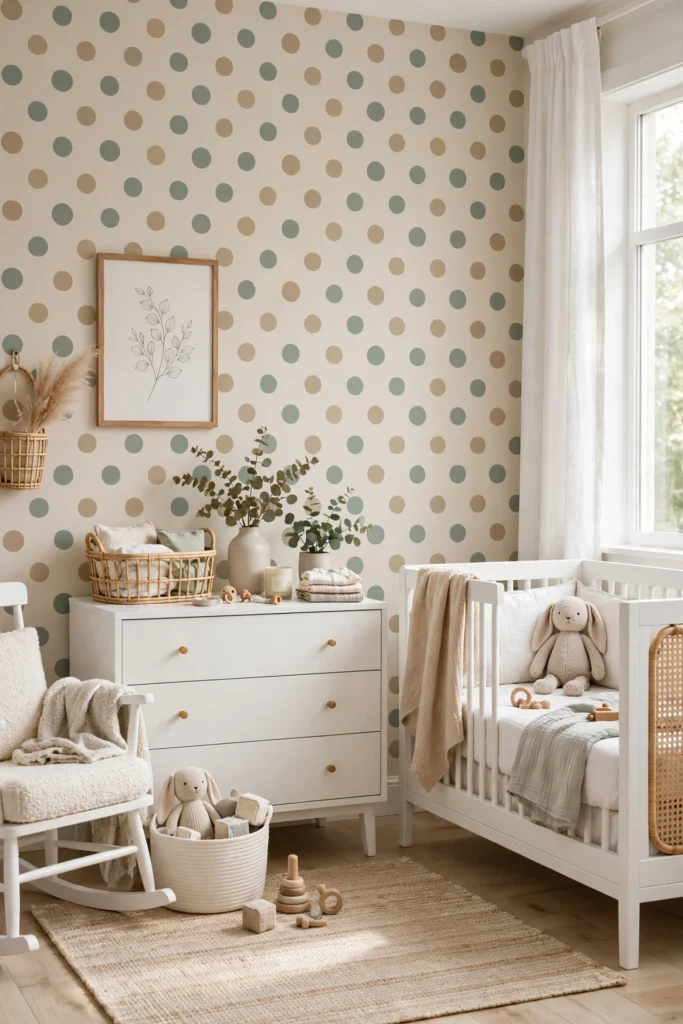
Watch out for multicolour dots. Several bright colours together can clash with bedding and toys, which already bring plenty of colour into a nursery. Two colours, or one colour in two tones, keep the room restful. For cleaning and removal, polka dots are forgiving: a small repeat hides a seam repair better than a large scene, and a peel and stick dot is easy to replace if one panel gets damaged.
Classic and heirloom
These five designs lean traditional, and they are the ones most likely to be handed down in spirit, if not in fact, from one child to the next. They suit homes with classic furniture, painted wood and heirloom pieces.
Vintage Woodland Animals
Woodland animals drawn in a muted, vintage style bring storybook warmth without bright cartoon colours. Foxes, rabbits and deer in soft browns, sage and cream feel like a picture book, and they pair naturally with wooden furniture, warm earth tones and a simple rug. This is a good choice if you already own wooden pieces you want the room to grow around.
Use a medium repeat on the crib wall or across the room in a bright space. In a small room, one wall is enough, with plain walls elsewhere to keep the animals from crowding the space. Keep bedding plain and avoid a second animal theme on curtains. One story on the wall is plenty.

Watch out for animals that are too large or too realistic for a sleep space. Oversized faces at cot height can feel intense for a baby. A smaller, illustrated repeat feels gentler. For cleaning, a coated finish helps, since this wall often sits near the crib and gets touched during settling and night feeds.
Sky and Cloud Mural
A sky and cloud mural turns one wall into an open sky, and that sense of openness is its main gift in a small nursery. Because it is a single picture, not a repeat, it needs a clear wall with as few interruptions as possible. Measure the wall exactly, including skirting and any sloping ceiling, before ordering, because mural panels are cut to fit that wall.
Place it behind the crib for a dreamy focal point, or on the wall you face from the nursing chair. It pairs with white or pale wood furniture and plain bedding. In a dim room, a pale sky mural can lift the whole space, while a deeper dusk version needs good light to avoid feeling heavy.

Watch out for hanging art or shelves over a mural. A picture hung across the clouds breaks the illusion and can look accidental. Keep that wall clear, or use only a very small, low item such as a name plaque near the edge. For cleaning, spot clean gently and avoid scrubbing printed clouds, which can show wear sooner than a small repeat pattern.
Classic Gingham Check
Gingham in sage, blush or soft blue brings cottage cheer without competing with the rest of the room. The check is simple and the colours are soft. It suits farmhouse and cottage nurseries, painted furniture, and rooms where you want a homely feel rather than a designer statement.
A small check works on all four walls, while a larger check is better as one accent wall. Pair it with white or cream furniture, plain or gingham trimmed bedding in the same colour family, and natural textures such as cotton and wood. If you use gingham on the wall, keep curtains plain, so the room does not turn into a check on check contest.
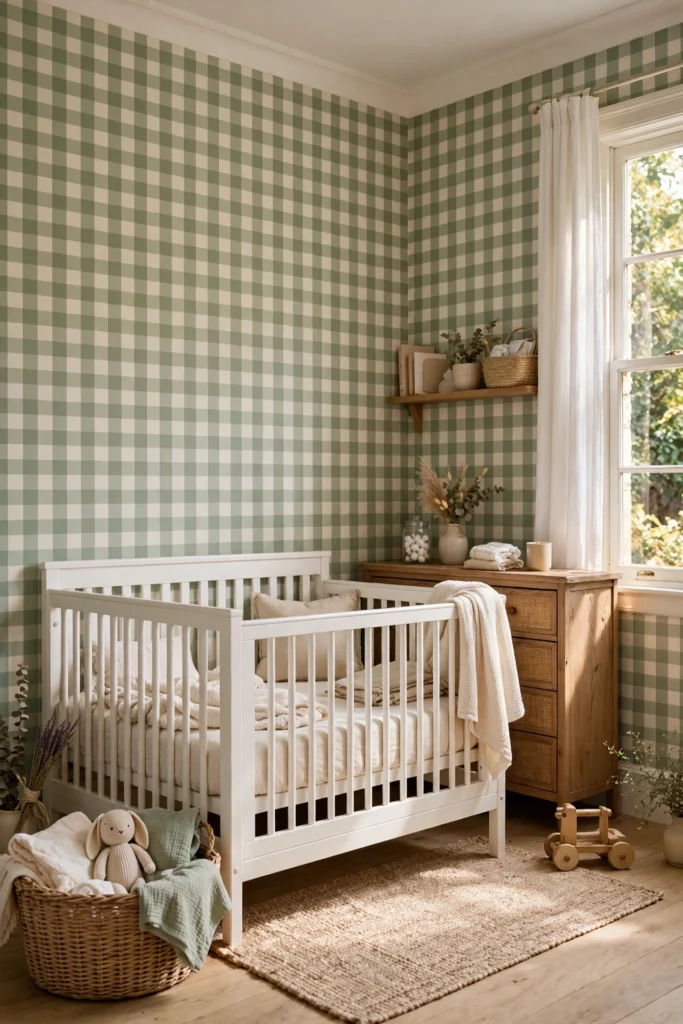
Watch out for checks that are too large or too bright. A big, bold gingham can feel more picnic blanket than nursery. A small, muted check ages better and is easier to pair with toddler bedding later. For cleaning, gingham in a coated finish is simple to wipe, and its regular pattern hides small marks well.
Nostalgic Toile
Toile tells a story in one ink colour on a neutral ground: pastoral scenes, small figures and winding trees drawn in a classic style. It brings heirloom elegance and suits a traditional home with antique furniture. It is also a pattern that does not look babyish, so it can stay on the wall well beyond the nursery years.
Use it as one accent wall in most nurseries, because the scenes need space to be read and a full room of toile can feel busy. Pair it with painted wood, a classic crib shape and plain bedding in cream or the ink colour. Keep wall art minimal on that wall, so the toile scenes are not hidden behind frames.
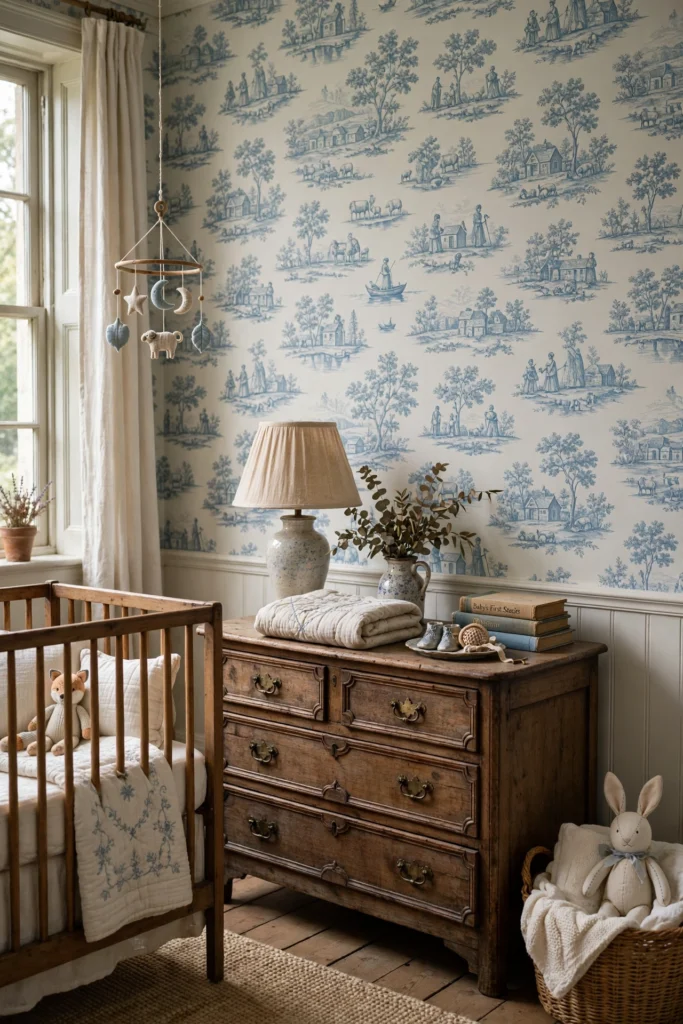
Watch out for toile scenes that are too detailed at a small scale. Fine lines can blur into a grey mass from across the room. A medium scale, where you can pick out trees and figures from the doorway, works better. For cleaning, choose a coated toile if the wall is within reach of little hands, and note that traditional toile is often a longer term choice, so be sure you love it before pasting it.
Nature Mountain and Forest Scene
A mountain and forest scene gives a nursery an outdoorsy, adventurous feel, and it works best as a mural style feature wall where the landscape can unfold as one picture. Peaks, pines and soft sky tones create depth on a flat wall.
Place it behind the crib or on the main wall of the room, with plain furniture in wood or white in front of it. Keep bedding and rugs in earth tones or soft greens pulled from the scene, and avoid adding a second landscape print elsewhere in the room. In a small nursery, one scene wall plus plain walls is the right balance. When the room later becomes a child’s bedroom, this kind of nature scene often still works, and it can be paired with later bedroom ideas, such as the kids bedroom ideas for girls with stylish decor, if the room’s next occupant wants a more grown up nature theme.

Watch out for a scene with a very dark forest base. Dark trees across the bottom of the wall can make the room feel lower, especially with a dark rug. A scene with a pale sky and lighter foreground keeps the room open. For cleaning, treat it like a mural: gentle spot cleaning, and keep the feature wall free of shelves that would puncture the scene.
Pattern scale, room size and light: get the proportions right
Pattern scale is the size of the repeat, and it changes how big a room feels. What matters is the balance between print, wall and light. Use the table as a starting point, then test a sample on the actual wall.
| Room and light | Pattern scale | Coverage |
|---|---|---|
| Small and dim | Small to medium, pale ground | All walls for a quiet print, or one wall for a bolder print |
| Small and bright | Small to medium | All walls for a quiet print, one wall for a large print |
| Medium, average light | Medium | All walls for a calm print, one or two walls for a bold print |
| Large and bright | Medium to large | All walls for a medium print, one wall for a mural or large scene |
| Low ceiling | Vertical stripe or small vertical repeat | One or all walls, with plain furniture to keep the lift |
For a small nursery, keep the crib wall as the focus and leave the other walls plain. If you need more small room ideas beyond wallpaper, the small bedroom design ideas to maximise space and style cover furniture and storage choices that work with the same logic.

Safety, airing and humidity: the nursery specific checks
Look for wallpaper labelled low VOC or formaldehyde free, and for peel and stick made without PVC where you can find it. These details matter more in a nursery, because a baby spends long hours in the room. Ask for the safety sheet if the label is vague.
Let a newly papered room air fully before a newborn sleeps in it. Open windows and allow at least two to three days for paste and print to cure. Watch out for humidity too: a humidifier can loosen some adhesives, so choose a moisture resistant finish if you run one often.
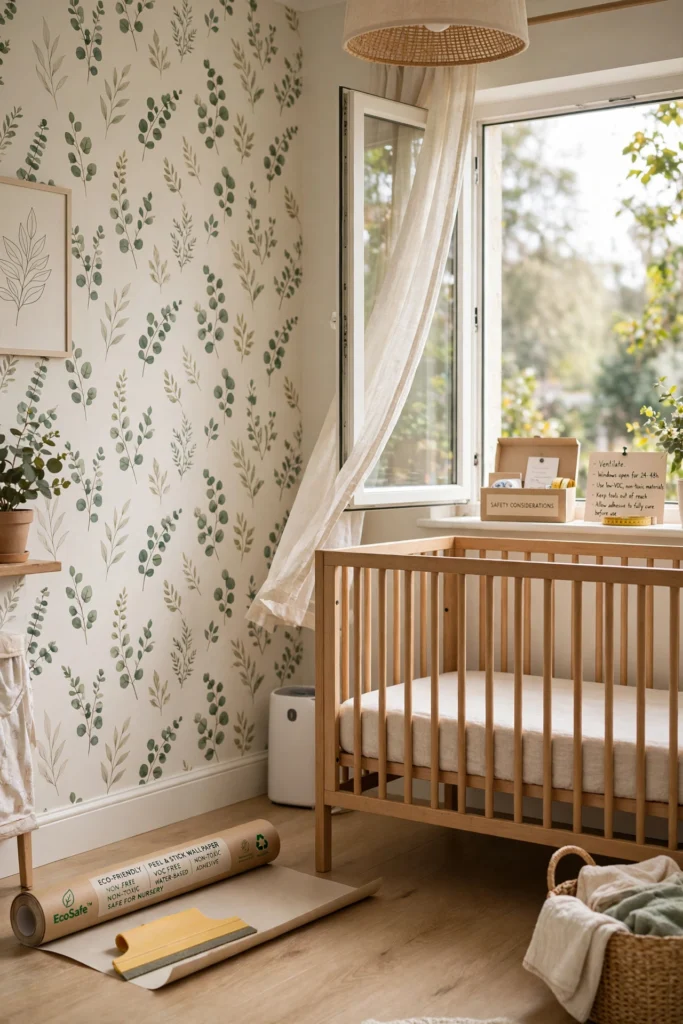
Your installation and cleaning checklist
- Measure each wall, note doors and windows, and order extra for pattern matching.
- Order a sample, tape it to the wall, and check it in morning, evening and lamplight.
- Clean and smooth the wall, fill holes, and prime if the maker recommends it.
- Start on the most visible wall, keep the pattern level, and match seams before pressing each panel flat.
- Air the room for two to three days before the baby sleeps there.
- For cleaning, dust first, then wipe with a damp cloth only if the finish allows it.
- Watch out for peeling edges near humidifiers, and replace a panel early before it lifts further.

Nursery wallpaper, before you order a roll
Is peel and stick wallpaper safe for a nursery?
Generally yes, if you choose a PVC free, low VOC product and let the room air after installation. It is popular because you can remove it later without major wall damage.
Should I wallpaper the whole nursery or just one wall?
One wall is safer for a bold print. A small, quiet print can cover all four walls in a bright room, but test it first.
What pattern works best for a gender neutral nursery?
Botanicals, cloud prints, watercolor washes and muted stripes all work well, because they do not rely on pink or blue coding.
How do I choose between a light and a dark background?
Use a light background in a small or dim room, and save a dark background for a large, bright room or one accent wall.
How long does peel and stick last in a nursery?
With good preparation it can last several years, though it is usually less durable than traditional paper.
Do I need a professional installer?
Not always. Peel and stick and a simple repeat are often manageable on one wall. A mural or a room with uneven walls is where a professional earns their fee.
Order the sample, live with it for a few days, then commit
The best nursery wallpaper is not the prettiest print in a photo. It is the print that still feels calm at night and still suits your furniture when the room changes. That is why the sample matters more than any list. Tape it up and see how it behaves in real light.
Then commit to one wall if you are unsure, or to the whole room if the print is quiet enough to carry it.