The mistake most people make first
A friend of mine fell in love with a round plunge pool at a garden show. She took photos, saved the brochure, and started picking tiles before she had measured a single thing in her own yard. When the installer came round, the gate was too narrow for the shell, one side of the garden had no room left for a path, and the filter equipment had nowhere to go except right beside the seating area. The pool she loved would not fit the garden she had. She ended up starting again, with a smaller rectangular pool in a different spot, and the second plan was better in every way.
That is the mistake to avoid. Do not pick the pool first and hope the garden bends around it. Start with the garden you actually have: the gate width, the narrowest point of access, the distance from the house wall, and the space you need to walk around the water once it is in. A plunge pool is a small pool, but it still needs room to breathe. Get those numbers right and almost any of the ideas below will work. Get them wrong and even the prettiest design will feel cramped.
A plunge pool is built for cooling off, soaking, and sitting in the water with a drink, not for swimming laps. That is why it can be so much smaller than a regular pool. Most are somewhere between 6 by 10 feet and 10 by 16 feet, with a depth of around 4 to 5 feet. They hold far less water, they cost less to heat, and they fit into corners, courtyards, and narrow side yards where a full size pool never could. The trade off is that every decision matters more, because there is no spare space to hide a bad one.
Measure first: the three numbers that decide everything
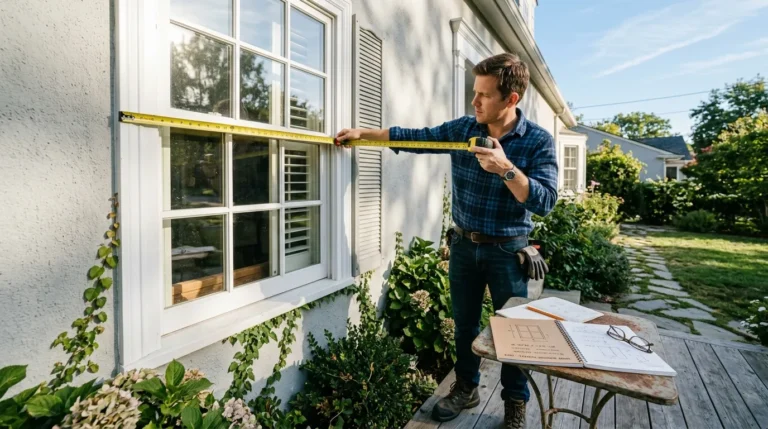
Before you look at another photo, take three measurements. First, the access route. A prefabricated shell has to get into the garden somehow, usually through a side gate or over a low wall by crane. Measure the gate, the path, and any tight turn. If the shell cannot get in, your choices narrow to a pool built on site or a smaller above ground model, and it is far better to know that now.
Second, the clearances. As a rule of thumb, leave at least 3 feet of clear space on every side of the pool for walking, cleaning, and getting in and out safely. On the sides you will actually use, the side with the steps and the side where chairs will sit, aim for 4 to 5 feet. That is the difference between a pool you can use comfortably and a pool you have to edge around sideways. Small space planning works the same way indoors, and the same discipline that makes a tiny flat work applies here: every square foot needs a job. If you want a refresher on that kind of thinking, these studio apartment layout ideas for small spaces show how zones, circulation, and furniture placement work when space is tight.
Third, the setbacks. Many local rules ask for a pool to sit a few feet away from boundary lines and house foundations, commonly around 3 to 5 feet, though the exact figure depends on where you live. Check before you dig, not after. A pool that has to move by two feet late in the job is an expensive lesson.
One more question people ask at this stage is how deep a plunge pool should be. For most adults, a steady depth of 4 to 4.5 feet puts the water around chest height when standing, which is right for soaking. A shallow end of about 3 feet with a deeper end of 5 feet suits families with children, because it gives a safer entry zone. Going deeper than 5 feet rarely helps in a plunge pool. It adds water, heating cost, and digging for no real benefit, since nobody is diving into it.
Plunge pool sizes that actually work in a small yard
Use this table as a starting point, then adjust to your own measurements. The sizes below are typical, not rules, and your installer will confirm what suits your soil, access, and local regulations.
| Pool size | Best for | Typical depth | Space to allow around it |
|---|---|---|---|
| 8 by 5 feet | A tight courtyard or a couple who mainly want to soak | 4 to 4.5 feet | 3 feet on all sides at minimum |
| 10 by 6 feet | The most common small plunge pool, comfortable for two or three adults | 4 to 5 feet | 4 to 5 feet on the entry and seating sides |
| 12 by 7 feet | Families, or anyone who wants gentle movement and a bench inside | 4 to 4.5 feet | 4 to 5 feet on the main sides, 3 feet elsewhere |
| 14 by 5 feet | Long, narrow side yards where width is the problem | 4 to 5 feet | A walking strip of at least 3 feet on the long side |
| 8 by 8 feet square | A corner plot or a courtyard with equal sides | 4 to 4.5 feet | 3 feet on all sides at minimum |
| 8 feet round | Softening a garden full of straight lines, or a central feature | 4 to 5 feet | 3 feet of clear circulation all round |
Notice how the pool itself is only part of the footprint. A 10 by 6 foot pool with 4 feet of clearance on the two main sides and 3 feet elsewhere needs a patch of ground roughly 16 by 13 feet. That is the number to test against your garden, not the pool size alone. Mark it out on the ground with string or garden hose before you commit. Walk around it. Put two chairs inside the outline. If it feels tight now, it will feel tighter once walls, planting, and furniture go in.
Now, with the practical side settled, here are the 16 ideas, grouped by the decision each one answers: where to put the pool, what to surround it with, and how to finish it.
Place it: three ways to fit the pool into the garden you have
1. Tuck a plunge pool into a backyard corner
The corner is the most underused spot in most small gardens. It collects a wheelie bin, a forgotten pot, and not much else. A rectangular pool pushed into that corner uses two boundaries at once and leaves the rest of the garden open for walking and sitting. This works especially well in narrow gardens, because the pool follows the shape of the plot instead of fighting it.
Keep the paving tight around the water rather than spreading hardscape across the whole yard. A few large planters will soften the edges without crowding the space, and if the corner catches strong afternoon sun, a movable shade sail or a cantilever umbrella gives you cover you can shift as the sun moves. Small rooms and small gardens share the same rule, which is that the layout does the heavy lifting. The same kind of careful placement shows up in these small bedroom design ideas, where putting the biggest piece in the right spot frees up everything else.

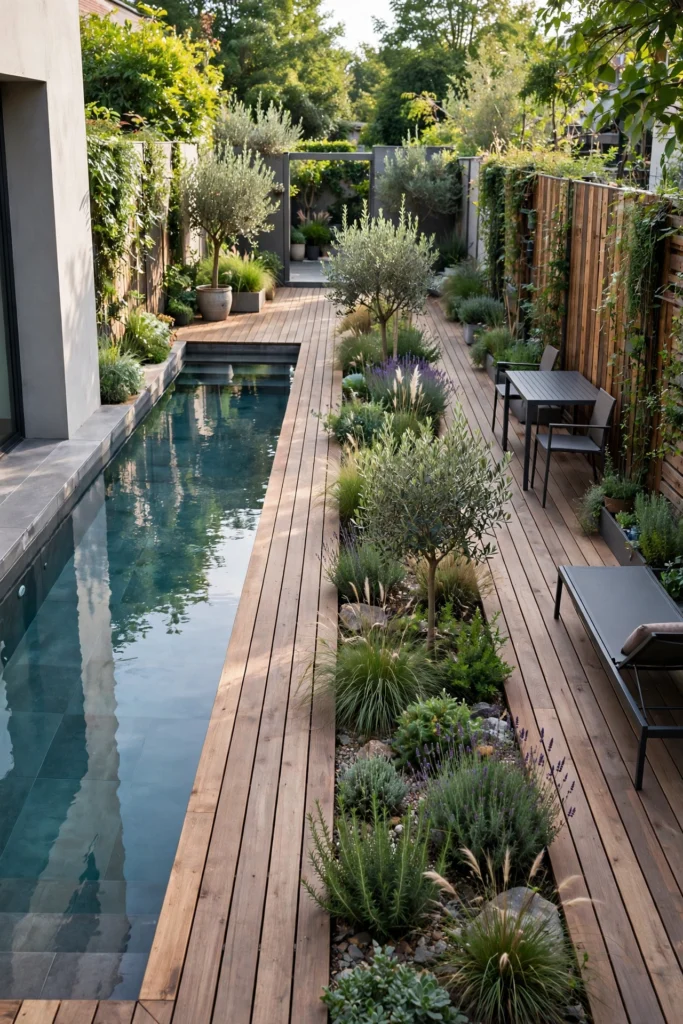
2. Try a narrow rectangular pool along one side
When the garden is long and thin, a slim rectangular pool is usually a better fit than a round or square one. Run it along one boundary and keep a walking route or a planting strip beside it. The pool then reads as part of the garden’s length rather than as an obstacle in the middle of it.
Use continuous paving or decking along the pool edge to stretch the feeling of length, and keep the furniture slim. A wide lounger or a chunky dining set will block the route and break the line. Two narrow chairs and a small side table are plenty. This is also the layout that makes a small garden look longer than it is, because the eye travels down the water instead of stopping at a wide shape in the middle.
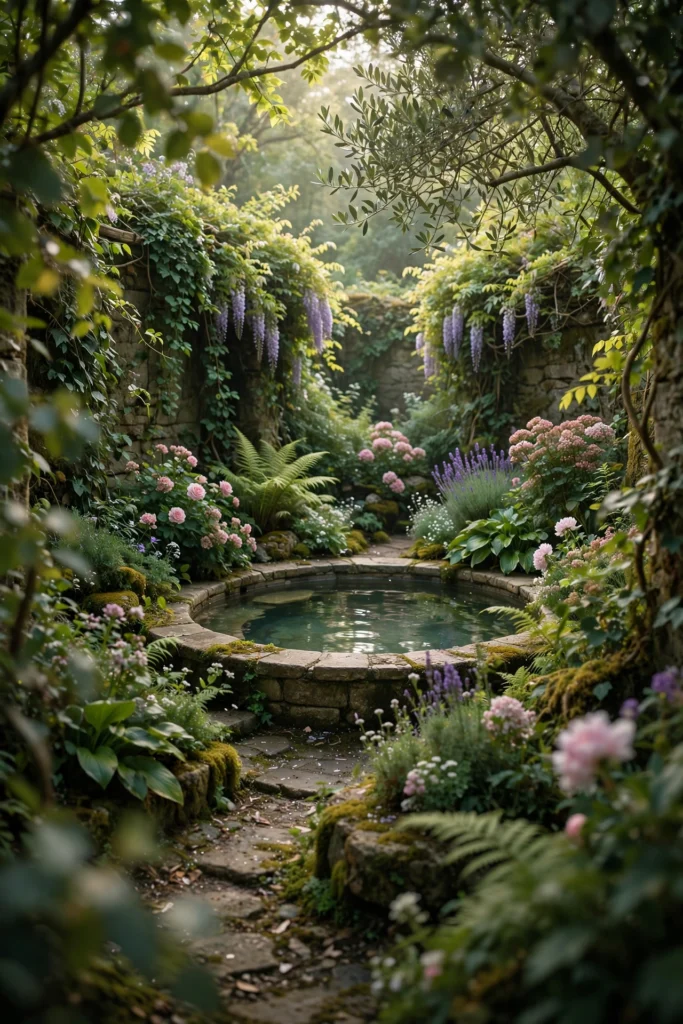
3. Create a secret garden feel, with the pool partly hidden
Not every pool needs to be visible from the back door. In a romantic or cottage style garden, a pool that reveals itself slowly feels special. Surround it with flowering shrubs, climbing greenery, and a simple stone path, and let the planting do the screening so that only part of the water shows from the house.
The trick is partial concealment, not total hiding. You still need a clear, safe path to the water, good light on the steps, and sightlines from the house if children will use it. One or two well placed shrubs near the path will give the sense of discovery without blocking access. Think of it like a hallway at home: the approach matters as much as the room itself, and the same care that goes into entryway decoration for small spaces applies to the walk from the house to the water.
Surround it: planting that softens the pool without swamping it
Planting around water is a balancing act. You want softness, shade, and privacy, but you do not want a daily skim of leaves, roots pushing at the pool wall, or a shrub that doubles in size and swallows the path. The rule that saves most people is simple: low plants near the water, medium shrubs behind them, taller screening at the boundary. And keep anything that drops heavy litter, seed pods, or sticky flowers well away from the edge.
4. Surround the pool with low grasses and flowers
You do not need tall tropical planting to make a pool feel like part of a garden. Low ornamental grasses, flowering perennials, and small shrubs create a soft, meadow like border while keeping the pool visually open. This suits anyone who wants a relaxed garden rather than a resort look.
Put the taller plants at the back of the bed and keep everything nearest the water low, below knee height if you can, so the view across the pool stays clear. As a rough guide, keep the first row of planting at least 18 inches to 2 feet back from the coping, so roots stay clear of the pool wall and you can clean the edge without trampling the plants. Clumping grasses are a safer bet than running types, which can spread into paving and drains.

5. Create a green privacy wall
Privacy matters more in a small garden than a large one, because the neighbours are closer. A living screen is softer than a tall solid fence, and it does a better job of making the pool feel like a garden room rather than a yard with a fence around it.
Layer it. A fence or trellis at the boundary, evergreen shrubs in front of it, and a climber on the trellis gives depth and blocks sightlines at different heights. Keep the planting nearest the water tidy and evergreen where possible, so you are not fishing leaves out of the pool every morning. For a screen that reads as a wall, allow the shrubs to mature to at least 6 feet, and plant them far enough from the pool wall that their roots will not trouble it, usually 2 to 3 feet back from the coping for shrubs, more for anything tree sized.
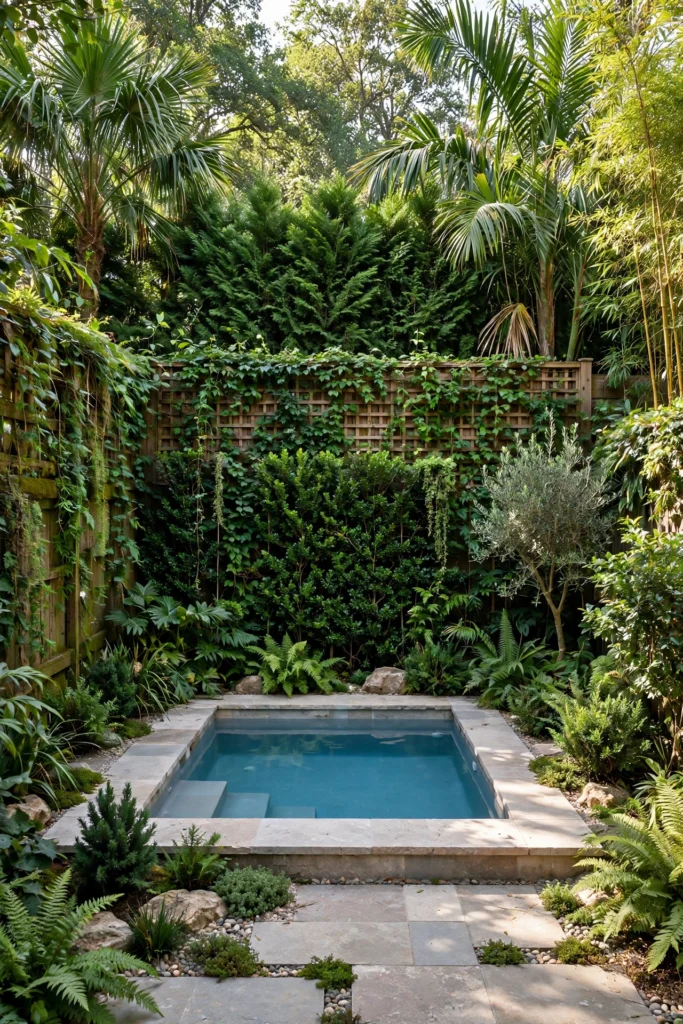
6. Use palm trees for a tropical backyard
If your climate supports palms, one or two can change the whole mood of a compact pool area faster than almost anything else. They give height without bulk, they cast moving shade, and they frame the water beautifully.
Restraint matters here. One palm at each end of the pool, or a single statement palm in a large pot at a corner, is usually enough. Planting a row of them in a small garden will crowd the walkway and drop fronds into the water. Give a palm at least 4 to 5 feet of clear space from the pool edge so falling fronds land on paving or soil, not in the water, and check the mature height before you plant. A palm that grows to 30 feet beside a small pool will dominate the whole garden.
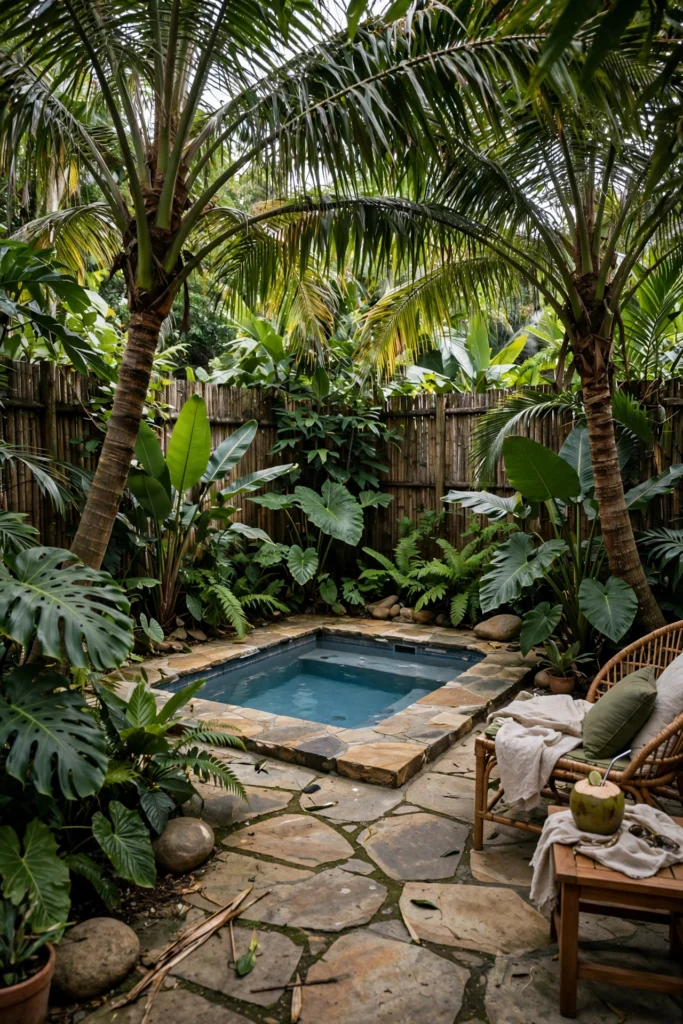
7. Choose a Mediterranean courtyard look
White plaster walls, pale stone, terracotta pots, an olive tree, and one simple rectangular pool. That is the whole recipe, and it works because it is restrained. The pool itself can stay plain. The materials around it carry the style.
Pick one statement plant, usually the olive or a citrus tree in a large pot, and keep the rest of the planting simple: lavender or rosemary near the path for scent, a couple of terracotta pots, and pale coping that matches the walls. People often ask whether a Mediterranean look needs a big garden. It does not. It needs sun, pale surfaces, and discipline about not adding too much. A compact courtyard with a plain pool and one good tree looks more convincing than a large garden packed with ornaments.

Finish it: the surfaces, features, and details that make it feel built in
This is where a plunge pool stops looking like something dropped into a garden and starts looking like part of the house. The finishes you choose matter more than the number of features you add. One or two done well will beat five done halfway, especially in a small space where everything is close together and visible at once.
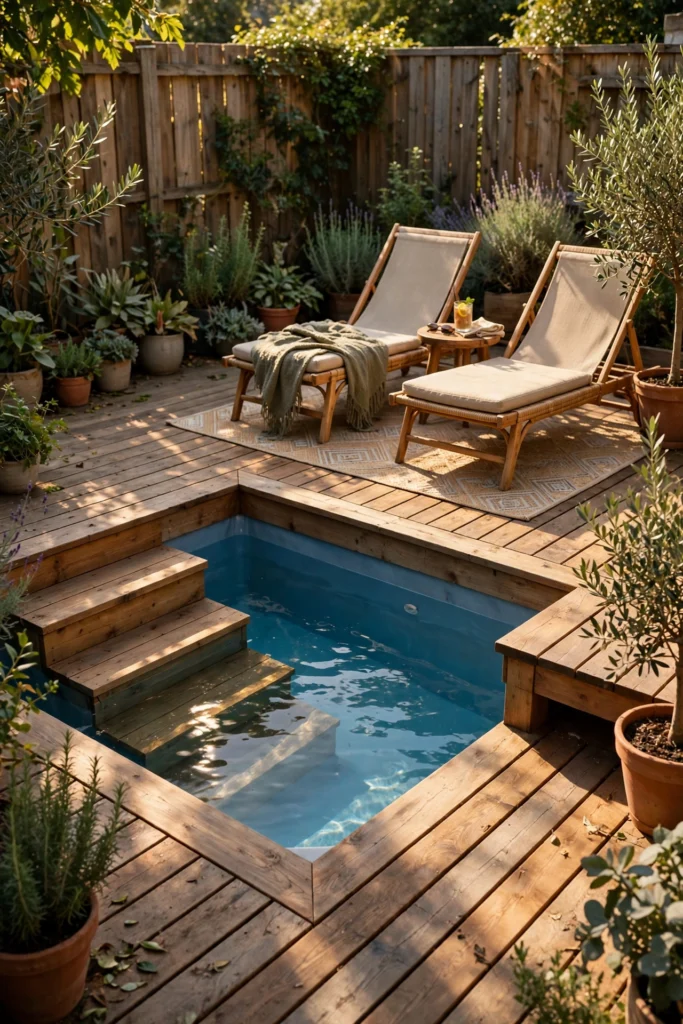
8. Build the pool into a wooden deck
An above ground plunge pool can look awkward sitting on its own, like a tub in the middle of a lawn. A wooden deck built around it changes that completely. The deck hides the pool wall, gives you a level surface for chairs, and lets you add wide steps that double as seating.
Build the deck so the coping sits flush with the boards, or just a small step up, and leave removable boards or a hatch over the pump and filter so maintenance does not mean dismantling the deck. Timber needs care near water: choose a hardwood or a good composite board, leave small gaps between boards for drainage, and slope the deck very slightly away from the pool so splashed water runs off instead of pooling. A deck also warms the space visually, which matters in a small garden where hard surfaces can otherwise feel cold.
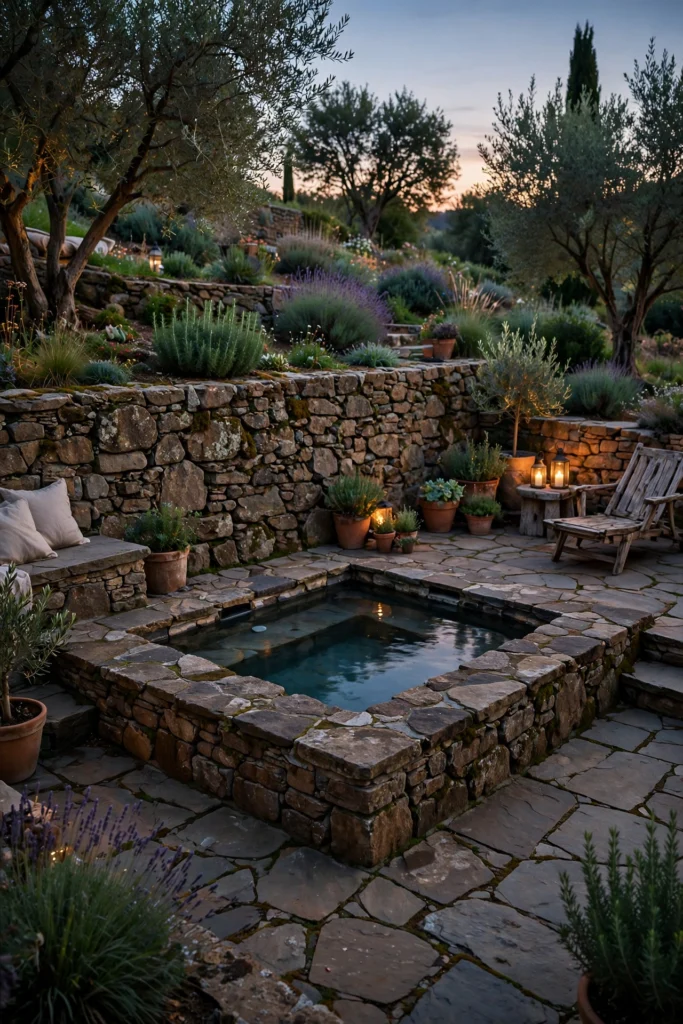
9. Use stone to make a small pool feel substantial
Stone cladding adds weight and permanence to a small pool without making it any bigger. A stone clad wall, a stone coping, or a retaining wall in the same material gives a compact pool an architectural presence that a plain shell does not have.
Match the stone to something else in the garden, the house wall, a boundary wall, or the patio, so the pool reads as part of the property rather than a separate object. Rough, uneven stone suits a rustic garden. Large, clean slabs suit a modern one. Either way, choose a coping stone with a slightly rounded or bullnosed edge. It is more comfortable to sit on, kinder on bare feet, and less likely to chip than a sharp square edge.
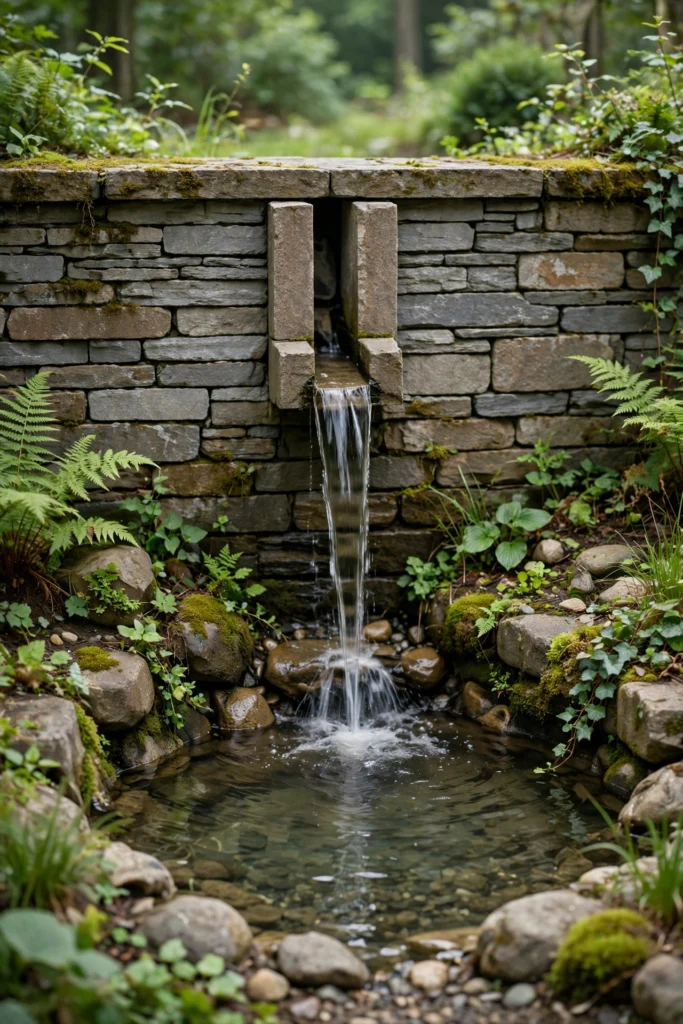
10. Add a simple waterfall
Moving water gives a small pool a focal point and a sound that masks traffic and neighbours. A narrow wall mounted spillway or a pair of small cascading outlets is plenty. The feature should be in proportion to the pool, or it will dominate the whole garden.
Keep the waterfall wall modest, roughly the width of the pool or narrower, and set the spillway so the water falls cleanly into the pool rather than splashing onto the coping. If you are building a feature wall anyway, think of it as a piece of wall decor that happens to carry water. The same sizing discipline that makes a wall display look right indoors applies here, and these above couch wall decor ideas are a useful reminder of how scale, placement, and breathing room around a feature make it work. One strong wall feature, well lit, will do more than three small ones competing for attention.
11. Match the pool deck to the house
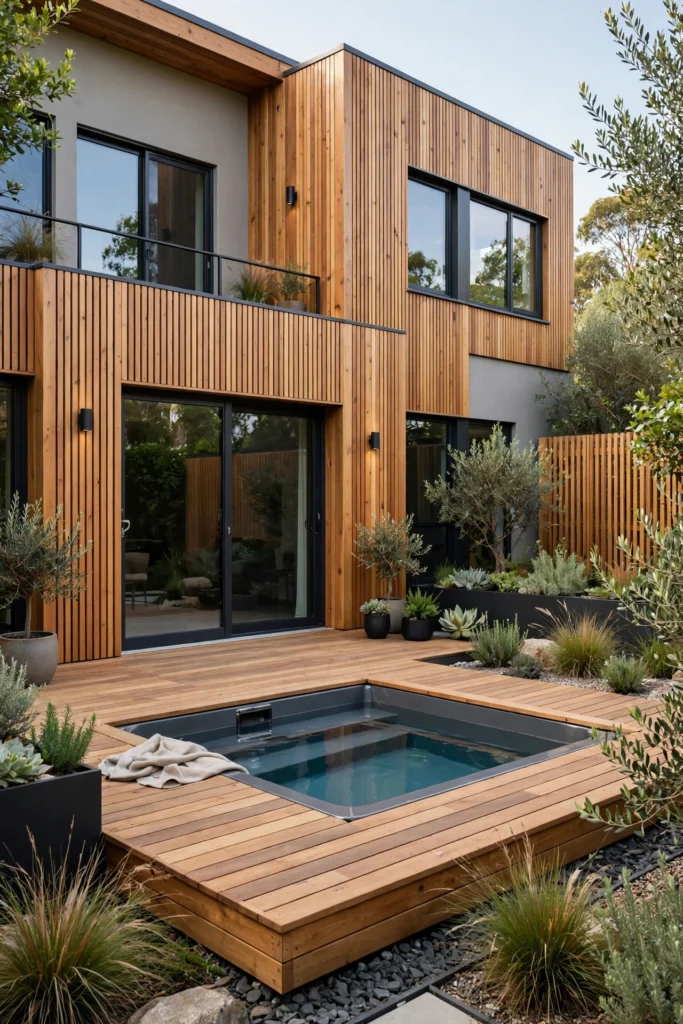
A pool looks intentional when its materials echo the house. Warm timber on the house calls for warm timber at the pool. Pale stone on the house calls for pale stone around the water. You do not need an exact match. The same family of colours and textures is enough to tie the two together.
Walk out of the back door and look at what your eye lands on first: the wall colour, the window frames, the patio material. Repeat one of those at the pool, and the garden will read as one place instead of two. This is also the cheapest way to make a pool look expensive, because continuity reads as design, while a random new material reads as an afterthought.
12. Add a small lounge beside the water
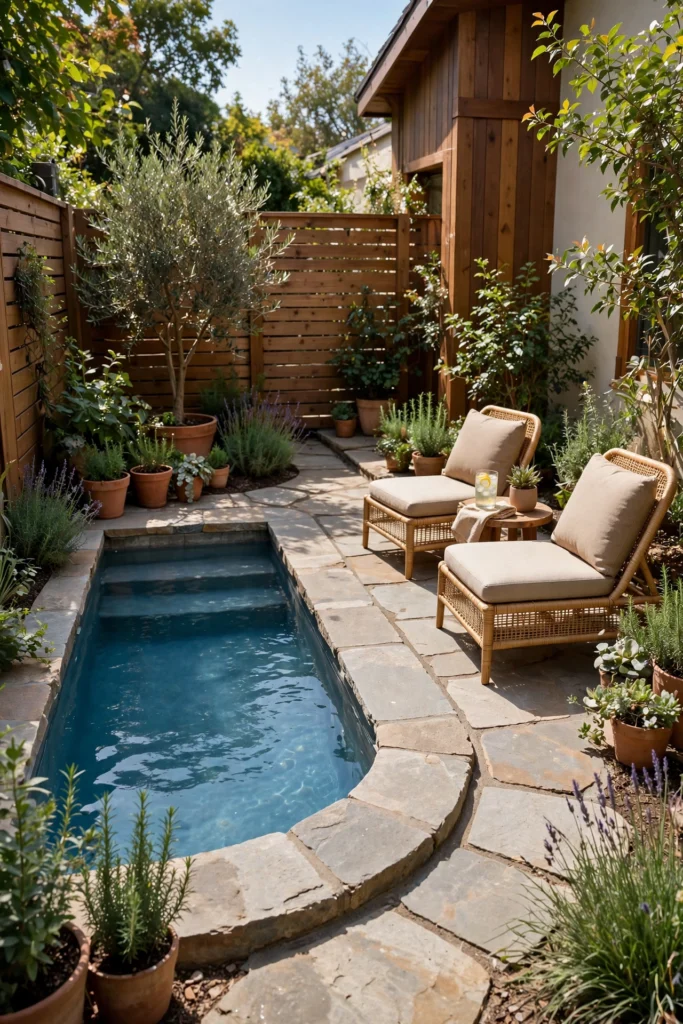
A plunge pool gets used far more when there is somewhere comfortable to sit beside it. You do not need a full outdoor living room. Two compact loungers, a small side table, and somewhere to put a towel and a drink will do.
Place the seating where someone getting out of the water can reach it in two or three steps, but keep the main path around the pool clear. In a very tight garden, a built in bench along the pool wall saves the space that separate chairs would need, and it doubles as a step. Leave at least 3 feet between the chairs and the pool edge so wet feet are not constantly on the cushions, and choose quick drying fabric or slatted timber that will not stay damp after a splash.
13. Install integrated landscape lighting
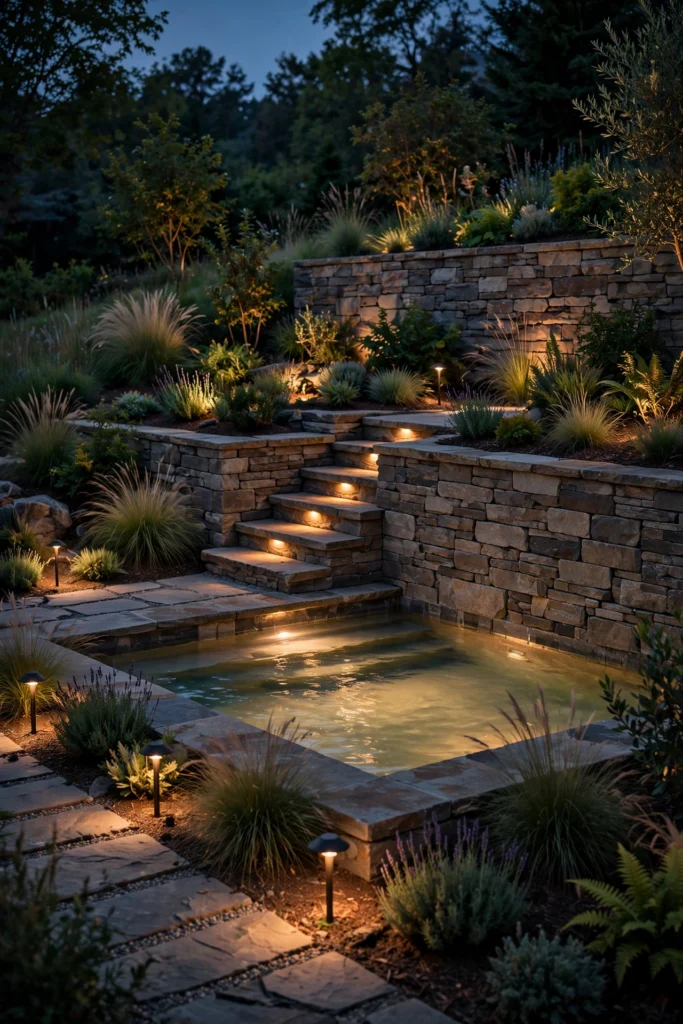
Lighting is what turns a daytime pool into an evening garden. The mistake is to flood the space with bright lights. A small pool needs a few well placed, warm lights, not a stadium.
Light the things people need to see: the steps into the pool, the path from the house, and the edge of any raised wall. Then add one feature light, an uplight on a tree or a wash of light across a stone wall, to give the space depth. Recessed lights in a retaining wall or step risers work beautifully here, and low path lights keep the walkway safe without glare. Warm white, around 2700 to 3000 Kelvin, flatters stone and timber and feels like evening, while cooler white can make a small garden feel clinical. If you want ideas for getting light levels right in a tight space, these mudroom lighting ideas show the same principle indoors: layers of gentle light beat one bright source. Keep all electrical work to a qualified installer, and use fittings rated for outdoor and wet locations.
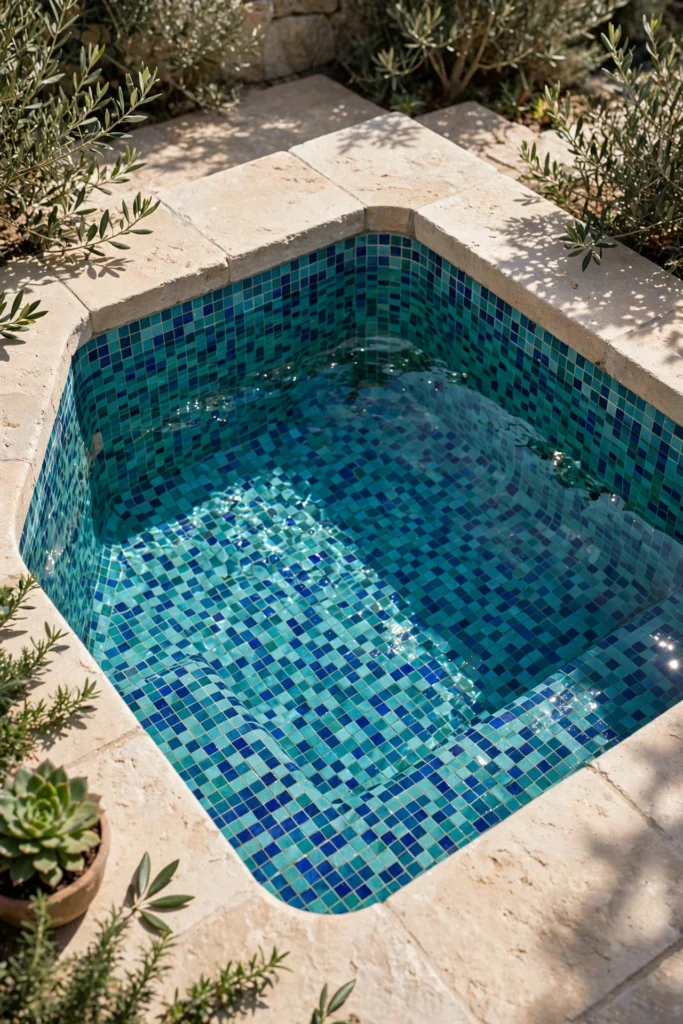
14. Give a small pool a colorful tile interior
When there is little room for extra landscaping, the inside of the pool can be the decoration. Blue green mosaic, teal tile, or a deep sapphire finish makes the water itself look richer, and the colour shows even from the house window.
The trick is to keep everything else quiet. A neutral stone surround, simple planting, and plain coping let the tile be the star. If the surround is also busy, the whole space starts to shout. Tile also has a practical side: a darker interior absorbs heat and makes the water look deeper, while a pale interior shows dirt more easily and needs more cleaning. Pick a grout colour close to the tile so the finish reads as one surface, and order spare tiles at the start. Matching a discontinued mosaic years later is a headache you can avoid for the price of one spare box.
15. Add a retractable umbrella
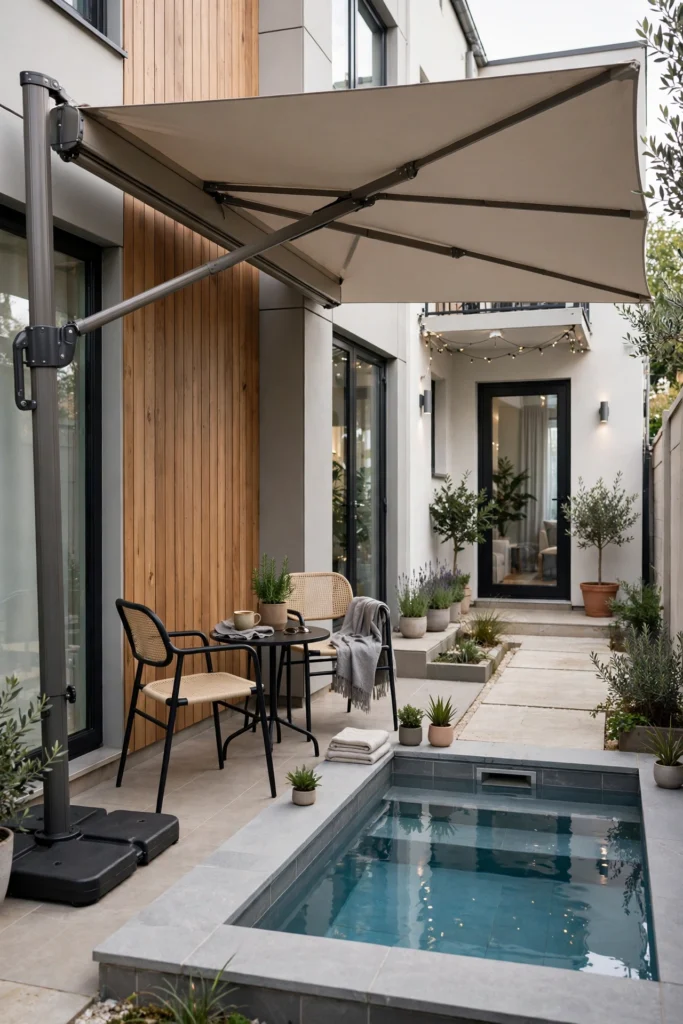
A permanent pergola is not always practical in a small garden, and it can shade the pool when you actually want sun on the water. A large cantilever umbrella gives you shade on demand and an open sky the rest of the time.
Choose a neutral fabric that works with the pool surround and the furniture, and size the umbrella to the seating area, not the pool. A typical cantilever umbrella spans about 10 to 11 feet, which covers two loungers comfortably. Position the base so it does not block the main walkway, and weigh it properly. An umbrella beside water catches wind, and a toppling umbrella near a pool is a real hazard. A heavy base, or a base bolted to the deck, is not optional.
16. Combine the pool with a fire feature
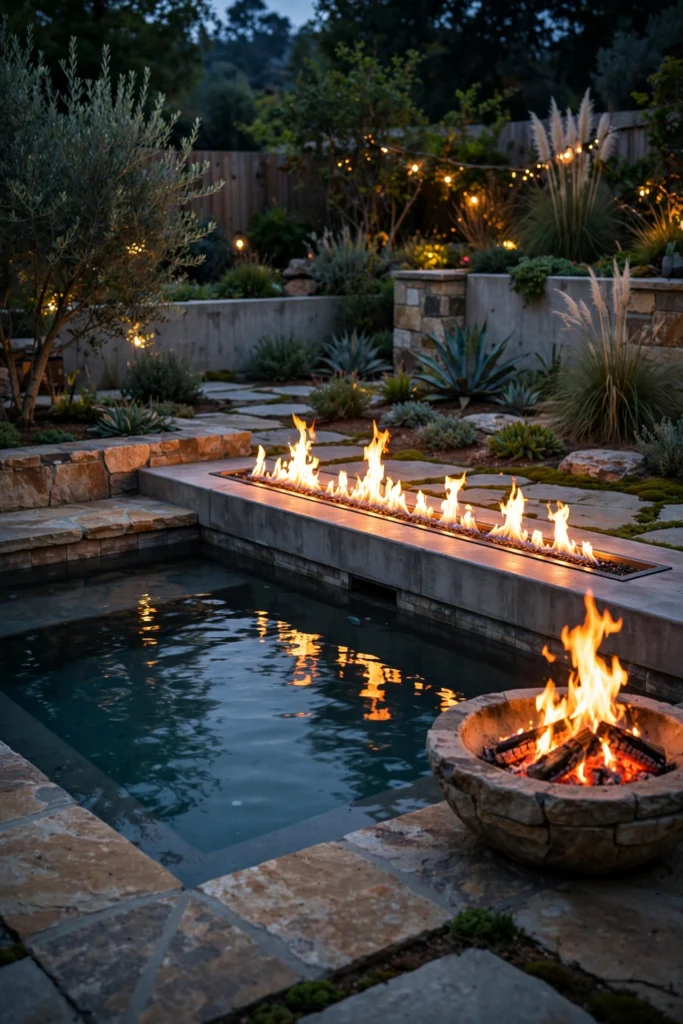
Water and fire together make an evening garden feel complete, and a small fire bowl or a slim linear burner can sit near a plunge pool without needing a large entertaining area. The contrast is the point: cool water, warm flame, and a place to sit between the two.
Keep the fire feature simple and put it where people sit, not where they enter the water. A fire bowl beside the lounge chairs works. A fire feature squeezed against the pool steps does not. Leave enough distance that nobody has to pass close to the flame with wet feet, and use stone or concrete for the fire surround so it ties visually to the pool coping. If you use a gas burner, have it installed by a professional and keep the controls accessible but out of the splash zone.
Three questions people ask before they build
Can a plunge pool work in a very small backyard? Yes, as long as the size is chosen after the clearances, access, and equipment space are measured, not before. The corner and narrow layouts above exist precisely for gardens where a regular pool would never fit.
What plants are best around a plunge pool? The ones that suit your climate and sunlight, drop little litter, and stay the size you expect. Low grasses, tidy shrubs, palms where the climate allows, and layered evergreen screening are all good starting points, as long as you check the mature size before planting and keep the first row back from the coping.
How do you make an above ground plunge pool look built in? Surround it with a deck, stone cladding, or coordinated paving, add proper steps, and repeat a material from the house. A pool that shares a material with its surroundings reads as part of the architecture. A pool that shares nothing reads as an object that arrived later.
Your first three steps
First, measure. Walk the garden with a tape and note the gate width, the narrowest point of access, the distance from the house to the boundary, and the patch of ground you can genuinely spare once paths and seating are allowed for. Mark the pool outline on the ground and live with it for a few days. Sit two chairs inside it. Walk around it in the dark and check where the light falls.
Second, check access and rules. Confirm how a shell or materials will reach the spot, confirm the setback and safety rules that apply where you live, and talk to an installer before you fall in love with a specific model. A ten minute conversation at this stage can save a redesign later.
Third, pick one finish to build the design around. One material, one feature, or one planting idea, and let everything else support it. If the deck matches the house, keep the tile calm. If the tile is the star, keep the surround plain. If the waterfall is the feature, keep the planting simple. Small gardens reward a single clear decision far more than a collection of good ones competing for attention.
Do those three things and the 16 ideas above stop being a gallery of pretty pictures and start being a plan. Your garden will not get bigger. But with the right size, the right spot, and one finish done properly, it will feel like it did.