If the object is flat, light, and you want to swap it often, buy a printer’s tray. If the object has real depth, or it is fragile, or you want it protected from dust and fading for years, buy a shadow box. In a printer’s tray vs shadow box choice, depth is the deciding factor. A printer’s tray is open and shallow, a shadow box is deep and sealed behind glass, and no amount of clever arranging changes that.
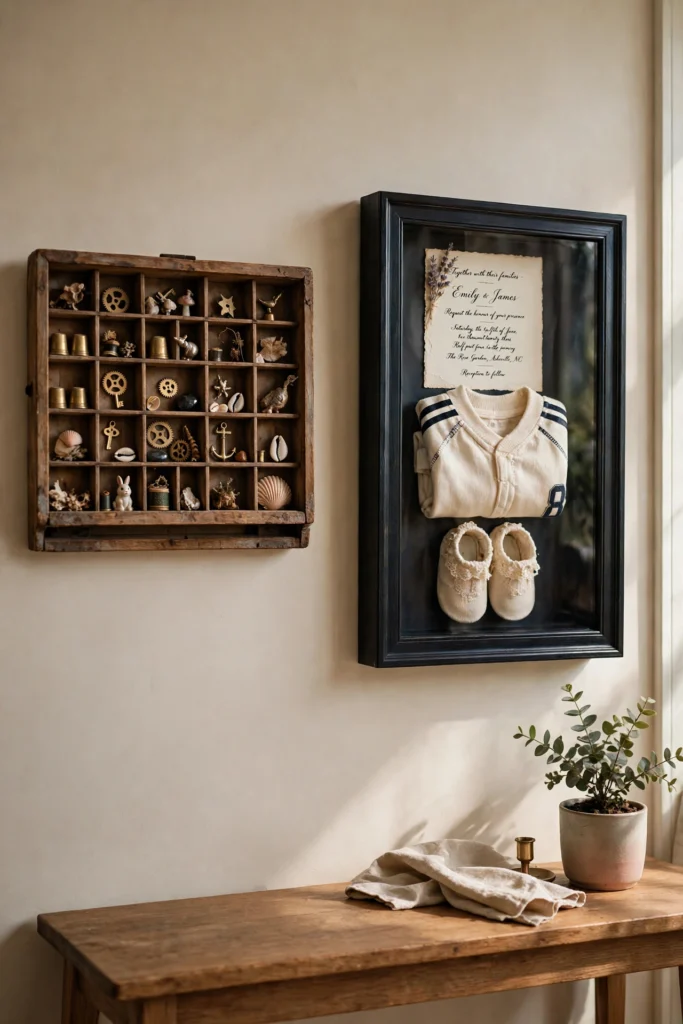
Walk into a home decor shop, or scroll Pinterest for five minutes, and you will see both of them everywhere. A printer’s tray full of tiny treasures. A shadow box holding a baby’s first shoes, a folded jersey, a wedding invitation pressed flat behind glass. They look like cousins, and in a way they are. Both hang on a wall, both turn ordinary objects into a display, and both can make a plain room feel personal.
But they solve different problems, and choosing the wrong one is an easy mistake. A beautiful tray is no use if your grandmother’s brooch rattles around in a compartment too shallow to hold it, and a sealed shadow box is a chore if you bought it for coins you like to rearrange every few weeks.
The printer’s tray vs shadow box question is not about which one is better. It is about which one fits the thing you want to display, the wall you have, and the way you live with your belongings.
This guide compares the two side by side, explains what each one really is, and walks you through five plain questions that settle the decision in minutes.
Printer’s Tray vs Shadow Box at a Glance
This table holds the whole comparison in one place, so if you are short on time, read the table and the five questions further down.
| Feature | Printer’s Tray | Shadow Box |
|---|---|---|
| Depth | Shallow, usually 1 to 2 inches | Deep, usually 2 to 6 inches, with at least about 1 inch of internal depth |
| Compartments | Dozens of small, irregular compartments in a grid | Usually one open interior space, arranged freely or mounted on a backing |
| Glass front | None, open to the air | Glass or acrylic front, often available with UV protection |
| Best for | Small, flat, light objects you enjoy handling | Three dimensional, bulky, fragile, or valuable objects |
| Dust protection | None, items need regular dusting | Strong, the sealed front keeps dust and fingers off |
| Weight | Light to moderate, easy to hang | Heavier, especially large sizes with real glass |
| Typical cost | Typically modest for a reproduction, more for a genuine vintage piece | Typically modest for a basic craft store frame, more for large or archival quality work |
| Where it hangs best | Busy, lived in rooms where you pass it daily and enjoy touching the display | Low traffic spots where it can sit undisturbed, away from knocks and bumps |
One row in that table matters more than the rest, and it is depth. A tray is shallow and open, so it suits flat things you like to move around. A shadow box is deep and closed, so it suits dimensional things you want to protect.
What Is a Printer’s Tray?
A printer’s tray began its life as a working tool, not a decoration. In the days of letterpress printing, a typesetter kept individual metal or wooden letters in a shallow wooden tray, sorted by character, size, and font, so they could be picked up quickly while setting a page. Each little compartment held one kind of type. When offset printing replaced letterpress in the middle of the last century, those trays became useless to print shops, and collectors started rescuing them for a second life on the wall.
That history is still visible in every tray you see today. The compartments are irregular on purpose, because different letters needed different amounts of room. The wood is pine or oak, often with a worn finish that shows its age. A typical tray measures somewhere around 18 by 24 inches to 24 by 36 inches, though vintage originals and modern reproductions both vary. The frame itself is part of the charm, because a real tray is a piece of printing history, not just a container.
The Compartments Are the Whole Point
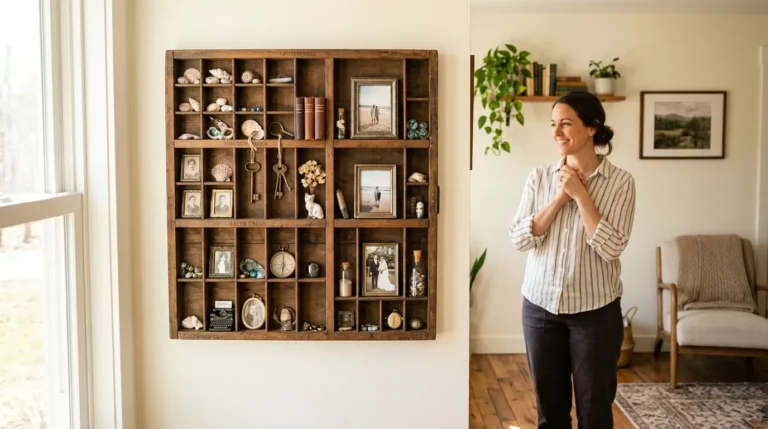
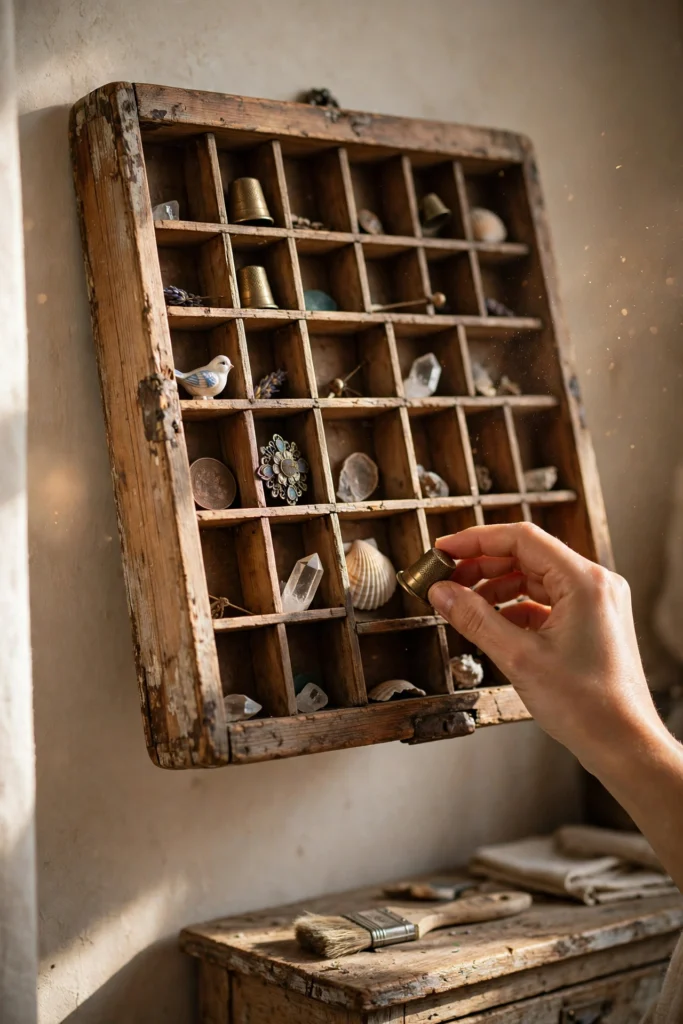
A printer’s tray is a grid: dozens of small pockets, each one a little stage for one small thing. That structure is what makes it so satisfying to fill. A thimble in one square, a shell in the next, a coin below that, a crystal tucked into a corner. The grid gives a mixed collection a sense of order that a plain shelf never manages, and every object gets its own small frame.
The grid also sets the tray’s limits. Each compartment is only about 1 to 2 inches deep, and most are narrow. Anything thicker than that will sit proud of the surface, and anything much wider will not fit at all. A flat brooch works. A chunky pocket watch does not.
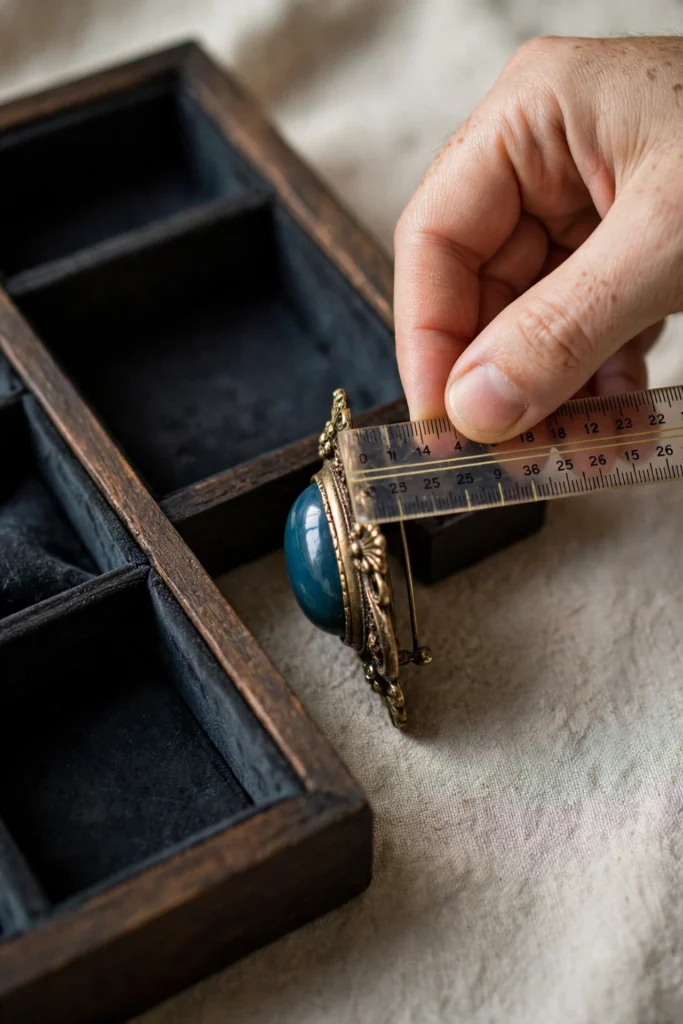
A tiny porcelain bird looks wonderful. A baseball looks absurd, and it will probably fall out the first time someone walks past. If you are shopping for a tray, bring a ruler and the measurements of the objects you plan to display. The tray does not forgive guessing.
An Open Display You Can Touch
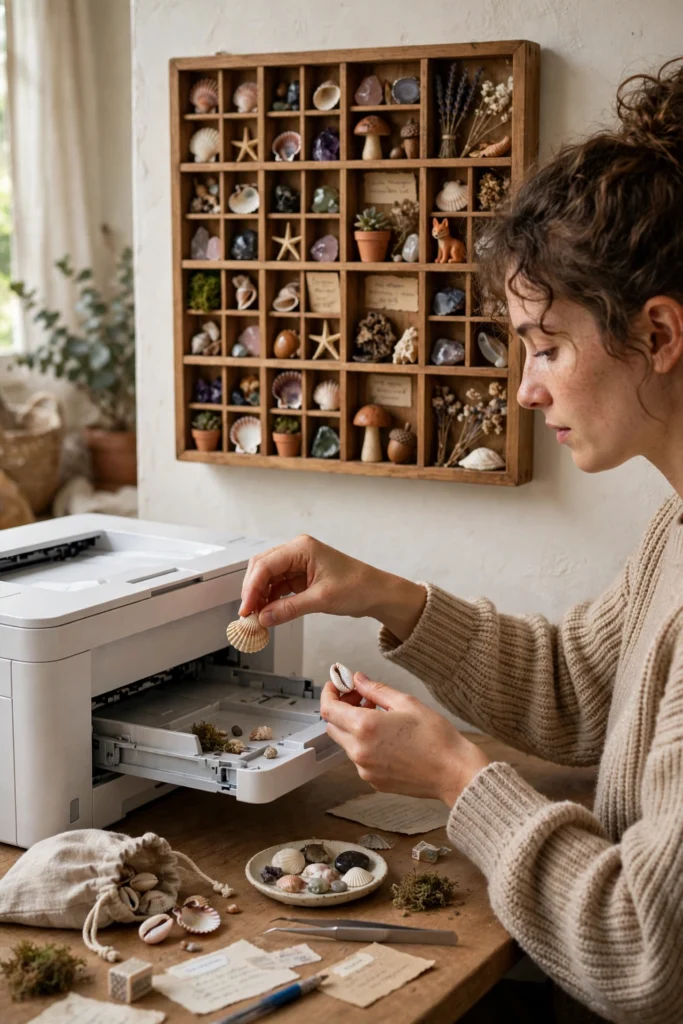
A printer’s tray has no glass. That is both its greatest pleasure and its biggest weakness. You can reach out, lift a piece down, turn it over, and put it back somewhere new. A tray is not a museum case, it is a living display that changes as your collection changes, and rearranging it on a quiet Sunday afternoon is half the fun.
The price of that freedom is dust. An open tray collects it, and small objects in small compartments are fiddly to clean. A soft brush and a few minutes every couple of weeks will keep it looking good, but if you hate dusting, be honest with yourself before you buy. A tray also offers no protection from curious hands, pets, or a ball thrown indoors, so choose the wall with care. A hallway where children run past is a risky home for a tray full of tiny porcelain figures.
Where a Printer’s Tray Feels at Home
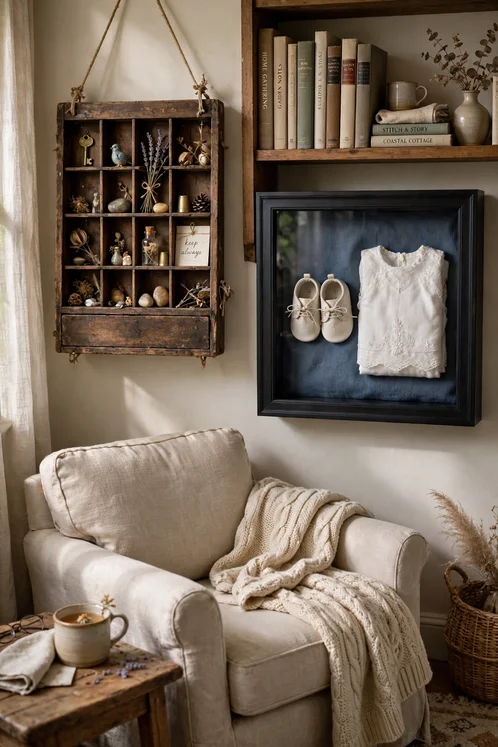
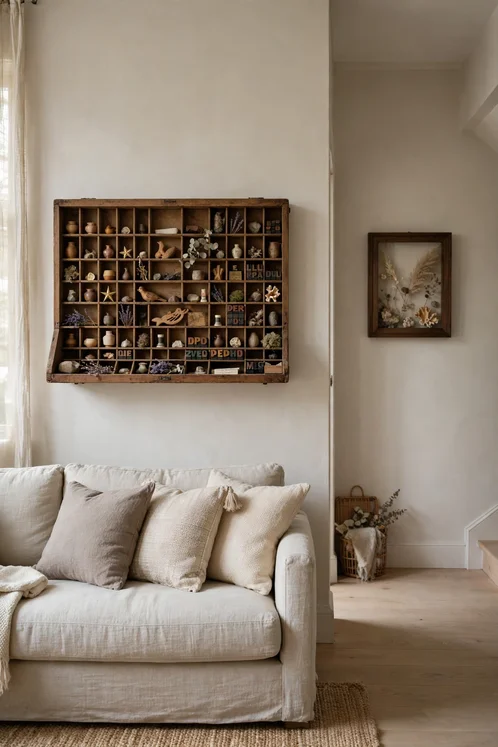
Printer’s trays suit rooms with a handmade, collected feel: farmhouse kitchens, cottage style living rooms, craft rooms, and entryways. They look natural above a desk, beside a bookshelf, or as part of a gallery wall. A tray hung near a reading chair keeps small treasures within reach, and these reading nook ideas with bookshelves show how a small display can sit naturally in a quiet corner without taking over the room.
The tray itself brings warmth, because old wood and small objects feel personal in a way a blank frame never does.
One more thing worth knowing: vintage trays and modern reproductions are not the same purchase. A genuine vintage tray, sometimes called a typesetter’s tray or a Hamilton cabinet, has real age in the wood, but its condition varies
from piece to piece. Check the joints, look for cracked dividers, and smell it if you can, because some old trays carry a musty odour that never quite leaves.
A reproduction is more predictable, with an even finish and solid dividers. Choose vintage if the history matters to you. Choose a reproduction if you want a reliable result and a fair price.
What Is a Shadow Box?
A shadow box is a framed display case with real depth, built to hold three dimensional objects and protect them. The name comes from the soft shadows that deep set objects cast against the backing. Unlike a tray, a shadow box usually has one open interior space instead of a grid, so you arrange objects freely against the back panel, or mount them on it.
The defining feature is depth. A shadow box has at least about 1 inch of internal depth, and many run from 2 to 6 inches. That changes everything about what you can display. A folded baby blanket, a pair of first shoes, a signed baseball, a dried wedding bouquet, a military medal with its ribbon, all of these need room. A shadow box gives them that room, and then closes the front with glass or acrylic so they stay clean and safe.
Depth That Actually Fits Real Objects
Here is where a little technical knowledge saves you from a costly mistake. A standard picture frame has a rabbet, the little ledge inside the frame that holds the glass and the artwork, of under half an inch. A deep frame stretches that to about three quarters of an inch. That is fine for a flat print or a very thin object, but it is not a shadow box, and it will not hold anything with real dimension.
If you press a dimensional object against the glass, you risk damaging it, and the glass can mark or crush delicate surfaces over time.
A true shadow box starts at about 1 inch of internal depth and goes up from there. Before you buy, measure the thickest part of your object, then add a little breathing room so nothing touches the glass. A folded jersey needs at least 3 to 4 inches, and 4 to 6 inches if you want it partly spread out rather than tightly folded.
A pair of baby shoes needs less, perhaps 2 to 3 inches. Measure twice, because a box that is too shallow is a box you cannot use.
Back loading shadow boxes are worth a look if you plan to arrange the contents carefully. In these, the contents mount on a fabric covered backing, and the backing slides into the frame from behind. That makes it easier to pin, stitch, or glue items in place without reaching through a narrow front opening.
Linen and velvet backings are popular because they add colour and texture, and they grip pins well. A plain white or cream backing suits photographs and paper keepsakes, while a deep navy or charcoal backing makes pale objects stand out.
The Glass Front: Protection and Trade Offs
The glass or acrylic front is what makes a shadow box a preservation tool rather than just a deep frame. It keeps dust out, fingers off, and shields contents from accidental knocks. For anything fragile or irreplaceable, that barrier matters more than it first appears. A christening gown folded in a drawer stays safe but unseen. The same gown in a shadow box is seen every day, and the glass is what makes that safe.
Glass also brings choices. Standard glass is clear and cheap, and suits most displays. UV protective glass or acrylic costs more, but it slows the fading of photos, textiles, paper, and autographs, which matters if the piece will hang in a bright room or if you want it to last for decades. Acrylic is lighter and shatter resistant, a smart choice for a large box or a child’s room, though it scratches more easily, so clean it with a soft cloth only.
If your display will hang opposite a window, UV protection is worth the extra cost. You can also cut the light before it reaches the glass, and these window treatment ideas for every room help you manage sunlight in the room where your keepsakes hang.
One honest trade off: a glass front reflects light. In a very bright room, or directly opposite a window, you may see a reflection instead of your display from some angles. Anti reflective glass exists, but it is expensive. Most people simply choose the wall with care, hanging the box where the light falls across it gently rather than straight on.
Weight, Size, and Where It Hangs
Shadow boxes are heavier than they look, especially large ones with real glass. A small 5 by 7 inch box is light and easy. A large box holding a jersey or a wedding dress can weigh enough to need a proper wall anchor, not just a picture hook. Always check the weight limit of your hanging hardware, and always anchor into a stud or use a wall anchor rated for the weight. A shadow box that falls is not just a broken frame, it is a damaged keepsake.
Because a shadow box protrudes from the wall, it suits low traffic spots: a quiet hallway, a bedroom wall, a home office, or the wall above a sideboard. Give it breathing room too. A deep frame crammed between two other frames looks cluttered, while the same box with space around it looks intentional and calm.
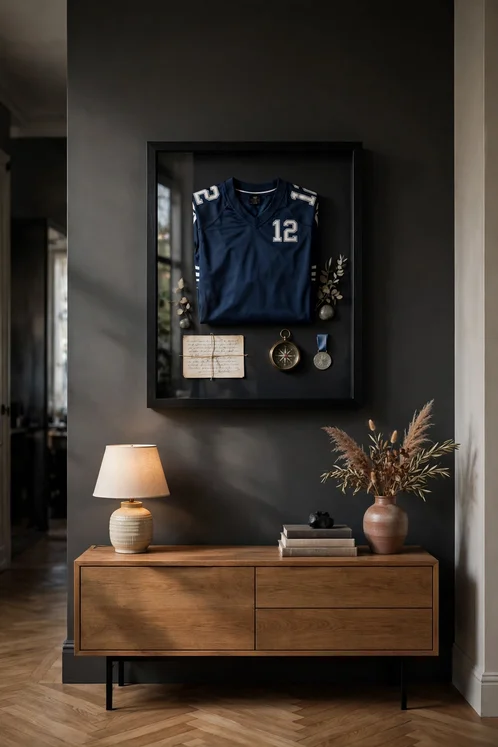
A shadow box also pops beautifully against a dark wall, because the glass catches the light, and these black accent wall ideas show how a deep frame can become a focal point rather than a flat decoration.
Five Questions to Ask Before You Buy
Forget the product listings for a moment. These five questions settle the decision faster than any comparison chart, because they start with your object and your life, not with the product.
1. What Are You Displaying?
Start with the objects, not the frame. Gather them on a table and look at them honestly. Are they flat and light? Coins, buttons, thimbles, small shells, beads, and miniature figures are tray objects. They sit happily in a shallow compartment, they look good in a grid, and you will enjoy picking them up. Are they bulky, soft, or fragile? A folded jersey, a pair of baby shoes, a dried bouquet, a signed baseball, a medal with a ribbon, these need depth and protection, and that means a shadow box.
If your collection is mixed, say so to yourself plainly. A tray will not hold the bulky pieces, and a shadow box wastes its depth on flat coins. Some people buy one of each, and that is a perfectly good answer. A tray for the small things you handle often, a shadow box for the one or two pieces that deserve protection.

2. How Deep Is the Thickest Object?
Measure the thickest part of the object you want to display, not the average thickness, because that is what has to fit. A brooch with a raised stone, a shoe with a heel, a medal with a pin on the back, these are the measurements that catch people out.
Here is the simple rule. If the thickest object is under about three quarters of an inch and mostly flat, a deep frame or a tray can hold it. If it is about 1 inch or more, you need a shadow box with at least that much internal depth, plus a little breathing room so nothing presses against the glass.
If you are anywhere near the limit, go deeper. A box with an extra inch of depth costs little more, and it gives you room to arrange things properly instead of squeezing them in.
3. Do You Need Dust and Fading Protection?
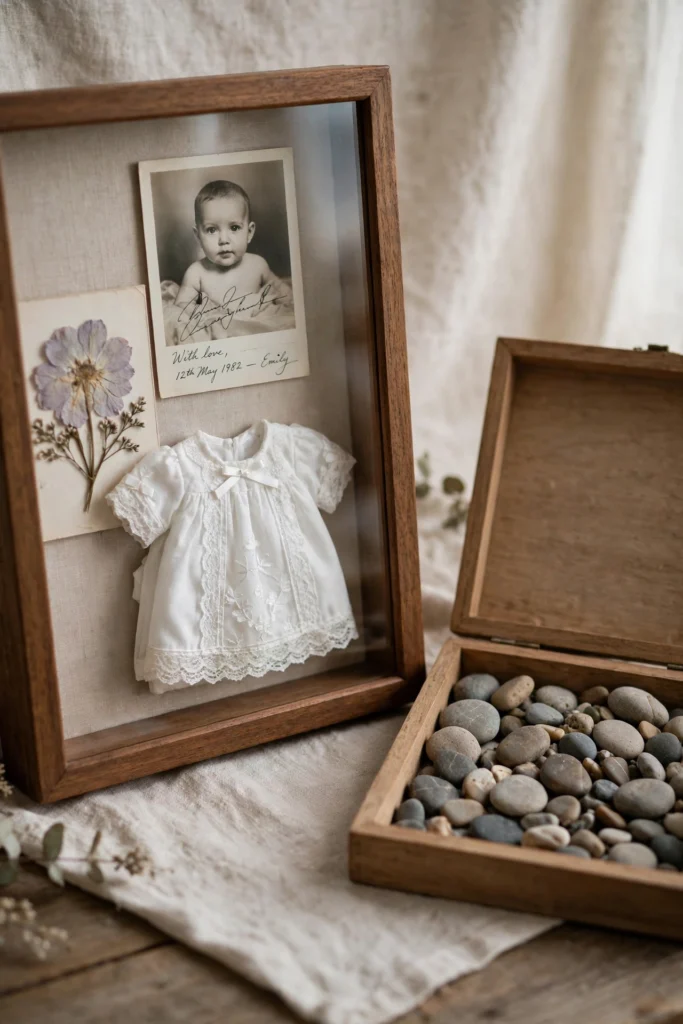
Think about what would happen if the object sat out in the open for a year. A collection of beach pebbles would be fine, a little dusty, nothing more. A signed photograph, a piece of embroidery, a christening gown, or a pressed flower would fade or yellow in ways you cannot undo, because paper, fabric, and ink are all vulnerable to light and air.
If the object is replaceable and you enjoy handling it, an open tray is a joy. If it is irreplaceable, or you want it to look the same in twenty years, the glass front and UV protection of a shadow box earn their keep. Ask yourself one blunt question: if this object were damaged, could I replace it? If the answer is no, choose the shadow box.
4. Will You Change the Display Often?
Be honest about your habits. Some people love rearranging a display. They swap pieces with the seasons, add a new find from a holiday, or move things around on a whim. If that sounds like you, a printer’s tray is built for it. Lift a piece out, put another in, done in seconds. No screws, no glass to remove, no fuss.
A shadow box is the opposite. It is designed to be arranged once and left alone. Opening it means removing the back or the front, handling the contents, and resealing it. That is fine for a permanent memorial display, and it is a nuisance for a collection that changes monthly. Match the frame to your habits, not to your intentions.
5. Where Will It Hang?
Walk to the wall you have in mind and look at it properly. How wide is it? How much light does it get? Who walks past it, and how close do they come? A wide tray suits a wide, horizontal space, such as the wall above a sofa. If that wall is bare and you are planning the whole arrangement, these above couch wall decor ideas show how to balance a wide piece with the furniture below it so the display feels anchored rather than floating.
A shadow box needs a calmer spot. Low traffic, gentle light, enough room around it for its depth to read as intentional. A busy hallway where shoulders brush the wall is a bad home for a protruding glass case. A bedroom, a quiet landing, or a home office wall are all better. Hang both at eye level, so you can see into the compartments or the case without stretching or stooping.
Best Use Cases for a Printer’s Tray
A printer’s tray shines when the display is part of your daily life. Here are the uses where it genuinely beats a shadow box.
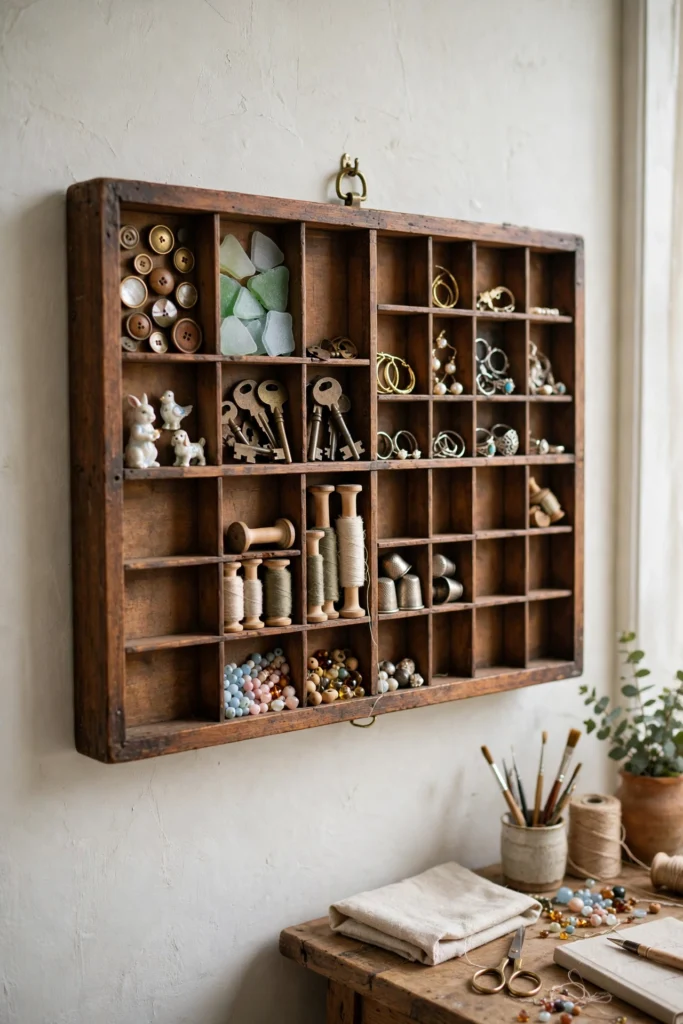
Vintage collections are the classic case. Antique buttons, miniature porcelain figures, old keys, tiny toy cars, and sea glass all look wonderful in a grid. The tray itself is a historical object, which adds authenticity that a new frame cannot match. Group similar items together, leave a few compartments empty for breathing room, and let the collection grow slowly. An overfilled tray looks cluttered, while a tray with a little space looks curated.
Craft supplies and jewellery are a practical use many people overlook. Mounted near a craft table or a vanity, a tray becomes a working organiser. Earrings, rings, bobbins, thimbles, beads, and spools each get their own compartment, visible at a glance and easy to grab. It beats a drawer, because you can see everything, and it beats a jewellery box, because it is also a decoration.
Best Use Cases for a Shadow Box
A shadow box shines when the display is about memory, protection, and permanence. Here are the uses where it genuinely beats a tray.
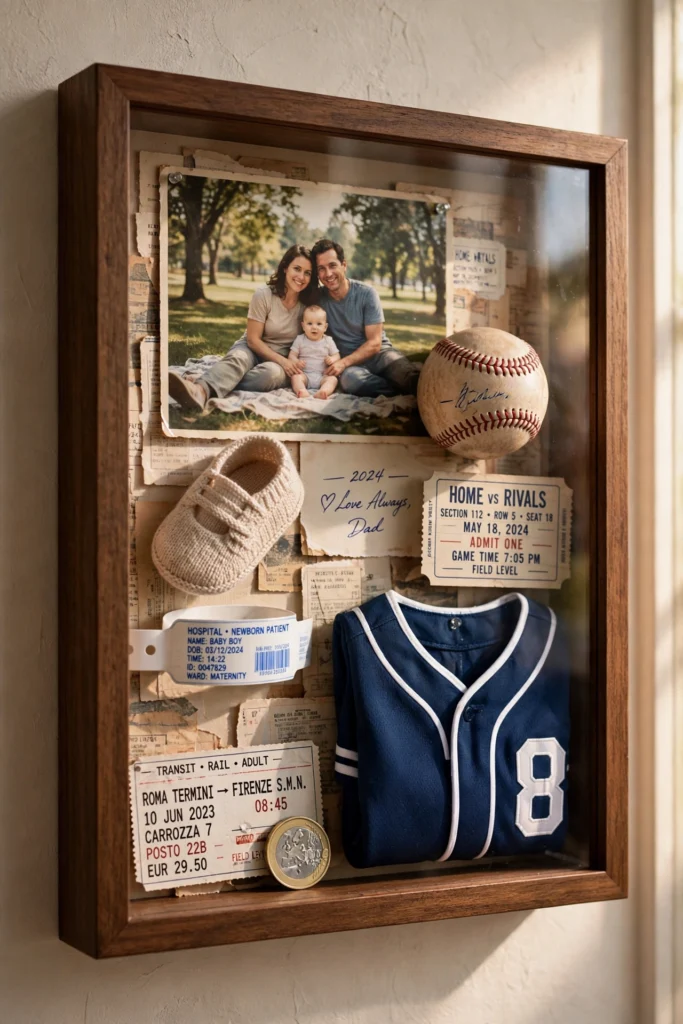
Family memories and layered displays are the heart of it. Combine a photograph with a physical memento, a birthday card beside a party photo, a travel snapshot with a ticket stub and a local coin, and the result feels far more personal than a standard frame. The depth lets you layer items, a photo at the back, a ticket in front of it, a small object in front of that, so the display has a sense of place and time.
Preserving sentimental or fragile items is the shadow box’s real job. UV protective glass slows the fading of fabrics, paper, and photographs, which matters when you are preserving something meant to last decades. Baby keepsakes, first shoes, a hospital wristband, an ultrasound photo, a lock of hair in a small pouch, all belong behind glass. The box keeps them safe and visible at the same time, which is the whole point.
Sports memorabilia comes alive in a shadow box. A signed baseball sitting on a shelf is easy to overlook, but the same ball mounted with a photo and a game ticket becomes a real display piece. A folded jersey needs that 3 to 4 inch depth, and a larger box if you want it partly spread out.
Professional and artistic presentation is the last strong use. Artists use larger shadow boxes for layered textile work, dimensional paper art, and mixed media pieces that need room to breathe. A deep frame gives a textile piece the space it needs to cast its soft shadows, and the glass keeps it clean without flattening it.
Buying Checklist: What to Check Before You Pay
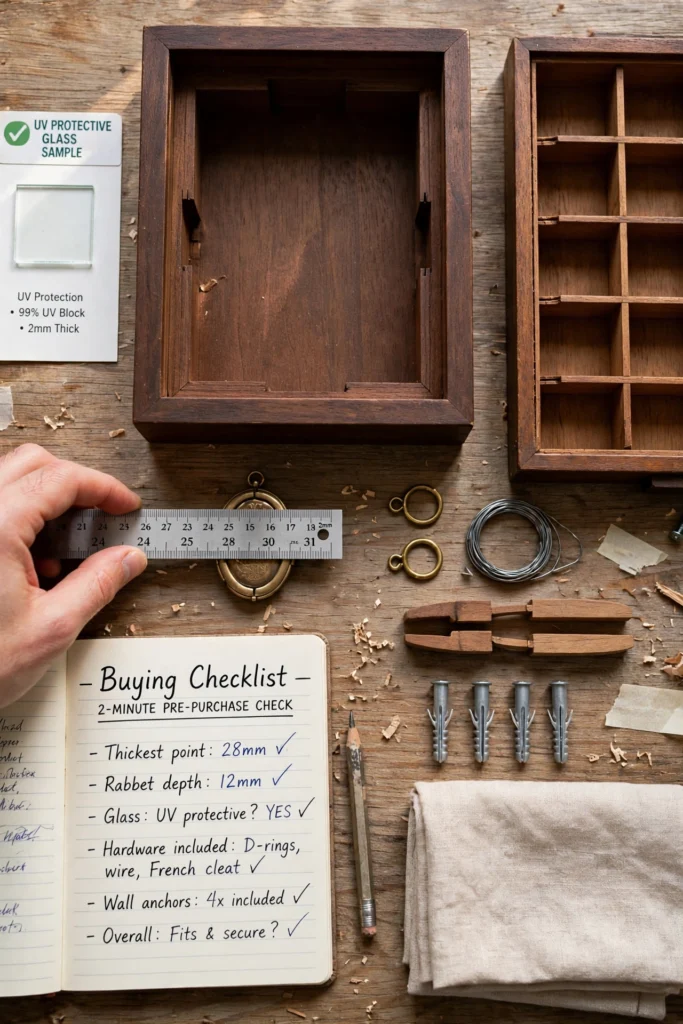
Use this checklist before you buy. It takes two minutes, and it catches the mistakes that lead to returns.
Measure the Object First
Measure the thickest part of the object, its width, and its height, and write the numbers down. Then compare them with the internal depth of the frame, not the outside depth, because the frame’s own wood takes up space. If you cannot find the internal depth in the listing, ask the seller before you order.
Check the Rabbet Depth
For a shadow box, confirm the rabbet depth, the internal depth from the glass to the backing. Remember the figures: a standard frame rabbet is under half an inch, a deep frame reaches about three quarters of an inch, and a true shadow box starts at about 1 inch. If the seller calls something a shadow box but the rabbet is under an inch, it is a deep frame, not a shadow box, and it will not hold a dimensional object.
For a tray, check the compartment depth instead, usually 1 to 2 inches, and make sure your bulkiest piece fits.
Choose the Glass or Acrylic
Decide before you buy whether you need UV protection. If the display will hang in a bright room, or holds photos, textiles, paper, or autographs, UV protective glass or acrylic is worth the extra cost. For a dark hallway or a display of sturdy objects, standard glass is fine. If the box is large, or it will hang where children play, consider acrylic for its light weight and shatter resistance, and remember to clean it with a soft cloth only.
Inspect the Hanging Hardware
Look at what comes in the box. A small frame with a single sawtooth hanger suits a light piece. A large or heavy shadow box needs a wire, D rings, or a French cleat, and wall anchors rated for the weight. If the hardware looks flimsy, replace it before you hang anything. Renters can still hang either piece safely, and these renter friendly upgrades and decor ideas include damage free hanging methods that hold real weight without leaving holes to repair later.
Check the Weight Limit and the Wall
Weigh the frame once it is filled, and match it to your wall. Plasterboard needs proper anchors, a stud is stronger still, and brick or concrete needs the right fixings. A shadow box full of glass and keepsakes is heavier than it looks, and a fall can damage both the frame and the object inside.
Look at the Backing and the Finish
For a shadow box, look at the backing. A fabric covered backing in linen or velvet holds pins well and adds colour, while a plain backing suits photographs. For a tray, look at the wood. Check the joints, look for cracked dividers, and run a hand over the finish. Rough edges and loose dividers are signs of a cheap reproduction, and they will only get worse once the tray is filled and hung.
Where to Buy a Printer’s Tray or a Shadow Box
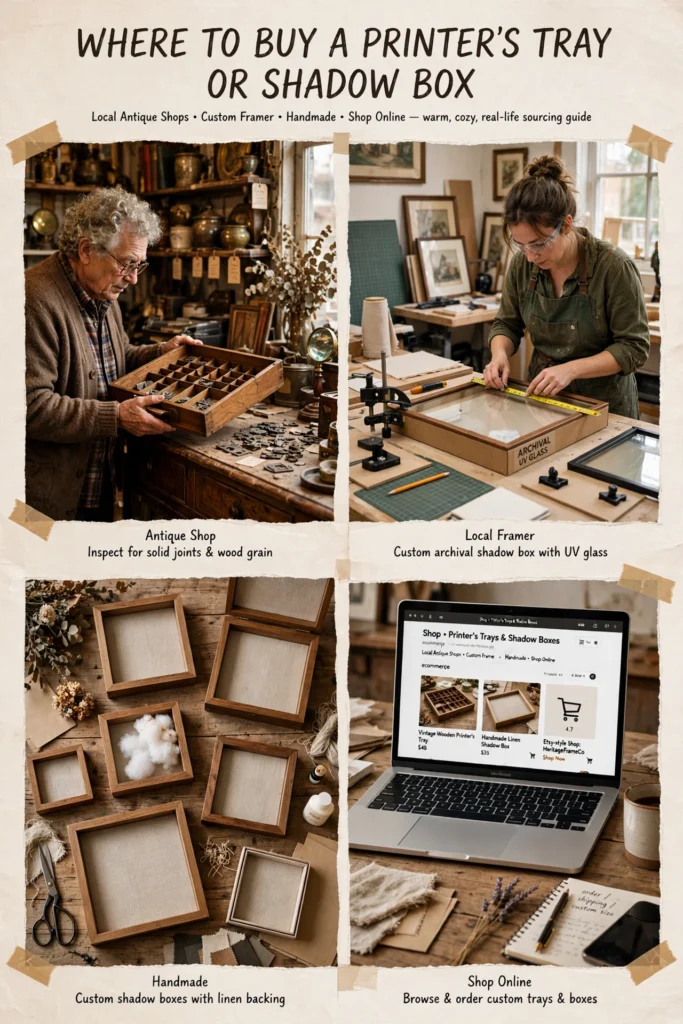
Etsy is the strongest option for handmade and vintage printer’s trays, and for custom shadow boxes with personalised dimensions, frame finishes, and backing fabric. Amazon and Wayfair are reliable for budget friendly shadow boxes with a wide selection, and a good place to start if you want a standard size quickly.
Local antique shops and estate sales are often the best source for genuine vintage printer’s trays, and they are worth visiting in person so you can check the wood and the joints before you buy. Local frame shops are the right choice for archival grade shadow boxes, especially if UV protective glass matters to you, because a framer can measure your object and build the box around it.
A few practical notes before you order online. Large frames can cost a noticeable amount to ship, so factor that into the total before you buy. Craft and framing shops run frame discounts often, but the exact offers change, so confirm the price at checkout. And if you are ordering a custom size, double check your measurements one more time. A custom frame that is half an inch too shallow is a frame you cannot use.
Printer’s Tray vs Shadow Box: Your Questions Answered
What is the main difference between a printer’s tray and a shadow box?
A printer’s tray is a shallow, open wooden frame with many small compartments, originally used to store movable type. A shadow box is a deeper, enclosed case with a glass front, built to protect and show three dimensional objects. A tray is for flat, light things you enjoy handling and rearranging. A shadow box is for dimensional, fragile, or valuable things you want to protect for years.
Can a printer’s tray be used as a shadow box?
Not effectively. A printer’s tray lacks the depth, the backing, and the glass front that define a shadow box, so it cannot protect fragile or valuable items from dust, handling, or light the way a proper shadow box can. If you put a dimensional object in a tray, it will sit proud of the compartments, collect dust, and risk being knocked out.
What items are best displayed in a printer’s tray?
Small, light, flat objects work best: miniature figurines, coins, crystals, jewellery, thimbles, vintage buttons, small shells, and craft supplies. The open compartments make them easy to rearrange, and the grid gives a mixed collection a sense of order. Avoid anything heavy, anything thicker than the compartments, and anything you would hate to find on the floor.
How deep should a shadow box be for a folded jersey?
Allow at least 3 to 4 inches of internal depth for a folded jersey, and 4 to 6 inches if you want it partly spread out so the number or the name is visible. Measure the folded jersey at its thickest point, then add breathing room so the fabric never touches the glass. A local frame shop can build one to your exact measurements if a standard size does not fit.
Are vintage printer’s trays worth buying over new reproductions?
It depends what you value. A genuine vintage tray offers authenticity and solid wood construction, and it carries a piece of printing history into your home. Its condition varies from piece to piece, though, so check the joints, the dividers, and the smell before you buy. A new reproduction is more consistent in quality and finish, and you know exactly what you are getting. Choose vintage for the aged look and the story, or a reproduction for a predictable result.
Where is the best place to buy a custom shadow box?
Etsy is the strongest platform for personalised dimensions, frame finishes, and backing fabric, because you can talk directly to the maker. Local frame shops are a solid alternative, and they are the better choice for archival grade or museum quality work, because a framer can handle your object, measure it properly, and choose UV protective glass and acid free materials for long term preservation.
Measure the Object First
Printer’s trays and shadow boxes occupy different corners of the same hobby, and once you see the distinction, the buying decision gets much easier. A printer’s tray is a working display with a vintage soul, ideal if you like to curate, rearrange, and handle the things on your wall. A shadow box is a preservation first frame, built to protect the things that deserve a permanent home.
Neither one is universally better. If you are still undecided, here is the simplest version of the guide. Buy a printer’s tray for the things you want to live with daily and change often. Buy a shadow box for the things you want to honour and protect for years to come.
And if you have both kinds of objects, and most of us do, buy one of each. They sit happily side by side on the same wall, and together they tell the story of a home that is collected, not decorated For my own keepsakes, I would pick the shadow box first, because the pieces I could never replace deserve glass between them and the room.
Before you buy anything, though, do the one thing this guide keeps coming back to. Take the object off the shelf, put a ruler against its thickest part, and write the number down. That single measurement will tell you more than any product page or photograph. It will tell you whether you need a shallow open tray or a deep sealed case, and it will save you the cost of a frame that does not fit. Measure the object first, and the rest of the decision makes itself.