Sophisticated Valentine’s Day decor is about restraint, not romance by the bucketload. Pick one muted palette, repeat it through three or four rooms, and let natural materials like linen, brass, wood and fresh flowers do the talking. A few well placed candles, one good bouquet and a single heart shaped accent in a room are enough.
The trick is to decorate the way you would for a quiet dinner party, not a themed event. If a piece would look strange in your home on any other evening, leave it in the shop. This guide walks you room by room, from the front door to the bedroom, with the palettes, placements and small touches that keep the whole house feeling grown up, warm and genuinely romantic.
Most Valentine’s Day decorating goes wrong in the same way: too many colours, too many hearts, and too many things bought in a hurry. The result feels like a party shop exploded in the living room. There is a better way. Start with what is already in your rooms, add one colour, one texture and one source of warm light per room, and stop there.
1. The Palette That Keeps It Sophisticated
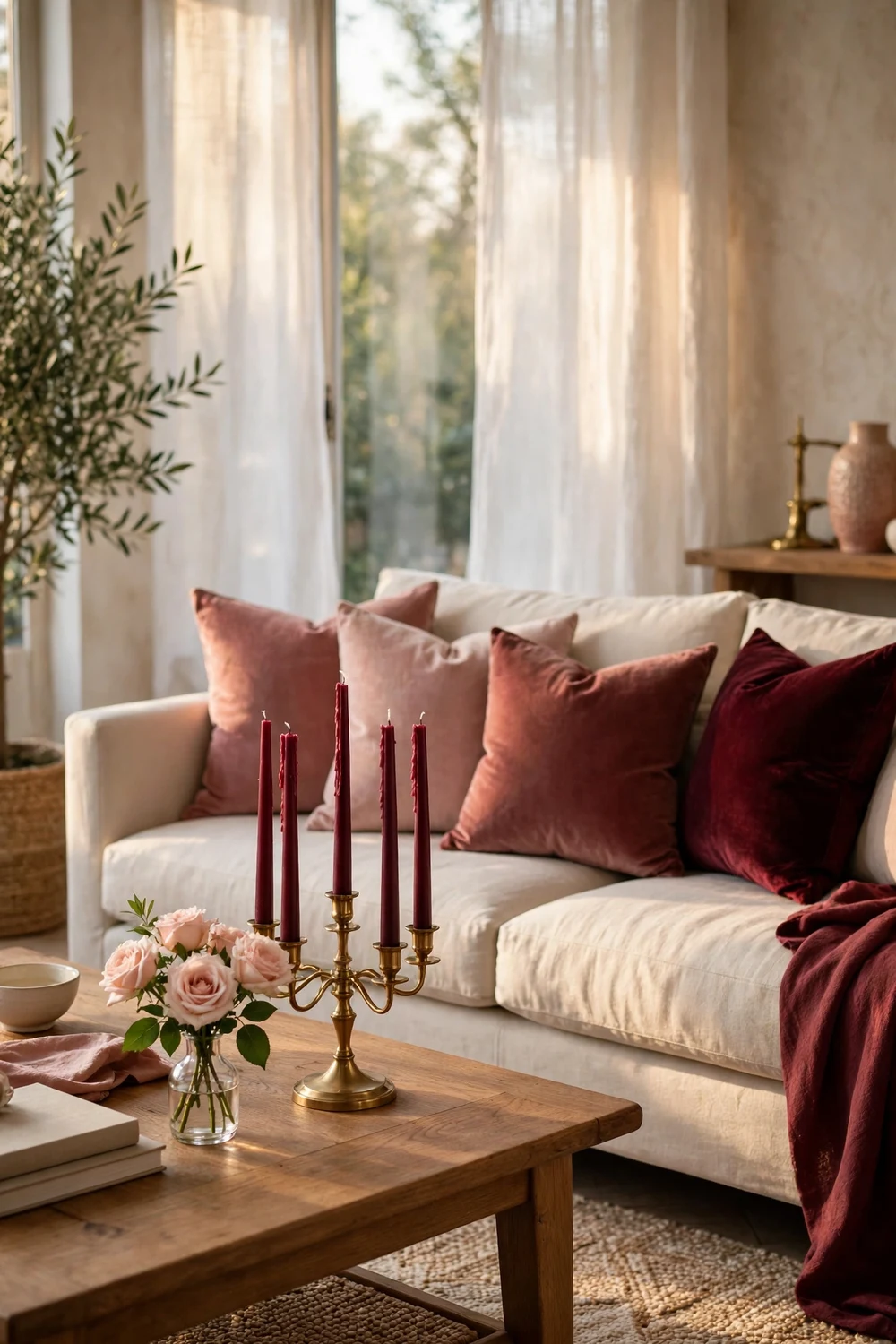
Every good room starts with a palette, and Valentine’s Day is no exception. The difference between a sophisticated room and a cutesy one is almost always the colour choice. Bright red and hot pink, used everywhere at once, shout. Muted versions of the same colours whisper, and whispering is what romance sounds like.
Choose three colours and one metal, then hold that combination through the whole house. Burgundy, dusty rose and cream with brass is the classic grown-up choice, and it is the one this guide uses throughout. Burgundy gives depth and drama, dusty rose softens it, cream keeps everything light, and brass makes candlelight feel golden. If burgundy feels too dark, swap it for deep plum or chocolate brown and keep the rest.
What matters most is the ratio. Let cream and other neutrals cover about two thirds of what you see, dusty rose or blush about a quarter, and your darkest colour, burgundy or plum, only in small doses: a pair of candles, one cushion, the roses in a vase. When the darkest colour takes over, the room feels like a set. Used sparingly, it reads as intention.
Texture does as much work as colour here. Velvet cushions, a linen throw and a ceramic vase all catch light differently, and that variety stops a limited palette from feeling flat. Mix matte with shine in every room: a matte ceramic heart beside a polished brass candlestick, a soft velvet cushion against smooth linen. That quiet contrast is what makes a simple arrangement look styled.
Before you buy anything, walk through your home and pull out what already fits your palette: the dusty pink throw, the brass candlesticks, the cream ceramics. You will be surprised how much of the look you already own. What you buy should fill gaps, not start a new collection.
For a wider look at warm, muted palettes in real rooms, see our guide to interior color trends for cozy homes, where the same principle of one anchor colour and two supporting tones runs through every scheme.
| Palette | Main colours | Metal | Best for |
|---|---|---|---|
| Classic Burgundy | Cream, dusty rose, burgundy | Brass | Traditional rooms, wood furniture, candlelight dinners |
| Soft Plum | Ivory, blush, deep plum | Antique gold | Bedrooms, small spaces, a quieter mood |
| Chocolate and Blush | Cream, blush, chocolate brown | Brass | Warm modern rooms, leather and dark wood |
| Terracotta Romance | Warm white, terracotta, dusty pink | Copper | Earthy, relaxed homes, lots of natural texture |
| Moody Charcoal | Soft grey, blush, deep red | Blackened brass | Contemporary rooms, a dramatic evening look |
2. The Entryway and the Mantel: First Impressions That Set the Tone
Guests form their impression of a home in the first ten seconds, and so do you when you walk in after a long day. That is why the entryway and the mantel deserve attention first. A small amount of styling here has the biggest effect, and it sets the palette for everything that follows.
Start at the front door. A hoop wreath of dried eucalyptus with a few dried roses tucked in, tied with a wide dusty rose ribbon, looks collected and calm. Skip the glittery plastic hearts. Hang it at eye level, and keep the ribbon tails long enough to move in a draught. If you have a console table in the hall, add one small vase with two stems and a candle. That is enough. The hallway is a passage, not a room to linger in.
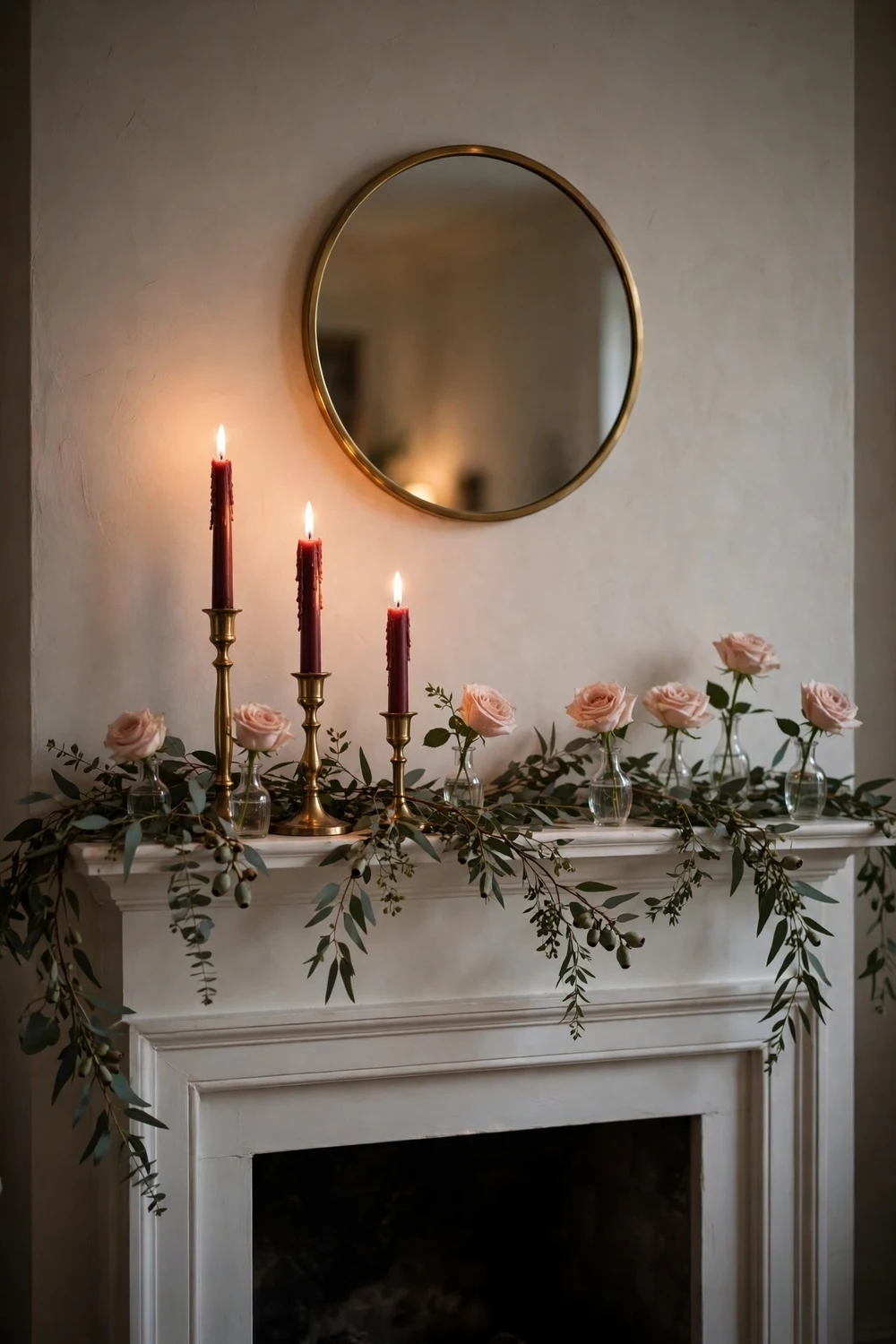
The mantel is where Valentine’s Day styling earns its reputation, for better or worse. The classic mistake is to fill every inch of it. A good mantel has breathing room. Start by clearing it completely, then build in three layers: something tall at the back, something medium in the middle, and something low at the front. A round mirror or a framed print anchors the back, candlesticks of different heights form the middle, and low bud vases with a loose garland sit at the front.
Greenery is what makes a mantel look alive rather than arranged. A eucalyptus garland draped loosely along the front edge, with a few stems trailing down at the ends, gives you a soft, unstructured line. Do not try to make it symmetrical. Real garlands sag and wander, and that imperfection is what makes them look natural. Tuck the rose stems into the garland, and space three small bud vases, each holding a single rose, unevenly along the mantel.
Candlelight is the mantel’s best friend. Use real taper candles if you will be in the room, and battery operated ones with a warm glow if you will not. Group them in odd numbers, three or five, and vary the heights so the flames form a gentle slope rather than a flat line. Keep them away from the garland and any ribbon, and never leave them burning in an empty room.
Here is my own opinion, and I hold it firmly. The mantel should look like the rest of your home, just a little more dressed up. If your home is full of clean lines and quiet colours, a mantel covered in red glitter hearts will look like it belongs to someone else. Trust the style you already have, and add romance to it instead of replacing it for one evening.
3. Setting the Dining Table for Two, or for a Few
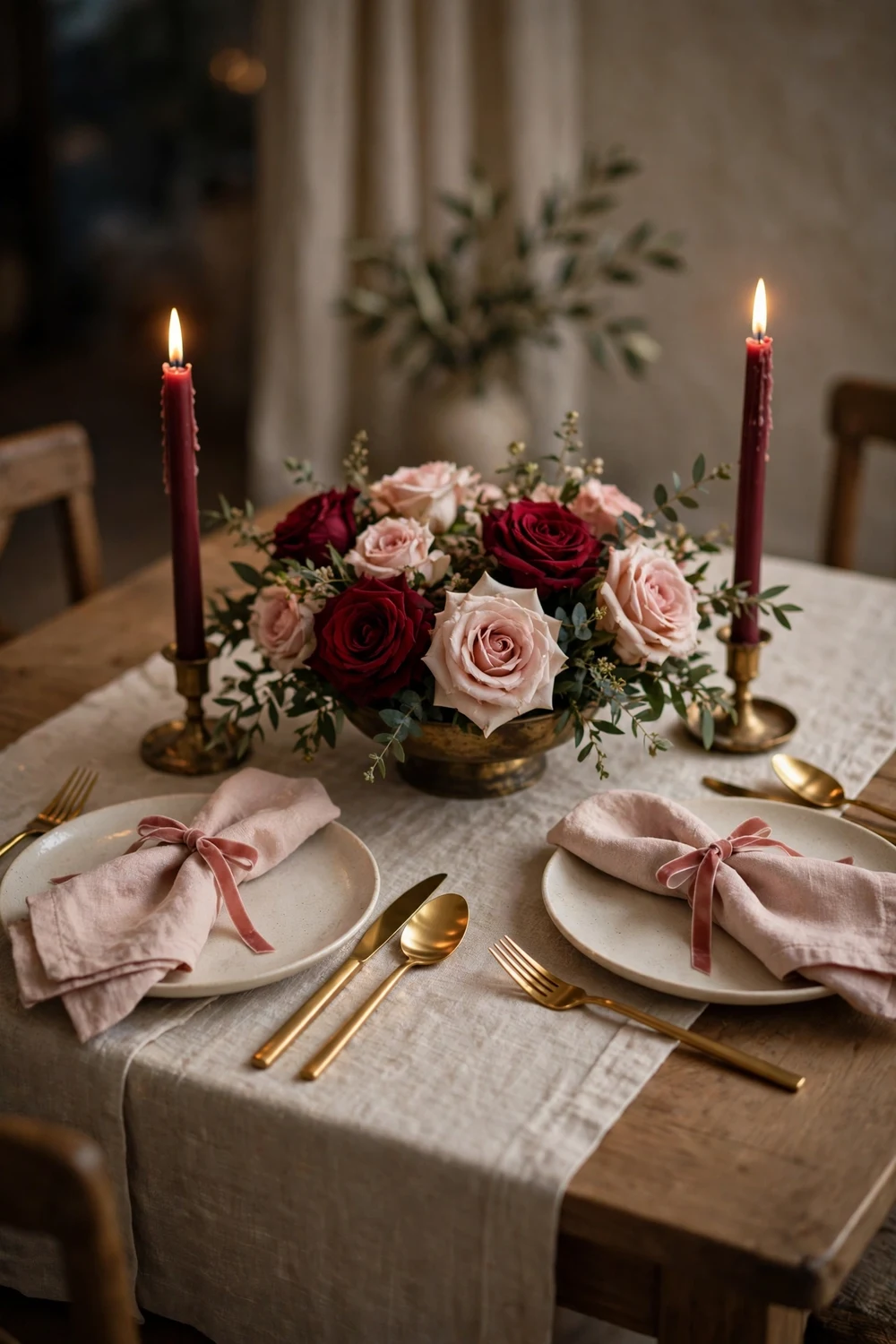
The dining table is where sophisticated Valentine’s Day decor does its most important work, because this is the room where people actually sit down together. A classy Valentine’s table decor scheme is built the same way as the mantel: a base layer, a low centrepiece, and light. Everything else is optional.
Start with the base. A natural linen runner down the centre of the table is enough, and it is often better than a full tablecloth, because the wood showing at the edges keeps the setting grounded. A cream runner lifts dark wood, while a deeper runner in dusty rose or chocolate adds contrast to a light table. Iron it, because creases are the first thing the eye catches in candlelight.
Keep the centrepiece low. This is the rule that matters most at a dinner table. If your guests cannot see each other across the flowers, the flowers have failed, however beautiful they are. A shallow brass bowl filled with burgundy and blush roses, with a little eucalyptus between the stems, sits about six inches high and leaves the sightline clear. For a long table, run three small arrangements down the centre, with a gap of open runner between them.
Candles give the table its height, so the flowers do not have to. Place tall, slim taper candles in brass holders on either side of the centrepiece. Two suit a table for two, four or six suit a longer table. Light them just before people sit down, and trim the wicks first so the flames burn steady.
Place settings are where the small details earn their keep. A blush linen napkin, folded simply and tied with a thin velvet ribbon, looks thoughtful without looking fussy. Tuck a single stem under the ribbon if you like, but do not add a printed place card, a favour and a menu all at once. One personal touch per setting is the limit. Two starts to look like a wedding, and three looks like a craft fair.
For a table for two, pull the settings closer together than usual, on the same side of a small table or at adjacent corners of a larger one. Scale the centrepiece down to match: one small vase, two candles, done. For a small group, keep the palette identical at every setting and repeat the napkin ribbon, the glassware and the candle spacing, so the table reads as one composition.
For more ideas that work on ordinary evenings as well as special ones, our guides to dining room centerpiece ideas and modern dining table centerpiece ideas are full of low arrangements that never block a conversation.
4. Bedroom Touches That Stay Soft and Grown Up
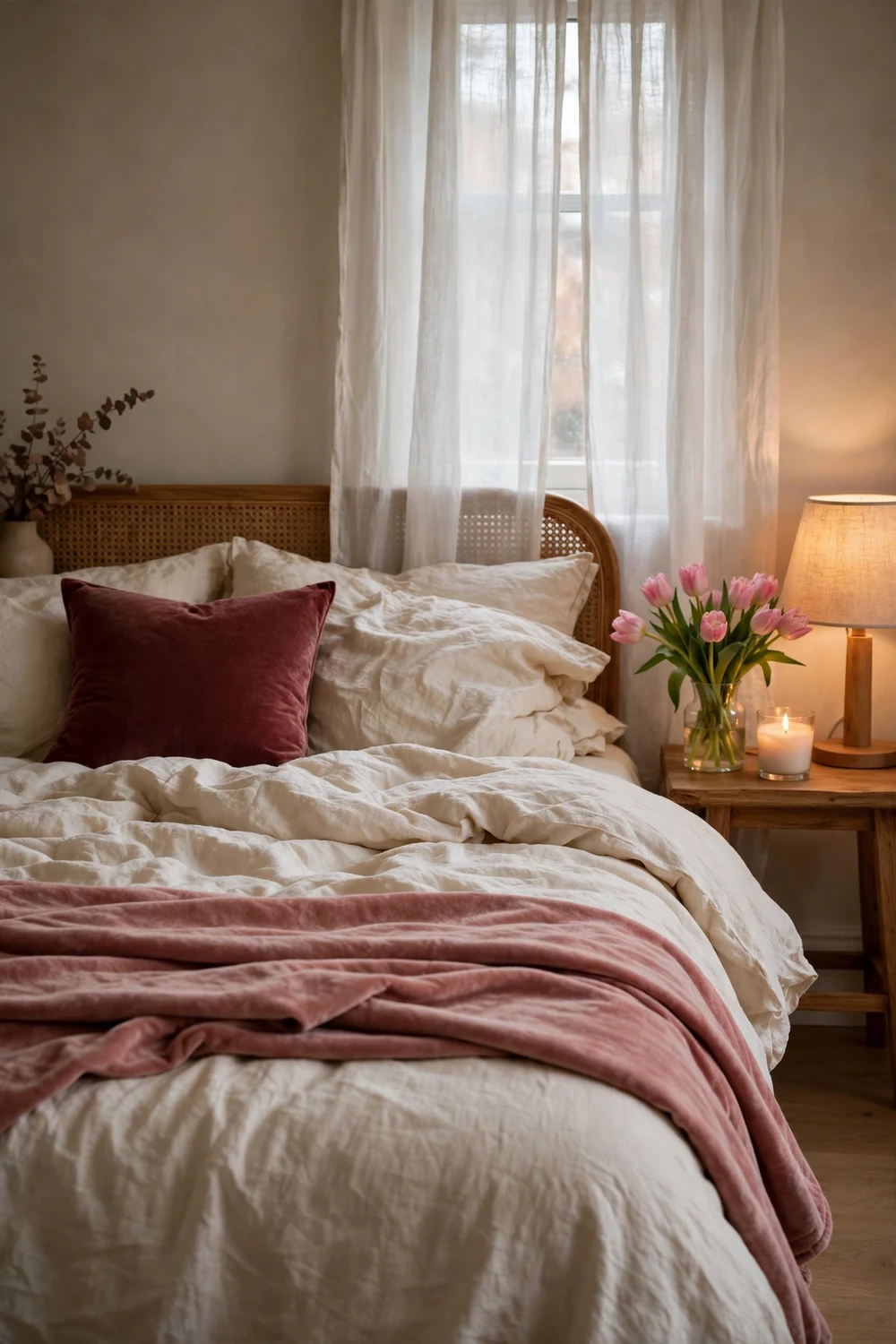
Romantic bedroom decor for Valentine’s Day is the easiest place to overdo it, because the room is private and the temptation is to go all out. Resist it. A bedroom should feel like a better version of itself, not like a hotel suite dressed for a photograph. The best romantic bedrooms use the same three moves: better bedding, softer light, and one small gesture on the bedside table.
Start with the bed, because it fills most of the room. Change the bedding if you can, or at least the top layer. Cream or ivory linen, slightly rumpled, looks instantly more romantic than a flat, tightly made bed in a busy pattern. Layer a dusty rose velvet throw across the foot of the bed, folded neatly, and add one burgundy cushion in front of your usual pillows. That is the whole bed. No rose petals across the sheets, no heart shaped cushions in a row, no balloon arch over the headboard.
Light is the second move, and it matters more in the bedroom than anywhere else. Turn off the overhead light and use the bedside lamps, with warm bulbs if you have them. A single candle on the bedside table, in a glass holder, adds a soft flicker that no lamp can match. Light real candles only while you are awake and in the room, and blow them out before you sleep. Battery operated candles with a warm glow are safer here, and from a few feet away they look convincing.
The bedside table is where the small gesture lives. A small vase with three or four pink tulips, a lit candle, and perhaps a handwritten note is enough. Tulips are elegant without being as expected as roses, and they last well in a cool bedroom. If you want roses, choose one colour and keep the bunch small. A single stem in a slim brass vase can be more romantic than a dozen in a large one.
Keep the rest of the room as it is. Do not redecorate the dresser or change the curtains. You are adding a mood, not rebuilding the room. Clear the surfaces before you style them, too. A bedside table with a phone charger, a water glass, a book and a vase is not a vignette, it is a pile. Ten minutes of tidying does more for a bedroom than any amount of shopping.
5. The Kitchen and the Coffee Corner
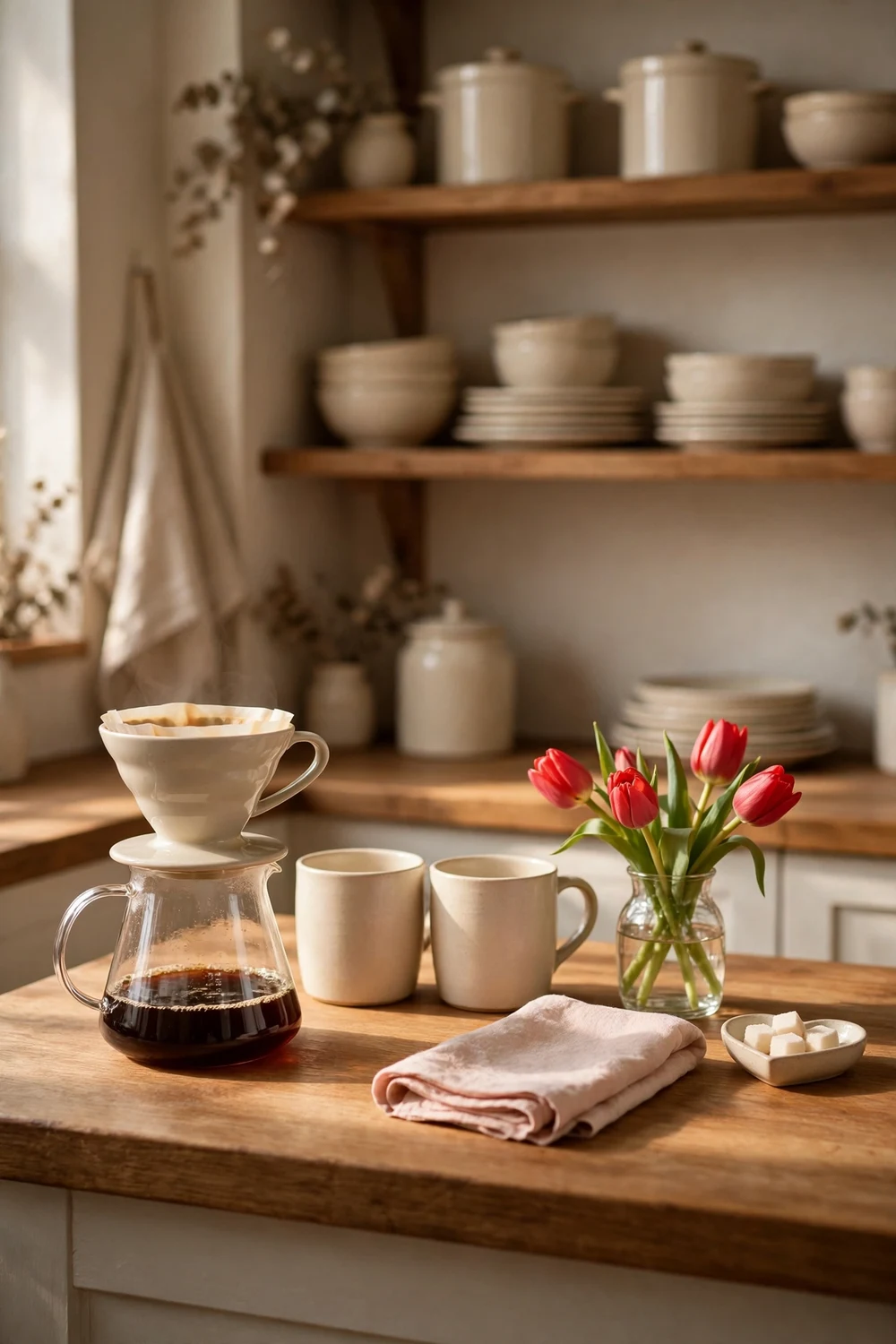
The kitchen is the room most Valentine’s Day guides forget, which is a shame, because it is where the day actually starts. A small, thoughtful touch here sets the tone before anyone has dressed for dinner, and it costs almost nothing. Style it the way you would style a good cafe: one beautiful corner, kept clear, with something fresh in it.
A coffee corner is the easiest place to start. Clear a small stretch of counter, and set out your coffee things with care: the pour over or the cafetiere, two matching mugs, a small jug of milk. Add a folded blush linen napkin and a tiny ceramic dish, heart shaped if you have one, holding sugar cubes or a few wrapped chocolates. Finish with a small vase of red tulips. That is the whole arrangement.
Open shelving is the second spot worth a small edit. Pick one shelf, the one at eye level, and make three small changes. Turn a stack of bowls so their best side faces out. Tuck a small vase with two stems between the plates. Move anything brightly coloured or chipped to a lower shelf.
Keep the kitchen practical. Do not hang garlands across the cupboards where they will get in the way of cooking. Do not put candles near the hob or the tea towels. Do not cover the worktops with decorations you will have to move to chop an onion. One corner, one shelf, one small vase.
For more ideas on keeping a kitchen warm and layered, our cozy winter living room decor guide uses the same layering of textiles, warm light and natural materials that works just as well in a kitchen corner.
6. Paper and Floral Crafts That Look Expensive
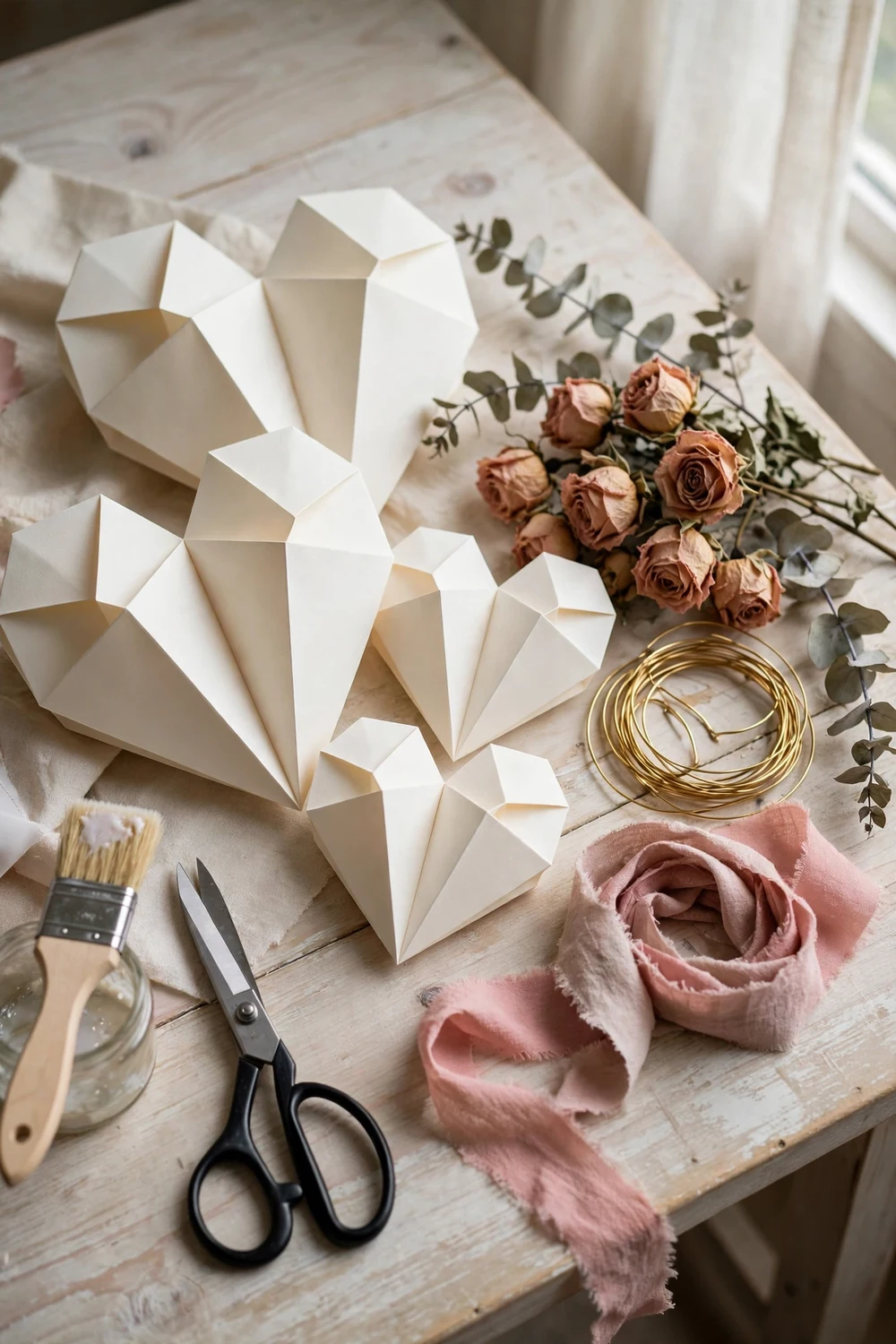
Handmade Valentine’s Day crafts have a reputation problem, and it is mostly deserved. Too many look like school projects: bright paper, glitter glue, uneven edges. But the right crafts, made with the right materials, can look genuinely expensive, and they are the pieces you will keep and reuse. The difference is not skill. It is material choice and restraint.
Start with paper, because it is the most forgiving material. Thick cardstock in cream, blush or burgundy, cut and folded into three dimensional hearts, looks like a boutique window display when it is done well. The key is the paper weight. Thin printer paper folds badly and looks flimsy. Cardstock of around 200 grams per square metre holds a crisp fold and casts a real shadow. Cut each heart the same size, fold along the centre line, and glue two folded hearts back to back to make a full, rounded shape. String five or six on linen twine at uneven intervals, and hang the garland across a mirror or along a shelf.
Dried flowers are the second craft worth your time. A small bunch of dried roses, tied with dusty rose velvet ribbon and hung from a brass hook, looks collected and lasts for months. Pressed flowers in a simple floating glass frame are equally good. Choose one type of flower and one colour. A frame of mixed, brightly coloured petals looks busy, while three pressed roses and a stem of eucalyptus look like a botanical print.
A brass wire wreath is the most modern of the three crafts, and it suits homes that lean contemporary. Shape a length of brass wire into a hoop, then wire on small sprigs of dried flowers and eucalyptus, leaving gaps so the metal shows through. Hang it on a door or lean it on a mantel. The asymmetry is the point: a perfect, full circle looks shop bought, while a hoop with flowers on only two thirds looks handmade.
Here is the rule that keeps all of these crafts looking expensive: use natural materials, one colour, and plenty of empty space. Linen, brass, dried flowers, heavy paper and velvet ribbon all look like they belong in a grown-up home. Glitter, foil, bright plastic and printed slogans do not. If a craft supply looks like it came from a party aisle, it will look like one when it is finished.
7. What to Avoid So It Never Looks Like a Party Shop
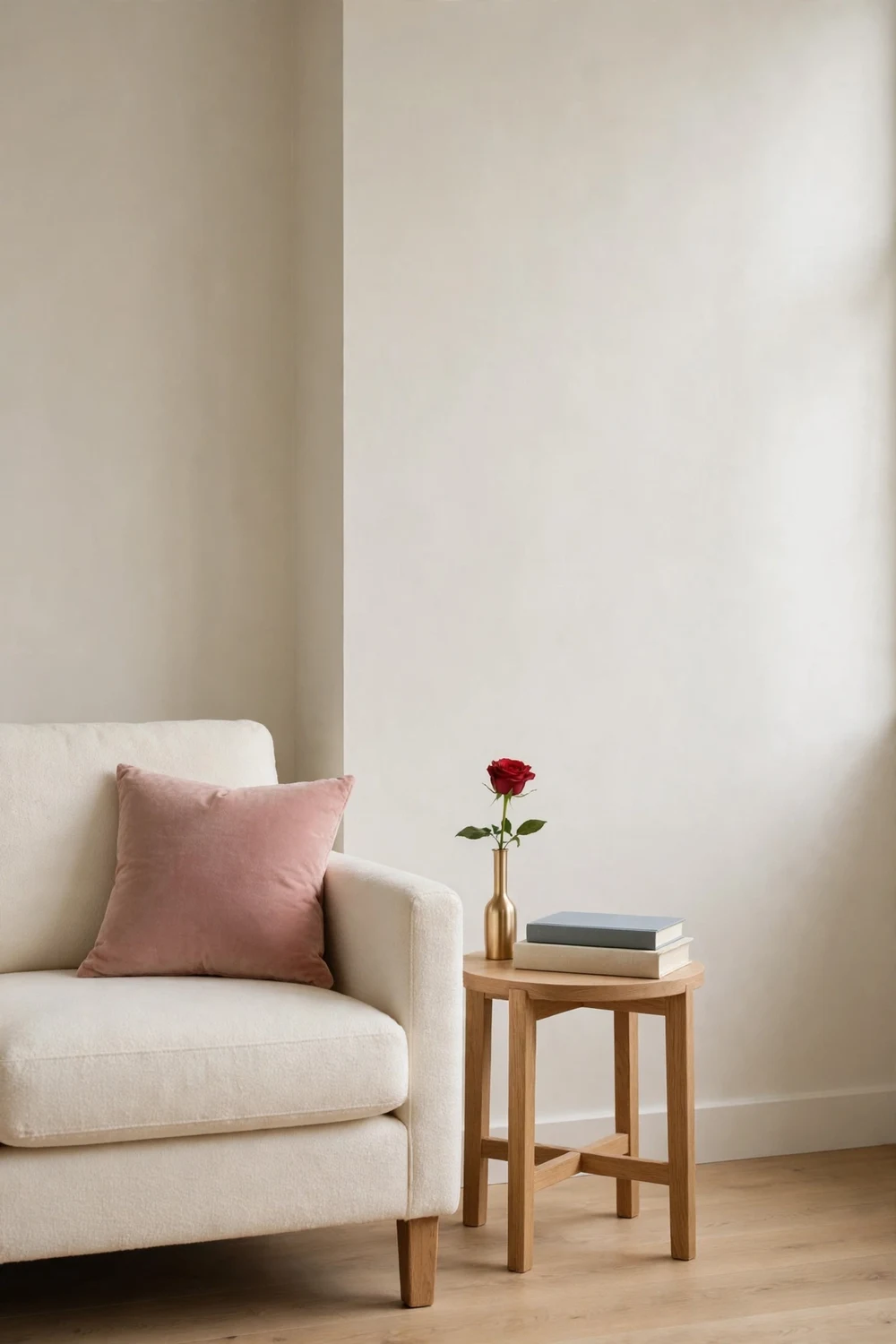
Knowing what to leave out is more important than knowing what to add. Most Valentine’s Day rooms fail because of a handful of common mistakes, and all of them are easy to avoid once you can name them.
The first mistake is too many hearts. One heart shaped object in a room is charming. Five is a theme. Ten is a party shop. Count them. If you have a heart cushion, a heart garland, heart candles and heart shaped dishes all in the same room, take most of them away. Keep the one you like best, and let it be the only heart in that room. The same rule applies to the word love: a single handwritten note is lovely, a sign that spells it out in lights is not.
The second mistake is too many colours. A room that mixes bright red, hot pink, gold, silver and purple at once has no calm place for the eye to rest. Stick to the palette you chose at the start, and be honest when something does not fit it. That pink gift bag, those red foil balloons, the purple candles from last year: they can stay in the cupboard.
The third mistake is decorating every surface. A home with a heart on every shelf, a candle on every table and a garland on every doorframe feels frantic, not romantic. Choose three or four spots in the whole house and decorate those well. The undecorated rooms make the decorated ones look deliberate.
The fourth mistake is buying everything new. A room full of freshly bought, matching Valentine’s decorations looks like a display, because it is one. The most sophisticated rooms mix old and new: your own candlesticks, your own linen, your own books, plus one or two new pieces that fit the palette.
The fifth mistake is ignoring scale, and the sixth is forgetting that you have to live with it. A tiny heart on a huge empty wall looks lost, and a giant balloon arch in a small flat looks absurd. Match the decoration to the space, then walk the routes you actually use. If you have to step around something, move it.
Minimalist Valentine’s Day decor is not about owning less, it is about choosing well. Our guide to minimalist Halloween decor ideas makes the same point for a different season: restraint is a style, not a lack of effort.
8. Storing and Reusing Your Pieces Next Year
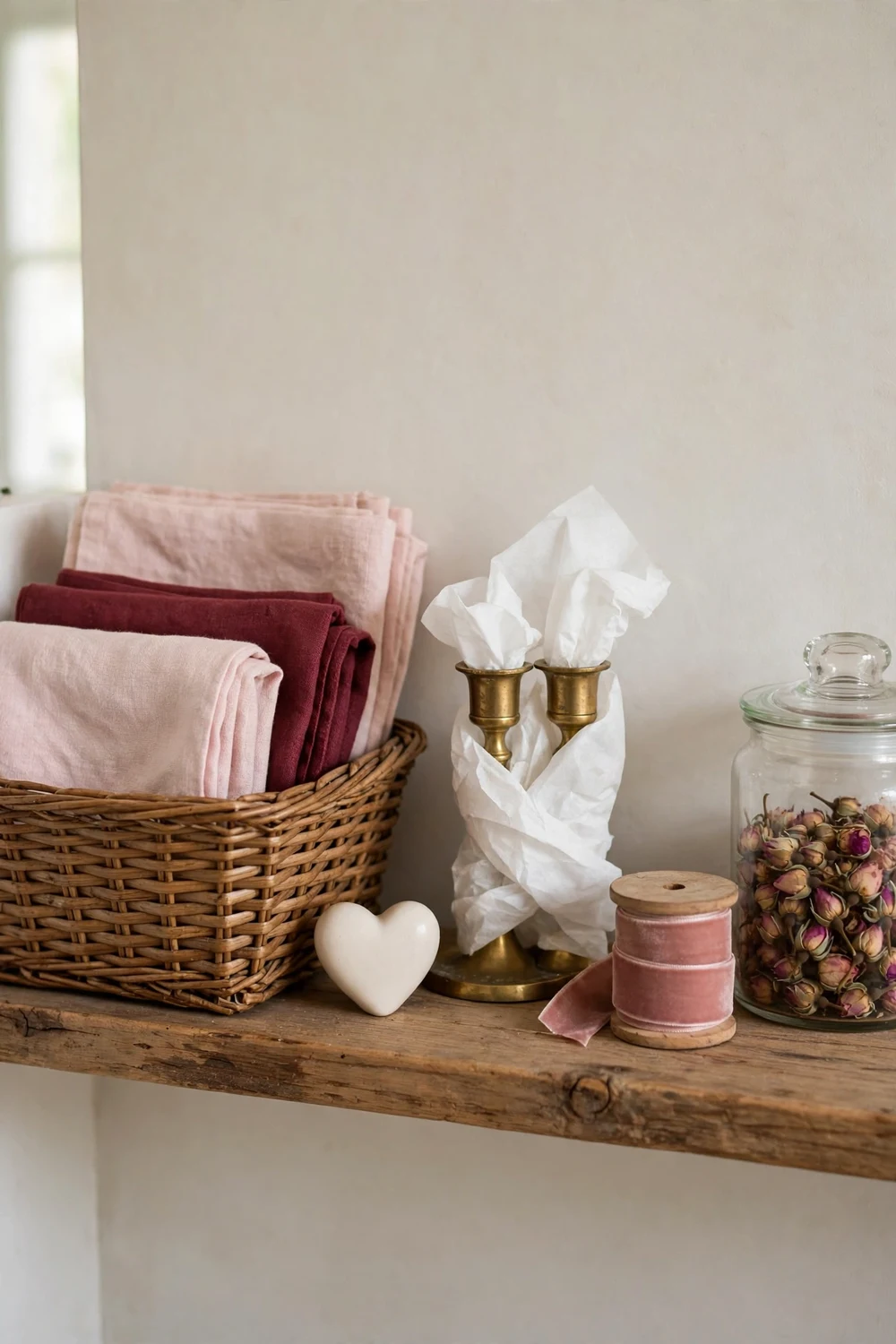
Good Valentine’s Day decor is an investment, not a single use purchase, and the way you store it decides whether it is still good next year. Most decorations are ruined in storage, not in use. They get crushed, tangled, stained or lost, and by the following year they look tired enough to throw away. A little care now saves money and keeps the pieces you love looking like new.
Start by sorting before you pack. Put everything into three groups: keep, repair, and let go. Keep the pieces that still look good and fit your palette. Repair the ones that are nearly there: a candle that needs a wipe, a ribbon that needs pressing, a garland that needs one sprig replaced.
Pack by material, not by room. Candles go together, wrapped in tissue paper so they do not mark each other. Linen napkins and throws get folded, not rolled, and stored in a breathable basket or a cotton bag, never in a sealed plastic box where damp can gather. Brass candlesticks get wrapped individually so they do not scratch. Dried flowers go in a jar with the lid left slightly loose, or in a paper bag. Paper hearts lie flat between tissue sheets in a shallow box, with nothing heavy on top.
Some pieces do not need storing at all. Brass candlesticks, linen napkins in dusty rose, a cream runner, a brass bowl: these are everyday objects that happen to suit Valentine’s Day. Keep them in use through the year. The candlesticks can hold candles at any dinner, the napkins work at any table, and the bowl holds fruit in summer.
Finally, make a short note of what worked and what did not. Which palette felt right. Which arrangement you kept looking at. Which piece you never used. One paragraph in a notebook is enough. Next year, you will start with a plan instead of a blank page. If you host outdoor gatherings as the weather warms, the same habits apply outside too, and our elegant garden party ideas show how a restrained palette and low centrepieces work just as well in a garden as they do at a dining table.
Frequently Asked Questions
How do I decorate for Valentine’s Day without it looking cheesy?
Choose one muted palette, such as burgundy, dusty rose and cream with brass, and use it through the whole house. Limit hearts to one per room, keep decorations to three or four spots, and let natural materials like linen, wood, brass and fresh flowers carry the look.
What colours make Valentine’s Day decor look sophisticated?
Muted versions of romantic colours work best: burgundy instead of bright red, dusty rose instead of hot pink, cream instead of white. Pair them with one warm metal, brass or antique gold, and keep neutrals covering about two thirds of what you see.
How many rooms should I decorate for Valentine’s Day?
Three or four spots are enough: the entryway or mantel, the dining table, the bedroom, and one small touch in the kitchen. Decorating every room makes the house feel frantic, while a few well styled spots look deliberate.
Can I use real candles for Valentine’s Day decor?
Yes, if you will be in the room while they burn. Use taper candles in stable holders, keep them away from garlands, ribbon and curtains, and trim the wicks before lighting. Battery operated candles with a warm glow are safer for the bedroom and for rooms you will leave unattended.
What flowers are best for a sophisticated Valentine’s Day look?
Garden roses, ranunculus, tulips and peonies in a single colour look elegant and grown up. Buy one bunch in one colour rather than several mixed bunches. If fresh flowers are hard to find, dried roses and eucalyptus last for weeks.
How can I reuse my Valentine’s Day decor next year?
Choose pieces made from lasting materials: brass candlesticks, linen napkins, a ceramic bowl, a velvet ribbon. Store candles wrapped in tissue, linen folded in a breathable basket, and paper crafts flat between tissue sheets. Photograph your mantel and table before you pack them away.
A Quiet, Romantic Home Is Closer Than You Think
You do not need a new theme, a big budget or a whole weekend. You need a palette, three or four styled spots, and the confidence to leave the rest of the house alone. Start with the mantel, because it is the room everyone sees first. Clear it, build it in three layers, and light the candles. Then set the table, lay the bed with one good throw, and put a small vase of tulips by the coffee things. By dinner time, the house will feel like a different place.
That is the real secret of sophisticated Valentine’s Day decor. It is not about the day. It is about learning to see your own home with fresh eyes, and realising that a little intention goes a long way. The candles will burn down and the flowers will fade, but the habit of styling a room with care is worth keeping all year.